

Welcome to Carbon Brief’s Cropped.
We handpick and explain the most important stories at the intersection of climate, land, food and nature over the past fortnight.
Key developments
Protecting the Amazon
ILLEGAL FARMING: Illegal cattle ranching is occurring in large areas of Brazil’s Arariboia territory, despite being prohibited on Indigenous lands across the country, a Mongabay investigation revealed. The investigation also found that killings of Guajajara Indigenous people inhabiting the region increased in mid-2023, coinciding with the construction of an unlicensed airstrip near the Buriticupu River. “Our research reveals a pattern of killings of indigenous Guajajara amid the expansion of cattle ranching and illegal logging in and around Arariboia,” Mongabay pointed out.
OTHER THREATS: Brazil’s Pantanal wetlands have already broken records for the number of fires this year, even before the technical start of the fire season, ABC News reported. Speaking to the press, environment minister Marina Silva attributed the fires to human activity, climate change and the prolonged effects of El Niño. At the same time, InfoAmazonia reported on research from the National Institute for Amazonian Research (INPA), which found that climate change has led to increasingly wetter and drier seasons in the city of Manaus, Brazil, at the confluence of the Negro and Amazon rivers. This poses a threat to the food security of riverine communities and has resulted in increased fish and dolphin deaths, the outlet said. It adds that the Amazon river recorded its lowest level since 1902 in October last year, yet it has also had “severe flooding with increasing frequency in recent years”.
AMAZON FORUM: A march by activists and Indigenous leaders from the nine countries of the Amazon region at the Pan-Amazon Social Forum (FOSPA) called for the defence of the Amazon, Inside Climate News reported. The marchers felt “disconnected” from international negotiations, such as the UN summits on climate change and biodiversity, and argued that government talks “have failed”, the article said. The four-day FOSPA meeting “is one of the few spaces for us to have our own dialogues”, said Vanuza Abacatal, the leader of the Quilombola community in Pará, Brazil. Inter Press Service added that those attending the forum agreed to continue defending Amazonian territories from deforestation and other extractive activities. A Pan-Amazonian women’s rights court was also held and revealed a systematic pattern of dispossession of territories suffered by women and their families, the article noted.
Agri climate impacts
KEY CROPS HIT: Extreme weather is delaying crop planting and impacting yields around the world, Reuters reported. “Vast swathes” of farmland in Russia, China, India and parts of the US recently experienced “extremely hot conditions and below-normal rainfall”, the outlet said. Low rainfall forecast for July and August in the “breadbasket” Black Sea region could “stunt sunflower and corn yields”, the newswire noted. Meanwhile, the Financial Times said that sales of olive oil “plunged” in parts of the Mediterranean due to “steep price rises”. The FT added: “Droughts and heatwaves exacerbated by climate change have knocked olive oil output in Spain, the world’s largest producer, as well as other major producing countries such as Italy and Greece, creating a global shortfall.”
INTENSE RAIN AND DROUGHTS: Thousands of agricultural workers are dealing with the aftermath of a “downpour that lasted a week” in El Salvador and other parts of Central America last month, the Inter Press Service reported. The region “suffers almost year after year from the onslaught of extreme rains or prolonged droughts”, the outlet said. One cattle rancher from El Salvador told the outlet that his herd declined from 150 to 40 in recent years due to heavy rainfall and other extremes. Meanwhile, the Guardian looked at the impact of drought on farmers in the Italian island of Sicily, where “the desert is encroaching” and rainfall has dropped by more than 40% since 2003.
WILTING: In India, recent extreme heat and rainfall impacted a range of crops, including flowers. Mongabay reported that flower vendors are selling less as “erratic rain and heat has led to damaged crops and produce being sold for a lesser price”. A flower seller told the outlet: “In recent years, with excessive rain on some days and regular exposure to water, the life span of flowers has reduced from two-three days to one day.” Context News reported on the “double blow” India’s intense heat has on fruit and vegetable sellers – “more of their produce is spoilt, while buyers stay at home and [are] ordering online”.
Spotlight
Denmark’s new agriculture tax
Last week, Denmark proposed plans for a world-first carbon tax on agriculture by 2030.
New Zealand recently scrapped similar plans for a so-called “burp tax” to cut livestock emissions.
In this spotlight, Carbon Brief explains this tax and what it will mean for Denmark’s climate targets. A full article on this topic will be published on Carbon Brief’s website later this week.
How will Denmark’s meat tax work?
Under the plans, landowners will pay a levy based on their emissions from livestock, fertiliser, forestry and the disturbance of carbon-rich agricultural soils, reports the Copenhagen Post.
The effective cost of the tax amounts to 120 Danish kroner (£14) per tonne of CO2 equivalent emitted from 2030, rising to 300 kroner (£34) from 2035 onwards. (As the British Agriculture Bureau explains, the actual costs are higher, but will be reduced by tax breaks.)
The proceeds “are to be pooled in a fund to support the livestock industry’s green transition for at least two years after the tax comes into effect”, says the Guardian.
The tax is just one element of a wider agreement on a “Green Denmark”. This was signed by a Green Tripartite, namely, a three-party agreement between the Danish government, the industry and agricultural sector, and conservation groups.
Danish economy minister Stephanie Lose said the agreement aims to form a “long-term basis for a historic reorganisation and transformation of Denmark’s land and of food and agricultural production”, reports Politico.
Under the agreement, Denmark will convert some agricultural lands to provide more space for nature and biodiversity. It also mandates that the country will set aside carbon-rich lowland soils, pursue afforestation and boost technologies and measures to cut emissions.
All these targets will be financed by a new Denmark’s Green Area Fund, which amounts to 40bn kroner (£4.6bn). Denmark’s government will also use EU agricultural subsidies for technology transition.
The Danish parliament still needs to approve the plan, but Reuters noted that “political experts expect a bill to pass following the broad-based consensus”.
How could this tax help Denmark meet its climate targets?
Agriculture is responsible for around a quarter of Denmark’s greenhouse gas emissions.
A “major part” of these emissions stem from livestock production, according to the country’s most recent national inventory report. The sector also accounts for more than 80% of methane and nitrous oxide emissions, the report says.
Denmark’s climate minister Lars Aagaard said in a statement that agriculture’s high emissions “cannot continue” and that a “great deal of work awaits” to implement the new agriculture measures.
The tax is expected to cut 1.8m tonnes of CO2 in 2030, Bloomberg reports. The proposals will help Denmark meet its 2030 climate goals and “take a big step closer to becoming climate neutral in 2045”, the tax minister Jeppe Bruus said in a statement.
Prof Søren Petersen, a soil microbiologist at Aarhus University in Denmark, agrees that the plan “could lead to substantial reductions in agricultural emissions” if implemented correctly. He tells Carbon Brief:
“It is my impression that there is a real interest in promoting climate-smart solutions and developing solutions that achieve real reductions in emissions.”
News and views
DEFORESTATION: EU politicians are “split” after calls to delay the bloc’s upcoming ban on imported goods that can be linked back to deforested land, Reuters reported. The law requiring “companies and traders placing beef, coffee, palm oil and other products on the EU market to prove their supply chains do not contribute to the destruction of forests” is due to take effect this year, Reuters said. Last week, the European People’s Party environment spokesperson, Peter Liese, called for the law to be delayed and scaled back, describing it as a “bureaucratic monster”. Other EU political parties, including the Socialists & Democrats and the Greens, oppose a delay, Reuters said. The US recently asked the EU to postpone the law, a separate Reuters article noted, joining previous calls from Malaysia and Indonesia.
CONSERVATIONISTS’ PROTESTS: Local and international conservation organisations protested that the Republic of Congo’s Conkouati-Douli national park could be at risk after a Chinese company received an oil and gas exploration licence, according to Down to Earth. Conservationists said the exploration permit would damage the environmental health of “the country’s most biodiverse protected area”, home to endangered species such as the western lowland gorilla and forest elephant, and around 7,000 people “whose livelihoods are dependent on the forest”. They criticised that the decision came after the Congolese government signed a $50m forest protection agreement at last year’s COP28.
MARCH FOR NATURE: Thousands of people marched in London on 22 June to “urge” politicians to tackle the UK’s “wildlife crisis”, the Guardian reported. A rally held after the march heard from naturalist Chris Packham and musician Billy Bragg, the newspaper said, adding that actor Emma Thompson also called on politicians to “act now” on climate change. The Wildlife Trusts, one of the charities supporting the march, claimed that more than 60,000 people attended, urging UK political parties to “restore nature now”. The Guardian noted: “Protesters were calm but the placards they held up revealed an undercurrent of frustration and anger.” (UK voters will cast their ballots in a general election tomorrow.)
CHINESE FERTILISERS: China is imposing restrictions on fertiliser exports, especially urea and phosphates, risking a global price surge for essential crop nutrients, Bloomberg reported. The outlet noted that the Chinese government is protecting the domestic grain market due to the threat of extreme weather events impacting crop production and other challenges faced by farmers – including low grain prices and increased costs. Bloomberg added that in 2023 China was the world’s top exporter of both urea and the most used phosphate.
US OLD-GROWTH FORESTS: The US government advanced plans to “restrict logging within old-growth forests that are increasingly threatened by climate change”, the Associated Press reported. The newswire explained that there will be exceptions for tree-cutting to reduce wildfire risks. A government press release labelled the plan as “the most ambitious climate and conservation agenda in history”. The proposed amendment to 128 forest land management plans would use science and Indigenous knowledge to guide conservation and restoration efforts of old-growth forests. These ecosystems offset more than 10% of US annual greenhouse gas emissions and comprise 32m acres, according to the White House.
Watch, read, listen
SAHEL PLAN: A Deutsche Welle video discussed progress on Africa’s “Great Green Wall” project, which was “designed to stop land degradation and desertification”.
RIGHTS: During pride month in June, Dialogue Earth interviewed Aurélien Guilabert, a Mexico City-based activist focused on “both LGBTQ+ rights and environmental protection”.
RISING TIDES: The New York Times spoke to scientists and officials in the Maldives to understand how low-lying tropical islands have not yet been lost to rising sea levels and how “some have even grown”.
GROUNDWATER PROBLEM: Under the Surface explores the decline of EU underground freshwater in this interactive piece.
New science
Frontiers in Science
Protecting just 1.2% of the world’s land could save the most rare and threatened species from extinction, a study found. The researchers compared data identifying areas with rare and endangered species with current protected area maps to identify unprotected lands. They found that 16,825 of these unprotected sites around the world should be “prioritised for conservation action over the next five years as part of a broader strategy to expand the global protected area network”. They estimated that it would cost $29-46bn annually over the next five years to conserve these “last unprotected sites harbouring rare, range-restricted and threatened species”.
Ecological disturbance alters the adaptive benefits of social ties
Science
Monkeys became less aggressive and more tolerant towards each other after an intense hurricane in Puerto Rico, according to new research. Hurricane Maria hit the north-eastern Caribbean in 2017, killing almost 3,000 people in Puerto Rico. The hurricane also led to “persistent deforestation”, which reduced shade cover and increased animal “exposure to intense heat”, the study said. The researchers looked at a decade of data on rhesus macaques, a species of monkey, on a small island off the coast of Puerto Rico before and after the hurricane to assess any social behaviour changes. They found that the monkeys showed “persistently increased tolerance and decreased aggression toward other monkeys, facilitating access to scarce shade critical for thermoregulation”.
Threat of low-frequency high-intensity floods to global cropland and crop yields
Nature Sustainability
New research highlighted the “urgency” of protecting cropland in “neglected” areas that experience low-frequency, but high-impact floods. Using satellite imagery and data for 3,427 flood events around the world over 2000-21, the researchers found that flooding affected a larger proportion of cropland area in low-frequency flood areas (4.7%) compared to high-frequency flood areas (1.2%). In addition, the study found that the average losses of wheat and rice were greater in low-frequency flood areas, owing to “the higher precipitation anomalies, soil moisture anomalies and greater crop flooding during their growing seasons”.
In the diary
- 4 July: UK general election
- 1-5 July: Fifth Global Dialogue on Sustainable Ocean Development | Bali, Indonesia
- 15 July-2 August: Second part of the 29th Session of the International Seabed Authority Assembly and Council | Kingston, Jamaica
This is an online version of Carbon Brief’s fortnightly Cropped email newsletter. Subscribe for free here.
Cropped is researched and written by Dr Giuliana Viglione, Aruna Chandrasekhar, Daisy Dunne, Orla Dwyer and Yanine Quiroz. Please send tips and feedback to cropped@carbonbrief.org.

The post Cropped 3 July 2024: Brazil wetlands blaze; Denmark agri carbon tax; Heat and drought hit crops appeared first on Carbon Brief.
Cropped 3 July 2024: Brazil wetlands blaze; Denmark agri carbon tax; Heat and drought hit crops

Drought and heatwaves occurring together – known as “compound” events – have “surged” across the world since the early 2000s, a new study shows.
Compound drought and heat events (CDHEs) can have devastating effects, creating the ideal conditions for intense wildfires, such as Australia’s “Black Summer” of 2019-20 where bushfires burned 24m hectares and killed 33 people.
The research, published in Science Advances, finds that the increase in CDHEs is predominantly being driven by events that start with a heatwave.
The global area affected by such “heatwave-led” compound events has more than doubled between 1980-2001 and 2002-23, the study says.
The rapid increase in these events over the last 23 years cannot be explained solely by global warming, the authors note.
Since the late 1990s, feedbacks between the land and the atmosphere have become stronger, making heatwaves more likely to trigger drought conditions, they explain.
One of the study authors tells Carbon Brief that societies must pay greater attention to compound events, which can “cause severe impacts on ecosystems, agriculture and society”.
Compound events
CDHEs are extreme weather events where drought and heatwave conditions occur simultaneously – or shortly after each other – in the same region.
These events are often triggered by large-scale weather patterns, such as “blocking” highs, which can produce “prolonged” hot and dry conditions, according to the study.
Prof Sang-Wook Yeh is one of the study authors and a professor at the Ewha Womans University in South Korea. He tells Carbon Brief:
“When heatwaves and droughts occur together, the two hazards reinforce each other through land-atmosphere interactions. This amplifies surface heating and soil moisture deficits, making compound events more intense and damaging than single hazards.”
CDHEs can begin with either a heatwave or a drought.
The sequence of these extremes is important, the study says, as they have different drivers and impacts.
For example, in a CDHE where the heatwave was the precursor, increased direct sunshine causes more moisture loss from soils and plants, leading to a drought.
Conversely, in an event where the drought was the precursor, the lack of soil moisture means that less of the sun’s energy goes into evaporation and more goes into warming the Earth’s surface. This produces favourable conditions for heatwaves.
The study shows that the majority of CDHEs globally start out as a drought.
In recent years, there has been increasing focus on these events due to the devastating impact they have on agriculture, ecosystems and public health.
In Russia in the summer of 2010, a compound drought-heatwave event – and the associated wildfires – caused the death of nearly 55,000 people, the study notes.

The record-breaking Pacific north-west “heat dome” in 2021 triggered extreme drought conditions that caused “significant declines” in wheat yields, as well as in barley, canola and fruit production in British Columbia and Alberta, Canada, says the study.
Increasing events
To assess how CDHEs are changing, the researchers use daily reanalysis data to identify droughts and heatwaves events. (Reanalysis data combines past observations with climate models to create a historical climate record.) Then, using an algorithm, they analyse how these events overlap in both time and space.
The study covers the period from 1980 to 2023 and the world’s land surface, excluding polar regions where CDHEs are rare.
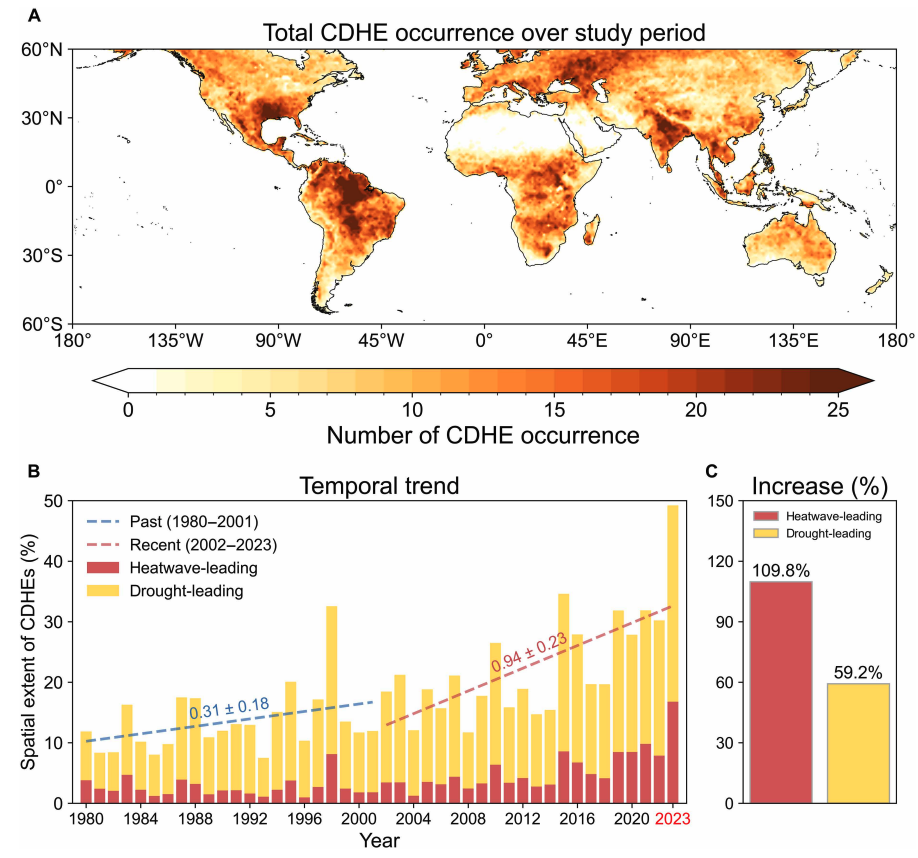
The research finds that the area of land affected by CDHEs has “increased substantially” since the early 2000s.
Heatwave-led events have been the main contributor to this increase, the study says, with their spatial extent rising 110% between 1980-2001 and 2002-23, compared to a 59% increase for drought-led events.
The map below shows the global distribution of CDHEs over 1980-2023. The charts show the percentage of the land surface affected by a heatwave-led CDHE (red) or a drought-led CDHE (yellow) in a given year (left) and relative increase in each CDHE type (right).
The study finds that CDHEs have occurred most frequently in northern South America, the southern US, eastern Europe, central Africa and south Asia.
Threshold passed
The authors explain that the increase in heatwave-led CDHEs is related to rising global temperatures, but that this does not tell the whole story.
In the earlier 22-year period of 1980-2001, the study finds that the spatial extent of heatwave-led CDHEs rises by 1.6% per 1C of global temperature rise. For the more-recent period of 2022-23, this increases “nearly eightfold” to 13.1%.
The change suggests that the rapid increase in the heatwave-led CDHEs occurred after the global average temperature “surpasse[d] a certain temperature threshold”, the paper says.
This threshold is an absolute global average temperature of 14.3C, the authors estimate (based on an 11-year average), which the world passed around the year 2000.
Investigating the recent surge in heatwave-leading CDHEs further, the researchers find a “regime shift” in land-atmosphere dynamics “toward a persistently intensified state after the late 1990s”.
In other words, the way that drier soils drive higher surface temperatures, and vice versa, is becoming stronger, resulting in more heatwave-led compound events.
Daily data
The research has some advantages over other previous studies, Yeh says. For instance, the new work uses daily estimations of CDHEs, compared to monthly data used in past research. This is “important for capturing the detailed occurrence” of these events, says Yeh.
He adds that another advantage of their study is that it distinguishes the sequence of droughts and heatwaves, which allows them to “better understand the differences” in the characteristics of CDHEs.
Dr Meryem Tanarhte is a climate scientist at the University Hassan II in Morocco, and Dr Ruth Cerezo Mota is a climatologist and a researcher at the National Autonomous University of Mexico. Both scientists, who were not involved in the study, agree that the daily estimations give a clearer picture of how CDHEs are changing.
Cerezo-Mota adds that another major contribution of the study is its global focus. She tells Carbon Brief that in some regions, such as Mexico and Africa, there is a lack of studies on CDHEs:
“Not because the events do not occur, but perhaps because [these regions] do not have all the data or the expertise to do so.”
However, she notes that the reanalysis data used by the study does have limitations with how it represents rainfall in some parts of the world.
Compound impacts
The study notes that if CDHEs continue to intensify – particularly events where heatwaves are the precursors – they could drive declining crop productivity, increased wildfire frequency and severe public health crises.
These impacts could be “much more rapid and severe as global warming continues”, Yeh tells Carbon Brief.
Tanarhte notes that these events can be forecasted up to 10 days ahead in many regions. Furthermore, she says, the strongest impacts can be prevented “through preparedness and adaptation”, including through “water management for agriculture, heatwave mitigation measures and wildfire mitigation”.
The study recommends reassessing current risk management strategies for these compound events. It also suggests incorporating the sequences of drought and heatwaves into compound event analysis frameworks “to enhance climate risk management”.
Cerezo-Mota says that it is clear that the world needs to be prepared for the increased occurrence of these events. She tells Carbon Brief:
“These [risk assessments and strategies] need to be carried out at the local level to understand the complexities of each region.”



The post Heatwaves driving recent ‘surge’ in compound drought and heat extremes appeared first on Carbon Brief.
Heatwaves driving recent ‘surge’ in compound drought and heat extremes
Greenhouse Gases
DeBriefed 6 March 2026: Iran energy crisis | China climate plan | Bristol’s ‘pioneering’ wind turbine