

Welcome to Carbon Brief’s Cropped.
We handpick and explain the most important stories at the intersection of climate, land, food and nature over the past fortnight.
Key developments
Wildfires resurfaced
PANTANAL FIRES: Climate change made the wildfires that scorched the Pantanal wetlands earlier this summer 40% more intense, according to a new rapid attribution study covered by Carbon Brief. Around 2,500 fires occurred in Brazil’s Pantanal wetlands in June 2024. The World Weather Attribution service found that “the month was the hottest, driest and windiest year in the 45-year record”, creating conditions that were highly conducive to wildfires. Separately, Reuters reported on a new study that found that fires, logging and “other forms of human-caused degradation, along with natural disturbances to the Amazon ecosystem, are releasing more climate-warming CO2 than clear-cut deforestation”.
EXTENDED IMPACT: In North America, 90 large fires burned nearly 4.5m acres across the US during the first days of August, the New York Times reported. The “devastating wildfires” spread ash and smoke “over large swathes of the continent…destroyed homes and charred through thousands of acres of farms and forests”, the outlet added. Particularly dry, hot weather affected the western US and caused four wildfires across Colorado, leaving one person dead and forcing hundreds of people to evacuate, according to the Washington Post.
BEYOND AMERICAN CONTINENT: On the other side of the ocean, wildfires swept Athens, where thousands of residents were evacuated as fires crossed into suburbs and flames rose up to 25 metres, BBC News reported. According to the outlet, June and July were “the hottest on record” for the European country, while Greece’s civil protection minister has “warned that extremely dangerous weather would continue”. Meanwhile, Algeria’s north-eastern Kabylie region has experienced blazes since last Friday, Agence France-Presse reported. The newswire added that homes, olive groves, hen coops and beehives were engulfed by flames. Most of the wildfires are now under control, a civil defence official said.
Offsets up in smoke
UP IN SMOKE: The Park fire – one of the “largest wildfires in California’s history” and is still blazing – destroyed around 45,000 acres of trees enrolled in the state’s carbon-offsetting programme, the Financial Times reported. According to analysis by the not-for-profit research firm Carbon Plan, cited in the story, buyers of credits included oil refining, power and lumber companies. The story also pointed to an unsold “buffer pool” of credits meant to replace losses to “credited trees” from wildfires, drought or pests. California authorities told the FT that the buffer was “quite sound”. But Carbon Plan scientist Dr Grayson Badgley said that the pool needed updating to “reflect the realities of fire risk” and that the state “should stop approving carbon credit projects in risky wildfire regions”.
STOLEN CREDIT: Brazil’s environment minister, Marina Silva, warned international buyers of carbon credits to be “vigilant” after police uncovered “allegedly fraudulent emissions-offset schemes on stolen land in the Amazon”, the Financial Times wrote. Silva said the issue was a “serious problem” and “could damage the credibility [and] integrity of this mechanism”, the story added. Separately, Bloomberg reported that a key oversight body is set to review carbon offsets generated from forestry projects “in the coming months”, after it found methods to assess renewable energy credits to be “insufficiently rigorous”.
FOREST THINNING: Meanwhile, scientists writing in the Conversation cautioned against the Australian forest industry’s plans “to remove trees from native forests, potentially including national parks, and claim carbon credits in the process”. They pointed to Forestry Australia’s “problematic proposal” that “purports to reduce environmental impacts, but still produce wood products”. It does so through a method known as “adaptive harvesting”, which involves forest thinning, or practices such as delaying logging until trees are older. The group’s acting president, William Jackson, responded to the piece, saying that forest thinning would be “conducted for ecological reasons, cultural values or fire management or other reasons” and that he “disagrees with the view that thinning makes forests more fire prone”.
Spotlight
Joshua trees are flowering more frequently due to climate change
This week, Carbon Brief explores a new study, published in Ecology Letters, looking at the impacts of climate change on the Joshua tree, a type of yucca plant that is native to California and other parts of the south-western US.
Climate change is causing Joshua trees – the iconic plant that dots the landscape of the south-western US – to flower more frequently, a new study has found.
Despite the plant’s importance as a keystone species in the Mojave Desert and other parts of the south-west, many studies of climate impacts on Joshua trees lack nuance – in part due to the resources needed to collect field data.
Using a machine-learning model trained on crowdsourced images from the biodiversity platform iNaturalist, researchers were able to examine the impacts of climate change on the trees since 1900.
The lead author of the study told Carbon Brief that “there’s a lot of potential” to use the team’s newly developed methods to study the impacts of climate change on other flora.
Beyond binary
Much of the existing work looking at climate change impacts on Joshua trees is based on so-called “distribution models”, Prof Jeremy Yoder, an evolutionary biologist at California State University, Northridge, told Carbon Brief.
These models are based on identifying the climatic factors that are closely associated with the presence or absence of a particular species. Then, he explained, researchers can “take a future climate projection and ask where conditions will look like places where we know Joshua trees are today”.
In the new study, instead of simply looking at the distribution of the species, the researchers modelled the flowering of the trees – using specific weather data to draw connections between a flowering year and the climatic conditions leading up to it.
Using this model, they were then able to “hindcast” previous instances of Joshua tree flowering. They matched up their predicted flowering with historical botanical collections, field notes and even newspaper reports and found that they “line up pretty well”.
By taking the hindcast as a whole, the team could then explore how climate change has affected Joshua tree flowering over the past century and a quarter. Yoder told Carbon Brief:
“That’s concretely new information that we did not have about Joshua trees before.”
Flowering frequency
Overall, the researchers found a “slightly rising frequency” in the flowering of Joshua trees over the past 123 years. The flowering was most closely related to year-to-year variability in rainfall.
But increased flowering on its own might not necessarily be beneficial to the trees. “Flowering is just the first step in regenerating Joshua tree woodland,” Yoder said – meaning that more frequent blooms will not necessarily result in a growing population. While a flowering Joshua tree may produce thousands of seeds in a year, those seeds will result in just a few seedlings.
Then, it’s “an even smaller subset of seedlings that start to get to something closer to an established tree over a couple of years”, he said. And some of the conditions that seem to be influencing the flowering frequency – such as contrasts in year-to-year rainfall – are “probably not good for seedling survival”.
Beyond the scientific result, Yoder is excited by the potential for further applications of the hindcast modelling. He told Carbon Brief:
“Hopefully this is something that folks can use to start to get that richer view of what climate change is doing to natural populations.”
News and views
SKYROCKETING: Researchers have warned that the current H5N1 bird flu outbreak “could reach Australia this spring”, according to the Guardian. Australia has thus far remained bird-flu-free since the strain emerged in 2020. Although some researchers think the island’s virus risk “is low” due to the country being outside the “flyways of migratory ducks and geese, [which are] the main hosts of bird flu viruses over long distances”, others say “there is still a risk, and we need to be ready for it”. Mongabay also covered the bird flu transmission, highlighting that it is the “fastest-spreading, largest-ever outbreak” and has infected “hundreds of species pole-to-pole”. The outlet reported that the virus has spread to at least 485 bird species and 48 mammals and that “the risk to humans [is] rising”.
WHEAT STOCKS: Iraq’s wheat harvest surged more than 20% this year due to a combination of “extraordinary” rainfall and improved irrigation, Bloomberg reported. The outlet added that the harvest “marked a second year of self-sufficiency in the grain” for Iraq. Meanwhile, France is facing “one of the worst harvests in the last 40 years”, according to the French agriculture ministry, as reported by Politico. The country – which is the EU’s largest producer of soft wheat – “experienced a very wet planting season last year and not enough sun in the spring and early summer”. Farmers’ unions in France are seeking governmental assistance, the outlet said.
SEABED SHAKE-UP: Leticia Carvalho was elected the new head of the International Seabed Authority, Australia’s ABC News reported, where she “will be the first woman, first oceanographer and the first representative from Latin America to serve in this position”. Carvalho unseated the incumbent secretary-general, Michael Lodge, who has presided over the ISA since 2016. The New York Times noted that Lodge “has been a polarising figure at the seabed authority” and has faced accusations that he “was too closely aligned with the mining industry”. Prior to the election, Foreign Policy Magazine profiled Carvalho and her proposed approach to the ISA.
COCA PROBLEM: Colombia’s programme for substituting coca crops in favour of legal alternatives “is failing to achieve its goals due to design, implementation and security issues”, Mongabay reported. The outlet pointed out that coca leaf growers and pickers “haven’t received the agreed technical or financial support from the government”, resulting in lower incomes and forcing them to engage in other activities, such as illegal mining, to survive. The programme was created one year after the 2016 peace deal between Colombia’s government and the Revolutionary Armed Forces of Colombia (FARC), the outlet said. It added that a recent UN assessment of the programme found that coca production has actually increased 13% between December 2021 and December 2022.
NEW SEEDS ON THE BLOCK: On 9 August, Indian prime minister Narendra Modi launched 109 “high-yielding, climate-resilient” seed varieties at three experimental plots in New Delhi, Livemint reported. Among these was a rice variety “ideal for coastal saline areas” and a wheat variety “tolerant to terminal heat”, it added. Another Livemint long-read looked at the impact of climate change on tur dal – India’s second most consumed legume – finding that dal prices soared “by a staggering 60% between July 2022 and July 2024”. Meanwhile, an Economic Times analysis found that food inflation in India “has remained above 6% since July 2023, driven mostly by vegetables”. Overall inflation climbed to 5.1% in June this year with “most of the pressure…coming from rising food prices”, Bloomberg reported.
Watch, read, listen
‘DEFORESTATION MAFIA’: Inside Climate News delved into the legal battle to save Argentina’s Gran Chaco forest from corruption and deforestation.
‘THINKING LIKE BEARS’: NPR’s Short Wave podcast addressed what scientists are doing to conserve grizzly bears in the US – including “thinking like bears”.
VULNERABLE SCIENTISTS: A Nature career feature explored the mental health issues that rainforest scientists experience while watching “the ongoing destruction of the forest[s]”.
REASONS TO WINE: In his Bloomberg column, David Fickling wrote about how a warming climate “could play havoc” with grape vines and imperil future wine production.
New science
Summer monsoon drying accelerates India’s groundwater depletion under climate change
Earth’s Future
New research found that changes in India’s summer monsoon, alongside warmer winters and increased demand, are driving “rapid depletion” of groundwater. Using satellite data, on-the-ground observations and a hydrological model, scientists observed that India’s groundwater declined substantially over 2002-21. They attributed the reduction in groundwater to “reduced groundwater recharge and enhanced pumping to meet irrigation demands” amid lower rainfall. They concluded: “Groundwater sustainability measures including reducing groundwater abstraction and enhancing the groundwater recharge during the summer monsoon seasons are needed to ensure future agricultural production.”
Highest ocean heat in four centuries places Great Barrier Reef in danger
Nature
Heat extremes in the sea containing the Great Barrier Reef over January-March in 2024, 2017 and 2020 were the “warmest in 400 years”, according to a new study. Using a multi-century reconstruction of sea surface temperature data on the Coral Sea on the Australian coast along with climate model analysis, the researchers highlighted the “existential threat” that human-caused climate change poses to the Great Barrier Reef ecosystem. Without “urgent intervention”, the researchers wrote that the reef risks “experiencing temperatures conducive to near-annual coral bleaching” in future. They noted: “In the absence of rapid, coordinated and ambitious global action to combat climate change, we will likely be witness to the demise of one of Earth’s great natural wonders.”
Global Change Biology
The 2022 marine heatwave in Fiordland, New Zealand – the “strongest and longest” to occur there – killed more than half of the marine sponges living there, a new study revealed. The researchers analysed the impacts of the marine heatwave – which had a maximum temperature of 4.4C above average and lasted for 259 days – on a particular photosynthetic sponge. They suggested that what killed marine sponges was not bleaching – which affected more than 90% of the sponges – but the high temperatures killing their tissues directly. The research concluded that the remaining sponges “had mostly recovered from earlier bleaching”, probably due to a microbial community shift as an “adaptive response”.
In the diary
- 12-16 August: Meeting of the working group on benefit-sharing from digital sequence information | Montreal
- 26-30 August: Pacific Islands Forum Leaders Meeting | Tonga
- 28-29 August: EU Dialogue on national biodiversity strategies and action plans | Brussels
This is an online version of Carbon Brief’s fortnightly Cropped email newsletter. Subscribe for free here.
Cropped is researched and written by Dr Giuliana Viglione, Aruna Chandrasekhar, Daisy Dunne, Orla Dwyer and Yanine Quiroz. Please send tips and feedback to cropped@carbonbrief.org.
The post Cropped 14 August 2024: Worldwide wildfires; Offsets up in smoke; Joshua tree spotting appeared first on Carbon Brief.
Cropped 14 August 2024: Worldwide wildfires; Offsets up in smoke; Joshua tree spotting

Drought and heatwaves occurring together – known as “compound” events – have “surged” across the world since the early 2000s, a new study shows.
Compound drought and heat events (CDHEs) can have devastating effects, creating the ideal conditions for intense wildfires, such as Australia’s “Black Summer” of 2019-20 where bushfires burned 24m hectares and killed 33 people.
The research, published in Science Advances, finds that the increase in CDHEs is predominantly being driven by events that start with a heatwave.
The global area affected by such “heatwave-led” compound events has more than doubled between 1980-2001 and 2002-23, the study says.
The rapid increase in these events over the last 23 years cannot be explained solely by global warming, the authors note.
Since the late 1990s, feedbacks between the land and the atmosphere have become stronger, making heatwaves more likely to trigger drought conditions, they explain.
One of the study authors tells Carbon Brief that societies must pay greater attention to compound events, which can “cause severe impacts on ecosystems, agriculture and society”.
Compound events
CDHEs are extreme weather events where drought and heatwave conditions occur simultaneously – or shortly after each other – in the same region.
These events are often triggered by large-scale weather patterns, such as “blocking” highs, which can produce “prolonged” hot and dry conditions, according to the study.
Prof Sang-Wook Yeh is one of the study authors and a professor at the Ewha Womans University in South Korea. He tells Carbon Brief:
“When heatwaves and droughts occur together, the two hazards reinforce each other through land-atmosphere interactions. This amplifies surface heating and soil moisture deficits, making compound events more intense and damaging than single hazards.”
CDHEs can begin with either a heatwave or a drought.
The sequence of these extremes is important, the study says, as they have different drivers and impacts.
For example, in a CDHE where the heatwave was the precursor, increased direct sunshine causes more moisture loss from soils and plants, leading to a drought.
Conversely, in an event where the drought was the precursor, the lack of soil moisture means that less of the sun’s energy goes into evaporation and more goes into warming the Earth’s surface. This produces favourable conditions for heatwaves.
The study shows that the majority of CDHEs globally start out as a drought.
In recent years, there has been increasing focus on these events due to the devastating impact they have on agriculture, ecosystems and public health.
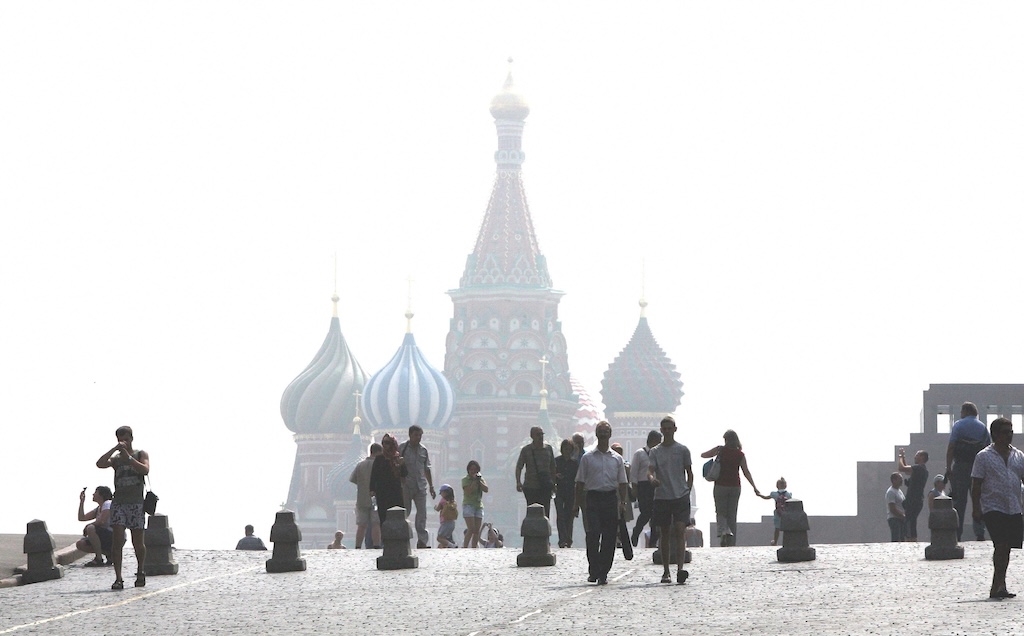
In Russia in the summer of 2010, a compound drought-heatwave event – and the associated wildfires – caused the death of nearly 55,000 people, the study notes.
The record-breaking Pacific north-west “heat dome” in 2021 triggered extreme drought conditions that caused “significant declines” in wheat yields, as well as in barley, canola and fruit production in British Columbia and Alberta, Canada, says the study.
Increasing events
To assess how CDHEs are changing, the researchers use daily reanalysis data to identify droughts and heatwaves events. (Reanalysis data combines past observations with climate models to create a historical climate record.) Then, using an algorithm, they analyse how these events overlap in both time and space.
The study covers the period from 1980 to 2023 and the world’s land surface, excluding polar regions where CDHEs are rare.
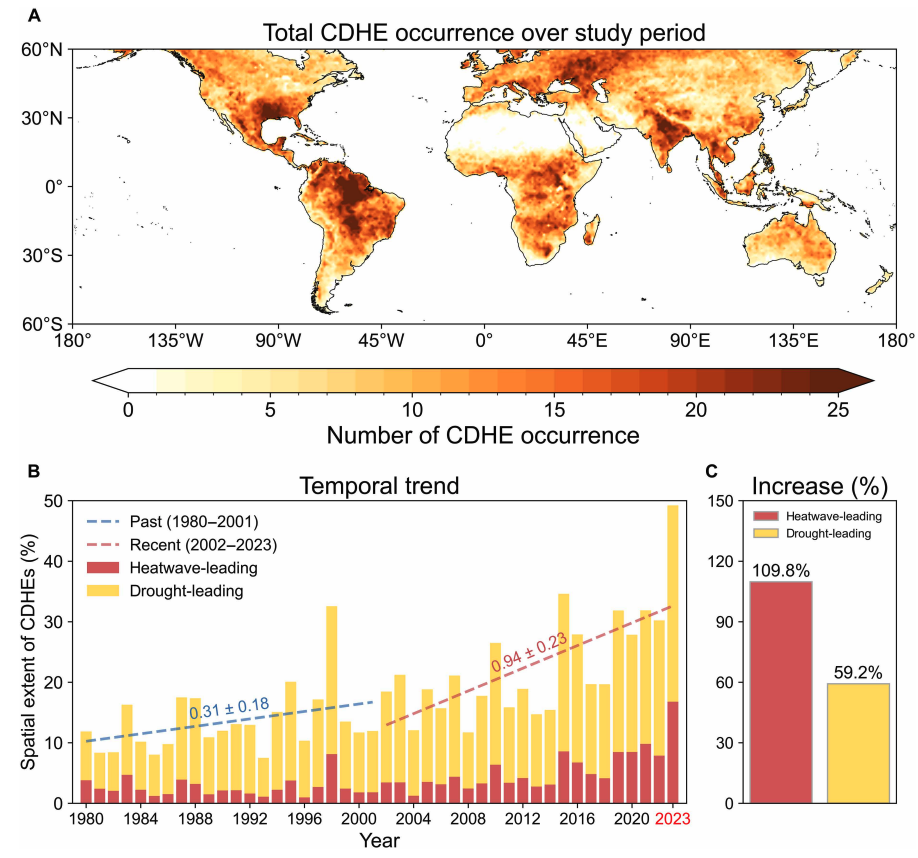
The research finds that the area of land affected by CDHEs has “increased substantially” since the early 2000s.
Heatwave-led events have been the main contributor to this increase, the study says, with their spatial extent rising 110% between 1980-2001 and 2002-23, compared to a 59% increase for drought-led events.
The map below shows the global distribution of CDHEs over 1980-2023. The charts show the percentage of the land surface affected by a heatwave-led CDHE (red) or a drought-led CDHE (yellow) in a given year (left) and relative increase in each CDHE type (right).
The study finds that CDHEs have occurred most frequently in northern South America, the southern US, eastern Europe, central Africa and south Asia.
Threshold passed
The authors explain that the increase in heatwave-led CDHEs is related to rising global temperatures, but that this does not tell the whole story.
In the earlier 22-year period of 1980-2001, the study finds that the spatial extent of heatwave-led CDHEs rises by 1.6% per 1C of global temperature rise. For the more-recent period of 2022-23, this increases “nearly eightfold” to 13.1%.
The change suggests that the rapid increase in the heatwave-led CDHEs occurred after the global average temperature “surpasse[d] a certain temperature threshold”, the paper says.
This threshold is an absolute global average temperature of 14.3C, the authors estimate (based on an 11-year average), which the world passed around the year 2000.
Investigating the recent surge in heatwave-leading CDHEs further, the researchers find a “regime shift” in land-atmosphere dynamics “toward a persistently intensified state after the late 1990s”.
In other words, the way that drier soils drive higher surface temperatures, and vice versa, is becoming stronger, resulting in more heatwave-led compound events.
Daily data
The research has some advantages over other previous studies, Yeh says. For instance, the new work uses daily estimations of CDHEs, compared to monthly data used in past research. This is “important for capturing the detailed occurrence” of these events, says Yeh.
He adds that another advantage of their study is that it distinguishes the sequence of droughts and heatwaves, which allows them to “better understand the differences” in the characteristics of CDHEs.
Dr Meryem Tanarhte is a climate scientist at the University Hassan II in Morocco, and Dr Ruth Cerezo Mota is a climatologist and a researcher at the National Autonomous University of Mexico. Both scientists, who were not involved in the study, agree that the daily estimations give a clearer picture of how CDHEs are changing.
Cerezo-Mota adds that another major contribution of the study is its global focus. She tells Carbon Brief that in some regions, such as Mexico and Africa, there is a lack of studies on CDHEs:
“Not because the events do not occur, but perhaps because [these regions] do not have all the data or the expertise to do so.”
However, she notes that the reanalysis data used by the study does have limitations with how it represents rainfall in some parts of the world.
Compound impacts
The study notes that if CDHEs continue to intensify – particularly events where heatwaves are the precursors – they could drive declining crop productivity, increased wildfire frequency and severe public health crises.
These impacts could be “much more rapid and severe as global warming continues”, Yeh tells Carbon Brief.
Tanarhte notes that these events can be forecasted up to 10 days ahead in many regions. Furthermore, she says, the strongest impacts can be prevented “through preparedness and adaptation”, including through “water management for agriculture, heatwave mitigation measures and wildfire mitigation”.
The study recommends reassessing current risk management strategies for these compound events. It also suggests incorporating the sequences of drought and heatwaves into compound event analysis frameworks “to enhance climate risk management”.
Cerezo-Mota says that it is clear that the world needs to be prepared for the increased occurrence of these events. She tells Carbon Brief:
“These [risk assessments and strategies] need to be carried out at the local level to understand the complexities of each region.”



The post Heatwaves driving recent ‘surge’ in compound drought and heat extremes appeared first on Carbon Brief.
Heatwaves driving recent ‘surge’ in compound drought and heat extremes
Greenhouse Gases
DeBriefed 6 March 2026: Iran energy crisis | China climate plan | Bristol’s ‘pioneering’ wind turbine
Welcome to Carbon Brief’s DeBriefed.
An essential guide to the week’s key developments relating to climate change.
This week
Energy crisis
ENERGY SPIKE: US-Israeli attacks on Iran and subsequent counterattacks across the Middle East have sent energy prices “soaring”, according to Reuters. The newswire reported that the region “accounts for just under a third of global oil production and almost a fifth of gas”. The Guardian noted that shipping traffic through the strait of Hormuz, which normally ferries 20% of the world’s oil, “all but ground to a halt”. The Financial Times reported that attacks by Iran on Middle East energy facilities – notably in Qatar – triggered the “biggest rise in gas prices since Russia’s full-scale invasion of Ukraine”.
‘RISK’ AND ‘BENEFITS’: Bloomberg reported on increases in diesel prices in Europe and the US, speculating that rising fuel costs could be “a risk for president Donald Trump”. US gas producers are “poised to benefit from the big disruption in global supply”, according to CNBC. Indian government sources told the Economic Times that Russia is prepared to “fulfil India’s energy demands”. China Daily quoted experts who said “China’s energy security remains fundamentally unshaken”, thanks to “emergency stockpiles and a wide array of import channels”.
‘ESSENTIAL’ RENEWABLES: Energy analysts said governments should cut their fossil-fuel reliance by investing in renewables, “rather than just seeking non-Gulf oil and gas suppliers”, reported Climate Home News. This message was echoed by UK business secretary Peter Kyle, who said “doubling down on renewables” was “essential” amid “regional instability”, according to the Daily Telegraph.
China’s climate plan
PEAK COAL?: China has set out its next “five-year plan” at the annual “two sessions” meeting of the National People’s Congress, including its climate strategy out to 2030, according to the Hong Kong-based South China Morning Post. The plan called for China to cut its carbon emissions per unit of gross domestic product (GDP) by 17% from 2026 to 2030, which “may allow for continued increase in emissions given the rate of GDP growth”, reported Reuters. The newswire added that the plan also had targets to reach peak coal in the next five years and replace 30m tonnes per year of coal with renewables.
ACTIVE YET PRUDENT: