

Andreas Sieber is head of political strategy at 350.org. Shady Khalil is a senior global policy strategist at Oil Change International.
COP31 will take place in the context of what Fatih Birol, the head of the International Energy Agency, has called the “biggest energy crisis in history” – an extraordinary warning from a typically measured leader. A UN climate summit that fails to address fossil fuel dependency, energy affordability and energy access will not only fail politically; it will fail economically and socially too.
The last COP in Belém created several important building blocks: a Global Implementation Accelerator, a Just Transition Mechanism, the climate finance work programme, an expanded Action Agenda linked to the first Global Stocktake (GST1), and the Presidency-led Belém Roadmaps on forests and transitioning away from fossil fuels (TAFF).
But COP31 will need to move from frameworks to delivery. The historic first international conference on the transition away from fossil fuels in Santa Marta, Colombia, in April added further momentum to this agenda.
Development hit to importing nations
The countries paying the highest price for fossil fuel volatility are not the richest countries. The cost of dependency on fossil fuels is hitting importing low-income countries the hardest. Over three-quarters of the world’s population lives in countries that are net importers of fossil fuels. High energy prices push up food costs. Inflation fuels political instability. Debt burdens deepen. The fossil fuel crisis has become a development crisis. That is why COP31 matters.
The Presidency-led Belém Roadmaps on forests and TAFF are expected to be presented at COP31. The next step should be obvious: countries need domestic roadmaps showing how they will actually implement the transition at home.
-
El Niño expected to bring next record-hot year as soon as 2027
With El Niño set to return, the World Meteorological Organization has raised its predictions for another record-breaking hot year -
UN General Assembly backs “climate obligations” set by world’s top court
A UN resolution endorses a landmark climate ruling by the International Court of Justice that states should reduce fossil fuels and repair the damage from global warming


A growing number are expected to develop such plans. COP31 should encourage them to put together domestic implementation roadmaps for shifting off fossil fuels that have concrete milestones, sectoral targets, investment strategies and policy measures.
At the same time, these processes must recognise that countries do not share the same starting points, capacities or development needs. For some, this may take the form of comprehensive roadmaps to phase out production and consumption, while for others the priority may be economic diversification, industrial transformation or expanding energy access and energy sovereignty.
Risk of disorderly transition
Without credible planning and international cooperation, the transition risks being too slow and increasingly chaotic, with fossil fuel demand destruction occurring through rationing, price shocks and de-industrialisation rather than through a managed socially just transformation.
This stands in direct contrast to the GST commitment to an “orderly” transition away from fossil fuels. Domestic roadmaps can help chart more stable coordinated pathways that reduce social disruption while contributing to geopolitical and economic stability.
Türkiye and Australia should show leadership as the upcoming COP hosts. For Türkiye, this is particularly urgent given the absence of a coal phase-out date. Price spikes for oil and gas have siphoned around $3 billion from ordinary people and businesses in Türkiye in the first two months of the current crisis alone, calculations by 350.org show.
Australia faces a different credibility challenge. While positioning itself as a renewable energy powerhouse, it also remains one of the world’s largest fossil fuel expanders and is facing calls to tax its fossil fuel exports.
Watch CHN’s webinar: From Santa Marta to Bonn – where next for the fossil fuel transition?
According to Oil Change International, four Global North countries — the US, Canada, Norway and Australia — are responsible for nearly 70% of projected new oil and gas expansion between 2025 and 2035, equivalent to around three times the annual emissions of all coal-fired power plants worldwide.
Paragraph 36 of the Mutirão decision agreed at COP30 already invites governments to submit implementation and investment plans for their national NDC climate plans. Domestic TAFF roadmaps could become a practical way to operationalise that commitment, while also creating space for countries to define national pathways aligned with their own development priorities and constraints.
This matters because some of the most politically difficult elements of the first Global Stocktake in 2023 — especially the transition away from fossil fuels and halting deforestation — are where implementation lags furthest behind rhetoric. Governments continue to endorse transition goals but must more seriously address the harder questions: how workers are protected, how grids are modernised, how industries adapt, and how countries finance the shift while maintaining economic development and energy access.
Roadmaps for coordination and clarity
Domestic TAFF roadmaps can help answer those questions. They allow governments to coordinate internally across ministries and externally with investors, development banks and international partners. They can provide clarity on timelines, infrastructure needs, financing gaps, industrial strategy and social protection. Most importantly, they can help ensure the transition is not only fast, but fair.
The first countries willing to develop credible transition roadmaps could also help rebuild international trust. They would demonstrate that a managed phase-out of fossil fuels can support economic development, create jobs, improve energy security and expand energy access rather than undermine them. That’s the spirit of the Santa Marta conference that now needs to be emulated.
This is also becoming a geo-economic issue. In a world increasingly shaped by bilateral deals, industrial competition and fragmented trade relations, countries with credible transition plans will be more insulated from global fossil fuel shocks, far better positioned to negotiate on debt restructure and cancellation, climate finance, technology transfer and industrial policy. Governments that know where they are going can shape the transition to their advantage.

Leaders’ support needed
COP31 also presents Türkiye and President Recep Tayyip Erdoğan with a rare diplomatic opportunity. At a moment of growing fragmentation between North and South — and between East and West — Türkiye could utilise its role as a middle power and serve as a bridge-builder capable of restoring high-level political momentum to the climate process and convene a leaders summit with wide attendance.
Leaders attending COP31 should help countries agree that TAFF roadmaps are a practical way to turn climate promises into real action. These roadmaps would reflect national realities while identifying needs for international and regional cooperation, including on financing and barriers to transition such as debt burdens, technology access and trade rules.
Ultimately, roadmaps for transitioning away from fossil fuels are roadmaps for economic resilience, energy security, and political stability in a far more volatile world.
The post COP31 must persuade countries to make fossil fuel transition plans appeared first on Climate Home News.
COP31 must persuade countries to make fossil fuel transition plans

Continue Reading
Three countries have been named by the Paris Agreement’s compliance committee for failing to submit a nationally determined contribution (NDC) and repeatedly snubbing offers of help with their climate plans.
After months of internal debate over whether to identify serial non-responders, the Paris Agreement’s Implementation and Compliance Committee (PAICC) named the three countries which have failed to engage with it over their NDCs on Friday.
It named Democratic Republic of Congo, Senegal and North Korea in a footnote of its annual report, adding that it decided to name them “with a view to facilitating engagement”, adding that representatives of the three nations had been invited to its meeting in early 2027 “with the purpose of identifying any challenges and constraints”.
“The Committee noted the importance of Parties engaging with the Committee in a timely manner, while noting that some delays may be due to the national capabilities and circumstances of the Parties”, the report said.
-
Under US pressure, World Bank says it will back gas “where appropriate”
The US wants the World Bank to expand its gas support while climate campaigners are pushing for it to end – its head spoke this week of limited backing for the fossil fuel -
IPCC scientists vow to press on with climate reports despite political deadlock
After governments again failed to agree a timeline, nearly 120 IPCC authors pledged to complete their assessment on time and with full scientific rigour -
Paris Agreement committee snubbed over missing NDC climate plans
Many governments have still not submitted a nationally determined contribution to the UN, breaching a key requirement of the Paris Agreement

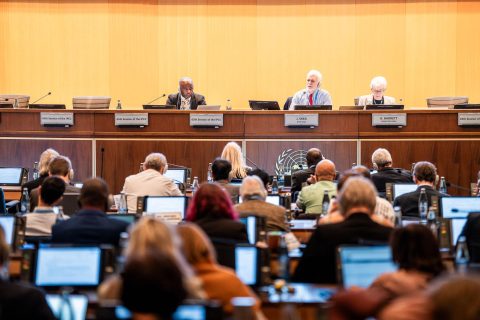

In July, PAICC said 12 countries had ignored its repeated attempts to discuss why they had not published an NDC as required every five years under the 2015 Paris accord.
Members of the committee had been divided over whether to name them, but at a September meeting decided to do so in their annual report to the annual climate COP summit.
By the time the report was published on Friday, only Congo, Senegal and North Korea “had not communicated an NDC or submitted a [Biennial Transparency Report] and had not yet responded to any of the Committee’s notifications, despite several reminders issued by the Committee in this regard”.
Rainforest and renewable energy ambitions
The silence from Congo and Senegal is notable because the former is home to much of the Congo Basin rainforest while the latter has sought billions of dollars in climate finance to support its renewable energy ambitions.
After Brazil, Congo has more rainforest than any country in the world. This forest, and the country’s peatlands, absorb huge amounts of greenhouse gas but are fast being lost to expanding farmland, charcoal production, logging and mining.
Senegal signed a Just Energy Transition Partnership with Canada and wealthy European nations in 2023, to help it meet its renewable energy targets under the-then government of Macky Sall. It was chair of the Least Developed Countries group between January 2022 and December 2023.

Tejas Rao, who is researching the PAICC as part of a doctoral thesis at Cambridge University, said the governments of the three countries should engage with the committee.
“Engagement costs these governments very little and the committee has shown it will listen,” he said.
“Silence leaves the committee with no basis to help, and it leaves the [governments] exposed to the narrative that they are simply disengaged,” he told Climate Home News.
Paris Agreement requirement
The 2015 Paris Agreement requires all parties to publish an NDC every five years outlining their emissions reduction targets, with each plan meant to be more ambitious than the country’s last NDC.
The latest set – the third round of plans, with new targets for 2035 – was due in February 2025. While most countries missed this deadline, all but around 30 – mostly small emitters but including Egypt, Vietnam and Argentina – have now submitted them.
Over the year, the PAICC – which is made up of government climate officials from developed and developing countries – has been communicating with governments that have not submitted NDCs and trying to overcome barriers to them doing so.
Some nations have cited exceptional circumstances as the reason for not submitting an NDC, a process that requires a significant amount of work in tracking emissions and consulting on how to curb them across the economy. For example, a letter from a Sudanese official to the PAICC, seen by Climate Home News, said that the country’s civil war had led to the suspension of its NDC preparation.
-
IPCC scientists vow to press on with climate reports despite political deadlock
After governments again failed to agree a timeline, nearly 120 IPCC authors pledged to complete their assessment on time and with full scientific rigour -
Under US pressure, World Bank says it will back gas “where appropriate”
The US wants the World Bank to expand its gas support while climate campaigners are pushing for it to end – its head spoke this week of limited backing for the fossil fuel -
Who shapes climate science? The equity question facing the IPCC
Early completion of the next global climate science assessment reports risks excluding research from the Global South, which is key to ensuring the findings are fair
The US and Iran are not signed up to the Paris Agreement and so do not have active NDCs, nor does Taiwan, which is not a UN member state.
Rao said that because the PAICC is “facilitative and non-punitive”, naming the countries “is meant to open a door, not close one – the invited consultation is the point”.
“In recent months, governments that explained their constraints, whether capacity, finance or domestic process, have been met with follow-up and support rather than sanction, and the number of silent governments has fallen sharply,” Rao said.
The post Paris Agreement committee names three countries snubbing it over NDCs appeared first on Climate Home News.
Paris Agreement committee names three countries snubbing it over NDCs