

“Exceptionally heavy” rainfall that led to deadly flooding across southern Africa in recent weeks was made more intense by a combination of climate change and La Niña.
This is according to a rapid attribution study by the World Weather Attribution service.
From late December 2025 to early January, south-eastern Africa was hit hard by intense downpours that resulted in more than a year’s worth of rain falling in some areas in just a few days, according to the study.
This led to severe flooding that left at least 200 people dead, thousands sheltering in temporary accommodation and tens of thousands of hectares of farmland waterlogged.
The analysis finds that periods of intense rainfall over southern Africa have become 40% more severe since pre-industrial times, according to observations.
The authors say they were unable to calculate how much of this increase was driven specifically by climate change, due to limitations in how climate models simulate African rainfall.
However, the study notes that the researchers “have confidence that climate change has increased both the likelihood and the intensity” of the rainfall.
The authors also note that the El Niño-Southern Oscillation phenomenon played a role in the “devastating” flooding, estimating that a La Niña event made the rainfall around five times more likely.
Major disruption
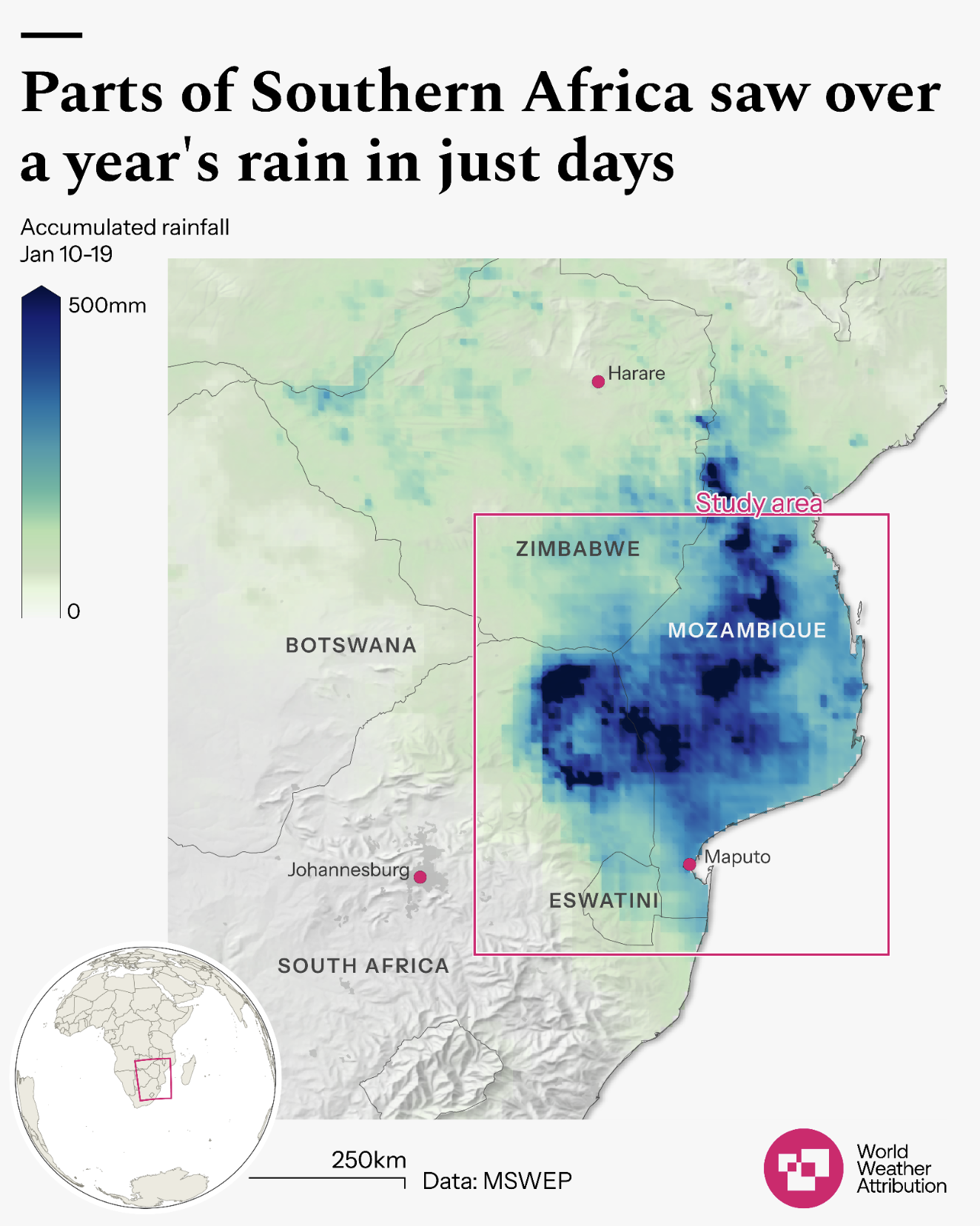
The heavy rainfall started on 26 December last year and intensified from early January. The most-extreme rainfall took place between 10 and 19 January.
The countries most affected by the floods, and analysed by the study, are Eswatini, Mozambique, South Africa and Zimbabwe, with some areas receiving up to 200mm of rain, according to the study authors.
Study author Bernardino Nhantumbo – a researcher at Mozambique’s National Institute of Meteorology – told a press briefing that in just two or three days, some areas recorded the amount of rainfall that is “expected for the whole rainy season”.
The map below shows the areas most affected by intense rainfall over 10-19 January. Darker blue indicates a greater accumulation of rainfall, while light green indicates less rainfall. The pink box shows the study area.
In Mozambique, the floods damaged nearly 5,000km of roads, which has hindered the transport of goods and affected pharmaceutical supply chains, the study says. In Zimbabwe, bridges, roads and infrastructure were “significantly damaged or destroyed”.
More than 75,000 people have been affected by the floods in Mozambique, according to the study. BBC News reported the floods were the worst seen “in a generation” in the country.
Dr Izidine Pinto, a climate scientist from Mozambique currently working at the Royal Netherlands Meteorological Institute, told a press briefing that the country was particularly affected because it “lies downstream of major river basins”.
The flooding prompted Mozambique’s education minister to consider rescheduling the start of the academic year, according to Channel Africa.
In South Africa, the country’s weather service said that areas receiving more than 50mm of rain over 11-13 January were “widespread”, with some places seeing up to 200mm.
South Africa’s Kruger National Park – the largest national park in South Africa – was severely damaged by floods and temporarily closed after several rivers burst their banks, reported TimesLIVE.
The South African news outlet quoted environment minister Willie Aucamp as saying: “The indication is that it will take as long as five years to repair all the bridges and roads and other infrastructure.”
Extreme rainfall
The peak of the rainy season in southern Africa falls between December and February.
To put the extreme rainfall into its historical context and determine how unlikely it was, the authors analysed a timeseries of 10-day maximum rainfall data for the December-February season.
They find that in today’s climate, extreme rainfall events of the scale seen this year in southern Africa would be expected only once every 50 years.
They add that such events have become “significantly more intense”, with observational data showing a 40% increase in rainfall severity since pre-industrial times.
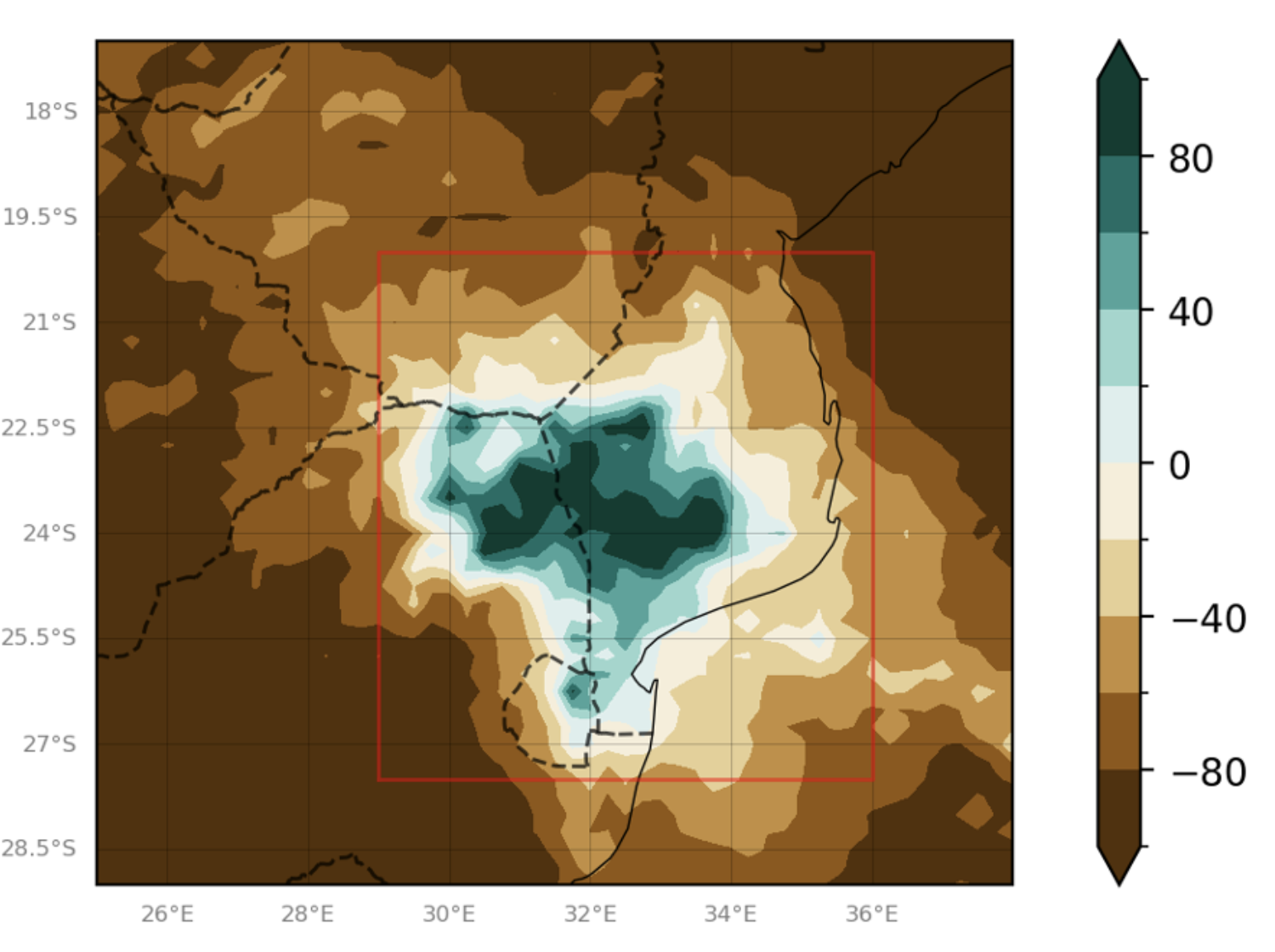
The map below shows accumulated rainfall over Eswatini, Mozambique, South Africa and Zimbabwe over 10-19 January, as a percentage of the average December-February rainfall for the region over 1991-2020.
Green shading indicates that the rainfall in 2026 was higher than in 1991-2020, while brown indicates that it was lower. The red box indicates the study region.
The study explains that in January and February, rainfall patterns in southern Africa are “strongly influenced” by the El Niño-Southern Oscillation (ENSO), a naturally occurring climate phenomenon that affects global temperatures and regional weather patterns.
La Niña is the “cool” phase of ENSO, which typically brings wetter weather to southern Africa.
Pinto told the press briefing that “most past extreme rainfall events [in the region] have occurred during La Niña years”.
The authors estimate that the current weak La Niña event made the extreme rainfall five times more likely and increased the intensity of the event by around 22%.
For attribution studies, which identify the “fingerprint” of human-caused climate change on extreme weather events, scientists typically use climate models to simulate and compare worlds with and without global warming.
However, many models have limitations in their simulations of African rainfall. In this study, the authors found that the models available to them cannot “adequately capture” the influence of ENSO on rainfall in the region.
Study author Prof Fredi Otto, a professor in climate science at the Imperial College London, told a press briefing that these limitations are “well known”. They stem, in part, because the models were “developed outside of Africa” by modellers with different priorities, she explained.
This means that the authors were unable to calculate how much more intense or likely the rainfall event was specifically as a result of human-caused warming.
However, Otto explained that the authors are “very, very confident that climate change did increase the likelihood and intensity of the rainfall” to some extent. This is because the observations all show an increase in rainfall over time and other existing literature supports this assumption, she added.
She told the press briefing that the results of this study were “definitely not 100% satisfactory”, adding that this study will “definitely not be the last of its kind in this region”.
(These findings are yet to be published in a peer-reviewed journal. However, the methods used in the analysis have been published in previous attribution studies.)
Vulnerability
The study warns that the flooding “exposed deep and persistent social vulnerability in the region”.
The authors say that a large proportion of the population – especially in urban areas – live in poor housing with “inadequate planning and insufficient provision of basic services”.
Paola Emerson, head of office at the UN Office for the Coordination of Humanitarian Affairs (OCHA) in Mozambique, told a UN press briefing about the flooding that nearly 90% of people in the country live in traditional adobe houses that “basically melt after a few days’ rains”.
In a WWA press release, study author Nhantumbo explained:
“When 90% of homes are made of sun-dried earth, they simply cannot withstand this much rain. The structural collapse of entire villages is a stark reminder that our communities and infrastructure are now being tested by weather they are just not designed to endure.”
Study author Renate Meyer – an adviser with the conflict and climate team at the Red Cross Red Crescent Centre – said in a WWA press briefing that the “recurring frequency of hazards such as drought and extreme rainfall have had a significant impact on communities experiencing, amongst others, displacement, health challenges, socioeconomic loss and psychological distress”.
For example, the World Health Organization (WHO) said in a press release that the event had disrupted access to health services and increased the risks of water- and mosquito-borne diseases, as well as respiratory infections across southern Africa.
Meyer explained that the countries included in this study have “substantial populations living below or near the poverty line with limited savings, low insurance cover and a high dependence on climate sensitive livelihoods”.


The post Climate change and La Niña made ‘devastating’ southern African floods more intense appeared first on Carbon Brief.
Climate change and La Niña made ‘devastating’ southern African floods more intense

Scientists have vowed to keep working on the next flagship set of reports for the Intergovernmental Panel on Climate Change (IPCC), after a political row over the timeline for their release saw its latest session suspended on Friday evening without agreement.
During the weekend, government officials and scientists alike expressed disappointment over the inability to reach a compromise before some delegates from developing countries and small island states had to leave the week-long meeting in Ethiopia to catch flights home.
The disagreement – which has persisted since early 2024 – turns on whether the three key parts of the AR7 assessment should all be published before the conclusion of the UN’s next Global Stocktake of global climate action, which is due to be completed in late 2028.
The IPCC issued a statement after the close of the session, saying that “key agenda items” – the timelines for the three AR7 reports, as well as the IPCC budget – remain open and under discussion. It said the IPCC’s plenary session and its deliberations on the pending agenda “will resume at the earliest opportunity”, giving no further details of when.
IPCC Chair Jim Skea told delegates in closing remarks that recent months had been some of the most turbulent for the climate science panel and that, if there were stronger words than “profound disappointment” he would use them, according to a summary published by the Earth Negotiators Bulletin (ENB). IPCC discussions happen behind closed doors.
IPCC scientists remained committed
In an open letter, issued on Monday, a group of nearly 120 scientists – from a total of 664 AR7 authors – said they “stand committed to continue working to deliver the AR7 reports in a manner that is rigorous, timely and inclusive, in line with our mandate to be policy-relevant”.
“An assessment that arrives after the decisions it is meant to inform cannot serve its purpose,” they emphasised. “The second Global Stocktake in 2028 is such a decision point, and the world should not have to face it without the IPCCʼs latest assessment.”
Europe, small islands and the least developed countries, plus many Latin American and developed nations, want the IPCC to meet this deadline, arguing that the findings from the UN climate science body are irreplaceable in the UN climate policy-making process.
However, around a dozen developing countries plus Russia have argued that the reports should come later in order to allow for greater research input from the Global South – something that, in their view, would make the findings fairer. They also claim that a shorter timeline would put excessive pressure on experts.
-
Who shapes climate science? The equity question facing the IPCC
Early completion of the next global climate science assessment reports risks excluding research from the Global South, which is key to ensuring the findings are fair -
Governments that support climate science must stand firm against naysayers
The IPCC is meeting to decide the timing of its next major report, as some countries try to delay it and weaken the case for faster emissions cuts


The most vocal of this group at last week’s meeting were India and Saudi Arabia, according to the ENB summary and a developed country diplomat. Critics see this push for a longer timeline as an excuse to deprive government decision-makers of the latest science and ease pressure on emerging economies to raise their ambition, particularly on cutting emissions.
Commenting on last week’s meeting, France’s ambassador for climate negotiations Benoît Faraco said a broad coalition of developed and developing countries from all five continents, “united in their support for science and the timeline proposed by scientists”, had withstood pressure “from a few countries” seeking to slow down the process of adopting the IPCC reports.
He added that France would not back down and would “continue to fight tirelessly for science, protect the integrity of information, and convince our partners that without the best available scientific data, we will be less effective in tackling climate change and protecting our populations”.
Inclusivity proposal stalled
In a bid to unlock a solution for the AR7 timeline, countries discussed ways to improve the inclusivity of the IPCC’s work. One option put on the table was for the IPCC to expand its funding for delegates from developing countries to attend some or all of its sessions from one to two participants, according to the ENB summary and a delegate speaking to Climate Home News.
That would increase the costs for the IPCC to complete AR7 by up to a quarter, according to an assessment shared by the secretariat. The panel’s budget is under severe strain and its officials have warned that, without additional voluntary contributions, it risks running out of money before it can deliver on this assessment cycle.
Climate Home News understands that some of the IPCC’s traditional donors – which mainly include European countries, Japan and Australia – indicated a willingness to support funding for an additional developing country participant. But without an agreement over the budget or the timeline for the reports, that option was ultimately not adopted.
‘Disappointed and worried’
The three reports are managed by working groups that collate and draw overall findings from the latest scientific studies and data on the physical effects of global warming around the world, how to adapt to it, and pathways for cutting planet-heating emissions in order to meet the temperature goals of the Paris Agreement.
Winston Chow, an urban climate professor at Singapore Management University who co-chairs Working Group II on adaptation, wrote in a LinkedIn post that he was “disappointed and worried” for the IPCC authors who have worked “extraordinarily hard” to assess the relevant climate science over the past two years.
He said he shared their concern that “the rigour, time and goodwill they’ve invested are now being put at risk by the Panel’s stalemate”.
As science comes under attack at UN talks, climate movement splits over how to respond
For Working Group II, a meeting for 250 experts writing that report is scheduled for January 2027, followed by the approval of a special report on cities and climate change in Singapore next March.
But because the IPCC’s budget has not been confirmed due to uncertainty about the AR7 schedule, travel support for those researchers is at risk, wrote Chow. “If they cannot participate, our assessments will lose vital expertise, perspectives and scientific breadth, and the collective effort of our authors will be undermined,” he warned.
Scientific work continues
Despite the political holdups, he – together with French climate scientist Robert Vautard, co-chair of Working Group 1 – agreed with IPCC head Skea who told the IPCC’s closing session on Friday: “The engine room of the IPCC is working, and it’s healthy.”
Vautard commented in a separate post on LinkedIn after it ended: “The boat is at full steam.” Working groups I and II are due to start revising the first drafts of their reports, while Working Group III on reducing emissions is finalising its first draft which will be out soon, he wrote.
“The most exciting two years of the cycle are ahead, for the authors. The momentum in the engine room is here and now. Trust the engine room!” he added.
The IPCC and some scientists report that progress has been made towards achieving an equitable balance of authors from the Global North and the Global South.
The group of researchers who signed the open letter on Monday noted that “inclusivity is at the heart of how we work”, with author teams bringing together experts from developed and developing countries with diverse backgrounds and at different stages of their careers.
Plea to overcome political differences
The signatories include several scientists from some of the countries opposed to the alignment of all IPCC reports with the Global Stocktake.
“We are committed to an assessment in which the knowledge, experience and priorities of every region are fully reflected, a commitment we share with the leadership of the IPCC.
Equity is built into how our assessment is being drafted,” they added.
They appealed to governments that make up the IPCC “to overcome their political differences and work together as we do as a global scientific community, so that we can deliver the IPCC reports the world needs to hear”.
In a statement published on Monday, IPCC chair Skea said reaching consensus on the schedule for the reports is “vital”. He added that the assessments provide authoritative scientific evidence to inform national climate policies, strengthen adaptation and resilience and support access to climate finance, as well as helping communicate the scale of the climate crisis and the urgency of efforts to tackle it.
The post IPCC scientists vow to press on with climate reports despite political deadlock appeared first on Climate Home News.
IPCC scientists vow to press on with climate reports despite political deadlock
An Lambrechts is a biodiversity politics expert at Greenpeace International with extensive experience in biodiversity-related multilateral negotiations. She is the head of the Greenpeace delegation at the Convention on Biological Diversity (CBD) COP17 happening in Yerevan, Armenia.
In 2022, COP15 delivered the landmark Kunming-Montreal Global Biodiversity Framework to halt and reverse biodiversity loss by 2030. With COP17 starting in Yerevan, we are now halfway to the deadline, and according to the first Global Review of progress, countries are not on track to meet the biodiversity targets, and implementation must accelerate fast.
One of the main findings of the Global Review is that funding falls far short of the scale needed to halt and reverse nature loss. But the crisis facing the world’s biodiversity is not an absolute scarcity of capital – it is a profound public policy distortion.
The global economy currently spends roughly $30 destroying nature for every single dollar invested in its protection. According to a report from the Intergovernmental Science-Policy Platform on Biodiversity and Ecosystem Services, a staggering $2.4 trillion is spent in public subsidies for fossil fuels, agriculture and water use, while global investment in biodiversity conservation and restoration stands at a mere $220 billion.
Countries urged to ramp up “insufficient” nature policies at COP17
Yet, discussions about how to close the biodiversity finance gap continue to claim that salvation lies in mobilising private capital, scaling offsets and “derisking” investments in nature. This is a fundamental misunderstanding of both the nature of ecological stewardship and of the global financial architecture.
Biodiversity conservation is not a speculative investment portfolio – it is the foundation of human survival. The health of our planet is a non-monetisable, non-excludable public good. Expecting profit-seeking private capital to protect nature perpetuates the structural drivers of ecosystem destruction in the first place.
But if private market mechanisms cannot save biodiversity, where will the necessary public resources come from?
Money going to the wrong places
The answer lies in recovering the vast public wealth currently drained by cross-border tax abuse, financial secrecy and corporate impunity. Finance and environment ministers meeting in Yerevan must give a strong political signal that, to avert ecological breakdown, countries need to take swift action to reform global tax rules, eliminate harmful public subsidies and cancel unsustainable sovereign debts for the public revenues to end up where they belong.
Extractive sectors such as industrial agriculture, fishing, timber and mining continue business-as-usual, often heavily subsidised by public treasuries, while voluntary carbon and biodiversity offset markets pose a serious risk to nature conservation. Offset schemes have delivered only a negligible fraction of the funding needed to preserve ecosystems, allowing industries to continue with their destructive business-as-usual practices.
-
Global deforestation slowed in 2025 but Brazil’s election could undo “fragile” gains
Countries remain 70% off track to meet a goal to end deforestation by 2030, as progress in Latin America offset by failures in Africa
