

Welcome to Cited, your essential guide to new climate research.
In the news
SCIENCE ‘UNDER ATTACK’: Climate Home News reported that “dozens” of countries called out “coordinated attacks” aimed at “undermining the role of climate science” at UN climate talks in Bonn, Germany, last week. According to the outlet, the countries said that UN decision-making had to remain based on the “best available science”, including the reports of the Intergovernmental Panel on Climate Change. One negotiator said that India and Saudi Arabia “opposed calls in draft texts to encourage scientific work on scenarios that would minimise the magnitude and duration of any overshoot of 1.5C”, the article noted. For more, read Carbon Brief’s summary of the negotiations.
REPORT OPPOSITION: “Oil industry allies” in the US are targeting a report on extreme weather attribution, due to be published by the National Academies of Sciences, Engineering and Medicine, according to Politico. The outlet reported that the “heightened scrutiny – which involves a secretive opposition research group scouring scientists’ emails – has prompted two people to leave the 15-person panel tasked with producing the report”. Separately, the Guardian reported that the Trump administration has “reversed its decision” to dismantle the Ocean Observatories Initiative, a $368m deep-sea observation system.
SUPER EL NIÑO: BBC News reported that the US National Oceanic and Atmospheric Administration announced that El Niño had “officially begun”. Forecasts suggest the event could be among the “strongest ever recorded”, it added. Meanwhile, a “vigorous debate” is taking place about whether climate change is making the El Niño phenomenon more intense, according to the New York Times. The outlet explained that some scientists see the run of “comparatively strong” El Niño events in recent decades as an indication that “climate change is supercharging El Niño”. However, it added that “others say there is no clear evidence to support that theory”.
Research picks
Water
- Global sea level rise has nearly tripled the number of days since the 1970s when coastal water levels have surpassed average tide gauge readings | Science Advances
- As the Arctic warms, increased iceberg activity could “reshape” deep-sea habitats and “elevate” navigational hazards as maritime traffic expands | Nature
- Sea level rise has quadrupled the frequency of extreme coastal sea-level events since the year 1900 | Nature Climate Change
Inequality
- The top 10% of consumers are responsible for $1.7-5.7tn of environmental damage each year, surpassing international climate and biodiversity financing gaps | Communications Sustainability
- Calculating an individual’s emissions based on their asset ownership suggests that wealthier people are responsible for an even higher share of global greenhouse gas emissions than indicated by past studies | Nature Climate Change
- A plan that places equity at the “centre” of climate adaptation efforts in cities is needed to address the “stark disparities” between “affluent” and “disadvantaged” urban communities’ ability to prepare for extreme heat | PLOS Climate
Extremes
- In the western US, 42% of burned area over 2001-24 occurred during, and immediately following, heatwaves | Science Advances
- “Hot-to-wet” whiplash events have become more frequent across Australia over the past century, with south-eastern Australia emerging as a hotspot | Journal of Climate
- Rapid urbanisation, combined with more intense rainfall from tropical cyclones, have increased people’s exposure to “extreme” rainfall from tropical cyclones across China | Journal of Hydrometeorology
Captured
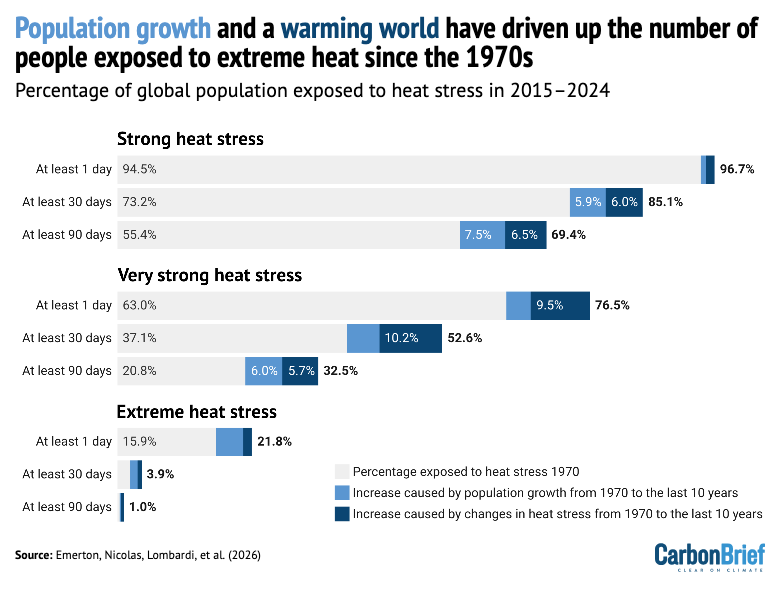
One billion additional people face at least one day of “extreme heat stress” every year compared to the 1970s, according to research published in Nature Climate Change.
The chart shows changes in “strong” (top), “very strong” (middle) and “extreme” (bottom) heat stress, defined as a “universal thermal climate index” above 32C, 38C and 46C, respectively. The grey bar shows the percentage of the global population exposed to at least one, 30 or 90 days of heat stress in 1970. The light and dark blue bars show the number of additional people experiencing heat stress over 2015-24 due to population growth and rising global temperatures, respectively.
10%
Equivalent damage to the UK’s GDP caused by climate change if global warming reaches 4C by 2100, according to new research in Nature Climate Change. The study estimates a range of 2-20%.
Spotlight
Introducing: Project Cosmos
Carbon Brief explains how it built a major new database of climate science research and unveils a new ranking of the 500 most highly cited publications, authors and institutions in climate science.
This week, Carbon Brief launched Project Cosmos – the world’s largest and most complete database of climate change research.
The database features more than 1.8m academic papers, books and reports, capturing the vast body of human knowledge about climate change that has accumulated over more than a century of academic study.
The climate science “universe” is based on reports from the Intergovernmental Panel on Climate Change (IPCC), which are recognised as the world’s most authoritative summaries of the latest climate science.
Since its first report was published in 1990, humanity’s knowledge about human-caused climate change has ballooned. The IPCC has published six sets of reports in total – each one longer than the last.
In total, IPCC reports reference more than 100,000 other papers, books and reports. This is the core of our climate science universe. Carbon Brief then built on this core, by looking at four other sources of data. Read more about how the Cosmos database was created here.
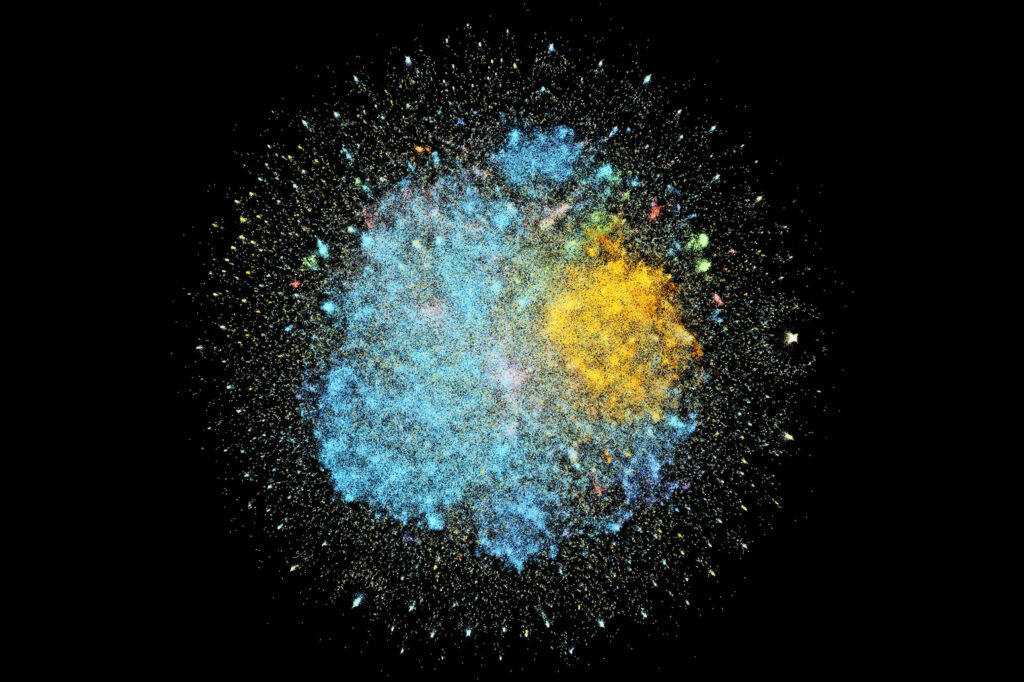
Every single publication in the Cosmos database is linked to at least one other through references. Visualising these links reveals a “galaxy” of references. In the image above, each colour and cluster reveals different topics and densities of research. Explore the galaxy in an interactive map here.
Cosmos 500
As part of an initial wave of preliminary analysis to demonstrate the scope of the Project Cosmos database, Carbon Brief has ranked the 500 most highly cited publications, authors and institutions in the database.
The most highly cited climate scientist is Prof Philippe Ciais, who has spent almost four decades researching the planet’s carbon cycle – and the ways in which humans have been impacting its balance. Carbon Brief recently interviewed Ciais in Paris.
The US tops the tables for the most highly-cited authors and institutions. Almost half of the 500 most highly-cited authors are from US institutions. This raises particular concerns for the future of climate science, as American climate scientists and institutions are coming under attack under the Trump administration.
Experts from global south countries account for only 4% of all authors in the Cosmos 500. China stands out as the most highly-cited global south country. Meanwhile, only 10% of authors in the Cosmos 500 are women.
There are many possibilities for future avenues of research using the Cosmos database. Over time, the database could be used to reveal, for example, how interest in different areas of climate science has changed over time, plus identify potential knowledge gaps and, thus, opportunities for future research.
Carbon Brief invites researchers – including academics, journalists and analysts – to submit their own proposals for co-authored studies, literature reviews and analytical projects.
Preprints to watch
Carbon Brief’s pick of new papers still going through peer review
- Regional reductions in aerosol emissions can “temporarily amplify” the likelihood of record-breaking heat events | Environmental Research: Climate
- Analysis of Reddit posts suggests the Fridays for Future movement has created “wider awareness” of global warming by drawing attention to climate change and “climate actions” | npj climate action
- Periods of simultaneous low wind and solar power generation, known as “renewable energy droughts”, will “intensify progressively” as the planet warms | Nature portfolio
Noticeboard
- 28-30 June: Seventh global conference on climate and sustainable development goal synergies, Bangkok, Thailand
- 29 June-1 July: Exeter climate conference, Exeter, UK
- 29 June-1 July: National Academy of Sciences hybrid workshop on seabed critical mineral resources, Irvine, US
- 30 June: Submission deadline for abstracts for MedCLIVAR conference, scheduled for 21-25 September in Limassol, Cyprus
- 30 June: Application deadline for postdoctoral position in ice-ocean interactions at the Physics Laboratory of Ecole Normale Supérieure de Lyon | Salary: €3,071-4,714 per month. Location: Lyon, France
- 30 June: Submissions open for abstracts for the pan-African conference on environment, climate change and health, scheduled for 21-24 October in Nairobi, Kenya
- 8 July: Application deadline for position as research officer in climate science and law at the Grantham Research Institute | Salary: £43,277-51,714. Location: London, UK
- 10 July: Application deadline for position as associate or senior editor at Nature Water | Salary: Unknown. Location: Shanghai, Beijing or Milan
Cited is researched and written by Cecilia Keating, Robert McSweeney, Ayesha Tandon, Daisy Dunne and Dr Giuliana Viglione.
Please send tips, feedback and upcoming climate research to cited@carbonbrief.org
This is an online version of Carbon Brief’s fortnightly Cited email newsletter. Subscribe for free here.
The post Cited 23 June 2026: Project Cosmos launch | Science ‘under attack’ at Bonn | Emissions inequality appeared first on Carbon Brief.
Cited 23 June 2026: Project Cosmos launch | Science ‘under attack’ at Bonn | Emissions inequality

Next week, diplomats from around the world will descend on Yerevan, Armenia, to negotiate a series of decisions under the UN Convention on Biological Diversity (CBD).
Between 19 and 30 October, 196 parties will gather to hammer out the precise wording of the dozens of legal texts that make up the decisions under the Conference of the Parties (COP) to the CBD.
This year’s summit is particularly significant, as it marks the halfway point between the agreement of the Kunming-Montreal Global Biodiversity Framework and the deadline for achieving its targets.
The CBD has found that countries are currently not on track to meet 22 out of the framework’s 23 targets.
During the fortnight, delegates will also be negotiating decisions relating to the two supplemental protocols to the CBD: the Cartagena Protocol, which covers biosafety; and the Nagoya Protocol, which covers access and benefit-sharing for the use of genetic resources.
(The Cartagena and Nagoya Protocols, which are each governed by a “meeting of the parties”, or “MOP”, have fewer parties than the CBD as a whole, with 173 and 141, respectively.)
Carbon Brief is tracking the progress of countries towards consensus on dozens of negotiating texts using the interactive table below.
The tracker includes texts from the COP, as well as the MOPs for the Cartagena and Nagoya protocols. It also includes draft decisions from the most recent subsidiary body meetings, as these form the starting point for the negotiations in Yerevan.
The CBD has three subsidiary bodies: the subsidiary body on scientific, technical and technological advice (SBSTTA), the subsidiary body on implementation (SBI) and the subsidiary body on article 8(j) and other provisions (SB8J).
SB8J focuses on issues related to the Indigenous peoples and local communities. It was established at COP16 in Cali, Colombia, in 2024.
The first two columns of the interactive tracker list the topic of each agenda item and the relevant body, with subsequent columns including dates, page counts and links to the original documents.
The table is searchable and can be sorted using the arrows in the header.
Areas of disagreement in UN draft texts are denoted by square brackets. Counting the brackets in a particular iteration of a text therefore gives a sense of how far parties are from reaching consensus.
The bracket column is colour-coded, with dark green indicating a low number of brackets and red indicating a high number of brackets remaining.
Texts can also present parties with choices using “options” or alternatives (“alt”), which are counted together in the sixth column of the table.
The key discussions in Yerevan will centre around two agenda items in particular. The first is the global review, which will assess progress towards the GBF and make recommendations for accelerating action.
The second is finance, which can be separated into two parts: resource mobilisation and the financial mechanism. On resource mobilisation, biodiverse global south countries are likely to push for an increased amount of international finance for conservation.
Disagreement over the creation of the financial mechanism led to the suspension of COP16 in Cali in October 2024, as parties failed to find agreement on the mobilisation of finance before the end of the summit.
Global south countries want the establishment of a separate financial mechanism under the control of the CBD; global north countries largely prefer to maintain the existing mechanism, which sits under the Global Environment Facility.
At the resumed session of COP16 in Rome in early 2025, countries agreed on a roadmap that would lead to the establishment of a permanent mechanism.
related
Analysis: Lula presidency saved at least 20,000km2 of Brazilian Amazon since 2022
Why land-use emissions have fallen by a third this century – in six charts
Analysis: 84% of nations miss deadline to identify ‘nature-harming’ subsidies by 2025
UK withdraws millions in funding from world’s second-largest rainforest in Congo
The post Interactive: Tracking negotiating texts at the COP17 biodiversity summit appeared first on Carbon Brief.
Interactive: Tracking negotiating texts at the COP17 biodiversity summit
A beacon of love
On an outer island of Fiji, two thousand nautical miles from Sydney, is a shining light of hope and resilience for our troubled world.
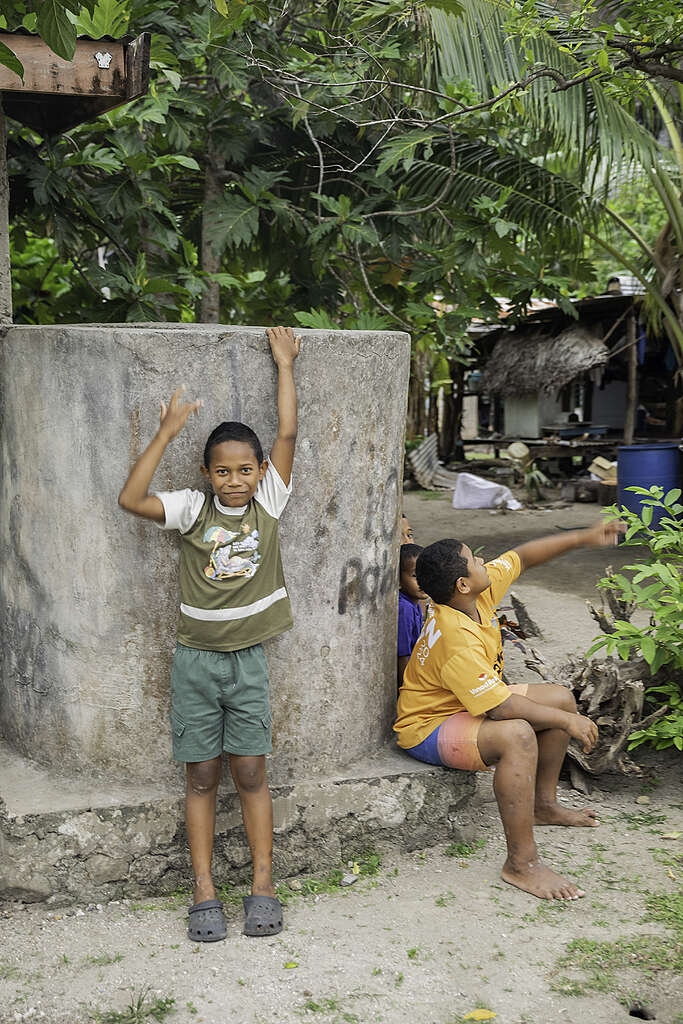
The island of Kioa is home to a Tuvaluan community who migrated from their atoll of Vaitupu in the late 1940s. It is a land of warm hearts, big smiles, and deep cultural roots; a place where the sound of a conch still summons the island together, where islanders paddle out to fish in carved outrigger canoes, and healthy happy children walk barefoot to school.
Here, culture is life. Kioans live sustainably through their traditional knowledge and practices. The island is alive with song, dance and the rhythms of a life tied to the tides, the winds, and the seasons.
Facing the future
Greenpeace has been lucky to have a relationship with Kioa for a number of years now, and we are continually learning from this remarkable community.
Last week, as part of our Voyaging Oceania project, we returned to the island. Our purpose was twofold —- to carry messages from the island to leaders gathering in Nadi this week for the Pacific Pre-COP, and to support the Kioa community in their efforts to improve water security for the island.
Unlike Tuvalu itself, with its eight atolls, Kioa is a mountainous, forested and richly fertile island. It will remain habitable far into the future. Kioans did not initially migrate from Vaitupu due to climate change, but the move was prophetic. They now have a lifeboat.
However, even Kioa faces challenges on our rapidly warming planet, in particular when it comes to water. Climate change is shifting once reliable rainfall patterns. On top of this, the island is already feeling the effect of this year’s intensifying El Niño event, which for Fiji means reduced rainfall and prolonged dry spells.
Right now, fresh water has to be carefully rationed, and is only available for a few hours a day. During last week’s visit aboard our campaigning ship Oceania, Greenpeace was privileged to work with the Kioa community on a new solar-powered water distribution project for the island.
Designed and led by the island, the project involves using a solar pump to move water from a reliable source to a storage tank and then using gravity to distribute the water around the village.
It was a lesson in how local knowledge and ingenuity can be the backbone of today’s climate solutions. To build a dam around the source, the local community knew the exact spot where they could gather gravel at low tide to mix with the cement. They took only what was needed, knowing that all resources must be carefully conserved. Kioa has no roads and no machinery, and it was an all-of-island effort to carry the materials up to the project site, including many heavy bags of sand and rock.
Such projects truly bring to life the vision of a resilient, locally-led, fossil fuel free Pacific.