Welcome to Carbon Brief’s China Briefing.
China Briefing handpicks and explains the most important climate and energy stories from China over the past fortnight. Subscribe for free here.
Key developments
‘Third Plenum’ called for unleashing tech innovation
FULL STEAM AHEAD: The “Third Plenum”, an important five-yearly political meeting traditionally associated with major economic reforms, concluded in Beijing on 18 July with a call to “make ‘high-quality development’ the guiding force” of the nation’s economy, Bloomberg reported. Policymakers resolved to foster “new quality productive forces” to “promote revolutionary breakthroughs in technology” and “in-depth industrial transformation and upgrading”, with a particular focus on strategic industries such as new energy, Reuters said. (See this issue’s spotlight or the full article on the Carbon Brief website for more on what this means for China’s industrial, energy and climate policy.)
SPECIFIC POLICIES: The full text of the resolutions adopted at the meeting includes several other policy prescriptions related to the energy sector, industry newspaper BJX News reported. These include calls to “deepen reform of the energy management system”, build a “unified national electricity market”, promote “price reforms” in the energy sector, and advancing “market-oriented reform” of the energy sector, it added. Specific policies related to these aims are expected to be released soon.
CLIMATE FOCUS: State news agency Xinhua said that policy goals also include to “improve ecological conservation systems”, take a “coordinated approach” to “carbon emissions reduction” and “actively respond to climate change”. On Twitter, Belinda Schäpe noted that this was the first time carbon emissions reduction has been mentioned in a Third Plenum communique. In an “explanation” of the plenum’s outcome published on the party-affiliated People’s Daily, President Xi Jinping said that China will “improve the mechanism of green and low-carbon development”, adding that “ecological and environmental protection still has shortcomings”.
PROVIDING ‘MIRACLES’: The state-run Science and Technology Daily reported that, in an “important barometer” of economic growth, electricity consumption by solar manufacturing rose 76% year-on-year, while that of new energy vehicle manufacturing grew 39% year-on-year. A commentary published in the People’s Daily by Zhong Yin – a nom de plume indicating that an article represents the view of party leadership – said that innovation and reform will allow China to create “miracles that will impress the world”.
Roadmap for ‘low-carbon transformation’ of coal
‘CLEAN COAL’: China’s National Development and Reform Commission (NDRC), the nation’s primary economic planning body, and the National Energy Administration (NEA), issued an action plan for the “low carbon transformation” of coal-fired power plants, Bloomberg reported. It added that the government will increase “financial support for projects to reduce emissions at coal power plants” through methods such as burning biomass and green ammonia or using carbon capture, utilisation and storage (CCUS). The plan, the outlet explained, aims to halve the “emissions intensity” – the emissions per unit of electricity generation – of an unspecified number of plants by 2027 compared to 2023 levels. If the 2027 target is achieved, these coal power plants’ emissions intensity will be “close to that of natural gas power generating units”, energy news outlet BJX News said. State news agency Xinhua, which described the plan as a “roadmap”, said it will “create a stronger leading role for the clean and low-carbon transformation of coal power”.
UNCERTAIN IMPACT: Asia Society Policy Institute senior fellow Lauri Myllyvirta noted on LinkedIn that the policy does not state how many plants will be retrofitted or how the state plans on incentivising industry players to do so, which will “determine the direct impact of this policy”. Analysis in the Shuang Tan newsletter argued that the policy is “unlikely to drive industry-wide transformation or attract large-scale investment”, stating that its true purpose may be to “test the selected technologies [CCUS, biomass and green ammonia] at a few carefully chosen coal power units”.
CARBON MARKET: One China-based power analyst told S&P Global that efforts to tackle coal emissions to date had largely been driven by the Ministry of Ecology and Environment’s (MEE) national carbon market (ETS), adding that the new “clean coal” policy “may be a call-out” by the NDRC that the MEE’s ETS targets are “too nice” and the mechanism is “too slow [in financing] these frontier decarbonisation technologies”. London Stock Exchange Group senior carbon analyst Luyue Tan argued on LinkedIn, however, that the ETS, which has been operating for three years as of 16 July, has encouraged greater uptake of emissions reduction technology. She added that its coverage will grow from 5.1bn tonnes of CO2 in 2022 to 8bn tonnes of CO2 in 2025, once the scheme is expanded to also cover the aluminium, cement and iron and steel sectors.
Tech and aluminium get ‘green and low carbon’ targets
DATA CENTRE TARGETS: The Chinese government released a new action plan for the “green and low carbon development” of data centres, Xinhua reported. The plan stated that by 2025, China’s data centres will achieve a power usage effectiveness (PUE) – a ratio that describes how much energy is used by the computing equipment – of below 1.5, and will “increase the utilisation rate of renewable energy in data centres by 10% annually”, it added. Energy news outlet International Energy Net said that the plan also includes goals for the centres’ “average PUE and energy carbon efficiency per unit [of computing power]” to reach “internationally advanced levels”.
COORDINATED DEVELOPMENT: In an interview shared by BJX News, an NDRC representative said that data centres, “as an important infrastructure for development of new quality productive forces”’ will be a sector where energy use is expected to grow by 15% per year. The official explained that China will encourage the “coordinated construction of large-scale wind and solar power bases and national [data centre] hubs”, with more data centres to be built in western regions to satisfy computing power demand in eastern China.
ALUMINIUM TRANSITION: China also released an action plan for energy efficiency and reducing emissions in the aluminium industry for 2024 and 2025, International Energy Net reported. The plan, which is linked to the overarching industry plan launched in May, states that construction of new “captive” coal-fired power plants will no longer be permitted and that existing coal-fired plants should be replaced by renewable energy sources, such as “renewable energy-based microgrids”, the energy news outlet said. It added that, according to the plan, the industry will save 2.5m tonnes of standard coal and reduce carbon dioxide emissions by 6.5m tonnes by 2025.
Wind turbines and EV software in the subsidies spotlight
SUBSIDIES: An investigation into Chinese wind turbine companies in Spain, Greece, France, Romania and Bulgaria has been expanded to include those operating in Germany, the Hong Kong-based South China Morning Post reported, amid concerns in the EU around China’s subsidisation of its low-carbon technologies sector. Meanwhile, the US may “impose limits on some software made in China” for vehicles, including electric vehicles (EVs), according to Reuters. Separately, E&E News said that China has called on the World Trade Organization (WTO) panel to resolve a dispute over US subsidies for domestically-manufactured EVs under the Inflation Reduction Act, which China argues “artificially sets trade barriers” and pushes “up the cost of green energy transformation”. The WTO said that China has a “lack of transparency” on industrial subsidies in its economy, citing this as a possible cause for the international concerns around “perceived” overcapacity, Bloomberg reported.
BUSINESS AS USUAL: US-based solar manufacturing plants built by Chinese companies will have at least 20 gigawatts of annual production capacity within the next year, enough to serve about half the US market, according to Reuters. By contrast, non-Chinese companies “have found it hard to compete”, with as many as half of their planned US factories possibly failing to come online, the newswire added. Meanwhile, Chinese wind turbine manufacturer Envision may soon sign a deal to build a wind turbine manufacturing plant in Saudi Arabia, “as part of the kingdom’s efforts to localise supply chains”, Bloomberg reported. Another Bloomberg article said that two Chinese solar giants will build manufacturing plants in Saudi Arabia worth $3bn, adding that Chinese vice-premier He Lifeng had previously said the two countries “should expand cooperation in emerging sectors such as renewable energy”.
Spotlight
Q&A: What China’s push for ‘new quality productive forces’ means for climate action
China’s Third Plenum, an eagerly awaited five-yearly meeting traditionally associated with major economic reforms, concluded on 18 July in Beijing.
The official readout calls on policymakers to pursue “high-quality economic development”, in part through “developing new quality productive forces” (NQPF).
NQPF was also listed as a policy priority in the ‘resolution’ released after the plenum. This, the resolution says, includes “pursuing innovation” in the new energy industry, “green” industrial upgrading and improving “environmental protection”.
However, there is significant debate as to whether this push will result in concrete policy outcomes.
In this issue, Carbon Brief unpacks what China’s NQPF drive means for its climate, energy and industrial policy. This analysis is published in full on the Carbon Brief website.
What does NQPF mean?
In January 2024, President Xi Jinping defined NQPF as innovation-led development that creates “a break with traditional economic growth models and development pathways”, resulting in a “high level of technology, efficiency and quality” as well as an “in-depth transformation and upgrading of industry”.
This has led to a “ubiquitous” focus on innovation across official discussions about NQPF, according to the University of Cambridge-affiliated thinktank Cambridge Industrial Innovation Policy.
But NQPF is about more than innovation and advanced technology alone. Analysis by the Council on Geostrategy says “while scientific and technological innovation is essential, [China recognises there] needs also to be deeper [economic] reforms”.
Low-carbon development is one of the few named priorities of the otherwise high-level theory. NQPF will provide an “important support for green development”, according to a commentary in the Communist party-affiliated People’s Daily.
“Protecting the ecological environment is to protect productivity and improving the ecological environment is to develop productivity,” it adds.
Why is the concept important?
NQPF represents a holistic approach “designed to address complex, interrelated challenges faced by China and to create a more resilient and dynamic economy”, Dr Muyi Yang, senior electricity policy analyst for China from the thinktank Ember, tells Carbon Brief.
Arthur Kroeber, founding partner and head of research at research firm Gavekal Dragonomics, tells Carbon Brief that NQPF is “the latest iteration of a long-running trend towards industrial policy, technology and intensive growth”.
This is “essentially a new bottle for old wine”, Kroeber adds. “I think what it does do is emphasise the point that there is a national mission” to build China into a technological superpower.
The idea addresses specific anxieties facing China’s leadership. As well as supporting economic growth, strengthening the country’s ability to innovate is part of a broader security drive.
Xi said in his January 2024 speech that he believes China is “still reliant on others for some core technologies…our industry is still not strong enough in spite of its size and falls short of excellence”.
What does this mean for China’s ‘green development’?
A primary aim of NQPF is to expand “strategic emerging industries” and “nurture future industries”, a commentary in the state-run newspaper China Daily argues.
These include a range of low carbon technologies, from electric vehicles (EV) to nuclear fusion. Recent analysis for Carbon Brief found that “clean energy” sectors contributed 11.4tn yuan ($1.6tn) to China’s economy in 2023.
Much of this will be driven by state-coordinated efforts. China Daily says that efforts to cultivate NQPF will “encourage” state-owned enterprises (SOEs) to deploy resources towards target industries.
These efforts are inspired particularly by the success of the EV industry, with several commentaries and articles highlighting its growth in analysis of NQPF.
Using innovation to foster leading expertise across different industries, China hopes, will allow the country to replicate this growth in other industries.
For example, a blog post on CCTV-affiliated WeChat account Yuyuan Tantian draws a link between China’s experience in manufacturing LCD televisions and its later success in developing solar technologies.
But China’s use of state resources to support strategically important industries has recently fuelled anxieties about “overcapacity” in some countries.
There are also concerns around overcapacity domestically. Han Wenxiu, executive deputy director of the Office of the Central Financial and Economic Affairs Commission, cautioned officials against “blind conformity and bubbles”.
But given current tensions with the US, Kroeber tells Carbon Brief, China “can’t rely on imports of technology in the same way…It must have an all-of-nation effort to develop its own alternatives.”
In his view, efforts to foster NQPF “could” lead to creation of more capacity, but this may be “unintentional” as “the Europeans and Chinese are actually starting discussions on [resolving concerns around] EVs”.
At the same time, Chinese ministries are highlighting the concept in more concrete policies. The Ministry of Ecology and Environment (MEE) announced that it will release a “1+N” policy on NQPF, while the Ministry of Science and Technology (MOST) will establish a centre promoting the concept.
Analysis has said this could signal the MEE “leveraging” the concept to “push through reforms that might otherwise be stymied” by other stakeholders, or improve MOST’s “autonomy” in making innovation policy.
Kroeber says that every policy document “now has to have some reference to NQPF”.
However, he adds, one area to watch is power market reform, as “coordination and the state playing a more leading role” will be crucial to progress.
Yang tells Carbon Brief that NQPF “is far from being purely conceptual”. He says: “I believe more actions in various sectors will come soon to translate it into concrete initiatives and programs.”
Watch, read, listen
BIG IDEAS: The European Council on Foreign Relations published a book explaining key theoretical concepts in Chinese policy discussions, such as “green industrialism” and “ecological civilisation”.
MARKET REFORM: Caixin carried a transcript of a recent speech by former central bank governor Zhou Xiaochuan, in which he argued for a “more responsive pricing system” in China’s power market to boost decarbonisation of the electricity system.
HYDROGEN PIVOT: China News published a video feature of how Lüliang city in coal-rich Shanxi province is betting on hydrogen to power its energy transition.
SPURRING STEEL: A new paper published by the Oxford Institute of Energy Studies explored the challenges of decarbonising China’s steel industry and the domestic and global climate policies that can incentivise a quicker energy transition.
20.8 million
The number of people in China affected by flooding between 1 January and 12 July, according to the Ministry of Emergency Management (MEM). The MEM also announced that, in the first half of this year, heavy rainfall, flooding and landslides caused 21,000 homes to collapse, affected 13.3m hectares of crops and caused 59bn yuan (£6.4bn) in direct economic losses.
New science
Substantial increase in perfluorocarbons CF4 (PFC-14) and C2F6 (PFC-116) emissions in China
Proceedings of the National Academy of Sciences
Chinese emissions of the greenhouse gases tetrafluoromethane and hexafluoroethane increased by 78% between 2011 and 2021, according to new research. The authors analysed “atmospheric observations” from nine sites in China, and found that the country’s combined emissions of the two gases reached 78m tonnes of CO2 equivalent in 2021. The study found “substantial” emissions from the less-populated western regions of China, likely because they are byproducts from the expanding aluminium industry.
The increasing water stress projected for China could shift the agriculture and manufacturing industry geographically
Communications Earth & Environment
A new study found that water stress will increase in China between 2020 and 2099 under both high and low emission scenarios, mainly due to “decreased water supplies like surface runoff and snow water content”. The authors developed a “water stress prediction index”, which revealed that changes in water stress will mainly be driven by changes in spring and autumn. They added that water stress is likely to be higher in north-western provinces than south-eastern ones. These changes in water stress “could lead to the north-to-south migration of the agriculture sector, manufacturing sector and human population”, the authors warned.
Prioritising forestation in China through incorporating biogeochemical and local biogeophysical effects
Earth’s Future
A new study highlighted the importance of considering the biogeophysical (BGP) effects of forestation – via modification of land surface temperature – as well as the biogeochemical (BGC) effects of carbon sequestration. The authors noted that current forestation policies in China only consider the BGC effect. However, by considering both BGC and BGP effects, the study identified an extra 167.2m hectares (Mha) of potentially suitable area for forestation in China. The paper added that “considering both effects will displace 17.7% (15.3 Mha) of forestation areas determined by considering only the BGC effect under the 2060 forestation target”. The study found that in China, the BGC and BGP effects of forestation “mostly work in synergy” to increase the “overall climate benefits”.
China Briefing is compiled by Wanyuan Song, Anika Patel and Ada Carpenter. It is edited by Wanyuan Song and Dr Simon Evans. Please send tips and feedback to china@carbonbrief.org

The post China Briefing 25 July: ‘Third plenum’ outcomes; ‘Low-carbon’ coal plants; EU probes wind subsidies appeared first on Carbon Brief.
China Briefing 25 July: ‘Third plenum’ outcomes; ‘Low-carbon’ coal plants; EU probes wind subsidies

Drought and heatwaves occurring together – known as “compound” events – have “surged” across the world since the early 2000s, a new study shows.
Compound drought and heat events (CDHEs) can have devastating effects, creating the ideal conditions for intense wildfires, such as Australia’s “Black Summer” of 2019-20 where bushfires burned 24m hectares and killed 33 people.
The research, published in Science Advances, finds that the increase in CDHEs is predominantly being driven by events that start with a heatwave.
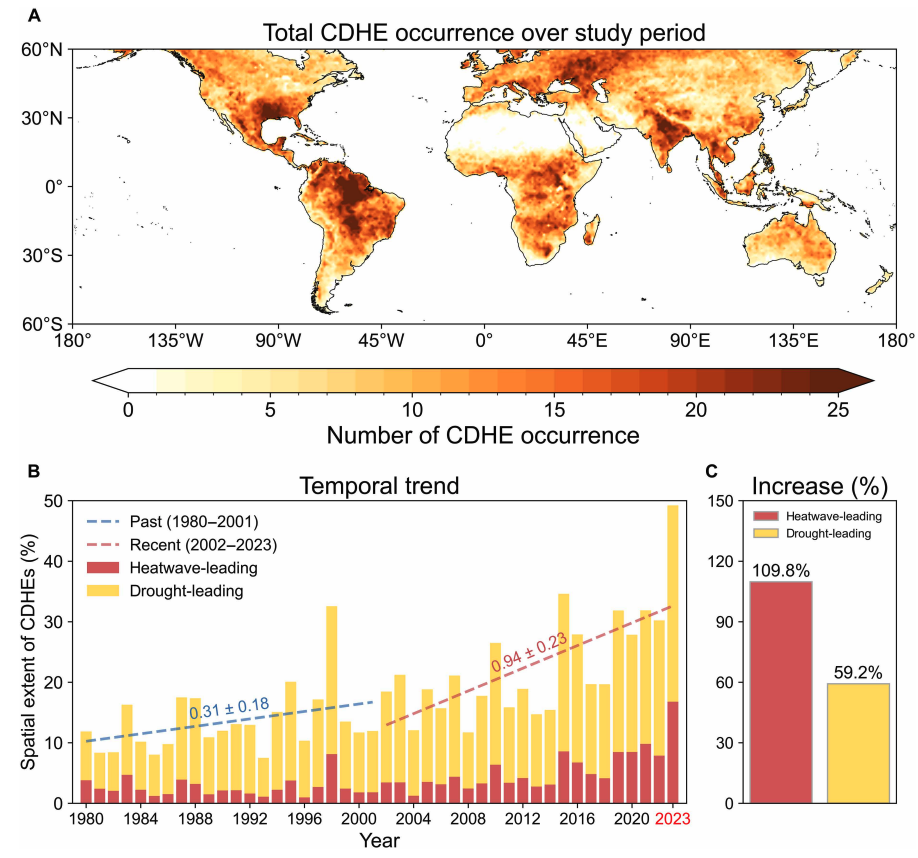
The global area affected by such “heatwave-led” compound events has more than doubled between 1980-2001 and 2002-23, the study says.
The rapid increase in these events over the last 23 years cannot be explained solely by global warming, the authors note.
Since the late 1990s, feedbacks between the land and the atmosphere have become stronger, making heatwaves more likely to trigger drought conditions, they explain.
One of the study authors tells Carbon Brief that societies must pay greater attention to compound events, which can “cause severe impacts on ecosystems, agriculture and society”.
Compound events
CDHEs are extreme weather events where drought and heatwave conditions occur simultaneously – or shortly after each other – in the same region.
These events are often triggered by large-scale weather patterns, such as “blocking” highs, which can produce “prolonged” hot and dry conditions, according to the study.
Prof Sang-Wook Yeh is one of the study authors and a professor at the Ewha Womans University in South Korea. He tells Carbon Brief:
“When heatwaves and droughts occur together, the two hazards reinforce each other through land-atmosphere interactions. This amplifies surface heating and soil moisture deficits, making compound events more intense and damaging than single hazards.”
CDHEs can begin with either a heatwave or a drought.
The sequence of these extremes is important, the study says, as they have different drivers and impacts.
For example, in a CDHE where the heatwave was the precursor, increased direct sunshine causes more moisture loss from soils and plants, leading to a drought.
Conversely, in an event where the drought was the precursor, the lack of soil moisture means that less of the sun’s energy goes into evaporation and more goes into warming the Earth’s surface. This produces favourable conditions for heatwaves.
The study shows that the majority of CDHEs globally start out as a drought.
In recent years, there has been increasing focus on these events due to the devastating impact they have on agriculture, ecosystems and public health.
In Russia in the summer of 2010, a compound drought-heatwave event – and the associated wildfires – caused the death of nearly 55,000 people, the study notes.

The record-breaking Pacific north-west “heat dome” in 2021 triggered extreme drought conditions that caused “significant declines” in wheat yields, as well as in barley, canola and fruit production in British Columbia and Alberta, Canada, says the study.
Increasing events
To assess how CDHEs are changing, the researchers use daily reanalysis data to identify droughts and heatwaves events. (Reanalysis data combines past observations with climate models to create a historical climate record.) Then, using an algorithm, they analyse how these events overlap in both time and space.
The study covers the period from 1980 to 2023 and the world’s land surface, excluding polar regions where CDHEs are rare.
The research finds that the area of land affected by CDHEs has “increased substantially” since the early 2000s.
Heatwave-led events have been the main contributor to this increase, the study says, with their spatial extent rising 110% between 1980-2001 and 2002-23, compared to a 59% increase for drought-led events.
The map below shows the global distribution of CDHEs over 1980-2023. The charts show the percentage of the land surface affected by a heatwave-led CDHE (red) or a drought-led CDHE (yellow) in a given year (left) and relative increase in each CDHE type (right).
The study finds that CDHEs have occurred most frequently in northern South America, the southern US, eastern Europe, central Africa and south Asia.
Threshold passed
The authors explain that the increase in heatwave-led CDHEs is related to rising global temperatures, but that this does not tell the whole story.
In the earlier 22-year period of 1980-2001, the study finds that the spatial extent of heatwave-led CDHEs rises by 1.6% per 1C of global temperature rise. For the more-recent period of 2022-23, this increases “nearly eightfold” to 13.1%.
The change suggests that the rapid increase in the heatwave-led CDHEs occurred after the global average temperature “surpasse[d] a certain temperature threshold”, the paper says.
This threshold is an absolute global average temperature of 14.3C, the authors estimate (based on an 11-year average), which the world passed around the year 2000.
Investigating the recent surge in heatwave-leading CDHEs further, the researchers find a “regime shift” in land-atmosphere dynamics “toward a persistently intensified state after the late 1990s”.
In other words, the way that drier soils drive higher surface temperatures, and vice versa, is becoming stronger, resulting in more heatwave-led compound events.
Daily data
The research has some advantages over other previous studies, Yeh says. For instance, the new work uses daily estimations of CDHEs, compared to monthly data used in past research. This is “important for capturing the detailed occurrence” of these events, says Yeh.
He adds that another advantage of their study is that it distinguishes the sequence of droughts and heatwaves, which allows them to “better understand the differences” in the characteristics of CDHEs.
Dr Meryem Tanarhte is a climate scientist at the University Hassan II in Morocco, and Dr Ruth Cerezo Mota is a climatologist and a researcher at the National Autonomous University of Mexico. Both scientists, who were not involved in the study, agree that the daily estimations give a clearer picture of how CDHEs are changing.
Cerezo-Mota adds that another major contribution of the study is its global focus. She tells Carbon Brief that in some regions, such as Mexico and Africa, there is a lack of studies on CDHEs:
“Not because the events do not occur, but perhaps because [these regions] do not have all the data or the expertise to do so.”
However, she notes that the reanalysis data used by the study does have limitations with how it represents rainfall in some parts of the world.
Compound impacts
The study notes that if CDHEs continue to intensify – particularly events where heatwaves are the precursors – they could drive declining crop productivity, increased wildfire frequency and severe public health crises.
These impacts could be “much more rapid and severe as global warming continues”, Yeh tells Carbon Brief.
Tanarhte notes that these events can be forecasted up to 10 days ahead in many regions. Furthermore, she says, the strongest impacts can be prevented “through preparedness and adaptation”, including through “water management for agriculture, heatwave mitigation measures and wildfire mitigation”.
The study recommends reassessing current risk management strategies for these compound events. It also suggests incorporating the sequences of drought and heatwaves into compound event analysis frameworks “to enhance climate risk management”.
Cerezo-Mota says that it is clear that the world needs to be prepared for the increased occurrence of these events. She tells Carbon Brief:
“These [risk assessments and strategies] need to be carried out at the local level to understand the complexities of each region.”