

Welcome to Carbon Brief’s China Briefing.
China Briefing handpicks and explains the most important climate and energy stories from China over the past fortnight. Subscribe for free here.
Key developments
Carbon emissions on the decline
‘FLAT OR FALLING’: China’s carbon dioxide (CO2) emissions have been either “flat or falling” for almost two years, reported Agence France-Presse in coverage of new analysis for Carbon Brief by the Centre for Research on Energy and Clean Air (CREA). This marks the “first time” annual emissions may have fallen at a “time when energy demand was rising”, it added. Emissions fell 0.3% during the year, driven by a fall in emissions “across nearly all major sectors”, said Bloomberg – including the power sector. It said the chemicals sector was an exception, where emissions saw a “large jump from a surge of new plants using coal and oil” as feedstocks. The analysis has been covered around the world by outlets ranging from the New York Times, Bloomberg and BBC News through to Der Spiegel, CGTN and the Guardian.
TOP TASKS: President Xi Jinping listed “persisting in following the ‘dual-carbon’ goals” as one of eight “key” elements of economic work in 2026, according to a December speech just published in Qiushi, the Chinese Communist party’s leading journal for political theory. This included “deeply advancing” carbon reduction in key industries and “steadily promoting a peak in consumption of coal and oil”, according to the transcript. The National Energy Administration (NEA) also outlined a number of priority tasks for the department, including resolving “grid integration challenges” to encourage greater use of renewable energy and “boosting investment” in energy resources, said energy news outlet International Energy Net.

ETS EXPANSION: Meanwhile, the government has asked “heavy polluters” in several sectors not yet covered in China’s emissions trading scheme (ETS) to report their emissions for 2025, reported Bloomberg, in a “key step” for the further expansion of the carbon market. The affected industries are the “petrochemical, chemical, building materials (flat glass), nonferrous metals (copper smelting), paper and civil aviation industries”, according to the original notice posted by the Ministry of Ecology and Environment (MEE), as well as steel and cement companies not yet covered by the ETS.
State Council issued ‘unified’ power market guidance
POWER TRADE: China will aim for “market-based transactions” to account for 70% of total electricity consumption by 2030, according to new policy guidance released by China’s State Council and published by International Energy Net. The policy also called for greater “integration” of cross-regional trading and “fundamentally sound” market-based pricing mechanisms. On renewable power, the guidance urged officials to “expand the scale of green power consumption” and establish a “green certificate consumption system that combines mandatory and voluntary consumption”, as well as encourage “implementation of inter-provincial renewable energy priority dispatch plans”. It also calls for “roll[ing] out spot trade nationwide by 2027, up from just 4% of the total transactions today”, reported Bloomberg.
CLEAN-POWER PUSH: An official at China’s National Development and Reform Commission said in a Q&A published by BJX News that establishing a “unified” national power market is “crucial for constructing a new power system”. A separate analysis by Beijing-based power services firm Lambda reposted on BJX News argues that China’s unified power-market reforms – which have been “more than two decades” in the making – will allow for “widespread integration” of renewable energy, resolving the challenge of wind and solar “generating but being unable to transmit and integrate”. Business news outlet Jiemian quoted Xiamen University professor Lin Boqiang saying that, while power-market reform may present clean-energy companies with “growing pains” in the short term, it will “force the industry to develop healthily” in the long term.
EU tariffs lifted on first firm’s China-built EV imports
‘SOFTENED’ STANCE: The Chinese government has “softened its stance” on electric vehicle (EV) manufacturers who seek to independently negotiate with the EU on prices for their exports to the bloc, said Reuters, after it previously “urged the bloc not to engage in separate talks with Chinese manufacturers”. The move came as Volkswagen received an exemption from tariffs for one of its EVs that is made in China and imported to the EU, which it committed to sell above a specific price threshold, reported Bloomberg. It added that the company also pledged to follow an import quota and “invest in significant battery EV-related projects” in the EU.
-
Sign up to Carbon Brief’s free “China Briefing” email newsletter. All you need to know about the latest developments relating to China and climate change. Sent to your inbox every Thursday.
‘MADE IN EU’ MELTDOWN: Meanwhile, EU policymakers attempted to agree legislation that may force EV manufacturers to ensure “70% of the components in their cars are made in the EU” if they wish to receive subsidies, reported the Financial Times. A draft of the plan was ultimately rejected by nine European Commission leaders and commission president Ursula von der Leyen, Borderlex managing editor Rob Francis wrote on Bluesky.
BRAZIL BACKTRACKS: Brazil has “scrapped” a tariff exemption for Chinese EV manufacturers that allowed cars assembled in Brazil with parts imported from China to be sold at much lower prices than similar vehicles made from parts imported from other countries, reported the Hong Kong-based South China Morning Post. Separately, Bloomberg reported on the surge of tariff-free Chinese EVs that has enabled Ethiopia to ban the import of combustion-engine cars.
PRICE-WAR BAN: The Chinese government has “banned carmakers from pricing vehicles below cost”, reported Bloomberg, in an effort to clamp down on a “persistent price war” affecting the industry. China’s car industry, “particularly in the EV segment”, has seen “aggressive discounting, subsidies and bundled promotions” pushing down profitability for companies across the supply chain, said the state-run newspaper China Daily.
More China news
- POWERFUL WIND: China has connected a 20-megawatt offshore wind turbine – the “world’s most powerful” and “equivalent to a 58-story building” – to the grid, reported state news agency Xinhua.
- PROVINCIAL MOVES: Anhui has become the first Chinese province to release data on how much carbon different forms of power in the province emits per kilowatt-hour of power, according to power news outlet BJX News.
- RARE-EARTH RUNES: China may hold a “policy briefing” on export restrictions for rare earths and other critical minerals in March, according to Reuters.
- NO CHINA CREDITS: The US confirmed that clean-energy tax credits will not be available for companies that are “overly reliant on Chinese-made equipment”, said Reuters.
Spotlight
Ma Jun: ‘No business interest’ in Chinese coal power due to cheaper renewables
Carbon Brief spoke with Ma Jun, one of China’s most well-known environmentalists, about how open data can keep pressure on industry to decarbonise and boost interest in climate change.
Ma is director of the Beijing-based Institute of Public and Environmental Affairs (IPE), an organisation most well known for developing the Blue Map, China’s first public database for environment data.
Speaking to Carbon Brief during the first week of COP30 in Brazil last November, the discussion covered the importance of open data, key challenges for decarbonising industry, China’s climate commitments for 2035, cooperation with the EU and more.
Below are highlights from the conversation. The full interview can be found on the Carbon Brief website.
Open data is helping strengthen climate policy
- On how data transparency prevents environmental pollution in China: “From that moment [when the general public began flagging environmental violations on social media in 2014], it was no longer easy for mayors or [party] secretaries to try to interfere with the enforcement, because it’s being made so transparent, so public.”
- On encouraging the Chinese government to publish data: “The ministry felt that they had the backing from the people, basically, which helped them to gain confidence that data can be helpful and can be used in a responsible way.”
- On China’s new corporate disclosure rules: “We’re talking about what’s probably the largest scale of corporate measuring and disclosure now happening [anywhere in the world].”
- On the need for better emissions data: “It will be impossible to get started without proper, more comprehensive measuring and disclosure, and without having more credible data available.”
‘Green premium’ still challenging despite falling prices
- On the economics of coal: “There’s no business interest for the coal sector to carry on, because increasingly the market will trend towards using renewables, because it’s getting cheaper and cheaper”.
- On paying for low-carbon products: “When we engage with them and ask why they didn’t expand production, they say that producing these items will have a ‘green premium’, but no one wants to pay for that. Their users only want to buy tiny volumes for their sustainability reports.”
- On public perceptions in China of climate change: “It’s more abstract – [we’re talking about] the end of the century or the polar bears. People don’t feel that it’s linked with their own individual behaviour or consumption choices.”
Climate cooperation in a new era
- On criticism of China’s climate pledge: “In the west, the cultural tendency is that if you want to show that you’re serious, you need to set an ambitious target. Even if, at the end of the day, you fail, it doesn’t mean that you’re bad…But in China, the culture is that it is embarrassing if you set a target and you fail to fully honour that commitment.”
- On global climate cooperation: “The starting point could be transparency – that could be one of the ways to help bridge the gap.”
The role of civil society in China’s climate efforts
- On working in China as a climate NGO: “What we’re doing is based on these principles of transparency, the right to know. It’s based on the participation of the public. It’s based on the rule of law. We cherish that and we still have the space to work [on these issues].”
- On the climate consensus in China: “The environment – including climate – is the area with the biggest consensus view in [China]. It could be a test run for having more multi-stakeholder governance in our country.”
This interview was conducted by Anika Patel at COP30 in Belém on 13 November 2025.
Watch, read, listen
GREEN ALUMINIUM: Lantau Group principal David Fishman wrote on LinkedIn about why China’s aluminium smelters are seeking greater access to low-carbon power, following heated debate over a Financial Times article.
STRONGER THAN EVER: Isabel Hilton, chair of the Great Britain-China Centre, spoke on the Living on Earth podcast about China’s renewables push and exports of clean-energy technologies.
CUTTING CORNERS?: Business news outlet Caixin examined how a surge in turbine defects at one wind farm could be due to “aggressive cost-cutting and rapid installation waves”.
POLES APART: BBC News’ Global News Podcast examined the drivers behind China’s flatlining emissions, as revealed by Carbon Brief.
600
In gigawatts, China’s total capacity of coal plants that are “flexible” and – in theory – better able to balance the variability of renewables, according to a new report by the thinktank Ember.
New science
- China will see a 41% decline in in coal-mining jobs over the next decade under current climate policies | Environmental Research Letters
- During 2000-20, China’s per-person emissions of CO2 increased from 106kg to 539kg in urban households and from 35kg to 202kg in rural households, indicating that the inequality between urban and rural households is shrinking | Scientific Reports
Recently published on WeChat
China Briefing is written by Anika Patel and edited by Simon Evans. Please send tips and feedback to china@carbonbrief.org

The post China Briefing 19 February 2026: CO2 emissions ‘flat or falling’ | First tariff lifted | Ma Jun on carbon data appeared first on Carbon Brief.

Drought and heatwaves occurring together – known as “compound” events – have “surged” across the world since the early 2000s, a new study shows.
Compound drought and heat events (CDHEs) can have devastating effects, creating the ideal conditions for intense wildfires, such as Australia’s “Black Summer” of 2019-20 where bushfires burned 24m hectares and killed 33 people.
The research, published in Science Advances, finds that the increase in CDHEs is predominantly being driven by events that start with a heatwave.
The global area affected by such “heatwave-led” compound events has more than doubled between 1980-2001 and 2002-23, the study says.
The rapid increase in these events over the last 23 years cannot be explained solely by global warming, the authors note.
Since the late 1990s, feedbacks between the land and the atmosphere have become stronger, making heatwaves more likely to trigger drought conditions, they explain.
One of the study authors tells Carbon Brief that societies must pay greater attention to compound events, which can “cause severe impacts on ecosystems, agriculture and society”.
Compound events
CDHEs are extreme weather events where drought and heatwave conditions occur simultaneously – or shortly after each other – in the same region.
These events are often triggered by large-scale weather patterns, such as “blocking” highs, which can produce “prolonged” hot and dry conditions, according to the study.
Prof Sang-Wook Yeh is one of the study authors and a professor at the Ewha Womans University in South Korea. He tells Carbon Brief:
“When heatwaves and droughts occur together, the two hazards reinforce each other through land-atmosphere interactions. This amplifies surface heating and soil moisture deficits, making compound events more intense and damaging than single hazards.”
CDHEs can begin with either a heatwave or a drought.
The sequence of these extremes is important, the study says, as they have different drivers and impacts.
For example, in a CDHE where the heatwave was the precursor, increased direct sunshine causes more moisture loss from soils and plants, leading to a drought.
Conversely, in an event where the drought was the precursor, the lack of soil moisture means that less of the sun’s energy goes into evaporation and more goes into warming the Earth’s surface. This produces favourable conditions for heatwaves.
The study shows that the majority of CDHEs globally start out as a drought.
In recent years, there has been increasing focus on these events due to the devastating impact they have on agriculture, ecosystems and public health.
In Russia in the summer of 2010, a compound drought-heatwave event – and the associated wildfires – caused the death of nearly 55,000 people, the study notes.

The record-breaking Pacific north-west “heat dome” in 2021 triggered extreme drought conditions that caused “significant declines” in wheat yields, as well as in barley, canola and fruit production in British Columbia and Alberta, Canada, says the study.
Increasing events
To assess how CDHEs are changing, the researchers use daily reanalysis data to identify droughts and heatwaves events. (Reanalysis data combines past observations with climate models to create a historical climate record.) Then, using an algorithm, they analyse how these events overlap in both time and space.
The study covers the period from 1980 to 2023 and the world’s land surface, excluding polar regions where CDHEs are rare.
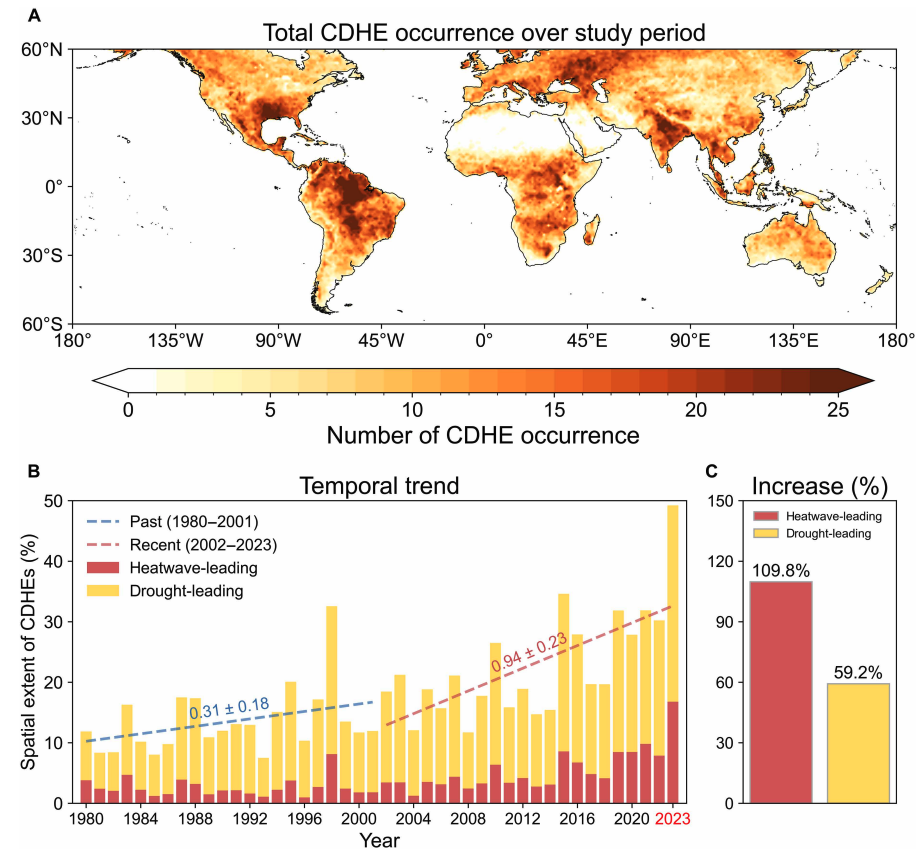
The research finds that the area of land affected by CDHEs has “increased substantially” since the early 2000s.
Heatwave-led events have been the main contributor to this increase, the study says, with their spatial extent rising 110% between 1980-2001 and 2002-23, compared to a 59% increase for drought-led events.
The map below shows the global distribution of CDHEs over 1980-2023. The charts show the percentage of the land surface affected by a heatwave-led CDHE (red) or a drought-led CDHE (yellow) in a given year (left) and relative increase in each CDHE type (right).
The study finds that CDHEs have occurred most frequently in northern South America, the southern US, eastern Europe, central Africa and south Asia.
Threshold passed
The authors explain that the increase in heatwave-led CDHEs is related to rising global temperatures, but that this does not tell the whole story.
In the earlier 22-year period of 1980-2001, the study finds that the spatial extent of heatwave-led CDHEs rises by 1.6% per 1C of global temperature rise. For the more-recent period of 2022-23, this increases “nearly eightfold” to 13.1%.
The change suggests that the rapid increase in the heatwave-led CDHEs occurred after the global average temperature “surpasse[d] a certain temperature threshold”, the paper says.
This threshold is an absolute global average temperature of 14.3C, the authors estimate (based on an 11-year average), which the world passed around the year 2000.
Investigating the recent surge in heatwave-leading CDHEs further, the researchers find a “regime shift” in land-atmosphere dynamics “toward a persistently intensified state after the late 1990s”.
In other words, the way that drier soils drive higher surface temperatures, and vice versa, is becoming stronger, resulting in more heatwave-led compound events.
Daily data
The research has some advantages over other previous studies, Yeh says. For instance, the new work uses daily estimations of CDHEs, compared to monthly data used in past research. This is “important for capturing the detailed occurrence” of these events, says Yeh.
He adds that another advantage of their study is that it distinguishes the sequence of droughts and heatwaves, which allows them to “better understand the differences” in the characteristics of CDHEs.
Dr Meryem Tanarhte is a climate scientist at the University Hassan II in Morocco, and Dr Ruth Cerezo Mota is a climatologist and a researcher at the National Autonomous University of Mexico. Both scientists, who were not involved in the study, agree that the daily estimations give a clearer picture of how CDHEs are changing.
Cerezo-Mota adds that another major contribution of the study is its global focus. She tells Carbon Brief that in some regions, such as Mexico and Africa, there is a lack of studies on CDHEs:
“Not because the events do not occur, but perhaps because [these regions] do not have all the data or the expertise to do so.”
However, she notes that the reanalysis data used by the study does have limitations with how it represents rainfall in some parts of the world.
Compound impacts
The study notes that if CDHEs continue to intensify – particularly events where heatwaves are the precursors – they could drive declining crop productivity, increased wildfire frequency and severe public health crises.
These impacts could be “much more rapid and severe as global warming continues”, Yeh tells Carbon Brief.
Tanarhte notes that these events can be forecasted up to 10 days ahead in many regions. Furthermore, she says, the strongest impacts can be prevented “through preparedness and adaptation”, including through “water management for agriculture, heatwave mitigation measures and wildfire mitigation”.
The study recommends reassessing current risk management strategies for these compound events. It also suggests incorporating the sequences of drought and heatwaves into compound event analysis frameworks “to enhance climate risk management”.
Cerezo-Mota says that it is clear that the world needs to be prepared for the increased occurrence of these events. She tells Carbon Brief:
“These [risk assessments and strategies] need to be carried out at the local level to understand the complexities of each region.”



The post Heatwaves driving recent ‘surge’ in compound drought and heat extremes appeared first on Carbon Brief.
Heatwaves driving recent ‘surge’ in compound drought and heat extremes
Greenhouse Gases
DeBriefed 6 March 2026: Iran energy crisis | China climate plan | Bristol’s ‘pioneering’ wind turbine
Welcome to Carbon Brief’s DeBriefed.
An essential guide to the week’s key developments relating to climate change.
This week
Energy crisis
ENERGY SPIKE: US-Israeli attacks on Iran and subsequent counterattacks across the Middle East have sent energy prices “soaring”, according to Reuters. The newswire reported that the region “accounts for just under a third of global oil production and almost a fifth of gas”. The Guardian noted that shipping traffic through the strait of Hormuz, which normally ferries 20% of the world’s oil, “all but ground to a halt”. The Financial Times reported that attacks by Iran on Middle East energy facilities – notably in Qatar – triggered the “biggest rise in gas prices since Russia’s full-scale invasion of Ukraine”.
‘RISK’ AND ‘BENEFITS’: Bloomberg reported on increases in diesel prices in Europe and the US, speculating that rising fuel costs could be “a risk for president Donald Trump”. US gas producers are “poised to benefit from the big disruption in global supply”, according to CNBC. Indian