

The need for climate justice education
When I ask visiting 6th grade students if they have heard of the word Climate, they all say yes. I ask the same about the word Justice and again I receive a chorus of “yeses.” But when I ask if they have heard those two terms used together, a confused silence descends on their faces. Climate Justice recognizes the disproportionate impacts of climate change on low-income communities and communities of color around the world – the people and places least responsible for the problem (University of California Center for Climate Justice). 6th graders in the Howard County, MD public school system are now learning about Climate Justice as part of a systemic science unit on Climate Change called Climate kNOWledge. Teaching the science behind climate change is an important tool to engage young people in making informed decisions that will lead to a better climate future for all. But teaching climate science through the lens of climate justice, will inspire youth to look for solutions to climate change that are equitable and just. At least that’s what the Climate kNOWledge project here in Howard County, aims to do.
Below is a list of ways you can bring climate justice into your teaching about climate change.
Step 1 – Identify places in your curriculum where climate justice can be taught
If your state has adopted the Next Generation Science Standards, you are already required to teach about climate change and human impacts on the environment (MS-ESS3 Earth and Human Activity, HS-ESS3 Earth and Human Activity). While climate change is but a small part of the NGSS science curriculum, these opportunities can provide a rich dialogue about climate justice topics while also tackling many of the practices and crosscutting concepts students are expected to master. Engineering design practices can even play a part in the climate justice conversation by challenging students to not only design solutions to the impact of climate change but evaluate where those solutions are needed most.

Step 2 – Engage student interest by focusing on a locally relevant Issue
Identifying a locally relevant issue that your students can research and relate to can increase student engagement in the lesson. For example, students in the Climate kNOWledge program learn about two real flooding events that took place in a popular historic main street in their county. Most students have been to this location or at the very least, heard of it. They recognize local landmarks and buildings, know the name of the watershed that flooded, and are currently watching Howard County dismantle several buildings along main street to install a flood resilient park. When students learn about the devastating floods that destroyed this area of town in 2016 and 2018, they feel connected to the history because they are already connected to the place. Pair these place-based relevant floods with another local flooding disaster that takes place in a less affluent part of the region, and students are now faced with a dilemma. Why is their beloved main street receiving a wealth of resources to protect itself from future flooding events while a neighboring town, who suffered similarly from the same storms, is not? Answering this question takes the students on an exploration of why both communities are prone to flooding (yay science!) while exploring the inequities in access to resources that help the towns rebuild.

Step 3 – Support learning science through a climate justice framework
Using a climate justice lens to teach about the science of climate change does the double duty of teaching climate change science while helping students understand that the impact of climate change on people and communities is not equitable. Students learn about heat capacity, greenhouse gas emissions, weather and climate patterns, and other climate science topics by studying the impacts of these phenomena on different communities around the world. For example, students predict expected impacts of temperature rise on low income vs. high income communities by analyzing available data such as land cover, percentage of people in poverty, tree canopy, and human health data. Similarly, students model future global energy use to simulate temperature rise scenarios which help them predict which low lying communities are most at risk for sea level rise.
Using a climate justice framework to teach about climate change science also brings real world examples to the students. We can think of this approach as science and policy with a face. The science helps explain the “why” behind the phenomena (heat waves, sea level rise, etc.) while a study of human behavior (such as past housing policies, racist belief systems, and/or discriminatory laws – both expired and current) explains the who – who will be impacted by heat waves, sea level rise, etc.

Step 4 – Support students in learning how different groups of people are impacted by the consequences of climate change.
It can be challenging to help students with privilege and access to resources understand how climate change impacts those around them, particularly those students who haven’t had to confront the harsh realities of the impacts of climate change in their day to day lives. On the contrary, students whose lives have been directly affected by climate change are more likely to face wealth disparities and live in communities with low climate resilience and therefore feel they are unable to do anything about their circumstances. In the Climate kNOWledge unit, students play an interactive game where groups of students act as households who have access to different resources. They are faced with two natural disasters and must navigate purchasing and selling resources to best protect their households from these disasters. Those households that start with more resources tend to do better than those who start with less. The game reinforces what students already observe in the real-world, those who have access to less resources, do not fare as well as those with access to more. The game also simulates what happens when resources are shared. In other words, when the wealthier households share their resources, the end result is more positive for ALL households in the game.
What do our teachers say?
We asked one of the 6th grade science teachers in the Climate kNOWledge program to share how she felt about introducing Climate Justice into her Climate Change lessons.
“Studying Climate Change through the lens of climate justice has been transformative for my students. By examining how climate change affects people in different parts of the world (or even within a community right next door!) students build empathy and a sense of urgent advocacy on behalf of those who are experiencing more significant impacts. Additionally, my students’ anger towards the injustice of climate change is tempered by hope when they learn about how various communities around the world are innovatively adapting. Ultimately, by the end of the unit my students feel inspired by the climate stories of others and empowered to address the climate injustices within their own community.”
-Katie White, 6th grade science teacher, Howard County Public School System
Including Climate Justice in your teaching may seem like a far reach. But with proper planning, a connection to real science and your students’ first hand experiences, this topic can fit seamlessly into your curriculum. For more information on the Climate kNOWledge project, visit their website.
The Climate kNOWLedge program is funded through a NOAA BWET grant.


Bess Caplan is the Climate Change Program Manager for the Howard County Conservancy, a private non profit organization in central Maryland that connects thousands of people a year to nature through environmental education programs. Ms. Caplan completed her B.S. in Environmental Science and Policy at the University of Maryland in 2002 and her M.S. in Environmental Science with a concentration in water resource management from Towson University in 2006. Prior to her current position, Bess spent 13 years as the Ecology Education Program Manager for the Baltimore Ecosystem Study where she helped infuse local ecology into school curriculum working with students and teachers of all ages. Bess is a certified Maryland Master Naturalist, a Maryland Association for Environmental Education certified Environmental Educator, certified Weed Warrior and founder and chair of Wilde Lake CARES, a grassroots movement to organize and educate residents of her home town on environmental issues.
The post Building a science-based climate justice lesson for middle school students appeared first on Climate Generation.
Building a science-based climate justice lesson for middle school students

Three countries have been named by the Paris Agreement’s compliance committee for failing to submit a nationally determined contribution (NDC) and repeatedly snubbing offers of help with their climate plans.
After months of internal debate over whether to identify serial non-responders, the Paris Agreement’s Implementation and Compliance Committee (PAICC) named the three countries which have failed to engage with it over their NDCs on Friday.
It named Democratic Republic of Congo, Senegal and North Korea in a footnote of its annual report, adding that it decided to name them “with a view to facilitating engagement”, adding that representatives of the three nations had been invited to its meeting in early 2027 “with the purpose of identifying any challenges and constraints”.
“The Committee noted the importance of Parties engaging with the Committee in a timely manner, while noting that some delays may be due to the national capabilities and circumstances of the Parties”, the report said.
-
Under US pressure, World Bank says it will back gas “where appropriate”
The US wants the World Bank to expand its gas support while climate campaigners are pushing for it to end – its head spoke this week of limited backing for the fossil fuel -
IPCC scientists vow to press on with climate reports despite political deadlock
After governments again failed to agree a timeline, nearly 120 IPCC authors pledged to complete their assessment on time and with full scientific rigour -
Paris Agreement committee snubbed over missing NDC climate plans
Many governments have still not submitted a nationally determined contribution to the UN, breaching a key requirement of the Paris Agreement

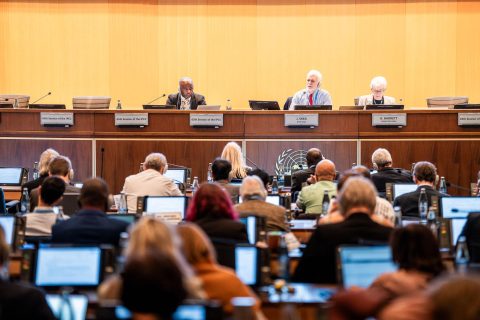

In July, PAICC said 12 countries had ignored its repeated attempts to discuss why they had not published an NDC as required every five years under the 2015 Paris accord.
Members of the committee had been divided over whether to name them, but at a September meeting decided to do so in their annual report to the annual climate COP summit.
By the time the report was published on Friday, only Congo, Senegal and North Korea “had not communicated an NDC or submitted a [Biennial Transparency Report] and had not yet responded to any of the Committee’s notifications, despite several reminders issued by the Committee in this regard”.
Rainforest and renewable energy ambitions
The silence from Congo and Senegal is notable because the former is home to much of the Congo Basin rainforest while the latter has sought billions of dollars in climate finance to support its renewable energy ambitions.
After Brazil, Congo has more rainforest than any country in the world. This forest, and the country’s peatlands, absorb huge amounts of greenhouse gas but are fast being lost to expanding farmland, charcoal production, logging and mining.
Senegal signed a Just Energy Transition Partnership with Canada and wealthy European nations in 2023, to help it meet its renewable energy targets under the-then government of Macky Sall. It was chair of the Least Developed Countries group between January 2022 and December 2023.

Tejas Rao, who is researching the PAICC as part of a doctoral thesis at Cambridge University, said the governments of the three countries should engage with the committee.
“Engagement costs these governments very little and the committee has shown it will listen,” he said.
“Silence leaves the committee with no basis to help, and it leaves the [governments] exposed to the narrative that they are simply disengaged,” he told Climate Home News.
Paris Agreement requirement
The 2015 Paris Agreement requires all parties to publish an NDC every five years outlining their emissions reduction targets, with each plan meant to be more ambitious than the country’s last NDC.
The latest set – the third round of plans, with new targets for 2035 – was due in February 2025. While most countries missed this deadline, all but around 30 – mostly small emitters but including Egypt, Vietnam and Argentina – have now submitted them.
Over the year, the PAICC – which is made up of government climate officials from developed and developing countries – has been communicating with governments that have not submitted NDCs and trying to overcome barriers to them doing so.
Some nations have cited exceptional circumstances as the reason for not submitting an NDC, a process that requires a significant amount of work in tracking emissions and consulting on how to curb them across the economy. For example, a letter from a Sudanese official to the PAICC, seen by Climate Home News, said that the country’s civil war had led to the suspension of its NDC preparation.
-
IPCC scientists vow to press on with climate reports despite political deadlock
After governments again failed to agree a timeline, nearly 120 IPCC authors pledged to complete their assessment on time and with full scientific rigour -
Under US pressure, World Bank says it will back gas “where appropriate”
The US wants the World Bank to expand its gas support while climate campaigners are pushing for it to end – its head spoke this week of limited backing for the fossil fuel -
Who shapes climate science? The equity question facing the IPCC
Early completion of the next global climate science assessment reports risks excluding research from the Global South, which is key to ensuring the findings are fair
The US and Iran are not signed up to the Paris Agreement and so do not have active NDCs, nor does Taiwan, which is not a UN member state.
Rao said that because the PAICC is “facilitative and non-punitive”, naming the countries “is meant to open a door, not close one – the invited consultation is the point”.
“In recent months, governments that explained their constraints, whether capacity, finance or domestic process, have been met with follow-up and support rather than sanction, and the number of silent governments has fallen sharply,” Rao said.
The post Paris Agreement committee names three countries snubbing it over NDCs appeared first on Climate Home News.
Paris Agreement committee names three countries snubbing it over NDCs