

Dark clouds are gathering over adaptation finance. The US has all but stopped providing it and European countries are slashing their aid budgets to spend more on their militaries. Much of what is flowing comes in the form of loans and doesn’t reach the most vulnerable, as we’ve reported.
Over the years, one bright spark has been the Adaptation Fund and its grants to developing countries for pioneering work in communities. It has allocated $1.6 billion to 226 projects, benefiting 90 million people, its website says. And, while rich nations are failing to give the fund all the money it needs to finance its growing pipeline, new revenues are supposed to come in from the Paris Agreement’s new carbon market, known as Article 6.4.
Back at COP26 in Glasgow, governments agreed that the Adaptation Fund should get 5% of the proceeds from all Article 6.4 carbon credits – other than those based in small islands and least developed countries.
How much money that will amount to is uncertain. It depends on how many projects there are and the price of their credits.
The fund got over $200 million from a similar share of proceeds under the Kyoto Protocol’s Clean Development Mechanism (CDM), although the price of those credits collapsed.
While $200 million was a disappointment as ten times that was expected, the Adaptation Fund head Mikko Ollikainen told Climate Home News in Bonn that the sum was “not insignificant”. By comparison, the fund has been seeking $300 million per year from donor governments in recent years.
Hopes are that the CDM’s successor will yield bigger sums for adaptation. But for the fund to get its hands on the share of cash it is expecting from Article 6.4 projects , governments need to agree to transition the fund to “exclusively” serve the Paris Agreement. They are hoping to wrap up those talks in Bonn this week, so that they can rubber-stamp the decision early at COP31.
-
Bonn Bulletin: Finance dominates discussions in every room
Lack of progress on finance issues – including putting a number on the new goal to triple adaptation funding – is causing blockages across negotiating tracks at UN climate talks -
Climate adaptation helps African nations tackle rising conflict over resources
The growing overlap between insecurity and climate vulnerability is forcing governments and development agencies to rethink adaptation efforts


It has not been plain-sailing. As small islands’ lead negotiator Anne Rasmussen told a press conference on Tuesday, this transition “is being blocked, frustrating efforts to replenish the fund and ensure that the crucial adaptation finance can flow to those that need it the most”.
This issue, along with other finance complaints, leads small islands “to question whether the implementation of the NCQG [the 2035 finance goal agreed at COP29] is dead on arrival”, she added.
The problem is related to who is considered a developed country at UN climate talks, with the responsibilities for providing climate finance that designation implies.
Traditional donor countries, which have been pushing for years for some wealthier developing countries like Saudi Arabia and China to contribute to climate finance as well, want the Adaptation Fund’s board seats to be split between “developed” and “developing” countries.
They argue that these are the categories referred to in the Paris Agreement and so are appropriate for a fund that exclusively serves that accord.
Developing countries – which have long opposed any of their members being considered developed – argue that the board seats should continue to be split between “Annex 1” and “non-Annex 1” countries.
These categories, based on lists of nations drawn up in 1992, are more rigid than “developed” and “developing”. While development status can change over time, you’re either on the Annex 1 list or you’re not.
Ollikainen said a delay in agreement beyond COP31 – a risk if the issue is not resolved here in Bonn – would harm people in the real world where adaptation needs are rising sharply while the money to protect them from worsening climate impacts is not.
“If we don’t address adaptation,” the fund’s head told Climate Home News, “that will lead to loss and damage and that’s going to be even more costlier than adaptation – and the cost will be borne by people who have done least to cause this problem who typically don’t have social safety networks to support them.”
The post Bonn Bulletin: Adaptation Fund stalemate puts people at risk, says head appeared first on Climate Home News.
Bonn Bulletin: Adaptation Fund stalemate puts people at risk, says head

For the first time, new-energy vehicles (NEVs) made up 67% of new car sales in China in September, according to the latest data from the China Passenger Car Association (CPCA).
The figures show that NEVs, which include battery electric cars and plug-in hybrids, captured a record share of sales, even though fewer were sold than last year.
This is because sales of combustion-engine cars are falling steeply, a trend that the CPCA has attributed to rising petrol prices following the start of the Hormuz crisis.
Indeed, sales of fuel-only cars were down 31% year-on-year in the first nine months of 2026, with plug-in hybrid sales down 26% – whereas battery EV sales were only down 4%.
One analyst tells Carbon Brief that China’s rapidly growing EV fleet has offset demand for 143m barrels of oil since the start of the Hormuz crisis.
Another says that the crisis is “reinforcing China’s electrification of road transport”.
Meanwhile, amid slowing domestic sales, Chinese carmakers’ exports of NEVs more than doubled [in 2026 to date / in September] from a year earlier.
NEV record
A record two out of every three cars sold in September in China were NEVs, according to CPCA data, as shown in the figure below.
(NEVs predominantly include battery electric vehicles – BEVs – and plug-in hybrids – PHEVs. BEVs only run on electricity, whereas PHEVs also have a combustion engine.)
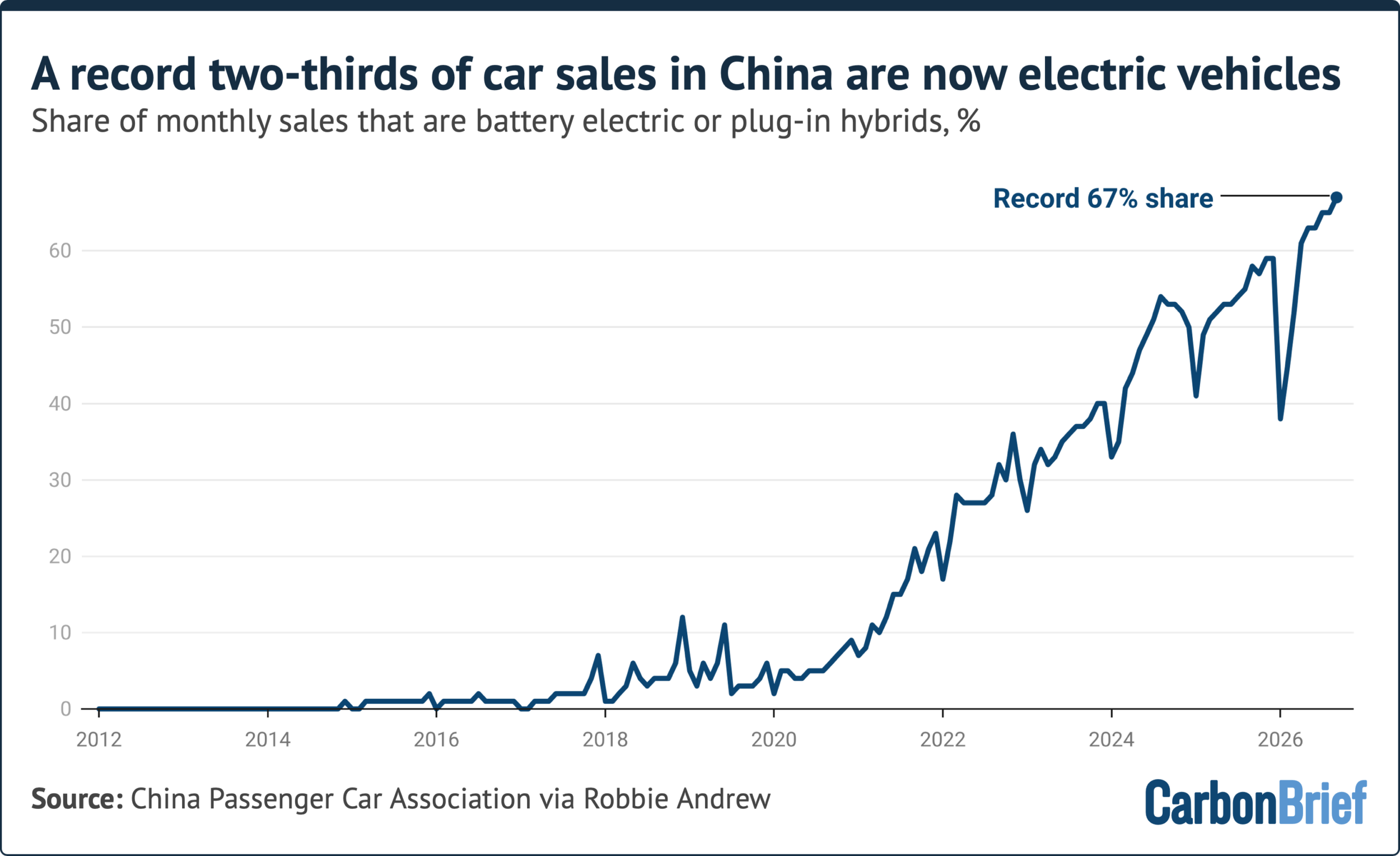
This marks a rapid rise for NEVs from just 6% of new car sales in 2020 up to 58% in 2026 to date – and a record 67% in the month of September.
This year, NEVs’ share of sales has also bounced back from a low of 39% in January, after the full purchase tax exemption that had been in place for more than a decade came to an end in December 2025.
The gain in NEV share in 2026 has come amid a slowdown across the wider domestic passenger-car market, which has hit sales of combustion-engine vehicles particularly hard.
This September, passenger-car retail sales across all categories declined, with overall sales volumes falling 28% year-on-year.
The contraction was led by combustion-engine vehicles, which saw sales fall 43% year-on-year in September and 31% in 2026 to date.
However, sales of PHEVs also fell by 36% year-on-year in September and by 26% in 2026 to date. By comparison, BEVs performed better, although sales still declined 8.5% from a year earlier in September and 4% in 2026 to date.
As a result, NEV sales overall fell by 17% in September and 13% in 2026 to date.
While the market changes in 2026 to date were particularly dramatic, they reflect a broad continuation of trends seen over the past decade.
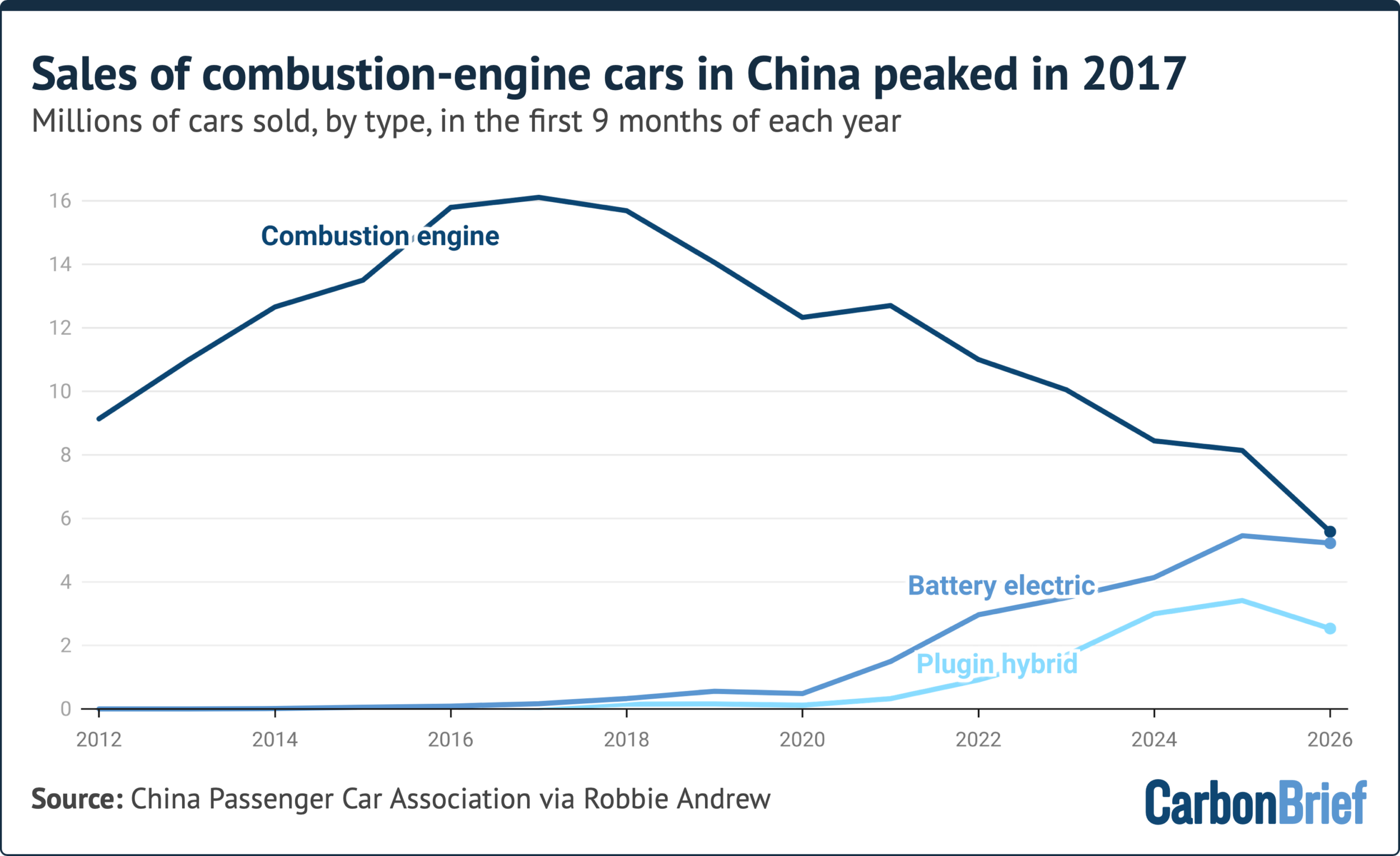
Indeed, sales of combustion-engine cars in China peaked in 2017 and they have been declining ever since, shown in the figure below.
Impact of Hormuz
Part of the reason for the advance of NEVs in 2026, said Chinese technology news outlet OFweek, was petrol cars “giving up market share” as they were outperformed by electric alternatives.
Cui Dongshu, secretary-general of the CPCA, cited higher petrol prices as an explanation for September’s weak combustion-car sales, in comments to financial news outlet National Business Daily.
Imports of oil into China in January-September have fallen 15% compared to 2025, equivalent to 470m barrels, as ongoing conflict tightened supply and drove up prices.
China’s passenger-car NEV fleet has displaced 143m barrels of oil so far during the strait of Hormuz crisis, Euan Graham, senior energy analyst at thinktank Ember, tells Carbon Brief.
EVs “accounted for 12% of the decrease in China’s oil use post-Hormuz”, according to an estimate provided to thinktank the Brookings Institute by an unnamed analyst.
Erica Downs, a senior research scholar at Columbia University’s Center on Global Energy Policy, tells Carbon Brief that the strait of Hormuz crisis and higher oil prices are “reinforcing China’s electrification of road transport”.
She says the “world’s largest oil supply disruption” vindicates China’s early bet on EVs, which was partly driven by concerns about oil-supply security.
NEV demand down
Nevertheless, NEV sales have fallen year-on-year, albeit at a slower rate than overall car sales. The growth in NEV market share has also been decelerating.
Zhang Yichao, a partner at consulting firm AlixPartners, tells Carbon Brief that NEVs benefit from government trade-in policies and a “strong pipeline” of new models, particularly those involving innovation.
He says these factors help explain why NEVs sales have fallen at a slower rate to their combustion-car counterparts.
Cui told the state-run China National Radio that the fall for NEVs and for cars overall in September 2026, is also due to a high baseline of sales from the same month in 2025, as well as changes to trade-in policies and disruptions from the holiday period.
Other factors, says consulting firm Wood Mackenzie, are the weakened demand due to “demand pull-forward” in 2025 caused by the end of subsidies, as well as “tighter financing conditions”.
Zhang tells Carbon Brief he does not “see much more room ahead” for further growth in NEVs’ market share.
He adds that, in his view, their share in China is unlikely to exceed 80%, as some premium-market segments and specific use cases will continue to require combustion-engine vehicles.
Exports surge
Meanwhile, while domestic NEV retail sales fell 17% in September 2026, exports more than doubled, increasing 164% year-on-year, according to the CPCA.
This extends the decline in domestic sales and very strong growth in exports seen across 2026 to date, as shown in the figure below.
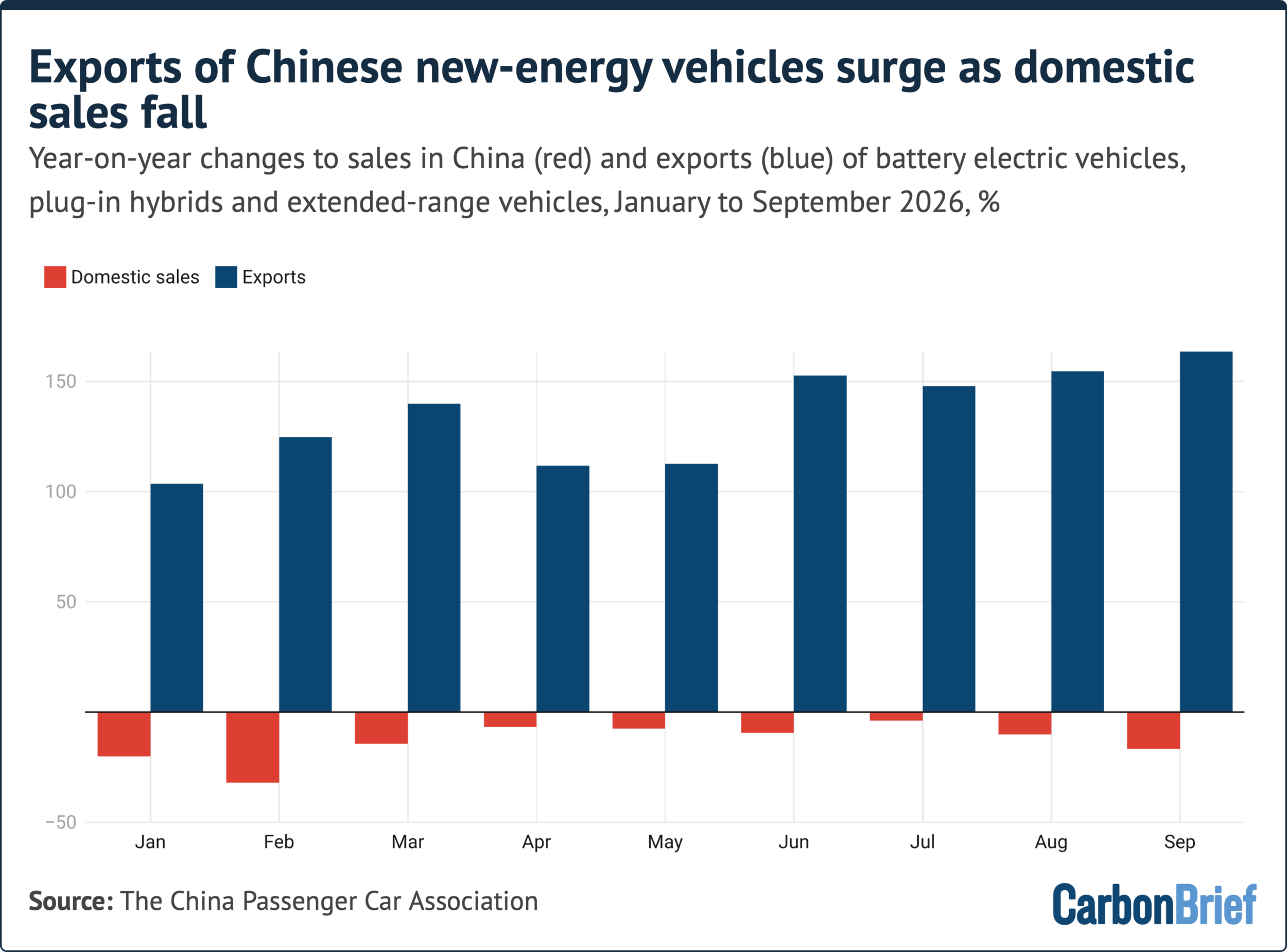
In September, 1,084,000 NEVs were sold domestically in China, while 558,000 NEVs were exported.
Exports are becoming increasingly important to Chinese carmakers, in the face of weaker domestic demand and cut-throat industrial competition.
The CPCA says exports have become “a core priority” for some carmakers.
However, the surge in exports from China has created concer