

Weather Guard Lightning Tech
Blade Failure Alert: How ONYX Prevents Million-Dollar Disasters
ONYX Insight‘s ecoPITCH system prevents catastrophic wind turbine blade failures caused by pitch bearing issues. Forrest French and Martin McLarnon reveal how continuous monitoring and early detection can save wind farms millions.
Contact Martin McLarnon: martin.mclarnon@onyxinsight.com
Sign up now for Uptime Tech News, our weekly email update on all things wind technology. This episode is sponsored by Weather Guard Lightning Tech. Learn more about Weather Guard’s StrikeTape Wind Turbine LPS retrofit. Follow the show on Facebook, YouTube, Twitter, Linkedin and visit Weather Guard on the web. And subscribe to Rosemary Barnes’ YouTube channel here. Have a question we can answer on the show? Email us!
Allen Hall: ONYX Insight’s ecoPITCH monitoring system has become crucial for wind farm operators facing blade root insert failures. These failures start invisibly but can end catastrophically with blades detaching completely. This week we speak with Forrest French Senior Project Engineer, and Martin McLarnon, sales Director for North America at ONYX Insight.
Their ecoPITCH system detects dangerous movements before visible signs appear as Forest notes in the interview. By the time you can get a feeler gauge measurement, it’s probably too late. So join us to discover how data-driven monitoring is helping operators make smarter maintenance decisions preventing million dollar disasters and keeping turbines spinning safely.
Welcome to Uptime Spotlight, shining Light on Wind. Energy’s brightest innovators. This is the progress powering tomorrow.
Allen Hall: Martin and Forest. Welcome to the [00:01:00] show. Hello. How’s it going? Thanks for letting us. Yeah, we’re really interested to, to talk to you today just because there’s so many blade root issues from pitch bearings and blade bushings or inserts as they’re called sometimes, and a number of other issues. And when we talk to operators, what they tell us is, oh, we, you use ecoPITCH.
And they love that system. But I want to, I wanna back up first and talk about what are some of the operators experiencing out there in the field And ecoPITCH system was originally developed to look at pitch bearing problems and forests. What are some of those pitch bearing problems you’re seeing out in the field today?
Forrest French: Yeah, so it, it, it’s a funny story. It was originally developed for pitch bearing, uh, applications. Um, the industry as a whole started experiencing this root insert issue, so we were able to, we were kind of in a perfect position, right? It was, it was a, it was a [00:02:00] really serendipitous thing that we, we had just developed this product and we could easily pivot.
To measure both the pitch bearing and this root insert issue. Uh, the, the pitch bearing issues are admittedly the, the more difficult, uh, issue, right? To measure. Um, there’s, there’s some, some great opportunities for value and there’s also some really good challenges to come along with that. Um, pitch bearings, uh, they, they don’t rotate quickly.
Right. Uh, when, when we talk about typical CMS typical vibration monitoring, you’re looking at a very, very fast rotating, uh, shaft or bearing, et cetera, and you’re able to pick up on those frequencies as they revolve. You don’t get that with a pitch bearing. It’s a very slow moving, uh, slewing bearing. Um, so picking up.
Noise through vibration can be very difficult, uh, because again, you don’t get that frequency of that [00:03:00] rotation, so you’re left with nothing but uh, a bunch of noise. Right. And you’re hoping that that noise floor is low enough that you might capture a bit of crunching of cage material or anything like that?
Right. The alternative in what, in what we use ecoPITCH for is it’s very simple. We, we point a an inductive displacement sensor right at the pitch bearing itself. Typically the inner ring, depending on the type of turbine. And what we’re looking for is any kind of slop or displacement between the inner and outer ring.
And there’s always gonna be some, right. Uh, but, but what we’re looking for is. Is a change in the amount of, of movement between those two rings, which may indicate falling or, or other failure modes within the raceways. The challenges come along when you have failure modes that maybe, maybe don’t show themselves right through that displacement because it’s absolutely possible to, to completely lock [00:04:00] up a bearing while, while showing almost no displacement.
So there’s, there’s, there are challenges to come along with this, so, so. ecoPITCH is great for pitch bearings, but it really needs to be coupled with good visual inspections by the sites to make sure that that bearing’s not spitting out cage material right. And something that, that maybe isn’t being seen in the data.
Allen Hall: So those measurements are important.
Right? And it’s very difficult to go up there every month or two and try to take those measurements. Are there signs on the outside that everybody should be watching for? I know when we were on site a number of times. If there’s a pitch bearing problem, you typically see grease on the outside of the blade, near the root area.
Is that the, the main source of detection at the moment?
Forrest French: Yeah. And, and you know, I think, I think every operator’s gonna have a different way of looking for this stuff. It’s, it’s not there, there’s not a, uh, a very uniform strategy, I would say. Um, but really what they’re gonna be [00:05:00] looking for yeah. Is, is exactly that.
It’s gonna be grease purging out of the seals. Um, it’s gonna be the seals themselves blowing out. Right. Um, that’s, uh, cage material. Coming out of the seals is a, is obviously gonna tell you that you’ve got some, some, uh, some balls inside your bearing that are getting locked up and pulling the cage to bits, right?
And that’s what’s gonna happen when that displacement I was talking about gets severe. So you get severe displacement. It jams up a ball, but you continue to pitch. So other balls continue to move and you kind of shred that cage and it starts spitting that material out, damaging the seal. Um, so it’s, it’s a whole process.
Yeah.
Allen Hall: So if you see grease on the outside, the seal is blown. And more than likely, if you look on the ground, you’re gonna see metal shards.
Forrest French: Potentially, yeah. Depending on what kind of collars and stuff you have. Uh, but, but yeah, usually a lot of those, a lot of those shards and, and that, that metal material is gonna get captured in a lot of that grease.
Um, so really it’s just gonna turn your [00:06:00] hub into a greasy metal mess. Right. It’s, it’s still fun to be in those, those hubs. For sure. Well,
Allen Hall: let’s talk blade uh, inserts or bushings. What do you typically see if you’re walking around a farm? When a blade bushing is starting to fail, what’s the indicator from the ground?
Forrest French: From the ground? It’s difficult. Um, what, what we’ve seen typically is you’re gonna see a, uh, and, and again, this, this depends on the turbine, uh, whether it’s an electrically driven turbine or a hydraulically driven, uh, pitch bearing, sorry. Um, with the electrically driven pitch bearings, it’s a little bit easier to spot these issues.
You’ve, you’ve got. Uh, when, when the bushing starts to fail, it will basically spit out some of this, they call it dust, like a metal dust basically. And that dust will kind of make its way out onto the outside of the blade usually. So. From the Nelle, for example, you might pop your head out the hatch, do a visual inspection of the outside of the root, [00:07:00] and you might see some of that dusting heading down, down the blade.
That’s a good indicator that, that you’ve potentially got an issue. It’s, it’s not a, a, a, a sure thing at that point. Right. Um, because there’s a lot of places where metal can can make its way into the system with the hydraulically driven turbines that. Indicator gets a lot more difficult. Um, if anybody, you know, and I’m sure a lot of the folks on the call have some of these turbines, they’re a mess usually, right?
Um, if, if, if any bit of debris gets loose, it’s gonna knock off a bunch of hydraulic lines and it’s gonna make an absolute mess. And any material that’s being spit out by those bushings, it’s just gonna get. Caught up in all that hydraulic oil, and again, it’s just gonna turn into a mess and you’re not really gonna know one from the other at that point.
You’re really just left with, with uh, uh, kind of your more rudimentary ways of looking for this and some of your [00:08:00] more labor intensive ways of looking for this
Allen Hall: force. There’s a lot of ways to inspect the blade root insert. Bushing issue as the blade moves around and I, I’ve seen some of these, uh, sites where they got a technician who climbs up in there and he is got a feeler gauge of some sort.
Is that really an effective way to, to even measure that problem?
Forrest French: Yeah. The, the feeler gauge method is. Is better than nothing. Right? You’re, you’re doing something at that point. What, what we’ve found historically is that by the time you can really get a feeler gauge measurement, uh, it’s probably too late.
At that point, you, you’re seeing a significant enough gap that you can get material in there. It’s, it’s a, you’ve got a big problem on your hands. We also see paired with that, um. We see folks doing a dial indicator measurement, right? Where you’re taking sta uh, dial indicators, you’re placing them around the circumference of the blade, and that usually involves pitching the blade out, cantilever, and then you, you just rotate the blade, and that’s in that [00:09:00]static position.
You’re not actually rotating the hub. That is, is definitely better than something like a feeler gauge methodology. The, the, the, the good thing about that is you get higher resolution and you can track that over time as you use that, that methodology. The problem with both of those though, is they’re, they’re offline measurements.
I. You’re not seeing any of the loading due to the rotation of the hub, none of the arrow loads on the blades. So what you’re gonna see is if you place a continuous monitoring system, or, or even a, a, a, a portable monitoring system on this, and you rotate that turbine, you’re gonna see a significant increase in displacement value.
So you’re getting the real picture of what’s actually happening when this turbine is operating. Right? That’s gonna give you. A lot more insight into when you need to make a decision to shut this thing down.
Allen Hall: So how far off are the feeler gauge measurements compared to the ecoPITCH system?
Forrest French: It varies. Uh, it, that’s, that’s the issue with the feeler gauge is that depending on [00:10:00] which technician, on which day.
In which position, you know, how they’re feeling that day. They’ll get a different measurement every time. Um, and that’s nothing against the technicians themselves. They’re, it doesn’t matter how perfect, how perfect you do it, you’re gonna get a different measurement every time because that, that blade is shifting and moving around and it might just sit somewhere new one day when you go up to check it.
Um, but on average, I could say easily that you could see up to. A, a difference of, I mean, two, three millimeter I’ve seen before, a difference between a feeler gauge and an actual live measurement when operating the turbine. So very significant.
Allen Hall: Well, yeah. Well, what I want to talk to then is what happens if we don’t catch these, uh, these indicators early enough?
What is the downstream effect and sort of how expensive does that get
Forrest French: The final failure is, is catastrophic. Right. The final failure is that the [00:11:00] blade falls off. It, it liberates, right? That’s the, the correct term is a liberation. Um, but nobody wants to end up with a blade in on the ground. Um, and so you, you generally have a lot of signs leading up to that.
Um, that again, you, you need some type of system to measure those. Whether that’s a manual measurement, um, using feeler gauges or dial indicators, and I have my opinions on those and we will get into that. But, or, or, or a continuous monitoring system, whether that’s permanent or a portable system, uh, such as a, a sweep.
Um, but you need to be looking out for these items in some way, shape, or form. There’s, there’s a particular subset of turbines, of blade types that are, that are known to be seeing this failure more. And it’s highly likely that if you’re listening to this, you probably know whether you have those, those blades.
You’ve probably been notified one way or another. [00:12:00] Um, but if not, we can help, we can help make that call.
Martin McLarnon: Yeah. And just, just add to that, you know, there’s other, um, owners, you know, the blade liberation potentially if it strikes the tower. Could you get tower collapse as well? So that’s like obviously, uh, huge increases.
Um, and then when that happens, you know, what are the options? You know, um, you know, what damage does that do? How long does it take to get a new blade in an expedited fashion can be even more expensive. And then the whole time you’ve got, um, the turbine is offline. And depending on what time of year that happens, you may not be able to kinda get it all, all lined up, um, for several months.
Um, so, so yeah, definitely. It’s, it’s extremely, we’d say high risk. So the, the cost impacts are, are, are really big.
Joel Saxum: I’ve, I’ve heard of, uh, touching the insurance world, right? Like farms where, and this is where the ecoPITCH system comes into play.
Wind farms that have been shut down and they haven’t been turned back on for months, entire wind farms because they don’t know how to monitor for this, or they don’t know if it’s safe to go back on. Once [00:13:00] they’ve discovered a problem, they don’t know what that, um, you know, what is our safety margin here?
What. Can we play with, how can we get this thing back running? So you guys as eco with the ecoPITCH system, have walked into that, right? You’ve been able to get these things up and running. How does that work? How does that process work with you guys?
Forrest French: So, so a situation like that, and we’ve seen this, right?
Uh, customer has a blade liberate they shut down their entire fleet because to your point, they don’t know. They don’t know, right? They don’t know what’s out there. Now, what, what other insidious failures are just waiting for them. So. What we can provide in that case is, is our, our ecoPITCH system. We have a portable.
Portion or a portable version of this where we go up tower, it’s a real quick and dirty type thing, right? We’re using magnets and Velcro, whatever we can right to crudely get this stuff into the turbine safely. Obviously it’s not going anywhere, um, but whatever it takes to quickly [00:14:00] get this system installed, what we’ll do is we’ll run the turbine for about 10 minutes, right?
We’re gonna. Take our measurements, we’re gonna get outta there, we’re gonna yank our equipment out, and we’re gonna move on to the next turbine. Generally speaking, with that system, and this depends on the turbine, you’re looking at about two turbines per day. Certain certain blade types, we have to get in the blade itself.
That can push us back to, you know, one turbine per day for confined space reasons and things like that. Um, but what that does is it provides you with. Your full population. Now you know what every blade looks like compared to the rest of the population. And what we’re doing with that data is we’re, again, we’re taking all these 10 minute data samples and we’re just saying, Hey, these, this subset of turbines needs further analysis, right?
You need to be watching these. The rest of these though are baseline. They’re all right where we expect them to be. They’re all [00:15:00] the same. The operator can quickly just go and fire those turbines back up and get back to business.
Allen Hall: And what does that data look like for us? Is it just a, a measurement or? Do you see the movement of the root and the, the pitch bearing as the turbine spins?
What, what is that data?
Forrest French: The data is, is really rudimentary. It’s very, it’s very cool and, and there’s a lot of information that you can take away from it, but at the end of the day, it’s just a sine wave. And I’m sure we’ll, we’ll provide some, some examples of that that you guys can toss up on the screen.
Um, but really what you’re seeing, and generally in a simple system, we’re gonna put a sensor up near the leading edge. Near the trailing edge, right? And if you put those two, uh, sign waves on a graph, what you’ll typically see is they’re, they’re out of phase by about 90 degrees. That’s expected as the turbine is rotating.
One side, you know, one side of the blade’s gonna go into compression, one’s gonna go into detention, and then as it swings around, it’s gonna reverse, right? So you get that 90 degree phase [00:16:00] where it starts to get fun is, uh, or fun, fun for me as the engineer looking at the data. Maybe not fun for the, the person who owns a turbine, but, uh, where it starts to get interesting is when these failures get.
Very severe. We’ve seen that that phasing actually start to line up. And what that means to me is that the blade is no longer wobbling. It’s literally pulling away all at one time and dropping back down all at once, right? So you have the entire blade system plunking up and then falling back on the bearing.
So at that point, that means that likely you’ve, you’ve lost. Enough bushings around the circumference of that blade that the entire blade is moving at the same time rather than flexing in and out. That’s a little more rare, but it’s just an example of some of the cool, uh, bits of information that we can take away from this
Allen Hall: for us, when you see these kinds of large measurements, uh, displacement happening [00:17:00] as the hub spins, putting a permanent system in, I think makes sense because you want to be able to project.
Ideally where this growth is or if it starts to vary wildly uh, or grow rapidly, you wanna be able to understand how soon to shut the turbine off. Explain to me what the logic is that goes into that, because there’s a lot of engineering that looks at that data.
Forrest French: Yeah, and this is, this is the key difference between something like a portable system that we talked about where you go up, you take 10 minutes of data and you yank it out.
The key difference between that and a continuous monitoring and a permanent system. The portable system is gonna tell you on this day at this time, what was your displacement? And that’s great information. You can absolutely action that information, but what you’re lacking is the full story, right? What, okay, it was here today, what is it tomorrow?
What is it? The next day? I’ve seen examples where, uh, I’ve put a permanent system in place and the [00:18:00] displacement value is, we’ll call it elevated. It’s maybe not in like emergency status, but it’s elevated. It stayed there. For as long as we’ve monitored this turbine, it stayed. What that means is that had you just gone and done dial indicator measurements or even a portable suite, you might end up thinking, we need to, we need to action this.
We need to replace this blade. However, with a permanent system, you’re now armed with that knowledge to say, no, let’s monitor. Let’s keep watching it and wait until it does actually grow. And that’s the full picture, right? If I go and put a system in place, and I’m seeing that gross pattern, and, and Martin used the term peak to peak earlier, and what that’s referring to is that sine wave that we’re talking about.
The distance that the target is moving away from the sensor, the top minus the bottom of that waveform, gives you your full displacement, your peak to peak, as that peak to peak grows. What we generally see is a, an an [00:19:00]exponential growth. Once it starts to go, once you get a, a significant number of these bushings that start to fail, the rest of the bushings that are already prone to failure continue to fail, and then you have a cascading effect where you just start to release.
Um, so being able to watch for that and being able to make a risk-based decision with that data. Is crucial.
Joel Saxum: So for, with that being said, when an, when you guys are dealing with an operator, do you have a set metric or is it case by case? When you know like, hey, this thing is starting to unzip itself. What does that look like?
What’s the time look like? Do they have an hour? Do they have a month? What does, what are they thinking?
Forrest French: The timing can change depending on the, the type of blade, the environment right. That it’s in, how it was installed. Um. How many, how many blade bolts have broken over time, right? That, that time can change significantly.
On average, I would say that we go [00:20:00] from making a call to notify a customer that you have an issue that is starting to reveal itself to, we probably need to consider shutting this thing down is usually on the order of two months, on average, probably. Um, so. Not, we’re not talking days. Right. It, it, it can be though.
Allen Hall: Maybe give us a picture of what the system looks like when it’s installed in, at the base of Blade or in the hub.
Well,
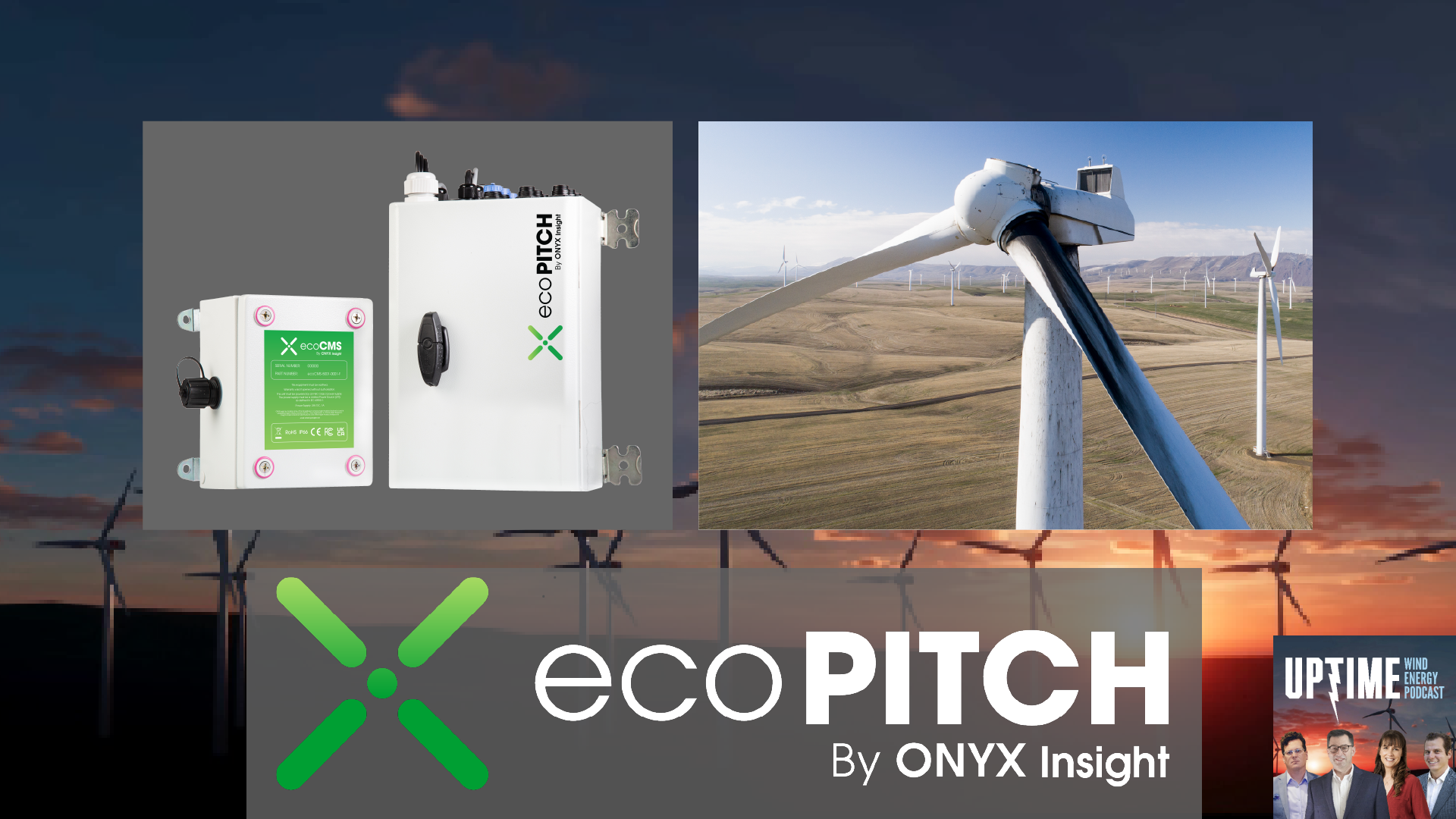
Forrest French: I’ll, I’ll, I’ll, I’ll start with the root insert. Um, it’s the one that’s a little more interesting as far as the installation goes, but. Typically what we’re gonna have is we’re gonna have our CMS boxes, right? There’s two of them. Um, they’re about, yeah, I mean about a foot, foot by foot, maybe. Um, you’ve got two of those guys depending on the turbine.
And this is the fun of my job as, as the ecoPITCH application lead. Every turbine I get to go up and make a custom installation design, right? We have to find somewhere to put these boxes, and, and we’ve talked about it. These, these turbines, these hubs [00:21:00] are not designed to be, uh, retrofit friendly, right?
There’s nowhere to put this stuff. They don’t, they don’t leave bolt holes for you to put things. So we have to get really creative in order to design a robust system that’s gonna survive in this environment. But I digress. Generally you’re gonna have your two CMS boxes mounted somewhere in the hub, um, on a, a mounting plate of some kind.
Uh, and then from there, at most you’re gonna have about nine displacement sensors. So three sensors in each blade. Those sensors are wired. Uh, so what, we’ll, what we’ll typically do is I’ll have, uh, for example, a, an anchor of some kind. Dead center or in the center of rotation inside the blade itself. And I’ll typically have a, a.
Some kind of, uh, I’ve used very fancy, uh, uh, industry grade bungee cable, basically. Uh, or, or [00:22:00] similar, uh, metal, cable, whatever it may be. Um, it’s something with some stretch and some give because we have a rotating component, but the cables will then drop down onto that anchor. They’ll come up that, that fancy bungee cord right from there.
They’ll be routed along existing cable lines to the boxes themselves. Um, the sensors are mounted. It’s a pretty simple thing. The sensors are mounted using a combination typically of a, of a, of a double-sided tape and a liquid epoxy. The double-sided tape is there for installation efficiency, uh, because it’s very difficult to install a liquid epoxy overhead.
But we’ve never had any, any, any, any issues with that design so far.
Joel Saxum: And I’m gonna throw one more at you here because this is something that Alan and I run into almost everywhere. We, we end up when we’re talking I, iot or anything else. Cybersecurity. Right? Because at the end of the day, this is the conversation we have.
Oh, you can solve a problem. Great. I’m gonna pass it. Oh wait, cybersecurity. We gotta make sure this is, [00:23:00] that we can get these things actually installed in our turbine. So how does, uh, ONYX Insight handle that with this system?
Forrest French: Sure. So I, I think a couple key things, right. First and foremost, I think a lot of people jump for joy when we tell them that our system is run off of a 4G router.
It does not connect to the turbine operating, so it does not connect to the turbine at all. Right. It runs fully on its own. Um, there are, you know, there are still, those questions absolutely come up still. Right. Even though it’s, it’s just taking data from our system. It’s not getting any kind of operating data from the turbine itself.
We still get that question right, and I think it’s perfectly fair. However, um, we’ve had multiple success stories up to this point, right? We’ve, we’ve, we’ve, uh, we’ve been able to work through those. We have a dedicated IT team. We’re up to date on cybersecurity, uh, certifications and those items. I’m not an IT guy, but we have a whole IT group that takes care of this, right?
So when those [00:24:00] concerns do come up. We’re locked and loaded. We’re ready to get them chatting with the people who they need to chat to, to make sure that whatever cybersecurity questionnaires or, uh, you know, confirmations need to be done, it can be done and it, and it does get done. So that, that’s, that’s, I think, I think the best news is just, it’s, it’s fully standalone, right?
There’s no ethernet connection to the tower itself.
Allen Hall: All right, so that sounds really simple and easy to do, and you can do it in a temporary fashion and get yourself some data across the whole fleet. Or if in some cases when you triage these, you’ll want to keep the system in there longer term to help you understand when repairs need to take place.
And this is where the money comes in because it’s all at the end of the day, is about using your resources wisely as an operations. And your o and m budget is limited and is. Tends to get limited more and more every year. So you want to be spending the money wisely, which is what ecoPITCH System does.
How does, how do you project then, when you have that data [00:25:00] and you’re starting to get that streaming coming in, you’re seeing the, the blade movement play out. How are you spending your budgets there? How do you appropriate the right amount of funds for the right size of problem?
Martin McLarnon: Yeah, so we’ve got, um, um, a good case study with a customer who had installed ecoPitch permanent, uh, for insert issue. And they had quite a lot of historical issues with this, um, and, and really trying to manage this, this problem. Um, and like how do they keep operating the turbine, uh, wind farm safely while, while these, uh, issues are ongoing? So really legal pitch was really unique and enable enabling them to do that.
They get this peak to peak measurement that, that we’re measuring, you know, all the time. And seeing how that, um, changes over time. So gives ’em the benefit of an early stage indicator. And as far said, it’s a, it’s a direct measurement and it’s, um, you know, through the actual operation of the, the turbine rotation.
Like some of these other, you know, [00:26:00] one off measurements are very, you know, it’s whenever the, the, the blades are static, it doesn’t show that true, um, garbing throughout the whole rotation. So. Um, that we were able to see that whole progress from really early stage. So things that we talked about, getting a new blade or looking at some engineering, uh, solutions, gives them time to plan that out, but also in the right way so they can wait until it gets to a point, um, where they’re, um, you know, saying that this needs to be switched off.
We’re not comfortable anymore with the level of the gabbing. Um, and even to that point when even the, the blade itself is, is switched off, turbine, switched off, there could be still a chance of slippage and the blade continuing to, to fall off. They need to know that as well, for safety reasons. So until that blade gets replaced or repaired, they need to have really good visibility on, on what that condition is.
But effectively, you know, across a large wind farm, it really helps them manage things rather than, uh, you know, switching everything off when just, you know, [00:27:00] until they replace all the blades, which isn’t really. Realistically an option anyway. So they have to really help some manage that. Loose budgets, excuse me.
And uh, yeah, supply chain, um, lead times, things like that. You have, that all has to be managed. Um. So it’s been a really good success story.
Allen Hall: And all this is backed by all the engineers and scientists that are at ONYX Insight.
And Martin, maybe you can provide a little summary of that because if you haven’t worked with ONYX Insight, you may not realize the power and the capability that exists within in that building.
Martin McLarnon: Yeah, yeah. And it’s great, you know, here in Forest talk through the, uh. The application for, for ecoPITCH. So, you know, obviously, you know, we’ve got a really talented bunch of engineers that can, you know, really explain, uh, the issues and under, you know, we really are understanding, um, the problems customers have, which is unique, uh, depending on the turbine type, um, or, or the specific issue.
And, and that’s really how, you know, ONYX is, um, business has really grown over the [00:28:00] years. Is that continuous, um, collaboration with customers. What sorts of issues are coming up like for said. This root insert issue has just kind of emerged in the last couple of years. It wasn’t something people were, uh, necessarily expecting.
And, um, we were always trying to drive to have those, those discussions. So for us, we, um, you know, background is in, uh, a lot of me, mechanical engineering and gearbox design was our original, uh, how we started out. But then getting into drive, train, uh, monitoring, vibration monitoring, CMS hardware, um, um, with, you know.
Principal engineers with decades of experience, like, you know, global team, uh, different data analysts as well. So we, um, yeah, really have expanded that from drive chain, uh, skid analytics, um, foundation monitoring, uh, pitch bearing, um, and, uh, and this route insert blade monitoring as well. So, um, yeah, we really, whenever customers have have those issues, we like to [00:29:00]discuss it, figure out what, what the potential solutions are, and.
Uh, it could be a new, a new product for us. Um. E eventually, if that’s, if that’s something we can, uh, kinda get a good solution for or release. Provide advice to the customer.
Allen Hall: Yeah. If you have blade root insert issues or pitch bearing issues, you do not wanna mess with them. Or even blade bolts because blade liberation is so expensive.
And when you have those issues, you want to go to accompany. Like ONYX Insight because they have the expertise. They’ve been around a long time. They’re a part of some OEMs equipment and they understand the variations between all those different blade models and turbine types. That’s where you wanna start because you’re gonna save your company.
I. Millions of dollars in losses in downtime. And Martin, how do people who are not familiar with On Insight get ahold of you and talk about ecoPITCH to see how they can get it installed in their turbines?
Martin McLarnon: Yeah, I, um, we confirm my, uh, email address in the chat. Um, I’m a [00:30:00] cover the North American region, so hobby to, um, you know, get, get involved in that discussion.
And we’ve got global, uh, commercial folks, so I will get. Get the, you connected to them and I’d love to have a conversation.
Allen Hall: And you can always visit ONYX Insight ONYXinsight.com. Great website, and you can learn more about ecoPITCH on that site. There’s a good PDF download there if you wanna learn more.
And yes, reach out to ONYX Insight. Reach out to to Martin, reach out to, for. Get your questions answered now, because as the season progresses, it’s only gonna be more expensive and at the right time to do this kind of inspection and data acquisition is now so. Martin and Forrest, thank you so much for appearing on the show.
I really appreciate all of the information. Absolutely.
Forrest French: Thanks
Allen Hall: for having us.
Martin McLarnon: Thanks Al Joel. Appreciate [00:31:00] it.
https://weatherguardwind.com/onyx-insight-ecopitch-blade-root/

Weather Guard Lightning Tech
Trump Targets Revolution Wind, Nordex Q3 EBITDA Doubles
Allen covers the Trump administration’s bid to reopen Revolution Wind’s permit, a bipartisan Senate permitting deal, Nordex’s doubled third-quarter profit, and GE Vernova’s new wind chief.
The Uptime Wind Energy Podcast is brought to you by Weather Guard Lightning Tech, creators of the StrikeTape Ultra LPS retrofit. Subscribe to Uptime’s Substack newsletter. And check out Rosemary’s “Engineering with Rosie” Youtube channel. Have a question we can answer on the show? Email us!
 Have you ever wondered why every dictator in human history follows the exact same playbook? Check this out
Plato nailed this 2400 years ago, and it’s been on “rinse/repeat” ever since.
 On average, I meet perhaps 50 K-12 teachers each year, and I often ask them: What is the biggest challenge you face that impacts your ability to connect with and educate your students?
Here’s a rough tabulation:
Screen time, how it robs kids of their ability to pay attention, impedes social interaction, and makes parenting more difficult: 80%
Everything else combined: 20%
Maybe this is a cynical viewpoint, but it seems like that world of today revolves around the mega-corporations profiting by punishing their customers.
In this case, we have the tech giants ruining the lives of our children. Elsewhere, we have healthcare industry driving people into bankruptcy, Big Oil ruining our planet, the gun lobby murdering our kids, and, of course, an ultra-corrupt government looting our treasury to pay off billionaire donors.
Note that this wasn’t the case when we boomers were growing up 60 years ago. This is a distinctive shift from the 1960s when corporate America was focused on things like color TVs and the Ford Mustang.

IPCC scientists vow to press on with climate reports despite political deadlock
