Connect with us

Published

on

In recent years, most Australians have been intensively focusing on electrifying their homes and embracing solar power as a reliable, clean source of energy.  

But that’s not where it ends!  

With abundant sunshine and a strong commitment to sustainability, nowadays residents are increasingly turning to solar-powered electric vehicles as a natural extension of this green movement. 

These innovative electric cars harness the sun’s energy to reduce reliance on fossil fuels, lower carbon emissions, and offer greater energy independence. 

With that essence, as solar technology continues to advance and EV options expand rapidly, Australia is well on its way to becoming a global leader in sustainable transportation. 

So, are you ready to explore the best solar-powered electric cars lighting up Australia’s roads? Let’s dive in!

The Rise of Solar Energy and Electric Vehicles in Australia

Australia was already working toward its national Renewable Energy Target, aiming for 82% of its electricity to be generated from renewable sources by 2035.  

Adding to that, the growing adoption of electric vehicles (EVs) marks another significant step toward this clean energy goal.  

Previously in Australia, the transportation sector was responsible for approximately 19% of total greenhouse gas emissions annually. But now it is even possible to have zero net emissions from electricity and vehicles.  But how? 

Well, by simply transitioning to EVs powered by solar, wind, and other clean energy sources, Australia is not only reducing its carbon footprint and minimizing dependency on fossil fuels but also taking meaningful action against climate change 

Overall, with solar energy and EV adoption continuing to rise, the nation is steadily moving toward a cleaner, more sustainable future.

Australia’s Electric Car Statistics: How Many Are Being Sold?

If you ever look at the recent scenarios, nearly 1 in 10 new cars in Australia are electric. According to data from the Electric Vehicle Council in 2024, over 114,000 EVs were sold, among which 91,000 were battery-electric vehicles (BEVs) and 23,000 were plug-in hybrid electric vehicles (PHEVs).  

Altogether, these accounted for 9.65% of all new car sales in the country, an apparent increase from 8.45% in 2023. 

The rise in EV adoption has been fuelled by the arrival of more affordable models from brands such as BYD, GWM, and MG, as well as government support through the Electric Car Discount Policy. 
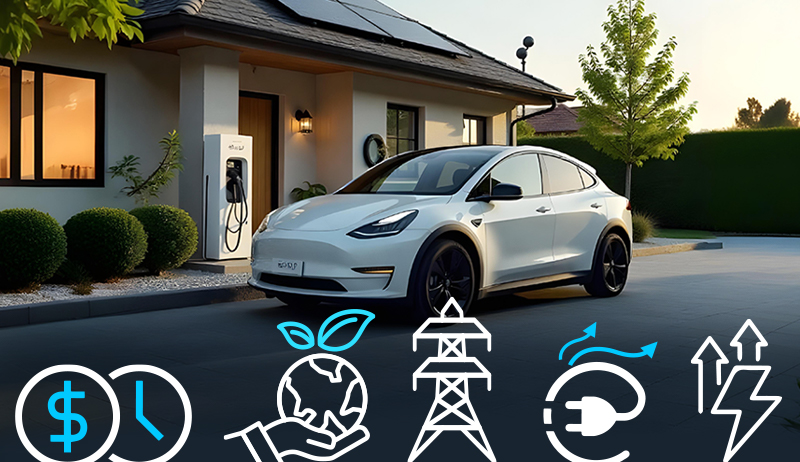
Benefits of Solar-Powered EVs

Top 5 Benefits of Solar-Powered EVs: A Real Game Changer

Combining solar power with electric vehicles isn’t just smart, it’s a fast and effective method for decarbonizing the Australian transportation sector.  

Whether you’re cutting energy bills, shrinking your carbon footprint, or powering your home from your car, this clean energy duo is transforming the way Australians move and live. 

So, let’s have a glance at all the advantages of solar-powered electric cars: 

1. Major Cost Savings and Faster Payback

    • Solar-generated electricity during sunny hours can significantly reduce or even eliminate charging costs.  

For instance, charging a 60 kWh battery from the grid costs around AU$15 to 18, whereas solar energy during the day is essentially free. 

  • They offer attractive payback periods in Australia. A typical 6.6 kW home solar installation may pay for itself in 4 to 6 years through combined energy and charging savings.
  • These cars reduce energy bills, offering an average savings of $1,500 per year. 

2. Environmental and Emissions Benefits

  • Charging EVs using solar instead of fossil-fuel–powered grid electricity cuts greenhouse gas emissions.  
  • Aligning EV charging with solar power accelerates decarbonization goals and supports Australia’s renewable transition, pushing toward clean energy.  

3. Energy Independence and Grid Support

  • Charging with home‑generated solar energy and storing excess in batteries helps homeowners avoid variable electricity prices. 
  • EV charging remains possible during power outages if a home battery system is present. 
  • Reduced reliance on the grid: 
    • EVs can utilize the excess energy generated by solar panels, reducing pressure on the grid during evening peaks.0 
    • In many parts of Australia, industrial leaders are using EVs as mobile batteries. They charge during the day, discharging to homes or the grid later to lower household power costs. 

4. Bi‑Directional Charging Evolving Business Opportunities

  • Vehicle‑to‑home or grid (V2H/V2G) 

Some EVs can send power back to your home or grid when needed, offering cost savings or even income.

  • Upcoming Australian standards 

New standards being implemented will make V2G systems viable in Australia soon, enabling EVs to act as batteries on wheels for homes and the grid.

5. Boost in Property Value & Smart Energy Integration

  • Homes with solar-compatible EV charging systems are increasingly appealing to eco-conscious buyers, potentially enhancing property value.
  • Smart charging solutions with advanced EV chargers and energy management systems can automatically prioritize solar energy, optimize charging times, and reduce costs.

Best Solar Powered Electric Cars in Australia| Go Green!

1. Aptera Solar Electric Vehicle (SEV) 

Aptera Motors, a company based in the United States, has created a solar electric vehicle available for pre-order in Australia.  

The Aptera SEV is a three-wheeled vehicle powered by solar energy and capable of plug-in charging. It has a solar array that produces up to 40 miles of range per day, and offers up to 1,000 miles total on a single battery charge. 

Among the most aerodynamic EVs out there, the Aptera accelerates from 0–60 mph in around 3.5 seconds and supports multiple battery sizes ranging from 23 kWh to around 100 kWh. 

2. Stella Solar Cars by Solar Team Eindhoven 

Created by Solar Team Eindhoven (Netherlands), these solar family cars repeatedly won the Cruiser Class in Australia’s World Solar Challenge (2013–2019) 

Stella was the world’s first road‑legal solar family car, combining practicality with innovation, even winning “Best Technology Development” at the 2015. Crunchies in San Francisco.  

They intend to be energy-positive, producing more energy than they consume. 

3. EVX Ventures’ Immortus 

EVX Ventures, an Australian company, has created a prototype solar sports car called the Immortus.  

Solar photovoltaic panelling covers the car’s body, allowing it to run entirely on solar power. While the Immortus is not yet commercially available, it represents a significant advancement in solar vehicle technology. 

4. Sunswift’s Violet 

Violet, developed by Sunswift, a team from the University of New South Wales, is a solar-electric car.  

This vehicle competed in the Bridgestone World Solar Challenge and is designed for functionality and comfort, with four-person seating and an 800-kilometre range on a single charge. 

All of the above electric vehicles represent Australia’s current state of solar vehicle technology. Additionally, Many more solar-powered cars will become commercially available soon as technology advances. 

Some Other Notable EVs in Australia in 2025

Besides the solar-powered electric cars, there are some best electric cars in Australia like Tesla Model 3, Model Y, or  BYD that are charged via external electricity sources.  

So, here’s a closer look at some leading EVs in Australia: 

Tesla Model Y 

The Model Y consistently ranks as Australia’s top-selling electric vehicle. You can charge your Tesla with solar-generated electricity at home, but the car itself doesn’t have built-in solar panels. 

  • It offers a spacious interior and cargo area, making it a versatile choice for families. 
  • Boasts a competitive range on a single charge, with various models offering different battery options.  
  • With advanced technology features, Tesla has a renowned Autopilot system and over-the-air software updates.  

Tesla Model 3 

The Tesla Model 3 is a fully electric compact sedan produced by Tesla, Inc. It’s one of the best-selling EVs globally and is known for its performance, tech features, and relatively affordable entry price compared to other Tesla models. 

  • The Model 3 is known for its stylish and modern design.  
  • It’s considered a great value for money EV, offering a blend of performance and affordability.  
  • The Model 3 is known for its impressive efficiency and driving range.  
  • This technologically rich car features a minimalist interior with a large touchscreen interface and advanced technology.  

BYD Dolphin 

The BYD Dolphin is a popular choice for budget-conscious buyers, offering a competitive price point in the EV market. 

  • Despite its affordability, the Dolphin comes with a good array of features and technology.  
  • Its WLTP-rated range is about 427 km for the 60 kWh version 
  • Its compact size makes it well-suited for city driving and parking.  

MG4  

The MG4, also known as the MG4 EV, is a compact electric hatchback built on SAIC Motor’s Modular Scalable Platform (MSP).  

This design enables dynamic styles and features while maintaining a balanced weight distribution for engaging drive quality. 

  • The MG4 is a strong contender in the competitive small car segment.  
  • It offers a good balance of price, features, and range. 
  • Supports up to 140 kW, allowing 10–80% charging in as fast as 26–35 minutes 
  • The MG4 has a stylish and modern design that appeals to a wide range of buyers.  
Government Rebates on Electric Cars

Australian Government Rebates on Electric Cars: Claim Now in 2025!

Government incentives for solar and EVs in Australia are now widely available, making the energy shift faster for Australian residents.  

Let’s see what incentives are on the table in 2025 for Solar and EVs: 

Federal Incentives for Electric Vehicle (EV) Incentives 

  • Electric Car Discount: Provides FBT exemption for eligible EVs/PHEVs, helping businesses and salary‑packaged users save thousands.
  • New Vehicle Efficiency Standard (NVES): Started from 1 Jan 2025, encourages manufacturers to sell more efficient vehicles and removes customs duties below the luxury car tax threshold.
  • CEFC (Clean Energy Finance Corporation) provides low‑cost green loans to facilitate EV purchases and clean energy upgrades.
  • Support for Farmers and Low‑Income Buyers:
    • $50 million in subsidized EV loans for farmers and truckers. 
       
    • $150 million program to help workers earning under $100,000 purchase EVs  

State‑Based Incentives 

  1. Queensland:
    • Up to $6,000 rebate for EVs under $68,000 for households <$180,000 income.
    • Reduced registration and stamp duty.
  2. New South Wales (NSW): They offered EV rebates and stamp duty exemptions. 
  3. Victoria: No current rebate, but EV road user tax scrapped.

Solar Power and EVs: A Perfect Pair for a Sustainable Future

So, why are solar energy and electric vehicles (EVs) such a perfect match for Australia?  

Simple! We’ve got abundant sun, vast open space, and a serious drive for sustainability. By combining solar power with EVs, you’re not just saving on fuel, you’re driving on sunshine.  

Moreover, less pollution, lower costs, and energy independence are all at your fingertips. Isn’t that a smart move? Surely it is! 

Let’s take it further and find out what this future could really look like in the next part.  

Australia’s Transition to Solar Power and EVs: What The Future Holds?

Australia is on the brink of a full solar‑EV convergence. With massive growth ahead, solar at 30 to 40% household coverage, and EVs near 10% of sales, the momentum is unstoppable.

Transition to Solar Power and EVs

Here’s a glimpse of what that future could look like: 

Charging your from Home for Free 

Imagine waking up every morning to a fully charged car, powered by the sun hitting your rooftop panels. No trips to the petrol station, no tension about the rising fuel costs, just clean, homegrown energy. 

Solar-Powered EV Charging Stations 

Across highways, rest stops, and shopping centres, solar-powered EV chargers can make long-distance travel greener and more convenient. Australia’s highways are the perfect place for a solar-charged transport network. 

Boosting Regional and Remote Communities 

Solar + EVs = energy freedom! 

In remote communities where fuel is expensive and power can be unreliable, solar EVs offer a self-sufficient alternative. They are clean, quiet, and cost-effective. 

Cleaner Cities, Healthier Lives 

With more EVs on the road and more solar on rooftops, we cut emissions and air pollution. That means better health outcomes, fewer carbon emissions, and a quieter, cleaner environment for the future. 

So what are you waiting for?  

To power up your future, contact Cyanergy today and make the smart switch to solar! From top-tier solar solutions to expert EV charger installations, we’ve got your energy needs covered. 

Get started with a FREE solar quote, unlock exclusive deals, and take the first step toward a greener, more sustainable tomorrow.  

Let’s build a brighter future together with Cyanergy!  

Your Solution Is Just a Click Away

The post Best Solar-Powered Electric Cars in Australia appeared first on Cyanergy.

https://cyanergy.com.au/blog/best-solar-powered-electric-cars-in-australia/

Continue Reading

Renewable Energy

Morten Handberg Answers the Big RCA Questions

Published

on

Weather Guard Lightning Tech

Morten Handberg Answers the Big RCA Questions

Blade specialist Morten Handberg on when an RCA pays off, what SCADA data can and cannot tell you, and why erosion gets written off as wear and tear.

The Uptime Wind Energy Podcast is brought to you by Weather Guard Lightning Tech, creators of the StrikeTape Ultra LPS retrofit. Subscribe to Uptime’s Substack newsletter. And check out Rosemary’s “Engineering with Rosie” Youtube channel. Have a question we can answer on the show? Email us!

Welcome to Uptime Spotlight, shining light on wind energy’s brightest innovators. This is the progress powering tomorrow

Allen Hall: Morten, welcome back to the program.

Morten Handberg: Thanks, Allen. It’s so– It’s, it’s so such a great, great pleasure to be back again.

Allen Hall: We have a lot to talk about today because of root cause analysis and the number of operators that are really struggling with RCAs, of when to do them or when not to go down the RCA pathway.

It, it– There’s a, a ton of confusion in the industry about it, and we thought, well, this would be a great time for Morten to come back and explain when is the right time for an RCA. So Morten, when is the right time for an RCA? What should we look for? Or wh- how big of the problem sh-should it be [00:01:00]before I find somebody to help me do this RCA?

Morten Handberg: So the obvious question is typically when something really bad happens, then I think everyone can agree that, you know, we should definitely do an RCA to get to the bottom of this. And that’s also just from a– It’s both from a technical perspective to sort of figure out, you know, why did this happen, and, you know, um, who…

Well, what is the, what is the main cause? Is it, is it something that, you know, it was happening while we were operating the asset, be it turbine or whatever? Uh, was it something that was inert in the bla- in the, in the turbine, the blade, the gearbox that was just waiting to happen? So that’s always very important to know.

Also because it tells you what is the chance of this happening again, you know, and, and can you prevent it in a meaningful way? Um, and there’s also a, a safety aspect to it because it’s– so it also tells, you know, uh, what if, you know, you don’t want blade falling left and right. You don’t want gearbox ex- [00:02:00] gearboxes exploding.

You don’t want towers to collapse. We can all agree on that. Uh, and you don’t want this to happen because you don’t, you don’t want to run the risk that someone gets hurt, uh, hurt by it. So then RCA is a really important tool to investigate and find out, well, what happened here, and how can we prevent it, and what is the chances that it happens another time?

So that, that is sort of the– That we can always agree and we would do it when, when something really terrible happens. Then there is the, you know, not so critical ones where, you know, you are just in time, uh, that, that, that you catch it, and then the question is, what is the– when is then the right time for that?

Allen Hall: There seems to be a couple of phases in the lifespan of a turbine where the RCA, it becomes a little more critical. In that first year or two, particularly if the turbine is under warranty or you’re getting close to the end of the warranty, there– at least from a lot of operators I have spoken with, that, uh, [00:03:00] they would like to do an RCA as more of a documentation of what has happened on the site to then maybe claim serial defect maybe l- at another point.

There’s just like the record-keeping part of RCAs, which I’m not sure is the right level of effort for what you’re trying to accomplish. Is, is the RCA the right approach there if you have a, a gearbox issue or a blade issue early in the life cycle of a turbine?

Morten Handberg: There is definitely before the end of warranty, there is a, there is an, there is an aspect, you know, when should you actually do an RCA?

And it should, it, it should benefit you in a way where you can– where there is an economical benefit, because it might not be a massive critical issue, but something that will lead to a lot of maintenance down the t- down the line. Um, but if you want to make it successful in the warranty claim, then you really need to know what is the, what is the cost behind it.

Is it wear and tear? Is it [00:04:00] a manufacturing defect? Is it, uh, environmental conditions, uh, that are, that are causing it? And these, these becomes really important. That’s also why you can, you, you can, you can do an RCA on erosion, uh, because it, it can be important if you see massive, uh, erosion degradation that you really want to understand, what are my local conditions?

Um, and a good example here is Australia, because Australia doesn’t work like Europe. We– You can take all the experiences we have from Europe, but it does not work in Australia. So you might want to do your, your, uh, root cause on that specific issue localized, uh, to really understand it, and that’s when RCA becomes really strong to sort of find out what are the underlying mechanisms, uh, that enables this.

But you can also pour in a lot of cost and effort into relatively minor defects, uh, or issues, um, where it does not really benefit you in the long run, and that will always be a challenge before end of warranty because you don’t really know what will, [00:05:00] what will hit you down the long run, and that’s where you, you know, then, then it becomes more of a strategic decision.

You know, breaking bolts, if you’ve seen one, maybe you don’t want to do an RCA on it. That does not really seem to matter to you that much. It’s just random occurrence. But if you start to see it, uh, in, in quick succession on multiple turbines, adjacent bolts, then it’s important for several reasons. One, you might– If you’re still within warranty, you really wanna know why is this happening and, and how do you fix it long term so this not– does not become a headache for the next 25 years?

Um, so you want to, you want– you really want to understand that. And two You can, you can live with a few broken bolts on the blade, but there, there will become a critical point where the blade will liberate and then, uh, it will, it will col- it will, it will, yeah, leave the turbine or, or collapse on its own, uh, depending on the turbine model.

And, and that is really critical to, to, uh, to avoid and, and to, uh, to [00:06:00]understand that. Um, and maybe the outcome of the idea of the RCA is monitoring, but that is a really important knowledge to have.

Allen Hall: That’s a good point about the monitoring aspect because I think a lot of times when a operator chooses to go down the RCA path, what they’re expecting is just to get a report of this is the conditions that created the damage or created the unexpected outcome Uh, it, sometimes you may not be able to get to that final answer, and the answer can be, we need to put conditioning monitoring on to have a better understanding of what the fault is.

That’s not a invalid RCA. That’s a really useful tool. But a lot of operators don’t think of an RCA as being that sort of outcome. That, that is actually where a lot of the industry problems can be solved, right, is to get the engineering up in upfront to then maybe have a little longer time or maybe instrument another [00:07:00] turbine to see how big this problem is.

I- is, is that the approach that which you would, uh, aspire to apply to some of these wind sites today?

Morten Handberg: I think that monitoring, uh, understanding the monitoring requirements is a very critical point, uh, outcome of an RCA. Both– And you can use it both during your investigation to sort of find out when you have, you know, uh, to, to find out how do you detect it efficiently, uh, but also what are the right methodologies and what is it actually that you want to achieve, uh, with mitigating this issue, and then what, what kind of, what kind of monitoring do you need.

So for instance, if you have, if you have, if you have cracks starting in your laminate, you know, do you need acoustics? Uh, do you need deflection monitoring? Um, is it es- is it vibration monitoring, or is it, um, or is it some kind of, uh, video monitoring, um, that or, or infrared scan that, that, that you need to, to keep, um, to, to, to ca- And again, the essential [00:08:00] part is then how do you catch it in time that it does not become a critical issue?

Uh, and, and then by using the RCA to find out, well, what is the best methodology to, to detect this and detect it in a cost-effective way, uh, that, that leaves you in, in good shape to, to maintain your turbines. That is a, you know, that is a really strong value proposition for the RCA.

Allen Hall: Morten, when I talk to a lot of operators about doing an RCA, uh, they don’t have access to high-speed scada, scada data.

They, they have access to low speed, depending on what their arrangement is with the OEM. Uh It’s really hard to get the high-resolution data, and they do not have the algorithms that maybe be able to tell them something about the turbine. They’ll just have sort of raw data streams. How important is it to get some of that high-speed data and the understanding of how that turbine is working as a, a fault [00:09:00] happens or s- some sort of failure happens?

Morten Handberg: It kinda depends on what it is that you’re, that you’re looking for. So for a lot of… for, for, so for SCADA data, it will, it will give you, um, a more holistic view of what, how the turbine is performing. It will give you the power production, wind speeds, wind turbine, uh, the blade pitching. Um, so it kinda gives you an understanding about how it is, how, how it is operating, but it st- does not really give you any specifics about the condition of, of the blades, of the gearbox, of the bearing, of the main shaft, of the tower.

So, um, so it does, so you don’t really have any, any detailed sense of that. You do have alarm logs, and they can be quite important. But in order for, uh, to sort of, uh, to tie that in with the failure that you’re seeing, you have, need to have a very, uh, a very strong sense of, you know, have, need to have an accurate sense of when did this actually happen.

So establishing the timeline of when the failure occurred, that, that sorta increases [00:10:00] the value of SCADA data. Um, so you can– The, one of the things you can learn from SCADA data is you can see the performance was, were, versus what, how the power production is. And then you can start to see, you can start to see how the, you know, if there’s any deviation, um, uh, that ties up in environmental conditions that, that sort of, that would affect the, the, uh, any of the turbine components.

And then SCADA data can be a very, uh, very important tool in addition to your other analysis. But you still need… But SCADA data is only a part of it, and it will only give you a s- a sense of, uh, com- with the alarm logs, it will give you, it will give you, it sorta help you build the timeline of what actually happened here.

And I can give you an example. So- If we’re looking at a blade failure, and we sort of know, well, the blade broke in half at a certain point in time. It was, uh, a very rapid occurrence, so it, it was not something that happened over a very long period of time. It was, it was a quick succession. When [00:11:00] did we start to go wrong?

Um, then scatter data can be really good to sort of, you know when it failed because the turbine did restart. But was that when things went wrong? Not necessarily. Uh, there could be times before that when you could have had tower oscillation, so shock effects. It can, it can be, um, it can be, uh, alarms from the pitch system that says, you know, the, that there is something with the blade.

It does not really behave right or that it can’t really turn right. Um, and/or the, the turbine does not really produce as it should. That can then, that can then help you establish, okay, how far back is this actually? When, when does this really start from when it collapsed and then when does the issue started to occur?

Um, so then, then, then scatter data becomes useful, but it’s not something that will tell you it was lightning, it was manufacturing, uh, or otherwise. That scatter data doesn’t really work for that, but it helps you establish the timeline of it.

Allen Hall: All right. That’s very interesting, uh, because I think that plays into some of the questions about [00:12:00] insurance and when you have a damage or some situation where you have had exceeded the deductible, right?

So you’re, you’re, now you’re into a couple hundred thousand dollars of a claim of some sort. There’s two opposing opinions about RCAs that right there is, one is I’m gonna file a claim. The insurer will perform the RCA and come back to me with what actually happened, and then we can figure out the financial details.

The other side is, I wanna have an RCA so when I hear back from the insurer, uh, that they, uh, my RCA aligns with their RCA, that we’re in agreement. And if we’re not in agreement, uh, how do we handle the difference? What is the right approach there? Is there a right approach there?

Morten Handberg: Often where you would start is, uh, you would actually a- if, if there is an issue and you’re, as an operator, is concerned, you would often start with going to your OEM and saying, “Hey- We see [00:13:00] this.

This does not seem right, or this component failed. We need you to provide an, an RCA and if you have a good contract, then the OEM is obliged, uh, to provide that. But that will state, that will be stated in, in your contract if they are required to do so. So I would, I would use my contract for that. Then if, uh, they don’t are required to perform an RCA, they don’t want to, or you’re unsatisfied with it or, and you have filed an insurance claim, then, uh, then there might be an obligation for you to carry out an RCA.

Or there might be a strong desire for you to sort of either find out, well, is the OEM right? Um, or is there something I need to challenge them on here? And then an RCA become– And that, that, that’s when you want to do your own RCA. Uh, and then whether or not you, the insurer, uh, will do an RCA, that, that sort of depends on the, on the process of the claim.

Uh, if there’s any, uh, if there’s a [00:14:00] contes- some, some contention, uh, between the parties. Um, more often than not, there is, there is a, there is collaboration between all parties if all are interested in, in seeing things coming to, to the right end, and that they use– sort of let the RCA be the, be the guiding star and that everyone can agree, okay, whatever the outcome of the RCA is, we’ll stand behind that as long as it’s carried out in a professional manner.

And these different boxes that we want to have checked, that they are all verified and there’s documentation for it. So it can be an, it can be a good tool to, uh, to sort of, uh, have an alignment on the, um, on, on a, on a claims process, really.

Allen Hall: I wanna touch on how the OEMs play into the RCA. So l- let’s use the example which is happening here in the United States quite a bit, and also in Europe offshore, which is leading edge erosion And the question regarding wear and tear versus something that’s a claim, and [00:15:00] if ex- there’s been accelerated leading-edge erosion, trying to put a root cause to that.

Is it a manufacturing issue? Is it a location issue? Is it a maintenance issue? It could be all of them or a combination thereof. Uh, how does that work? And is the RCA the right approach there just to put some markers in the ground as to what the issue really is or the underlying causes are?

Morten Handberg: Yes, but it has to be an independent RCA.

Um, because there, um, if there is invested interest in having one result over the other, then there will always be distrust between the parties. Um, you know as well as me that a lot of leading-edge degradation, I would say, is being marked out, marked out as leading-edge erosion. Uh, but from some of our previous talks then, you know, there is very much difference in leading-edge erosion defects because you can have scratches, you can have voids, you can have, uh, peeling, chipping, and you can have erosion.[00:16:00]

Um, but and, and they look very distinct, but often they get thrown into the same category, and they get thrown into the same cause, being wear and tear, which is ridiculous because, um, a lot of it is, uh, uh, uh, you know, some of the key defects they’re manufacturing with, uh, driven. So peeling and voids, that is manufacturing, and they are driving a lot of the erosion.

But if that gets masked as erosion, then, well, it’s just an environmental de- effect, so we can’t really tell. And I think also, you know, a lot… there’s a lot of, uh, issues regarding leading-edge protection systems peeling off, and then they don’t work as well, which is also somewhat, you know, we, we talked about this before ear- earlier in the podcast, you know, Australia having their own issues.

I think one of the issues that they have is environmental conditions, that’s very obvious, but that leading-edge protection systems are notoriously difficult to install there because of the hot and at times humid conditions, and they don’t work very well with a lot of [00:17:00] leading-edge, uh, products. So that would mean it’s not an environmental effect that caused a leading-edge erosion, uh, systems to fail, to fail.

It’s the application. Um, does that mean that Australia need their own product? Yes, but they need systems that are reliable and applicable in their con- in their conditions that will lead to, uh, stronger durability. And again, that’s what you need the RCA to, to, to figure out. And if you have a, an RCA carried out by someone who wants it to be wear and tear, then regard- then unless you can…

they, they, they come up with something else than wear and tear, you will always have a, a slight distrust in the result. So that’s why I would always argue, if you have concern for leading-edge erosion, then absolutely go to your O&M, figure out if they have a– if they’ve seen it before, they are keen to, to engage and provide a suitable solution and, and, you know, share actual knowledge.

But I would always keep in back of my head that if, if you’re not [00:18:00]100% sure about their– them telling the right– you– they’re, they’re telling you the truth, I would get it sanity checked, and I would carry out my own independent study which is what a lot of O- O&Mers are doing.

Allen Hall: That’s a really important bit of information for sure, Morten.

When going out to look for an RCA provider, what tends to happen, at least in the United States, and I think, uh, Australia can be this way at times and, and Europe definitely is, is that the chosen supplier of the RCA is one of the acronym companies. We all know who we’re talking about here. Just because they’re large in scale and they have a lot of capabilities, they have a lot of engineers, and, uh, they b- some of these things are pretty routine, and it does seem like they can, can do this job.

But I’m seeing more and more independent companies doing RCAs because of the level of detail. Some of the bearing issues that have popped up really require an expert in [00:19:00] bearings. Some of the tower issues require someone, especially foundation, someone who’s knowledgeable about concrete. Uh, same thing for lightning.

Usually you need somebody who knows something about lightning to be involved instead of a, a, a larger organization. What are you seeing in that space today? Are you seeing more, uh, narrow focus, uh, independent groups or engineers working on RCAs, or is it still mostly the big companies that we all know?

Morten Handberg: I would say that, uh, all of the acronym companies, uh, all have very good, talented engineers employed.

I don’t think we need to d- you know, we can all agree on that. But, uh, what I can sometimes be concerned is whether how much politics plays into their, um, their output. Um, so what would be important for me if I was, if I own a wind farm and my expertise is blades. So if I needed someone to look at my tower or my, my gearbox, I would find an expert within that [00:20:00] field.

I would definitely find someone in my network or, uh, uh, or, uh, otherwise that I know can provide an independent and honest opinion without, uh, having any any relationship to any of the OEMs or component suppliers, um, including the, including the coding suppliers. They’re all good. They’re all, uh, very, uh, all, all very skilled, have good products.

But they’re gonna want someone to look at, you know, what is the best solution for me with what is out there, um, and not be blindsided or focused on what is, you know, uh, other in, in interest in that.

Allen Hall: Right. Because it, it’s, it’s sometimes hard to tell where y- everybody’s intentions lie. It’s like hiring an attorney, I think, at some point, and that’s what I tell people is it’s like hiring an attorney.

Do you want an attorney that’s on your side, y- y- or and helping you? Do you want someone who’s more like a judge that’s just an independent person [00:21:00] or, or an advocate? Like, what are you looking for exactly? And it, uh, you need to think that out, uh, before you make your selection. And a lot of times there’s just a couple of defaults, which I have Have done really well, obviously, because the larger firms have a lot of engineering experience and have seen things globally, but not necessarily– That’s, that doesn’t mean they’ve seen your particular, uh, problem, particularly on a, on a new turbine design.

Those are really difficult RCAs, in my opinion. And Morten, you see this all the time on new turbines. Like, those are the

troublemakers in, in– from engineering to try to solve the problems ’cause they’re, they’re new.

Morten Handberg: Yeah, and we’re, we’re, we’re playing catch up, uh, with the, with the technology, and we’ve, we’ve been, been, been like that for for quite a few years now. And, and whenever, uh, a, a new blade that is, uh, ten meters long, well, we think we know what the, what the previous versions, how they worked and, uh, and what, what could go wrong with them, and that’s both in terms of the structure, in terms of the, uh, storage, in terms of, of lightning.[00:22:00]

But it seems like, you know, there’s some-always something new popping up, uh, and also in new environments that we’re installing turbines creates new problems that we haven’t really foreseen. And, and again, if something that you’re not expecting then suddenly starts to appear, that’s also when you, you really want to, to use the RCA tool to, to sort of get to, uh, get a handle on what is going on and get an– and get that deep dive understanding about what it is, because it will help you, uh, uh, understand, well, what are my risks going forward, and what can I do to mitigate?

Uh, and, um, yeah, on, you know, uh, and is there, is there, is– Do I need to, to look at, uh, putting a claim together?

Allen Hall: Morten, this is super helpful. I know a lot of operators around the world, uh, really question when to do an RCA, and if they should be doing RCAs, is it worth the spend? And you’re a great resource on that just because you’ve done a number of RCAs over the years, and you’ve been involved in [00:23:00] other companies that have performed tho-that task, and you have a, a sense of reality there of, uh, probably not an RCA, but probably some engineering time.

Or no, you really, really need to be on an RCA right now. How do people get ahold of you and, and to pick your brain about that an-and to get some, some knowledge, uh, to help them make their decision?

Morten Handberg: Um, yeah, you can always look me up on LinkedIn, and I am always happy to engage. Uh, if anyone has a question on, on blades or on RCAs or on maintenance, um, my door’s always open, and I’m happy to have a chat, uh, and share my knowledge.

That’s how I’ve been operating for my entire career, and that’s how I intend to continue. So please feel free to reach out, and ha-looking forward to, to the, to the discussion.

Allen Hall: Morten, it’s great to have you back on the program. Looking forward to having you again in the future.

Morten Handberg: I, I’m loo-looking forward to many more, more, more, more times on your show, Allen.

Thank you so [00:24:00] much.

Morten Handberg Answers the Big RCA Questions

Continue Reading

Renewable Energy

Banning Sharia Law in the U.S.

Published

on

The MAGA base is on fire about Trump’s quest to ban Sharia law.  It would take any of them about 15 seconds, if they wished to look into this, to learn that Sharia law has no official legal status or authority in the United States, because the U.S. Constitution and secular laws always come first.
  • No Authority: American courts do not follow or enforce Sharia law.
  • Religious Freedom: Muslims in the U.S. follow Sharia as a personal and moral guide for daily worship and life, just as people of other faiths follow their own religious rules.
  • Constitutional Limits: Religious practices cannot break federal or state laws.

For a moment, think about an American judge’s sentencing a thief to have his hand amputated, or having an adulteress stoned to death.

Banning Sharia Law in the U.S.

Continue Reading

Renewable Energy

American Farmers Are Singing a Different Tune

Published

on

The reason that the MAGA base supports Trump never was rooted in personal gain, whether that meant income, healthcare, or God knows, education.  Yes, they got shafted by the rising cost of living, but they never suffering anything like what’s happening the American farmer.

From AI:

Financial Losses and Debt
  • Deepening Deficits: The American Farm Bureau Federation projects that crop farmers will lose roughly $31 billion and face another $32 billion in losses.
  • Negative Returns: Major row crops like corn, soybeans, wheat, and cotton are operating well below breakeven.
  • Rising Debt: Total farm debt has climbed to record highs near $560 billion, straining producers who also face high interest rates and inflation for seeds, fuel, and fertilizer.
Trade Wars and Tariffs
  • Export Disruptions: Retaliatory tariffs from trading partners like China have severely cut into U.S. soybean and corn exports.
  • Beef and Rancher Backlash: Administration moves to temporarily lift tariffs on foreign beef imports to lower grocery store prices have angered domestic ranchers and farm bureaus who fear being undercut during a historic low in cattle inventory.

Capping all this off is Trump’s allowing hundreds of millions of pounds of ground beef to be imported with zero tariffs.

American Farmers Are Singing a Different Tune

Continue Reading

Trending

Copyright © 2022 BreakingClimateChange.com