

Argentine scientists have accused a nature conservation foundation of “intimidation” as an academic debate over rewilding descended into legal threats.
At issue is whether introducing certain large mammals to parts of Argentina will benefit ecosystems and cut emissions or harm local wildlife and threaten human health.
In April, a group of over 100 scientists published an article on the potential pitfalls of reintroducing the wrong kind of animals to the wrong kind of places.
The Rewilding Foundation Argentina (FRA) thought the article accused them of xenophobia and sent a legal letter to the authors, accusing them of slander, a criminal offence which could cost them their government jobs.
One of the scientists feeling threatened was Alejandro Valenzuela from the National University of Tierra del Fuego. He told Climate Home that “rewilding projects could have some minor climate benefits, as healthy ecosystems lock in more carbon.”
“But,” he said, “they have to be done right and scrutinised properly and freely”.
Although independent and based in Argentina, FRA has strong links to a conservation charity set up by American billionaires Douglas and Kris Tompkins, who made their money from the North Face brand of cold weather clothes.

Doug and Kris Tompkins, pictured in 2009 before Doug’s death in 2015 (Photo credit: Doug and Kris Tompkins)
FRA’s funders include companies like Rolex, Toyota and Patagonia, other charities like Turtle Conservancy and the Parrot Wildlife Foundation and several wealthy individuals.
Xenophobia accusations
The battle has played out mostly in the normally sedate pages of the an academic journal called Neo-Tropical Mastozoology.
Last year, an Argentine biologist called Mario Di Bitetti and two colleagues from Denmark’s Aarhus University published an article which was critical of the Latin American scientists.
“Until now, the Latin American scientific community has generally opposed the presence of perceived exotic mammals in natural settings, without even considering their effects are,” they said.
“A xenophobic and nationalist conception has dominated, which has produced a demonisation of exotics,” they added.
Rooftop solar panels offer fragile lifeline to besieged Gazans
In April 2023, over 100 Argentine scientists hit back in the same journal. They argued that reintroducing animals should not be a goal in itself but a way of restoring ecosystems.
They warned that big grass-eating animals can destroy grassland and that introducing animals in small numbers can leed to inbreeding, which produces weak and infertile offspring which are less likely to survive.
What most angered FRA though was a section which said that “some rewilding projects developed in Argentina propose a single interaction with local inhabitants, mainly through tourism projects, craft manufacturing and/or attention to visitors”.
It then asked: “Is it xenophobic to attempt to control introduced species… or is it xenophobic to ignore our multicultural reality, imposing the agenda of entrepreneurship on the native human populations of America?”
Lawyers get involved
FRA took this as a thinly-veiled criticism of them and reacted angrily. They sent a legal letter, seen by Climate Home, to one of the most high-profile of the article’s authors – the director of the Natural History Museum of Buenos Aires Pablo Teta.
The letter says that xenophobia is a criminal offence and they “will not tolerate” being accused of it.
They go on to accuse Teta and his fellow authors of the criminal offence of slander and demand a retraction “in the same medium in which the slander was poured out, under warning of initiating judicial actions”.
The letter finished by saying: “It is worth clarifying that the Penal Code provides for the accessory penalty of disqualification when the authors of the slander are public officials.” Like many of his fellow authors, Teta is a public official.
The editor of the journal Isabel E Gómez Villafañe declined their request for a public retraction. She said that FRA had not been directly named anywhere in the article and had been repeatedly invited to respond and not taken up the offer.
Small islands struggle to get help from UN’s flagship climate fund
Valenzuela told Climate Home that he had been disappointed that “what could have been a rich academic debate turned into a potential judicial dispute.”
He added: “In my own country, I was left feeling intimidated and threatened by censorship by this NGO which works with international funding”.
In a statement, FRA denied this letter was a form of intimidation a threat to freedom of speech. “On the contrary,” they said, “the letter helped to rectify a serious unfair accusation”.
The argument played out on social media too. As FRA posted on X about the “false accusations”, one user praised FRA’s “great work” while another said “what you can do if you don’t like Argentine science is leave our country”.
REWILDING, INVESTIGADORES, XENOFOBIA, FAKE NEWS Y CIERVOS · Respondemos a las acusaciones falsas que circulan por las redes sociales y publicaciones digitales: https://t.co/DBq73qLbgb pic.twitter.com/4jMva7Vqap
— Rewilding Argentina (@RewildingArg) July 8, 2023
Project rejected
At around the same time, FRA was invited to a meeting with the National Parks Administration (APN) to discuss their project alongside scientists, technicians and the health ministry.
On the day of the meeting, FRA legal representatives sent APN a note saying they weren’t going to show up. The experts in the room discussed the project anyway and a few weeks later, the APN rejected the plan.
In a statement, they said it was a risk to public health. Swamp deer can spread a potentially life-threatening disease called human monocytic ehrlichosis and, the APN said, the project lacks a plan to tackle this risk.
New #glamping adventures in El Impenetrable National Park!
La Fidelidad campground in El Impenetrable National Park has expanded! Camping is free and accessible to the public, and there are now a total of 18 camping platforms where tourists can set up their tent or rent one
pic.twitter.com/kFiI8da9Pk
— Tompkins Conservation (@tompkinsconserv) July 20, 2023

They added that the deer would be threatened by donkeys, dogs, wild animals, hunting and fire. Marsh deer are already considered vulnerable by the International Union for the Conservation of Nature (IUCN).
Ian Convery is the co-chair of the IUCN’s rewilding group. He told Climate Home that rewilding “has to be the right species, right place and right time”.
FRA pointed out that the APN had approved aspects of the project in 2019 and 2021.
They claim it only rejected it in 2023 because it had a new director of conservation called Pablo Berrozpe and he had consulted with scientists critical of FRA whose “ability to objectively evaluate the project was at least compromised”.
Lawful right not intimidation
In their statement, RFA said that “technical arguments revealing the limitations of any conservation strategy are always welcome as they help to improve the sorely needed restoration of the world’s ecosystems.”
“But,” they added, “actions must be taken when these criticisms turn into a collection of violent misleading arguments” and “in a
democracy, such actions include resorting to legal tools so the victims of false claims can defend themselves.”
“This defensive strategy is a lawful right, not an action of intimidation”, they said.
A spokesperson for Tompkins Conservation said they supported the statement of RFA, which is their “offspring organisation” although now independent.
The post Argentine rewilding debate descends into legal threats appeared first on Climate Home News.
https://www.climatechangenews.com/2023/11/06/argentine-rewilding-debate-descends-into-legal-threats/


For the first time, new-energy vehicles (NEVs) made up 67% of new car sales in China in September, according to the latest data from the China Passenger Car Association (CPCA).
The figures show that NEVs, which include battery electric cars and plug-in hybrids, captured a record share of sales, even though fewer were sold than last year.
This is because sales of combustion-engine cars are falling steeply, a trend that the CPCA has attributed to rising petrol prices following the start of the Hormuz crisis.
Indeed, sales of fuel-only cars were down 31% year-on-year in the first nine months of 2026, with plug-in hybrid sales down 26% – whereas battery EV sales were only down 4%.
One analyst tells Carbon Brief that China’s rapidly growing EV fleet has offset demand for 143m barrels of oil since the start of the Hormuz crisis.
Another says that the crisis is “reinforcing China’s electrification of road transport”.
Meanwhile, amid slowing domestic sales, Chinese carmakers’ exports of NEVs more than doubled [in 2026 to date / in September] from a year earlier.
NEV record
A record two out of every three cars sold in September in China were NEVs, according to CPCA data, as shown in the figure below.
(NEVs predominantly include battery electric vehicles – BEVs – and plug-in hybrids – PHEVs. BEVs only run on electricity, whereas PHEVs also have a combustion engine.)
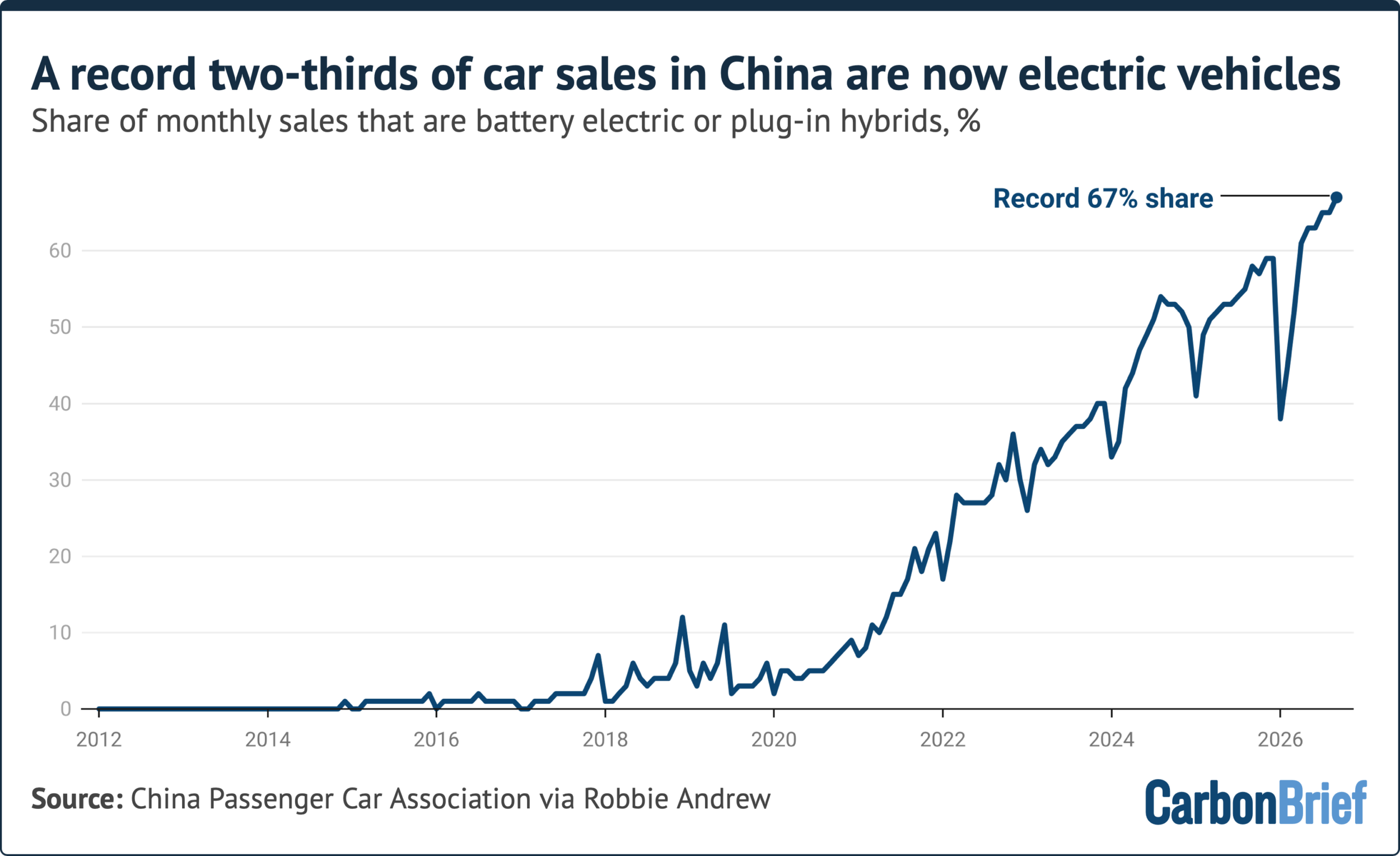
This marks a rapid rise for NEVs from just 6% of new car sales in 2020 up to 58% in 2026 to date – and a record 67% in the month of September.
This year, NEVs’ share of sales has also bounced back from a low of 39% in January, after the full purchase tax exemption that had been in place for more than a decade came to an end in December 2025.
The gain in NEV share in 2026 has come amid a slowdown across the wider domestic passenger-car market, which has hit sales of combustion-engine vehicles particularly hard.
This September, passenger-car retail sales across all categories declined, with overall sales volumes falling 28% year-on-year.
The contraction was led by combustion-engine vehicles, which saw sales fall 43% year-on-year in September and 31% in 2026 to date.
However, sales of PHEVs also fell by 36% year-on-year in September and by 26% in 2026 to date. By comparison, BEVs performed better, although sales still declined 8.5% from a year earlier in September and 4% in 2026 to date.
As a result, NEV sales overall fell by 17% in September and 13% in 2026 to date.
While the market changes in 2026 to date were particularly dramatic, they reflect a broad continuation of trends seen over the past decade.
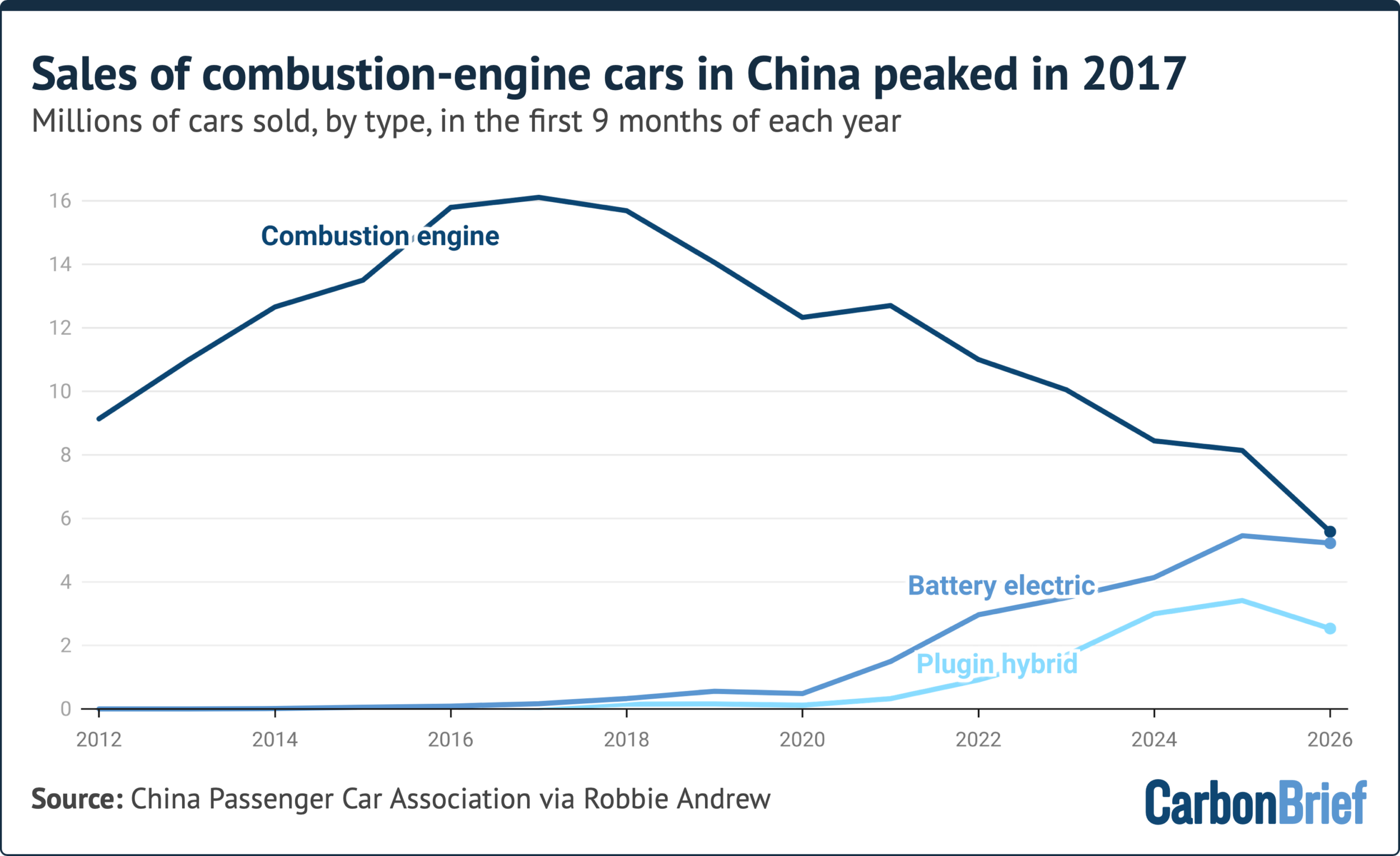
Indeed, sales of combustion-engine cars in China peaked in 2017 and they have been declining ever since, shown in the figure below.
Impact of Hormuz
Part of the reason for the advance of NEVs in 2026, said Chinese technology news outlet OFweek, was petrol cars “giving up market share” as they were outperformed by electric alternatives.
Cui Dongshu, secretary-general of the CPCA, cited higher petrol prices as an explanation for September’s weak combustion-car sales, in comments to financial news outlet National Business Daily.
Imports of oil into China in January-September have fallen 15% compared to 2025, equivalent to 470m barrels, as ongoing conflict tightened supply and drove up prices.
China’s passenger-car NEV fleet has displaced 143m barrels of oil so far during the strait of Hormuz crisis, Euan Graham, senior energy analyst at thinktank Ember, tells Carbon Brief.
EVs “accounted for 12% of the decrease in China’s oil use post-Hormuz”, according to an estimate provided to thinktank the Brookings Institute by an unnamed analyst.
Erica Downs, a senior research scholar at Columbia University’s Center on Global Energy Policy, tells Carbon Brief that the strait of Hormuz crisis and higher oil prices are “reinforcing China’s electrification of road transport”.
She says the “world’s largest oil supply disruption” vindicates China’s early bet on EVs, which was partly driven by concerns about oil-supply security.
NEV demand down
Nevertheless, NEV sales have fallen year-on-year, albeit at a slower rate than overall car sales. The growth in NEV market share has also been decelerating.
Zhang Yichao, a partner at consulting firm AlixPartners, tells Carbon Brief that NEVs benefit from government trade-in policies and a “strong pipeline” of new models, particularly those involving innovation.
He says these factors help explain why NEVs sales have fallen at a slower rate to their combustion-car counterparts.
Cui told the state-run China National Radio that the fall for NEVs and for cars overall in September 2026, is also due to a high baseline of sales from the same month in 2025, as well as changes to trade-in policies and disruptions from the holiday period.
Other factors, says consulting firm Wood Mackenzie, are the weakened demand due to “demand pull-forward” in 2025 caused by the end of subsidies, as well as “tighter financing conditions”.
Zhang tells Carbon Brief he does not “see much more room ahead” for further growth in NEVs’ market share.
He adds that, in his view, their share in China is unlikely to exceed 80%, as some premium-market segments and specific use cases will continue to require combustion-engine vehicles.
Exports surge
Meanwhile, while domestic NEV retail sales fell 17% in September 2026, exports more than doubled, increasing 164% year-on-year, according to the CPCA.
This extends the decline in domestic sales and very strong growth in exports seen across 2026 to date, as shown in the figure below.
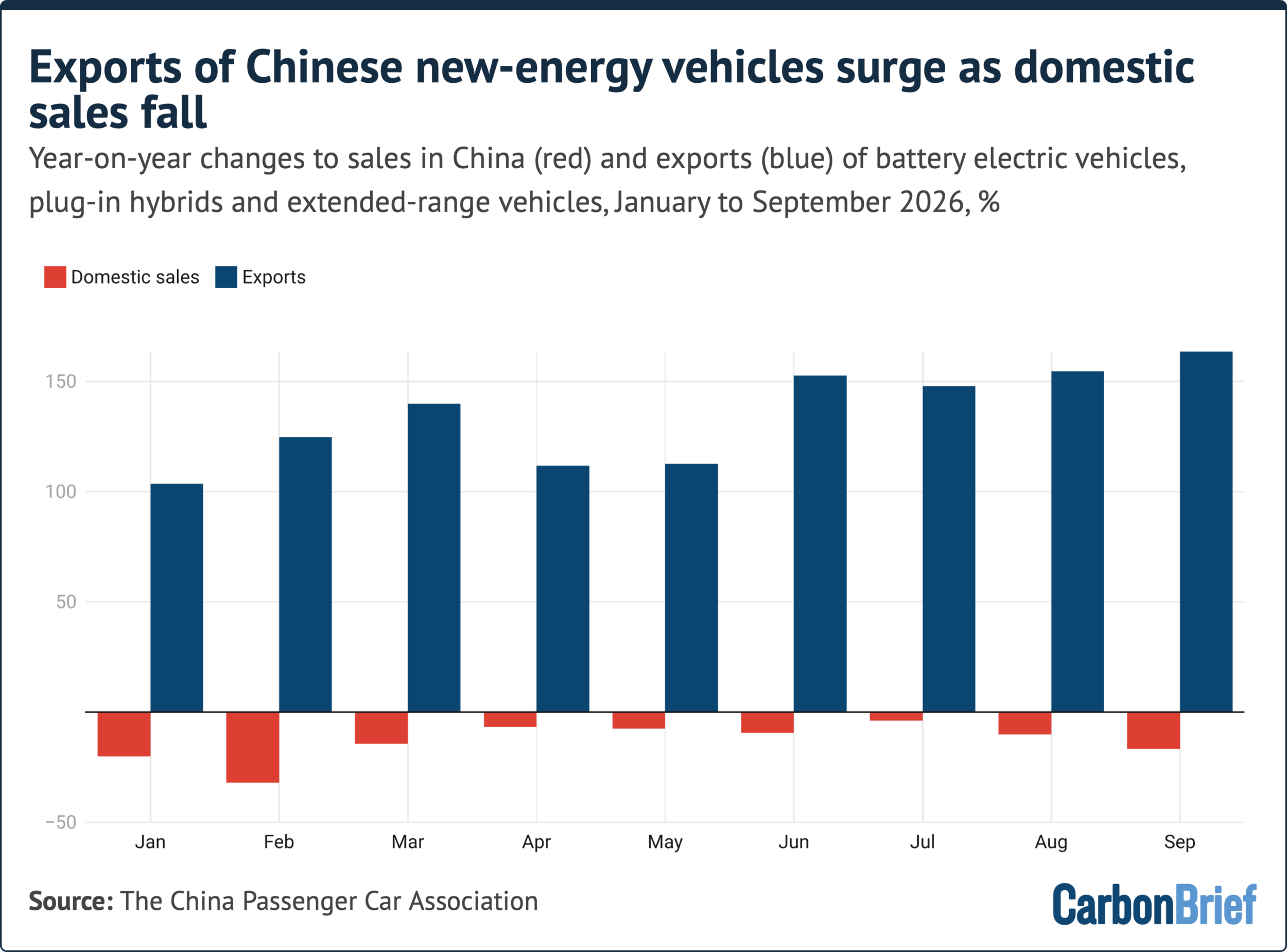
In September, 1,084,000 NEVs were sold domestically in China, while 558,000 NEVs were exported.
Exports are becoming increasingly important to Chinese carmakers, in the face of weaker domestic demand and cut-throat industrial competition.
The CPCA says exports have become “a core priority” for some carmakers.
However, the surge in exports from China has created concern in the EU, which has placed tariffs on imports of EVs from China and recently agreed plans to cut imports of hybrids.
Countries including Mexico and Turkey have also placed tariffs on Chinese EV imports.
At the same time, the Chinese government is putting policies in place that might be expected to disincentivise exports, such as cutting VAT export rebates.
Analysts differ on what impact this policy shift will have, with some saying it will be limited, while others believe it could cause the price of exported cars to rise.