

A US research non-profit called the Arctic Ice Project (AIP) is closing down its operations and has cancelled ongoing geoengineering experiments in the Arctic, citing environmental concerns and “potential risks to the Arctic food chain”.
The Silicon Valley-based organisation proposed the release of tiny silica particles over parts of the Arctic Ocean, which would in theory reflect sunlight from the surface and cool down melting ice.
Announcing the shutdown last week, AIP said test results – along with “skepticism towards geoengineering”, funding barriers and “resistance” to introducing new materials into the Arctic Ocean – had led it to end the project, which was conceived over a decade ago.
The proposed technique is one of several controversial methods aimed at slowing down global warming and its effects on the Earth. Broadly grouped under the term “geoengineering”, these emerging technologies have garnered growing attention in international policy discussions, with some countries like Switzerland proposing global regulation. Other countries like Mexico have placed cautionary bans on experiments.
Shell dodges paying compensation for sham carbon credits in China
Climate and indigenous campaigners welcomed the shutdown of AIP’s experiments in Alaska and noted that indigenous communities in Alaska have long opposed the project’s activities over fears of collateral impacts.
“Our concerns about the reckless use of harmful materials were dismissed, yet we knew that the health of our ecosystems and the wisdom of our people must not be overlooked,” said Panganga Pungowiyi, a climate geoengineering organiser at the Indigenous Environmental Network (IEN).
Ongoing experiments
More than 190 countries have signed a moratorium on new geoengineering experiments under the United Nations’ biodiversity convention, a decision that was reaffirmed at last year’s COP16 summit in Cali, Colombia.
However, dozens of new experiments have taken place in the last five years, according to German non-profit Geoengineering Monitor, including the use of methods that are currently covered by the international moratorium.
For example, Geoengineering Monitor recorded 27 ocean fertilisation experiments (harvesting plankton in the ocean to increase photosynthesis and capture CO2) and 17 solar radiation management experiments (spraying sulphur particles into the atmosphere to reflect sunlight and cool down the planet).
EU backs North Africa hydrogen pipeline, but is it a green dream?
In 2024, US-based startup Make Sunsets drew fire because it sprayed sulphur particles into the air in Mexico without prior consent, leading the country to enact a precautionary ban on similar tests.
The startup has been selling “cooling credits” – a similar concept to carbon credits, where companies fund emissions-cutting projects to offset their climate impact – to finance experiments and has conducted at least seven more tests in several places across California.
The US, which is not a signatory to the UN’s Convention on Biological Diversity (CBD), allows companies to engage in geoengineering tests under the Weather Modification Act of 1976, as long as they report them.

Aerial drone view of ice textures formed in the Svinafellsjokull glacier following global warming, Iceland, Polar Regions (Photo: Copyright: carloxalbertoxconti)
Arctic ice management
Despite AIP winding down its operations in the Arctic, other startups have ventured into the lesser-known group of methods known as Arctic ice management, which seek to halt melting ice through human interventions.
AIP aimed to use tiny particles of silicon dioxide, which it described as similar to “small, fine, white beach sand that floats”, to increase the reflectivity of sea ice and cool down the Arctic. Some others have pursued the same method.
US-based Bright Ice Initiative – which was also set up by AIP’s founder Leslie Field – has conducted experiments on glaciers in Iceland and plans new tests at the Chhota Shigri Glacier in the Indian Himalayas. A 2022 study published in the journal Earth’s Future suggested the particles might actually accelerate the loss of sea ice.
We must challenge rising demand for transition minerals, says UN rapporteur
Other companies have tried different approaches. UK-based startup Real Ice seeks to “refreeze” the Arctic by pumping seawater from below the ice to the surface during winter months to try and thicken ice cover. It aims to test the technique in Canada’s northern Nunavut region and eventually sell “cooling credits”.
Many indigenous organisations, meanwhile, have called for a halt to these experiments. “Nature is not a laboratory; it is a living entity we are in relationship with,” said the IEN’s Pungowiyi, cautioning against “other forms of geoengineering that threaten our sacred spaces”.
(Reporting by Sebastian Rodriguez; editing by Megan Rowling)
The post Arctic geoengineering experiment shuts down over environmental risks appeared first on Climate Home News.
Arctic geoengineering experiment shuts down over environmental risks

The conference is one of the largest aimed at preparing for hurricane season, which begins June 1. A task force report on potential reforms to the agency also remains on hold.
ORLANDO, Fla.—A major conference to help communities prepare for hurricane season kicked off Monday without the agency that coordinates federal disaster response.
Right now, Greenpeace activists are standing up to Big Gas at a major gas conference in Sydney.
Inside the Sheraton Grand Hotel, executives from fossil fuel companies have gathered alongside lobbyists, investors and political allies to plan the future of gas in Australia – and how to maximise their profits.
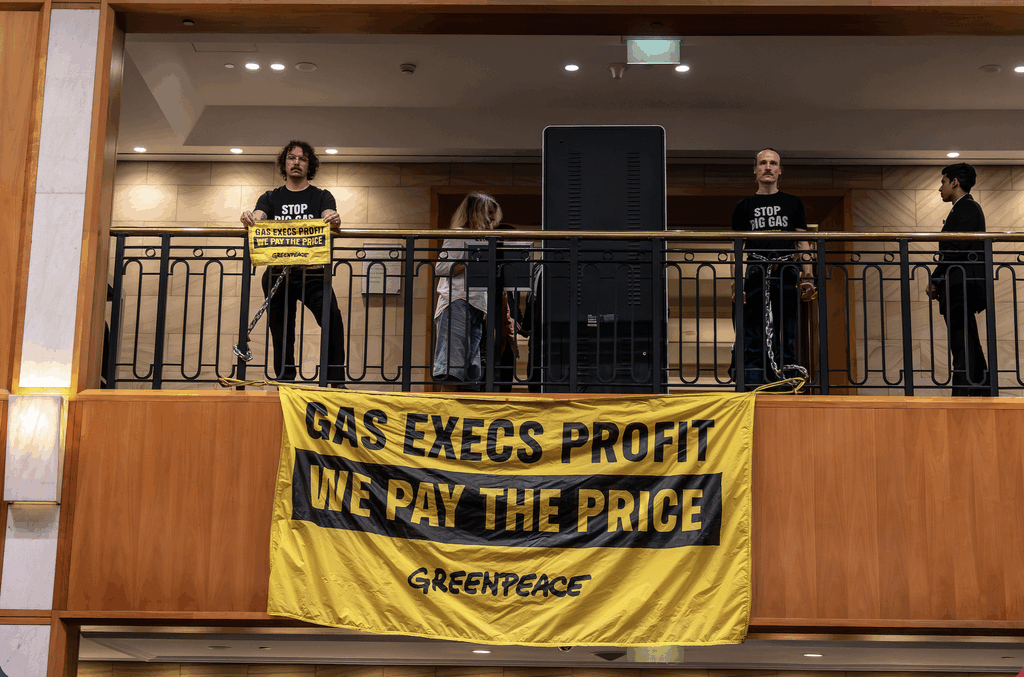
So Greenpeace has stepped in to call it out. Activists have dropped a banner inside the venue with a clear message: Gas Execs Profit. We Pay The Price.
We need your help to spread the message that we won’t stand by and let this happen.
What’s really going on
Gas corporations are making billions in windfall profits from global conflicts – from Ukraine to Iran – while Australians pay the price with higher energy bills and climate damage.
And they want more.
More drilling. More exports. More profit.
Why Greenpeace took action today
This conference is where it all comes together. Behind closed doors, gas executives, lobbyists, investors and political allies are meeting to push for more gas expansion, no doubt using global instability as their justification.
That’s why Greenpeace couldn’t let this gathering go uninterrupted.
Big Gas is counting on people not paying attention. Let’s prove them wrong.
Share the video to call out Big Gas.
What needs to happen now
Gas is expensive. It’s volatile. And it ties our energy system to global instability.
But there is a better way. Renewable energy is already cheaper, more reliable, and made right here in Australia. It’s the fastest path to lower bills, real energy security and a safer climate.
To get there, we need to:
- properly tax the gas industry and its exports
- stop expanding gas
- and speed up the transition to homegrown renewable energy.
Share this video far and wide to show just how much support there is to tax Big Gas properly and speed up the transition to renewable energy.
This is just the beginning
This action is part of a growing movement to stand up to Big Gas and challenge the power it holds over our government and society. The Federal Government has a role to play – starting by taxing gas corporations properly and then accelerating the transition to homegrown renewable energy.
Together, we can show just how much support there is for change and make it impossible for decision-makers to ignore.
What you can do
- Follow along on our social channels.
- Share the video far and wide to show how much support there is.
- Sign the petition to tell Albo to stand up to Big Gas – because if we can, he can.
BREAKING: Greenpeace activists disrupt major gas conference in Sydney
SYDNEY, Tuesday 31 March 2026 — Two Greenpeace Australia Pacific activists have been arrested following a peaceful protest at the Australian Domestic Gas Outlook conference in Sydney, where they dropped a banner that said — “Gas Execs Profit. We Pay The Price” and held banners saying “Tax Gas Profits”.
Photos and B Roll video of the protest and arrests are available here
Live updates on Greenpeace Instagram
The two activists were arrested by police around 9:00am AEDT and taken to Day Street Police Station. Information on this morning’s gas conference disruption can be found here.
Solaye Snider, Campaigner at Greenpeace Australia Pacific, said: “Greenpeace activists have taken a strong stand today against profit hungry gas corporations and lobbyists, who see horrific global wars as an opportunity to price gouge and profiteer, while everyday people pay the price.
“Australians have had enough of gas corporations like Santos and ConocoPhillips ripping us off, leaving us with nothing but empty pockets and climate damage. The gas industry is aggressively lobbying against being fairly taxed and pushing to drill for more gas. Change requires showing up and speaking out, and that’s what these activists have done today.
“Greenpeace Australia Pacific stands by our activists, and stands with all communities who are peacefully fighting for a safe and clean energy future. The right to peaceful protest is a fundamental pillar of a healthy democracy and a basic right of all Australians.”
-ENDS-
Media contacts:
Lucy Keller: +61 491 135 308 or lkeller@greenpeace.org or Kate O’Callaghan: +61 406 231 892 or kate.ocallaghan@greenpeace.org
Greenpeace activists arrested after disrupting major gas conference in Sydney



-
Greenhouse Gases8 months ago
Guest post: Why China is still building new coal – and when it might stop
-
Climate Change8 months ago
Guest post: Why China is still building new coal – and when it might stop
-

 Greenhouse Gases2 years ago
嘉宾来稿:满足中国增长的用电需求 光伏加储能“比新建煤电更实惠”
-
Climate Change2 years ago
Bill Discounting Climate Change in Florida’s Energy Policy Awaits DeSantis’ Approval
-

 Climate Change2 years ago
嘉宾来稿:满足中国增长的用电需求 光伏加储能“比新建煤电更实惠”
-
Climate Change Videos2 years ago
The toxic gas flares fuelling Nigeria’s climate change – BBC News
-

 Renewable Energy5 months ago
Sending Progressive Philanthropist George Soros to Prison?
-

 Carbon Footprint2 years ago
US SEC’s Climate Disclosure Rules Spur Renewed Interest in Carbon Credits