

The UK’s climate-aid spending on “nature protection and restoration” reached record levels of nearly £800m last year, according to government figures obtained by Carbon Brief.
The data suggests the UK is on track to achieve its five-year pledge to provide £3bn in nature-related funds for developing countries by 2026.
Funding for forest protection has also increased, but will need to rise by an additional £100m this year in order to meet the target of £1.5bn, within the £3bn total.
The latest figures, provided to Carbon Brief via freedom-of-information (FOI) requests, include climate-aid contributions to forest-dense regions, from the Amazon to the Congo Basin.
By far the largest slice of last year’s finance – amounting to almost half of forest funds – came from a £153.9m project supporting controversial carbon-offsetting schemes in developing countries.
This is one of the largest donations the UK has made to a nature-and-forests project since 2021, outstripping others that have been underway for years.
Targets on track
The UK has a target to provide £11.6bn in climate finance over a five-year period ending in 2026. This is the nation’s contribution to a wider effort under the Paris Agreement to provide developing countries with funds that help them deal with climate change.
Within this target, the previous government had pledged in 2021 that £3bn would go to projects that “protect and restore nature”. This, in turn, was to include £1.5bn for forest-related projects.
Last year, the Labour government confirmed that it would “continue to honour” these sub-goals, along with the overall £11.6bn target it inherited.
Alongside many other developed countries, however, the UK has announced major cuts to its aid budget in recent years, placing climate-focused spending under pressure.
Nevertheless, Carbon Brief analysis suggests that the country is on track to meet its £11.6bn climate-finance target. This is partly due to accounting changes that have allowed the government to include additional forms of finance in its figures, without committing as much new money.
Government data obtained by Carbon Brief via FOI suggests that the UK is broadly on track to meet its nature-and-forest targets as well.
UK spending on nature-related programmes reached £796.6m in 2024-25, bringing the cumulative total to £2.3bn. This means it would need to spend £684.8m on such projects in 2025-26 to hit the target, as shown in the chart below.

Projects covered by the “nature” target include an initiative tackling water insecurity and pollution in Nepal, support for “climate-smart agriculture” in African countries and a fund aimed at delivering the global target to protect “30% of earth’s land and sea for nature”.
For the forest-finance target, which only covers projects addressing deforestation or forest restoration, spending on relevant projects reached £341.6m in 2024-25. This brings the cumulative figure up to just over £1bn since 2021.
Forest aid would, therefore, need to increase by more than £100m to £466m in 2025-26, in order to meet the £1.5bn goal, as shown in the chart below.
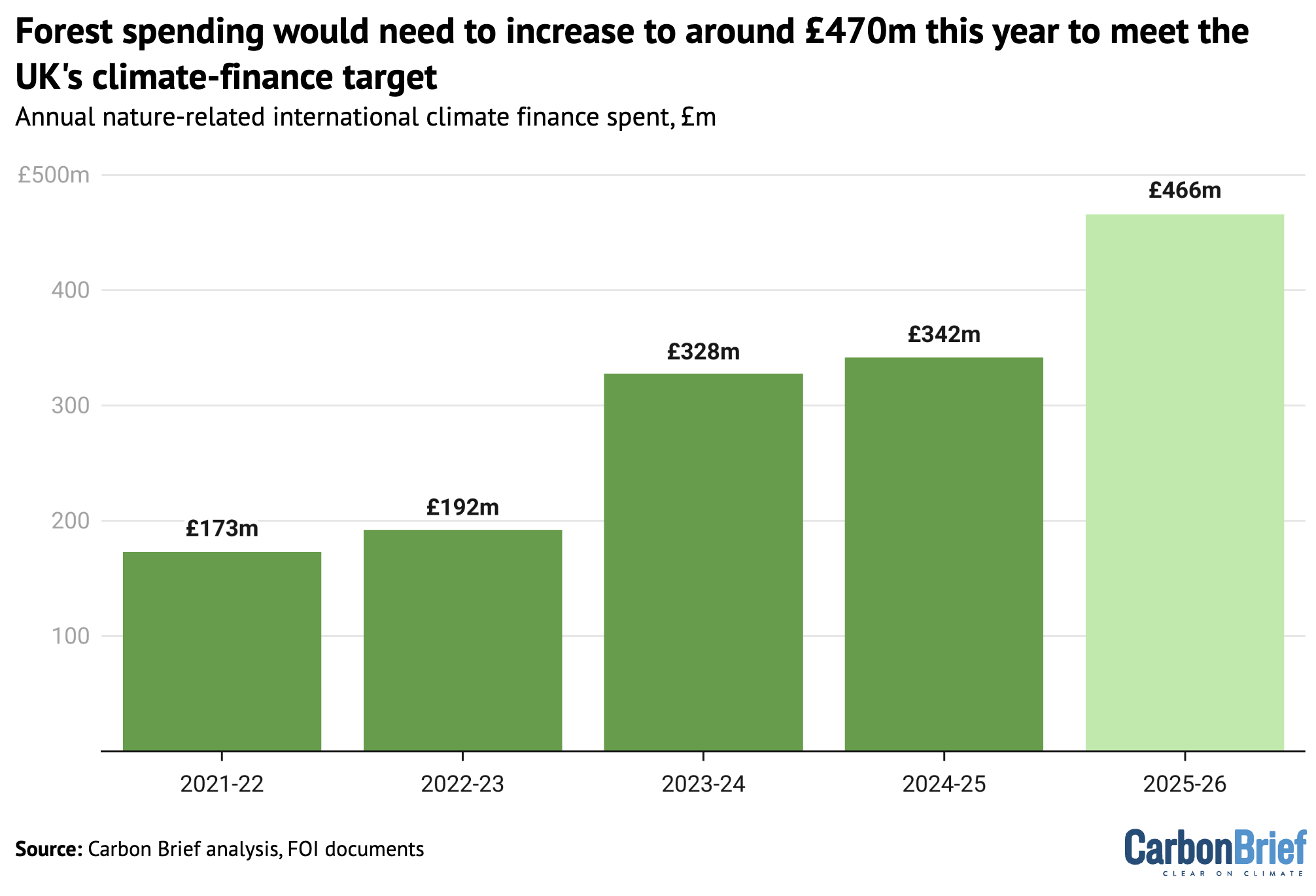
While this is a fairly steep increase, the government’s climate-finance targets were always designed to be backloaded, with more spending planned towards the end of the five-year period.
UK aid spending is set to drop sharply again in 2026-27, beyond the timeframe of current climate-finance goals.
The government has said it will continue to prioritise climate projects, but unpublished analysis of government forecasts by the Center for Global Development (CGD) – shared with Carbon Brief – suggests the departments financing these areas face major cuts.
The Department for Energy Security and Net Zero (DESNZ) and Department for Environment, Food and Rural Affairs (Defra), provided nearly half of all nature finance in 2024-25. They will see their aid spending drop by 59% and 45%, respectively, in 2026-27, which is a steeper drop than the aid budget as a whole, according to the CGD estimates.
Besides setting climate-finance targets, the UK also has obligations to provide biodiversity finance under the UN’s Kunming-Montreal Global Biodiversity Framework (GBF).
In its FOI responses, the government stated that it has not recorded project-level biodiversity-focused spending over the five-year period covered by its climate-finance targets.
However, the government cites the £3bn nature target in its national biodiversity strategy and action plan (NBSAP) as one of the ways the UK is “clos[ing] the global biodiversity finance gap”. This indicates that the money is counted as both climate and biodiversity finance.
Carbon-offsetting
The largest portion of UK nature and forest spending last year was £153.9m from DESNZ for a project called “Scaling Climate Action by Lowering Emissions (SCALE)”.
This World Bank-backed programme funds projects that generate “high-integrity carbon credits” and provides technical assistance to help developing countries trade them.
The carbon credits will be generated via projects that curb carbon dioxide (CO2) emissions by preserving or restoring forests and other ecosystems. These credits could then be purchased by companies or state actors, which may allow them to comply with climate targets while still producing emissions.
Combined with a smaller associated programme called “EnABLE” – which is designed to ensure that local communities receive benefits from carbon trading – the SCALE initiative made up a fifth of the total nature finance and 45% of forest funding in 2024-25.
(The government acknowledges in its FOI response that, despite counting 100% of the SCALE funding as forest-related, it “may benefit various ecosystems, not just forests”.)
The chart below shows the nature-and-forest projects that received the most funding from the UK in 2024-25, with combined spending on SCALE and EnABLE in the top spot.
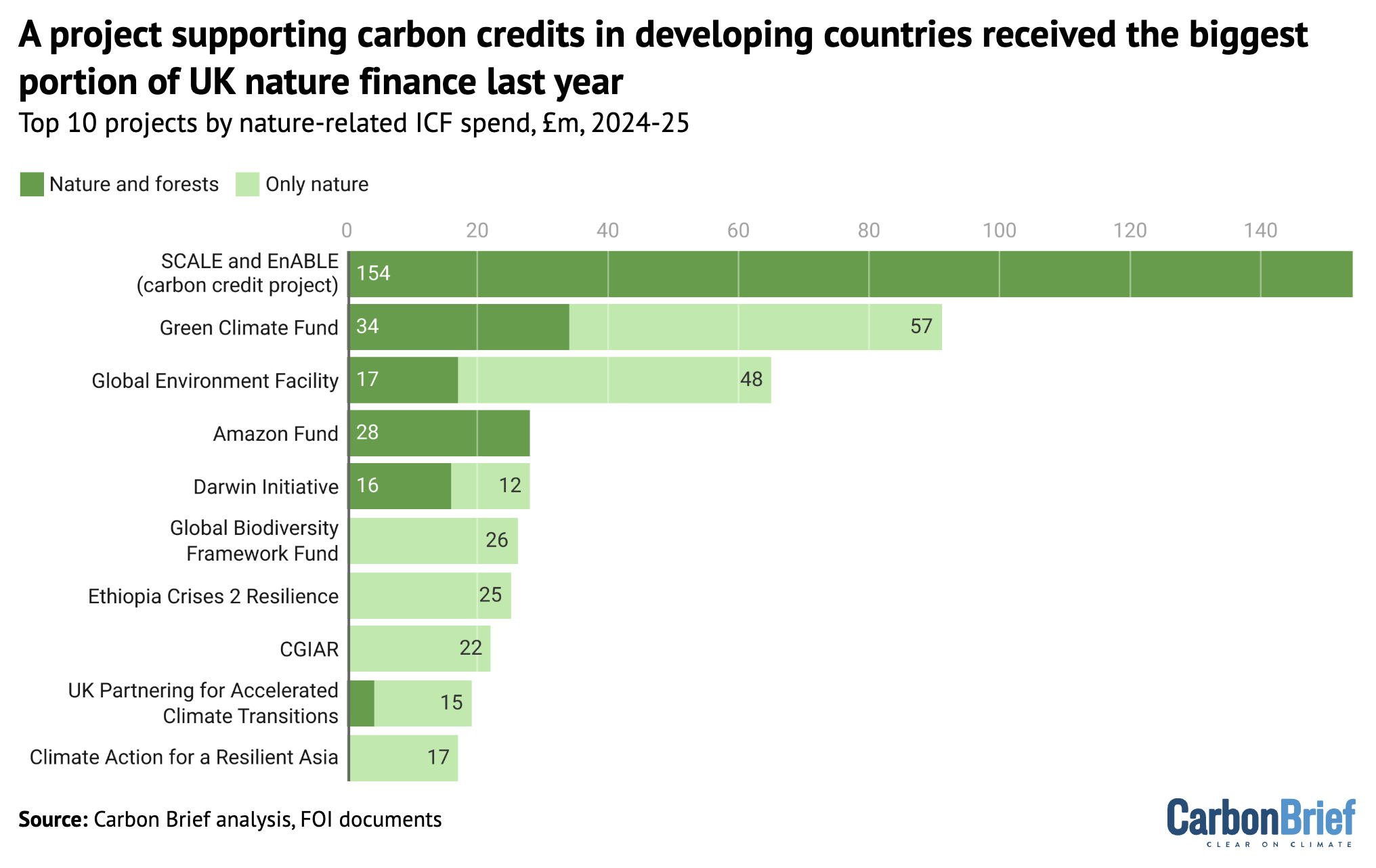
Another initiative involving forest-related carbon credits – the Brazilian Amazon Fund – was also one of the top recipients of UK support last year, with £28.5m.
Carbon-offsetting is viewed by many as an important way to encourage external investment in nature protection, particularly for densely forested global-south nations.
Nevertheless, carbon credits, particularly those based on forest conservation, have been dogged by controversies. These range from Indigenous people being driven off their land to companies exaggerating the extent of forest protection and emissions savings.
Sarah Colenbrander, director of the climate and sustainability programme at ODI, tells Carbon Brief that the “risks to nature-based carbon offsets are well-documented”. She adds:
“Carbon and biodiversity markets have a role to play in tackling climate change and nature loss – but it is not obvious that the UK should allocate such large grants to this topic when there are many more proven, cost-effective options to cut emissions and protect the environment.”
The single payment of £153.9m means SCALE and EnABLE have received more money from the UK government than virtually any other nature projects since 2021.
The only larger overall recipients have been multilateral funds such as the Green Climate Fund (GCF) and the Global Environment Facility (GEF), which tend to be viewed favourably by developing countries.
These funds, which provide grants to developing country applicants, received large contributions from the UK last year of £90.8m and £64.8m, respectively.
When asked about the funding given to SCALE and EnABLE, a government spokesperson stresses the importance of tackling “the existential climate crisis”, adding:
“This includes putting Britain back in the business of climate leadership by supporting the reform of the global financial system and mobilising private finance for nature and to help developing countries accelerate the energy transition.
“This comes on top of working alongside other countries and the EU in the forests and climate leaders’ partnership to drive progress towards halting and reversing forest loss.”
Of the other top projects funded by the UK, some have a clear focus on nature, such as the Darwin Initiative. This project, which received £27.8m in 2024-25, is the “UK’s flagship international challenge fund for biodiversity conservation and poverty reduction”.
For others, nature is not the primary goal. Ethiopia Crises 2 Resilience, which received £24.9m last year, focuses on providing humanitarian relief from war and drought, but its annual review mentions “land treated through area enclosures, rangeland management, soil and water conservation, forage and forestry activities”.
Methodology
The nature-and-forest climate finance figures were provided to Carbon Brief via FOI by the Foreign, Commonwealth and Development Office (FCDO); the Defra and DESNZ.
The path to the £1.5bn and £3bn targets appears more achievable than it did in Carbon Brief’s previous analysis of nature-and-forests data, as the final 2023-24 figures provided by the government are higher than those obtained last year.
Unlike the other departments, FCDO declined to provide its 2023-24 figures last year, so Carbon Brief estimated the figures based on a dataset containing “provisional” figures for all climate-finance projects that year. However, this resulted in an underestimate, due primarily to larger-than-expected contributions to multilateral funds and banks being counted as nature-related.
Unlike the previous analysis, most of the figures provided via this year’s FOIs are the government’s “final” figures, meaning they are unlikely to change. For 2024-25, only Defra – which was responsible for 17% of nature finance that year – provided “provisional” figures.


The post Analysis: UK foreign aid for nature hits £800m record due to cash for carbon credits appeared first on Carbon Brief.
Analysis: UK foreign aid for nature hits £800m record due to cash for carbon credits

Australian indie-folk duo Hollow Coves have found a special way to combine their love of music and the natural world. They have lent their, very soothing, voices to the Save Scott Reef campaign by recording a music video of their much-loved song Coastline at the reef.
We sat them down on the Rainbow Warrior to talk about their musical inspiration, their experience on the reef, and why they believe it’s so important to protect these incredible places for future generations.
1. Tell us a little about Hollow Coves and the music you make.
Matt: Our music is acoustic indie folk. We like bands like Angus and Julia Stone, Ben Howard, Mumford and Sons – acoustic music like that.
Ryan: Historically, a lot of our music has been inspired by travelling and seeing beautiful places in nature, and just writing about experiences in the world.
We both live on the east coast of Australia, on the Gold Coast, and we’re surrounded by nature. We’ve got beautiful oceans, amazing hinterland spots and some really cool rock pools.
2. Your music is often inspired by nature and the outdoors. What is your personal connection to the ocean?
Matt: I’m in the ocean as much as I can. I surf, and I’ve always loved the ocean. I grew up just outside Brisbane, and we would catch the ferry across to North Stradbroke Island. A lot of our mates would just camp over there on the weekends. It’s been a natural part of my life.
Ryan: I don’t surf, but I have an appreciation of the ocean. When we were writing Coastline, I was actually living in Canada, and being away from the ocean made me realise how much I missed it. There’s something about living near the ocean and being able to go and be by the ocean. It’s just a different feeling.

3. You recently joined Greenpeace aboard the Rainbow Warrior to visit Scott Reef and film a music video for Coastline. What made you want to get involved?
Ryan: We’ve been so fortunate to have the success that we’ve had with our music, and when this opportunity came up, we were like, man, it just feels so fitting to give back in whatever way we can. The music has been so inspired by these places of beauty, and so we just want to do our part to protect and preserve these places so that future generations can appreciate them in the same way that we do.
Matt: Collaborating with Greenpeace has just been so aligned with our mission as well. We love nature, we love singing about it, and I think it’s so important to protect these places that are vulnerable and unique to the world. They really are just a natural wonder.
4. What was it like seeing Scott Reef for the first time?
Matt: The first time was really magical. I didn’t realise there was even this amazing coral shelf out off the Kimberley Coast. Just being able to go snorkelling every day and see the wildlife and what’s actually underneath the water – the whole world around is just something else.
Ryan: The first day we arrived at the reef, the sun was rising and this pod of about 50 dolphins greeted us as we entered. It was like, wow, this place is just so brimming with life. It was really beautiful to see, and the colour of the water – everyone was just like, oh my gosh, this water is insane!
Matt: You just always forget that when you’re sailing, it’s obviously beautiful, and every sunset’s magical, but you forget there’s this whole world underneath the ocean and just how lively and vibrant it is.
5. Tell us about filming the Coastline music video. What was it like performing on that tiny island?
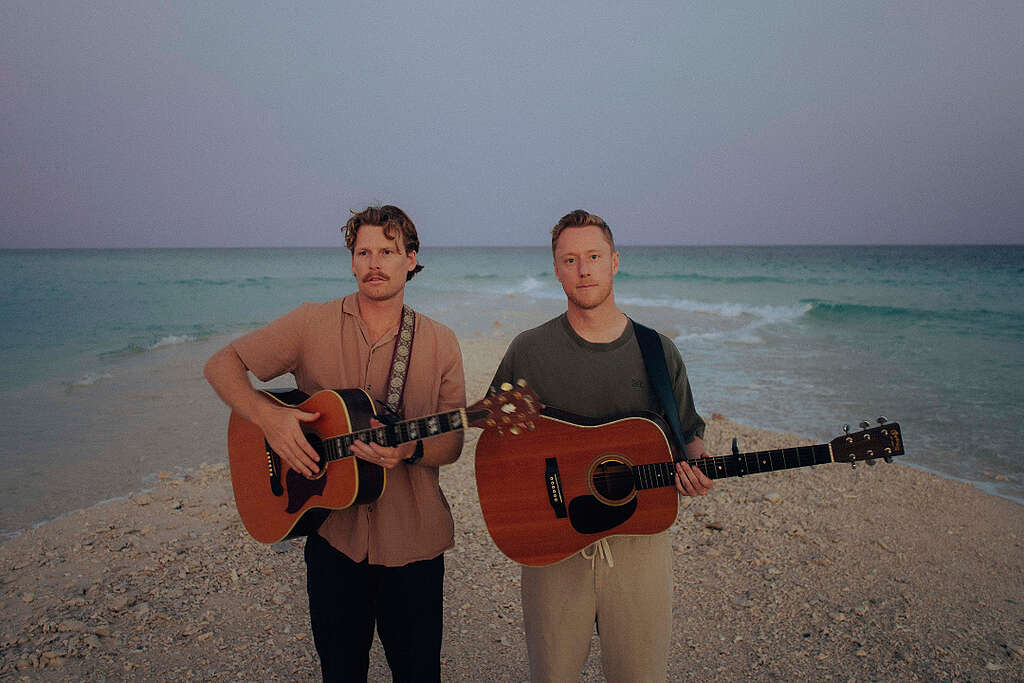
Matt: It was an amazing opportunity to be alongside this project and get on the Rainbow Warrior, see Scott Reef and go play on this amazing little sandbank island in the middle of the ocean. We were losing our minds with the beauty of it.
It was a big team effort. The island only comes out at low tide, and on the day we arrived it was completely submerged. We had to wait for the right opportunity to get onto the island safely.
Ryan: When we first got on there, the waves were still crashing over it from either side. As the tide kept going down, a bit more of the island was revealed.
Matt: There was a whole film crew, with a drone flying around to capture the scale of how small this little island is and how big the ocean is. It was just so magical, like a pinch-me moment. Something we’ll remember for the rest of our lives.

6. What surprised you most about Scott Reef and the marine life you discovered?
Matt: The third day was the highlight for me. I got to see a turtle swim by, a little reef shark and another sea snake which tried to chase me, which was pretty scary! But it was cool.
Ryan: Just the colours, all the coral and so many beautiful, colourful fish. It’s such a crazy experience to be down there.
Matt: I think you just forget there’s this whole world underneath the ocean. It just felt really cool to be down there and a part of it.
7. Before this trip, how much did you know about Scott Reef, and why do you think it’s important to raise awareness about it?
Ryan: Prior to this trip, we knew very little about Scott Reef, and I think that’s part of the problem. It hasn’t been very common for people to know about this place. Part of the trip is to bring awareness to how beautiful Scott Reef is and to show people that it is something worth protecting.
If we don’t stand up and protect these places, then we are at risk of losing them. It just sets a really bad precedent for coral reefs in Australia.
Matt: Scott Reef doesn’t really have the name like a lot of other places. I think that’s the key, to spread the word and tell people about what’s happening out here and how beautiful it is.
8. What is at stake if the proposed drilling project near Scott Reef goes ahead?
Ryan: Currently there’s a proposal for a drilling project that would take place near Scott Reef. If that was to go ahead, it would be a massive risk for the reef, and it would put a lot of the wildlife at risk as well.
Having been out there and seeing the beauty there, it just doesn’t feel right. It doesn’t feel like it’s a risk that we need to take. Particularly with these places that are so beautiful, why would we want to risk losing them?
Matt: I think it’d be an absolute tragedy. Just experiencing it yourself, it’s like, wow, this place is incredible. There are so many endangered sea creatures. I think for anyone that would come out here and experience it, everyone would be aligned with how important it is to keep this place.
9. What was your experience like aboard the Rainbow Warrior and getting to know the Greenpeace crew?
Matt: I didn’t really know what to expect, but everyone was so lovely and passionate. It was cool just being part of the process of running the ship. We had very strict schedules, and we did cleaning at eight o’clock every day! It was really cool to see how the ship operates.
Ryan: We were welcomed like family to the crew on board. Everyone’s been so encouraging and helpful. It was really special to see the amount of effort that goes into trying to protect these places.
I hadn’t really explored Greenpeace too much before this trip, so it’s been cool to learn more about the organisation and the people involved and hear more of their heart towards preserving these beautiful places.
10. What message would you like to share with people who want to help protect Scott Reef?
Matt: I think anyone that loves the ocean or finds nature a big part of their life should get behind this campaign. It’s about raising awareness, sharing the word of what Scott Reef is and how beautiful it is.
Being a father myself, it’s just made me even more passionate about these places that we have, how fragile they are and how important it is to pass them on to the next generation. I just want my kids to see it and future generations, because it really is a spectacular thing.
Ryan: I think it’s important to be on the right side of history with things like this. You can sit back and do nothing and just see these beautiful places be lost. Or you can stand up and fight for what’s right.
We’re at this point in history where we have an opportunity to make a difference. These places are constantly being put at risk, and if we do nothing, then we’ll just see them go. We’ve already lost so much, and so it’s important to stand up and fight for these places that we want to keep.
Matt: Absolutely, we’ve got this. Let’s spread the word. We can absolutely win this campaign!
Climate Change
‘Ode to Scott Reef’: Indie-folk duo Hollow Coves performs at famous Australian reef in call for protection
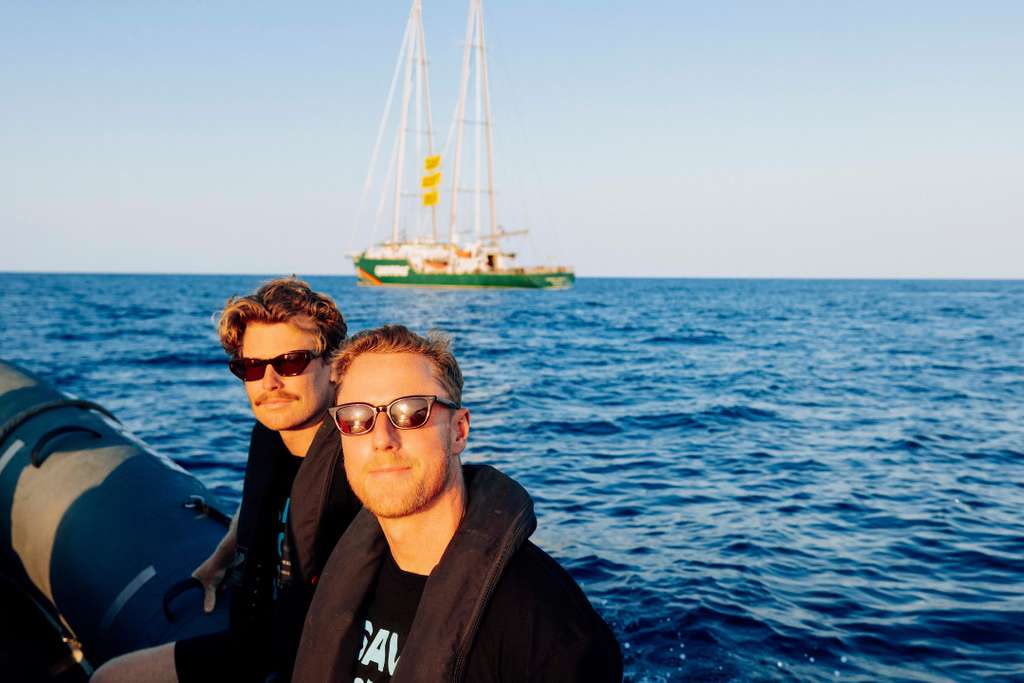
SCOTT REEF, Tuesday 24 November 2026 — Released today, a new music video with Gold Coast duo Hollow Coves performing onboard the flagship Rainbow Warrior at Scott Reef calls for protection of the ancient ecosystem from oil and gas drilling proposed by multinational Woodside.
- Watch ‘Coastline’ shot at Scott Reef here and see visuals from the shoot at sea here
The new music video, in collaboration with Greenpeace Australia Pacific, captures a performance of Hollow Coves’ viral single ‘Coastline’, joining a nationwide push by Australian artists to protect heritage-nominated Scott Reef, located 270 kilometres off WA’s Kimberley coast. The video was shot on multiple cameras including a Bolex 16mm vintage movie camera, and boasts original underwater and aerial footage of Scott Reef.
Scott Reef is home to thousands of marine species, genetically unique green sea turtles and endangered pygmy blue whales but is threatened by oil and gas drilling proposed by multinational corporation Woodside, the Browse project.
Matt Carins, Hollow Coves musician, said: “It would be such a tragedy if gas drilling happened at Scott Reef. It’s such an incredible part of the world and is something that we want to pass on to future generations. Being a father myself, I want to share these places with my kids.
“There’s still hope in saving Scott Reef. I think it’s our time now to spread the word of how beautiful this place is. It may not have the same fame as other reef systems, but it’s just as amazing and just as important.”
Ryan Henderson, Hollow Coves musician, said: “Scott Reef is incredible. We were greeted by a pod of dolphins the first day we arrived. The whole place is brimming with wildlife.
“It would be such a shame to allow gas drilling to go ahead at Scott Reef. We wouldn’t allow drilling at the Great Barrier Reef so why should we allow it at Scott Reef which is also so beautiful and so precious. We want to preserve these places.
“There’s still hope. The Australian Government has an opportunity now to save Scott Reef and be on the right side of history.”
Hannah Schuch, Senior Campaigner at Greenpeace Australia Pacific, said: “It was a privilege to witness Hollow Coves playing their iconic single ‘Coastline’ live from Scott Reef, surrounded by wildlife and tranquil blue water.
“The ecological significance of Scott Reef to thousands of species, many of which are threatened, cannot be understated, but its surreal beauty is something that is so easy to capture and makes a perfect setting for a song like Coastline.
“Hollow Coves’ work is a perfect example of the symbiosis between Australian music and nature, and we are so excited to present this musical and cinematic ode to Scott Reef in collaboration with them.
“Drilling at Scott Reef is an unacceptable proposal, and Environment Minister Murray Watt has a generational opportunity to write a legacy of nature protection by putting a stop to Woodside’s plans and saving Scott Reef.”
Minister Watt is expected to decide if Woodside will be allowed to drill at Scott Reef for the Browse gas project in the coming months.
-ENDS-
Media contact
Emma Sangalli on 0431 513 465 or emma.sangalli@greenpeace.org
High res images and footage of Scott Reef can be found here