

- Formal negotiations
- Turkish and Australian leadership
- Cover decision
- COP reform
- Adaptation
- Finance
- Just transition work programme
- Loss and damage
- Gender
- Article 6
- Agriculture and food security
- Mitigation work programme
- Response measures
- Action for climate empowerment
- Trade
- Second global stocktake
- Long-term goal review
- Around the COP
- Fossil fuels
- Action agenda
- Global leaders
- Electrification
- China at COP31
- Ocean
- Deforestation
- Methane
- New climate science
- Food and water
- NDCs
- Protests and access
- Road to COP32 and beyond

Mohamed Adow is the founder and director of Power Shift Africa.
What does it mean to ask a continent to adapt to a crisis it did little to create? For Africa, that question has stopped being philosophical as it is answered every day in flooded communities, failed harvests, disappearing livelihoods and public budgets stretched by disasters they cannot afford.
Africa produces a negligible share of global emissions, but between 1970 and 2021 it accounted for around 35% of climate-related deaths worldwide. The continent is therefore confronting a brutal contradiction that is exemplified by the fact that those who have contributed least to the climate crisis are carrying some of its heaviest costs.
And that explains why, for us, it is worrying that much of the climate debate treats adaptation as a technical exercise. Build better infrastructure, they say. Improve early-warning systems, they urge. Develop drought-resistant crops, they preach. Strengthen disaster preparedness, they yell. All of these things matter, but they do not answer the harder question of why some people and countries are so much more vulnerable in the first place.
At pre-COP, UN climate chief warns of heat threat to mothers and babies
That is the question we have spent the last couple of years trying to answer, and it culminates in our recently launched thought-provoking report that shows how Africa’s vulnerability is not an accident of geography, but has instead been shaped by history, economics and power.
Colonial extraction, unequal development, debt dependency, global economic asymmetries and exclusion from international decision-making have all constrained the resources and choices available to African countries, and climate change is intensifying those existing inequalities, shows the report, titled “A Just Transition for Adaptation: A Framework and Vision for Africa”.
Widening adaptation finance gap
I say it is ‘thought-provoking’ because it asks us to rethink adaptation itself – not as a collection of projects designed to help people cope with climate impacts, but as a question of justice, power and structural change.
That distinction might not sit well with some people, but for Africa it matters, because there is a danger in asking vulnerable countries simply to become more “resilient”. Resilient against what? How can you ask people to toughen up while letting them be strangled by a system that continues to reproduce the very inequalities that have made resilience so difficult?
If you want to know where the problem is, see where the money is coming from and where it is going. That becomes quite stark when you consider the fact that Africa’s annual adaptation needs are close to $70 billion but its adaptation finance flows are only around $14 billion.
Editor’s Desk: Nepal’s disaster has laid bare the world’s adaptation accountability gap
At the same time, a growing proportion of climate finance is being delivered through commercial loans rather than grants. That means countries already under severe fiscal pressure are being asked to borrow to protect themselves from climate impacts they did little to cause.
There is something deeply wrong with a system in which climate-vulnerable countries are spending more of their own public money on adaptation than they receive in international support, because that system turns climate injustice into a financial transaction, with those least responsible carrying more of the cost.
From extractivism to African ownership
And, as the new report shows, the problem goes beyond finance. Africa’s land, minerals, forests and other resources have become central to the global transition towards lower-carbon economies. Markets and green industrial projects may offer genuine opportunities, but without African ownership, participation and accountability, there is a risk that old patterns of extraction will simply be repackaged in the language of the green economy, and that is why we argue that a transition can be low-carbon and still be unjust.
It is precisely because of this risk that the report’s idea of a just transition for adaptation becomes important as it expands the idea beyond the familiar focus on emissions and energy systems. It asks what justice looks like when the goal is not simply to reduce carbon, but to enable societies to withstand a changing climate without reproducing the inequalities that made them vulnerable.
The report places four dimensions of justice at the centre: recognition, participation, distribution and restoration.
From Belém to Antalya – gains, gaps and challenges for a new Just Transition Mechanism
Recognition means taking African realities and knowledge seriously. Indigenous and local knowledge has too often been treated as peripheral to “real” climate expertise, even though communities possess generations of detailed understanding of ecosystems, rainfall, soils, water and livelihoods. That knowledge should inform adaptation policy from the beginning, rather than being added after decisions have already been made.
Participation means giving affected communities a genuine voice in decisions about their land, resources and futures. Adaptation governance should be inclusive, democratic, rights-based and rooted in free, prior and informed consent.
Climate justice must confront unequal development
Meanwhile, distribution asks who actually receives adaptation finance, technology and protection? Money that is announced internationally but fails to reach vulnerable communities does little to change their reality.
And, finally, restoration recognises that present-day vulnerability has a history. Climate justice cannot begin and end with today’s emissions, but must also confront the structural conditions that have shaped unequal development and continue to limit African countries’ room to respond.
This report, therefore, is an invitation to change the terms of the conversation on just transition. Africa definitely needs adaptation, but that should not mean endlessly adjusting to an unjust system. The real goal should be something more ambitious; a transition in which resilience, development and justice reinforce one another, shaped by African priorities and grounded in African realities.
The post Africa should not have to adapt to an unjust climate system appeared first on Climate Home News.
Continue Reading
Climate Change
‘Ode to Scott Reef’: Indie-folk duo Hollow Coves performs at famous Australian reef in call for protection
SCOTT REEF, Tuesday 24 November 2026 — Released today, a new music video with Gold Coast duo Hollow Coves performing onboard the flagship Rainbow Warrior at Scott Reef calls for protection of the ancient ecosystem from oil and gas drilling proposed by multinational Woodside.
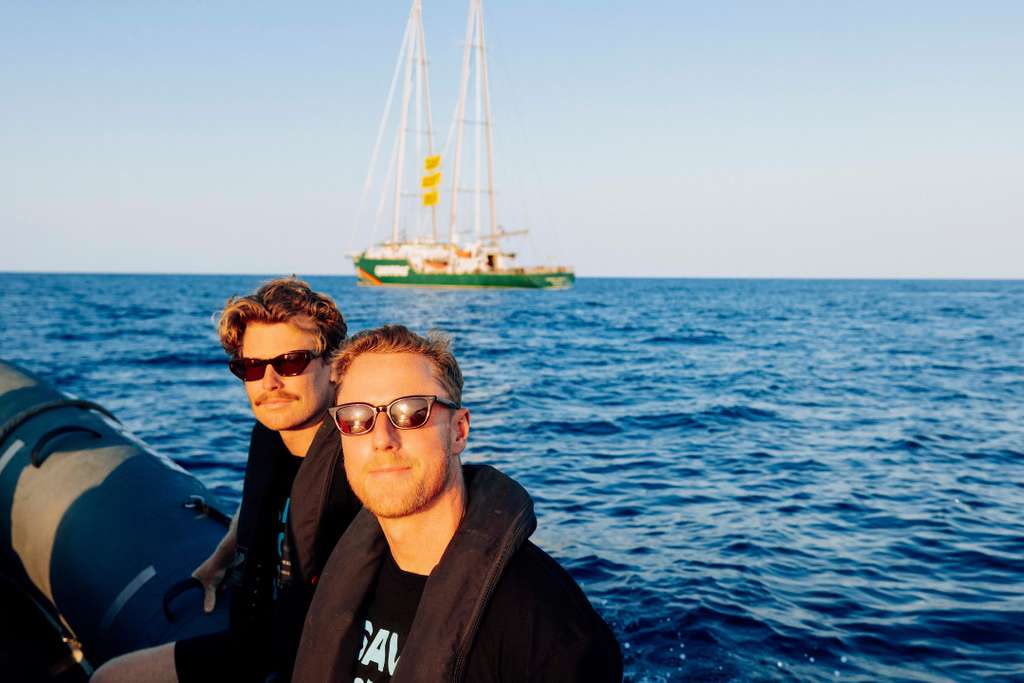
- Watch ‘Coastline’ shot at Scott Reef here and see visuals from the shoot at sea here
The new music video, in collaboration with Greenpeace Australia Pacific, captures a performance of Hollow Coves’ viral single ‘Coastline’, joining a nationwide push by Australian artists to protect heritage-nominated Scott Reef, located 270 kilometres off WA’s Kimberley coast. The video was shot on multiple cameras including a Bolex 16mm vintage movie camera, and boasts original underwater and aerial footage of Scott Reef.
Scott Reef is home to thousands of marine species, genetically unique green sea turtles and endangered pygmy blue whales but is threatened by oil and gas drilling proposed by multinational corporation Woodside, the Browse project.
Matt Carins, Hollow Coves musician, said: “It would be such a tragedy if gas drilling happened at Scott Reef. It’s such an incredible part of the world and is something that we want to pass on to future generations. Being a father myself, I want to share these places with my kids.
“There’s still hope in saving Scott Reef. I think it’s our time now to spread the word of how beautiful this place is. It may not have the same fame as other reef systems, but it’s just as amazing and just as important.”
Ryan Henderson, Hollow Coves musician, said: “Scott Reef is incredible. We were greeted by a pod of dolphins the first day we arrived. The whole place is brimming with wildlife.
“It would be such a shame to allow gas drilling to go ahead at Scott Reef. We wouldn’t allow drilling at the Great Barrier Reef so why should we allow it at Scott Reef which is also so beautiful and so precious. We want to preserve these places.
“There’s still hope. The Australian Government has an opportunity now to save Scott Reef and be on the right side of history.”
Hannah Schuch, Senior Campaigner at Greenpeace Australia Pacific, said: “It was a privilege to witness Hollow Coves playing their iconic single ‘Coastline’ live from Scott Reef, surrounded by wildlife and tranquil blue water.
“The ecological significance of Scott Reef to thousands of species, many of which are threatened, cannot be understated, but its surreal beauty is something that is so easy to capture and makes a perfect setting for a song like Coastline.
“Hollow Coves’ work is a perfect example of the symbiosis between Australian music and nature, and we are so excited to present this musical and cinematic ode to Scott Reef in collaboration with them.
“Drilling at Scott Reef is an unacceptable proposal, and Environment Minister Murray Watt has a generational opportunity to write a legacy of nature protection by putting a stop to Woodside’s plans and saving Scott Reef.”
Minister Watt is expected to decide if Woodside will be allowed to drill at Scott Reef for the Browse gas project in the coming months.
-ENDS-
Media contact
Emma Sangalli on 0431 513 465 or emma.sangalli@greenpeace.org
High res images and footage of Scott Reef can be found here
The COP31 climate talks in Antalya, Turkey, have failed to reach agreement on a “pact” that lacked clear references to curbing fossil fuels or scaling up climate finance.
The “Antalya pact”, proposed by the joint Turkish-Australian presidency, was rejected in the final hours by the EU, the UK and several climate-vulnerable nations.
Meanwhile, many developing countries criticised the lack of progress on climate finance and indecision on a proposed $120bn target for funding climate adaptation.
With stark divisions preventing agreement on the presidency-led pact, UNFCCC chief Simon Stiell expressed “deep disappointment”, speaking of “scope to improve, modernise and reform” the UN climate process.
Despite a chaotic endgame that saw the overrunning COP become the longest in history, it did not end in complete failure, with many items adopted in the closing plenary.
These included fairly limited or procedural outcomes on a new “mechanism” for global “just transitions”, plus support for countries struck by climate disasters.
There was some progress beyond the negotiations, though, with growing coalitions of nations championing “roadmaps” for “transitioning away” from fossil fuels.
With the presidency promoting “electrification” as a key theme, around 80 nations also signed up to a global target of securing 35% of final energy consumption from electricity by 2035.
Here, Carbon Brief provides in-depth analysis of all the key outcomes from Antalya, both inside and outside the COP31 negotiations.
(See Carbon Brief’s coverage of COP30, COP29, COP28, COP27, COP26, COP25, COP24, COP23, COP22, COP21 and COP20.)
- Formal negotiations
- Turkish and Australian leadership
- Cover decision
- COP reform
- Adaptation
- Finance
- Just transition work programme
- Loss and damage
- Gender
- Article 6
- Agriculture and food security
- Mitigation work programme
- Response measures
- Action for climate empowerment
- Trade
- Second global stocktake
- Long-term goal review
- Guidance on NDCs
- Rio synergies
- Around the COP
- Road to COP32 and beyond
Formal negotiations
Turkish and Australian leadership
Turkey and Australia presided over the longest COP in history – and failed to find consensus on their proposed “cover decision”, exposing deep fractures between countries on key issues such as fossil fuels and the need for developed nations to meet climate-finance pledges.
Experts told Carbon Brief that, strictly, the talks did not “collapse” as several negotiated items were still adopted.
Rather, the rejection of the cover decision represented, for the first time, “those who want a higher level of ambition actively reject[ing] the lowest common denominator on offer”, said one veteran observer.
Dispute over who would host COP31 – representing the “western Europe and other states” region – had gone on for three years.
In the end, the two main rivals, Turkey and Australia, agreed to a deal last year at COP30 that the summit would take place in Antalya, Turkey, with Australia acting as “president of negotiations”.