

Choosing the “least expensive” healthy food options could cut dietary emissions by one-third, according to a new study.
In addition to the lower emissions, diets composed of low-cost, healthy foods would cost roughly one-third as much as a diet of the most-consumed foods in every country.
The study, published in Nature Food, compares prices and emissions associated with 440 local food products in 171 countries.
The researchers identify some food groups that are low in both cost and emissions, including legumes, nuts and seeds, as well as oils and fats.
Some of the most widely consumed foods – such as wheat, maize, white beans, apples, onions, carrots and small fish – also fall into this category, the study says.
One of the lead authors tells Carbon Brief that while food marketing has promoted the idea that eating environmentally friendly diets is “very fancy and expensive”, the study shows that such diets are achievable through cheap, everyday foods.
Meanwhile, a separate Nature Food study found that reforming the policies that reduce taxes on meat products in the EU could decrease food-related emissions by up to 5.7%.
Costs and emissions
The study defines a healthy diet using the “healthy diet basket” (HDB), which is a standard based on nutritional guidelines that includes a range of food groups with the needed nutrients to provide long-term health.
Using both data on locally available products and food-specific emissions databases, the authors estimate the costs and greenhouse gas emissions of 440 food products needed for healthy diets in 171 countries.
They examine three different healthy diets: one using the most-consumed food products, one using the least expensive food products and one using the lowest-emitting food products.
Each of these diets is constructed for each country, based on costs, emissions, availability and consumption patterns.
The researchers find that a healthy diet comprising the most-consumed foods within each country – such as beef, chicken, pork, milk, rice and tomatoes – emits an average of 2.44 kilograms of CO2-equivalent (kgCO2e) and costs $9.96 (£7.24) in 2021 prices, per person and per day.
However, they find that a healthy diet with the least-expensive locally available foods in each country – such as bananas, carrots, small fish, eggs, lentils, chicken and cassava – emits 1.65kgCO2e and costs $3.68 (£2.68). That is approximately one-third of the emissions and one-third of the cost of the most-consumed products diet.
In comparison, a healthy diet with the lowest-emissions products – such as oats, tuna, sardines and apples – would emit just 0.67kgCO2e, but would cost nearly double the least-expensive diet, at $6.95 (£5.05).
This reveals the tradeoffs of affordability and sustainability – and shows that the least-expensive foods tend to produce lower emissions, according to the study.
Dr Elena Martínez, a food-systems researcher at Tufts University and one of the lead authors of the study, tells Carbon Brief this is generally true because lower-cost food production tends to use fewer fossil fuels and require less land-use change, which also cuts emissions.
Ignacio Drake is coordinator of the fiscal and economic policies at Colansa, an organisation promoting healthy eating and sustainable food systems in Latin America and the Caribbean.
Drake, who was not involved in the study, tells Carbon Brief that the research is a “step further” than previous work on healthy diets. He adds that the study “integrates and consolidates” previous analyses done by other groups, such as the World Bank and the UN Food and Agriculture Organization.
Food group differences
The research looks at six food groups: animal-sourced foods, oils and fats, fruits, legumes (as well as nuts and seeds), vegetables and starchy staples.
Animal-sourced foods – such as meat and dairy – are typically the most-emitting, and most-expensive, food group.
Within this group, the study finds that beef has the highest costs and emissions, while small fish, such as sardines, have the lowest emissions. Milk and poultry are amongst the least-expensive products for a healthy diet.
Starchy staple products also contribute to high emissions too, adds the study, because they make up such a large portion of most people’s calories.
Emissions from fruits, vegetables, legumes and oil are lower than those from animal-derived foods.
The following chart shows the energy contributions (top) and related emissions (bottom) from six major food groups in the three diets modelled by the study: lowest-cost (left), lowest-emission (middle) and most-common (right) food items.
The six food groups examined in the study are shown in different colours: animal-sourced foods (red), legumes, nuts and seeds (blue), oils and fats (purple), vegetables (green), fruits (orange) and starchy staples (yellow). The size of each box represents the contribution of that food to the overall dietary energy (top) and greenhouse gas emissions (bottom) of each diet.
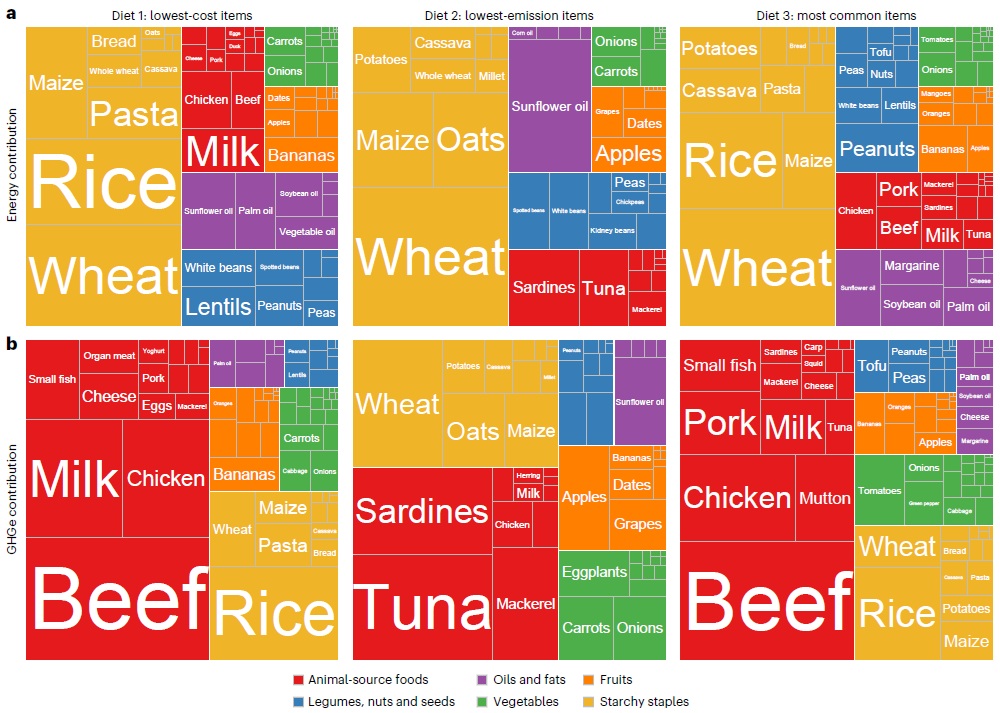
Prof William Masters, a professor at Tufts University and author on the study, tells Carbon Brief that balancing food groups is important for human health and the environment, but local context is also important. For example, he points out that in low-income countries, some people do not get enough animal-sourced foods.
For Drake, if there are foods with the same nutritional quality, but that are cheaper and produce fewer emissions, it is logical to think that the “cost-benefit ratio [of switching] is clear”.
Other studies and reports have also modelled healthy and sustainable diets and, although they do not exclude animal-sourced foods, they do limit their consumption.
A recent study estimated that a global food system transformation – including a diet known as the “planetary health diet”, based on cutting meat, dairy and sugar and increasing plant-based foods, along with other actions – can help limit global temperature rise to 1.85C by 2050.
The latest EAT-Lancet Commission report found that a global shift to healthier diets could cut non-CO2 emissions from agriculture, such as methane and nitrous oxide, by 15%. The report recommends increasing the production of fruit, vegetable and nuts by two-thirds, while reducing livestock meat production by one-third.
Dr Sonia Rodríguez, head of the department of food, culture and environment at Mexico’s National Institute of Public Health, says that unlike earlier studies, which project ideal scenarios, this new study also evaluates real scenarios and provides a “global view” of the costs and emissions of diets in various countries.
Increasing access
The study points out that as people’s incomes increase, their consumption of expensive foods also increases. However, it adds, some people with high income that can afford healthy diets often consume other types of foods, due to reasons such as preferences, time and cooking costs.
The study stresses that nearly one-third of the world’s population – about 2.6 billion people – cannot afford sufficient food products required for a healthy diet.
In low-income countries, primarily in sub-Saharan Africa and south Asia, 75% of the population cannot afford a healthy diet, says the study.
In middle-income countries, such as China, Brazil, Mexico and Russia, more than half of the population can afford such a diet.
To improve the consumption of healthy, sustainable and affordable foods, the authors recommend changes in food policy, increasing the availability of food at the local level and substituting highly emitting products.
Martínez also suggests implementing labelling systems with information on the environmental footprint and nutritional quality of foods. She adds:
“We need strategies beyond just reducing the cost of diets to get people to eat climate-friendly foods.”
Drake notes that there are public and financial policies that can help reduce the consumption of unhealthy and unsustainable foods, such as taxes on unhealthy foods and sugary drinks. This, he adds, would lead to better health outcomes for countries and free up public resources for implementing other policies, such as subsidies for producing healthy food.
Separately, another recent Nature Food study looks at taxes specifically on meat products, which are subject to reduced value-added tax (VAT) in 22 EU member states.
It finds that taxing meat at the standard VAT rate could decrease dietary-related greenhouse gases by 3.5-5.7%. Such a levy would also have positive outcomes for water and land use, as well as biodiversity loss, according to the study.



The post Adopting low-cost ‘healthy’ diets could cut food emissions by one-third appeared first on Carbon Brief.
Adopting low-cost ‘healthy’ diets could cut food emissions by one-third

Three countries have been named by the Paris Agreement’s compliance committee for failing to submit a nationally determined contribution (NDC) and repeatedly snubbing offers of help with their climate plans.
After months of internal debate over whether to identify serial non-responders, the Paris Agreement’s Implementation and Compliance Committee (PAICC) named the three countries which have failed to engage with it over their NDCs on Friday.
It named Democratic Republic of Congo, Senegal and North Korea in a footnote of its annual report, adding that it decided to name them “with a view to facilitating engagement”, adding that representatives of the three nations had been invited to its meeting in early 2027 “with the purpose of identifying any challenges and constraints”.
“The Committee noted the importance of Parties engaging with the Committee in a timely manner, while noting that some delays may be due to the national capabilities and circumstances of the Parties”, the report said.
-
Under US pressure, World Bank says it will back gas “where appropriate”
The US wants the World Bank to expand its gas support while climate campaigners are pushing for it to end – its head spoke this week of limited backing for the fossil fuel -
IPCC scientists vow to press on with climate reports despite political deadlock
After governments again failed to agree a timeline, nearly 120 IPCC authors pledged to complete their assessment on time and with full scientific rigour -
Paris Agreement committee snubbed over missing NDC climate plans
Many governments have still not submitted a nationally determined contribution to the UN, breaching a key requirement of the Paris Agreement



In July, PAICC said 12 countries had ignored its repeated attempts to discuss why they had not published an NDC as required every five years under the 2015 Paris accord.
Members of the committee had been divided over whether to name them, but at a September meeting decided to do so in their annual report to the annual climate COP summit.
By the time the report was published on Friday, only Congo, Senegal and North Korea “had not communicated an NDC or submitted a [Biennial Transparency Report] and had not yet responded to any of the Committee’s notifications, despite several reminders issued by the Committee in this regard”.
Rainforest and renewable energy ambitions
The silence from Congo and Senegal is notable because the former is home to much of the Congo Basin rainforest while the latter has sought billions of dollars in climate finance to support its renewable energy ambitions.
After Brazil, Congo has more rainforest than any country in the world. This forest, and the country’s peatlands, absorb huge amounts of greenhouse gas but are fast being lost to expanding farmland, charcoal production, logging and mining.
Senegal signed a Just Energy Transition Partnership with Canada and wealthy European nations in 2023, to help it meet its renewable energy targets under the-then government of Macky Sall. It was chair of the Least Developed Countries group between January 2022 and December 2023.

Tejas Rao, who is researching the PAICC as part of a doctoral thesis at Cambridge University, said the governments of the three countries should engage with the committee.
“Engagement costs these governments very little and the committee has shown it will listen,” he said.
“Silence leaves the committee with no basis to help, and it leaves the [governments] exposed to the narrative that they are simply disengaged,” he told Climate Home News.
Paris Agreement requirement
The 2015 Paris Agreement requires all parties to publish an NDC every five years outlining their emissions reduction targets, with each plan meant to be more ambitious than the country’s last NDC.
The latest set – the third round of plans, with new targets for 2035 – was due in February 2025. While most countries missed this deadline, all but around 30 – mostly small emitters but including Egypt, Vietnam and Argentina – have now submitted them.
Over the year, the PAICC – which is made up of government climate officials from developed and developing countries – has been communicating with governments that have not submitted NDCs and trying to overcome barriers to them doing so.
Some nations have cited exceptional circumstances as the reason for not submitting an NDC, a process that requires a significant amount of work in tracking emissions and consulting on how to curb them across the economy. For example, a letter from a Sudanese official to the PAICC, seen by Climate Home News, said that the country’s civil war had led to the suspension of its NDC preparation.
-
IPCC scientists vow to press on with climate reports despite political deadlock
After governments again failed to agree a timeline, nearly 120 IPCC authors pledged to complete their assessment on time and with full scientific rigour -
Under US pressure, World Bank says it will back gas “where appropriate”
The US wants the World Bank to expand its gas support while climate campaigners are pushing for it to end – its head spoke this week of limited backing for the fossil fuel -
Who shapes climate science? The equity question facing the IPCC
Early completion of the next global climate science assessment reports risks excluding research from the Global South, which is key to ensuring the findings are fair
The US and Iran are not signed up to the Paris Agreement and so do not have active NDCs, nor does Taiwan, which is not a UN member state.
Rao said that because the PAICC is “facilitative and non-punitive”, naming the countries “is meant to open a door, not close one – the invited consultation is the point”.
“In recent months, governments that explained their constraints, whether capacity, finance or domestic process, have been met with follow-up and support rather than sanction, and the number of silent governments has fallen sharply,” Rao said.
The post Paris Agreement committee names three countries snubbing it over NDCs appeared first on Climate Home News.
Paris Agreement committee names three countries snubbing it over NDCs