



- What timeline options were delegates debating?
- How did the timeline discussions unfold?
- What were the main points of disagreement?
- Why is the IPCC in a ‘serious funding crisis’?
- How have scientists reacted?
- What other issues remain unresolved?
- How are the IPCC AR7 reports progressing?
- How might the IPCC use AI and enhance gender inclusivity?

22 October 2025
The Hon Anthony Albanese MP
Prime Minister
Parliament House
CANBERRA ACT 2600
Sent via email
To the Prime Minister, Federal Environment Minister, and Members of the Albanese Government,
As researchers who study, document and work to recover Australia’s plants and animals, insects and ecosystems, we are keenly aware of the value of nature to Australians and the world.
Australia has one of the worst rates of deforestation globally. For every 100 hectares of native woodland cleared, about 2000 birds, 15,000 reptiles and 500 native mammals will die. As scientists and experts, we have sounded the alarm for more than 30 years that the large-scale destruction of native woodlands, forests, wetlands and grasslands was the single biggest threat to the nation’s biodiversity. That is still the case today, and it is driving an extinction crisis.
New figures show that Queensland continues to lead the nation in deforestation. The latest statewide landcover and trees study (SLATS) report shows that annually 44% of all deforestation in Queensland occurs in the Great Barrier Reef catchment areas, where over 140,000 hectares are bulldozed each year.
Deforestation in Great Barrier Reef catchments is devastating one of Australia’s most iconic natural wonders. When forests and bushland are bulldozed, erosion causes debris to wash into waterways, sending sediment, nutrients and pesticides into the Reef waters. This smothers coral, fuels crown-of-thorns starfish outbreaks, and reduces water quality. These impacts compound the damage caused by repeated mass bleaching events driven by climate change.
The Great Barrier Reef sustains precious marine life, supports local and global biodiversity, and underpins tourism economies and coastal communities that rely on its survival. Continued mass deforestation threatens these values and could jeopardise the Reef’s World Heritage status. In 2026 the World Heritage Committee will review Australia’s progress in protecting the Reef and may consider placing it on the World Heritage in Danger list, if key threats to the Reef, including deforestation, are not addressed.
This mass deforestation happens due to a loophole in the Environment Protection and Biodiversity Conservation (EPBC) Act, our national nature law. Exemptions allow deforestation to continue largely unregulated by the EPBC Act through a grandfathering clause from 2000 known as “continuous use”. Without meaningful reform, deforestation will continue to drive massive biodiversity loss. This loophole must be closed as part of the proposed EPBC Act reforms. The law is meant to safeguard our wildlife and our most precious places like the Great Barrier Reef. Please support closing major deforestation loopholes in the EPBC Act as an urgent and priority issue for the Federal Government.
Sincerely,
Professor James Watson, University of Queensland
Dr. Michelle Ward
Mandy Cheung
Mr Lachlan Cross
Timothy Ravasi
Gillian Rowan
Dr Graham R. Fulton, The University of Queensland
Dr Alison Peel
Dr James Richardson University of Queensland
Luke Emerson, University of Newcastle
Dr Hilary Pearl
Dr Tina Parkhurst
Dr Kerry Bridle
Dr Tracy Schultz, Senior Research Fellow, University of Queensland
Dr. Zachary Amir
Prof David M Watson, Gulbali Institute, CSU
Naomi Ploos van Amstel, PhD candidate
David Schoeman
Associate Professor Simone Blomberg, University of Queensland
Professor Euan Ritchie, Deakin University
Dr Ian Baird, Conservation Biologist
Paul Elton (ANU)
Melissa Billington
Hayden de Villiers
Professor Brett Murphy, Charles Darwin University
Professor Sarah Bekessy
Professor Anthony J. Richardson (University of Queensland)
Prof. Winnifred Louis, University of Queensland
Dr Yung En Chee, The University of Melbourne
Dr Jed Calvert, postdoctoral research fellow in wetland ecology, University of Queensland
A/Prof Daniel C Dunn, Centre for Biodiversity and Conservation Science, University of Queensland
Lincoln Kern, Ecologist
Professor Corey Bradshaw, Flinders University
Dr. Viviana Gonzalez, The University of Queensland
Prof. Helen Bostock
Dr Leslie Roberson
Bethany Kiss
Assoc. Prof Diana Fisher, UQ, and co-chair of the IUCN Marsupial and Monotreme Specialist Group
Dr Jacinta Humphrey, RMIT University
Professor Mathew Crowther
Christopher R. Dickman, Professor Emeritus, The University of Sydney
Fiona Hoegh-Guldberg, RMIT University
Dr Bertram Jenkins
Dr Daniela ParraFaundes
Dr Jessica Walsh
Dr. GABRIELLA scata – marine biologist, wildlife protector
Katherine Robertson
Professor Jane Williamson, Macquarie University
William F. Laurance, Distinguished Professor, James Cook University
A/Prof Deb Bower
Dr Leslie Roberson, University of Queensland
Ms Jasmine Hall, Senior Research Assistant in Coastal Wetland Biogeochemistry, Ecology and Management, Australian Rivers Institute, Griffith University
Dr Kita Ashman, Adjunct Research Associate, Charles Sturt University
Genevieve Newey
Matt Hayward
Jessie Moyses
Natalya Maitz, PhD Candidate, The University of Queensland
Christina Ritchie
Liana van Woesik, PhD Student, University of Queensland
Benjamin Lucas, PhD Researcher
A/Prof. Carissa Klein, The University of Queensland
Conrad Pratt, PhD Student, University of Queensland
Dr Ascelin Gordon, RMIT University
Professor Nicole Graham, The University of Sydney
Professor Murray Lee, University of Sydney Law School
Dr Tracy Schultz, Snr Research Fellow, University of Queensland
Libby Newton (PhD candidate, Sydney Law School)
Hannah Thomas, University of Queensland
Professor Richard Kingsford, Director of the Centre for Ecosystem Science, UNSW Sydney
Dr Anna Hopkins
Lena van Swinderen, PhD candidate at the University of Queensland
Professor Jodie Rummer, James Cook University
Dr Nita Lauren, Lecturer, RMIT University
Dr Christina Zdenek
Madeline Davey
Dr Rachel Killean, Sydney Law School
Dr. Sofía López-Cubillos
Dr Claire Larroux
Dr Alice Twomey, The University of Queensland
Zoe Gralton
Dr Robyn Gulliver
Ryan Borrett, Murdoch University
Adjunct Prof. Paul Lawrence, Griffith University, Brisbane Qld
Professor Susan Park, University of Sydney
Dr Holly Kirk, Curtin University
Deakin Distinguished Professor Marcel Klaassen
Dr Megan Evans, UNSW Canberra
Dr Amanda Irwin, The University of Sydney
Dr Keith Cardwell
Professor Don Driscoll, Deakin University
Susan Bengtson Nash
Distinguished Professor David Lindenmayer
Dr Madelyn Mangan, University of Queensland
Dr Isabella Smith
Geoff Lockwood
Dr Paula Peeters, Paperbark Writer
Prof Cynthia Riginos, University of Queensland
Dr. Sankar Subramanian
Associate Professor Zoe Richards
Dr Jessie Wells, The University of Melbourne
Professor Gretta Pecl AM, University of Tasmania
Dr April Reside, The University of Queensland
Oriana Licul-Milevoj (Ecologist)
Dr Yves-Marie Bozec, University of Queensland
Dr Julia Hazel
Dr Judit K. Szabo
Ana Ulloa
Dr Andreas Dietzel
Philip Spark – North West Ecological Services
Jonathan Freeman
Dr/ Mohamed Mohamed Rashad
Continue Reading
Three countries have been named by the Paris Agreement’s compliance committee for failing to submit a nationally determined contribution (NDC) and repeatedly snubbing offers of help with their climate plans.
After months of internal debate over whether to identify serial non-responders, the Paris Agreement’s Implementation and Compliance Committee (PAICC) named the three countries which have failed to engage with it over their NDCs on Friday.
It named Democratic Republic of Congo, Senegal and North Korea in a footnote of its annual report, adding that it decided to name them “with a view to facilitating engagement”, adding that representatives of the three nations had been invited to its meeting in early 2027 “with the purpose of identifying any challenges and constraints”.
“The Committee noted the importance of Parties engaging with the Committee in a timely manner, while noting that some delays may be due to the national capabilities and circumstances of the Parties”, the report said.
-
Under US pressure, World Bank says it will back gas “where appropriate”
The US wants the World Bank to expand its gas support while climate campaigners are pushing for it to end – its head spoke this week of limited backing for the fossil fuel -
IPCC scientists vow to press on with climate reports despite political deadlock
After governments again failed to agree a timeline, nearly 120 IPCC authors pledged to complete their assessment on time and with full scientific rigour -
Paris Agreement committee snubbed over missing NDC climate plans
Many governments have still not submitted a nationally determined contribution to the UN, breaching a key requirement of the Paris Agreement
In July, PAICC said 12 countries had ignored its repeated attempts to discuss why they had not published an NDC as required every five years under the 2015 Paris accord.
Members of the committee had been divided over whether to name them, but at a September meeting decided to do so in their annual report to the annual climate COP summit.
By the time the report was published on Friday, only Congo, Senegal and North Korea “had not communicated an NDC or submitted a [Biennial Transparency Report] and had not yet responded to any of the Committee’s notifications, despite several reminders issued by the Committee in this regard”.
Rainforest and renewable energy ambitions
The silence from Congo and Senegal is notable because the former is home to much of the Congo Basin rainforest while the latter has sought billions of dollars in climate finance to support its renewable energy ambitions.
After Brazil, Congo has more rainforest than any country in the world. This forest, and the country’s peatlands, absorb huge amounts of greenhouse gas but are fast being lost to expanding farmland, charcoal production, logging and mining.
Senegal signed a Just Energy Transition Partnership with Canada and wealthy European nations in 2023, to help it meet its renewable energy targets under the-then government of Macky Sall. It was chair of the Least Developed Countries group between January 2022 and December 2023.

Tejas Rao, who is researching the PAICC as part of a doctoral thesis at Cambridge University, said the governments of the three countries should engage with the committee.
“Engagement costs these governments very little and the committee has shown it will listen,” he said.
“Silence leaves the committee with no basis to help, and it leaves the [governments] exposed to the narrative that they are simply disengaged,” he told Climate Home News.
Paris Agreement requirement
The 2015 Paris Agreement requires all parties to publish an NDC every five years outlining their emissions reduction targets, with each plan meant to be more ambitious than the country’s last NDC.
The latest set – the third round of plans, with new targets for 2035 – was due in February 2025. While most countries missed this deadline, all but around 30 – mostly small emitters but including Egypt, Vietnam and Argentina – have now submitted them.
Over the year, the PAICC – which is made up of government climate officials from developed and developing countries – has been communicating with governments that have not submitted NDCs and trying to overcome barriers to them doing so.
Some nations have cited exceptional circumstances as the reason for not submitting an NDC, a process that requires a significant amount of work in tracking emissions and consulting on how to curb them across the economy. For example, a letter from a Sudanese official to the PAICC, seen by Climate Home News, said that the country’s civil war had led to the suspension of its NDC preparation.
-
IPCC scientists vow to press on with climate reports despite political deadlock
After governments again failed to agree a timeline, nearly 120 IPCC authors pledged to complete their assessment on time and with full scientific rigour -
Under US pressure, World Bank says it will back gas “where appropriate”
The US wants the World Bank to expand its gas support while climate campaigners are pushing for it to end – its head spoke this week of limited backing for the fossil fuel -
Who shapes climate science? The equity question facing the IPCC
Early completion of the next global climate science assessment reports risks excluding research from the Global South, which is key to ensuring the findings are fair
The US and Iran are not signed up to the Paris Agreement and so do not have active NDCs, nor does Taiwan, which is not a UN member state.
Rao said that because the PAICC is “facilitative and non-punitive”, naming the countries “is meant to open a door, not close one – the invited consultation is the point”.
“In recent months, governments that explained their constraints, whether capacity, finance or domestic process, have been met with follow-up and support rather than sanction, and the number of silent governments has fallen sharply,” Rao said.
The post Paris Agreement committee names three countries snubbing it over NDCs appeared first on Climate Home News.
Paris Agreement committee names three countries snubbing it over NDCs
Countries have failed – for the sixth time running – to agree on the timeline for publishing the Intergovernmental Panel on Climate Change’s (IPCC) next set of influential reports.
The IPCC’s 65th session (IPCC-65) was seen by many to be the final opportunity for countries to agree on a schedule where its seventh assessment report (AR7) would be published in time for the UN’s second “global stocktake” of climate action.
Before last week’s meeting in Addis Ababa, Ethiopia, IPCC chair Prof Sir Jim Skea had warned that releasing the reports in time for the stocktake in 2028 would depend on a timelines being agreed by the end of 2026.
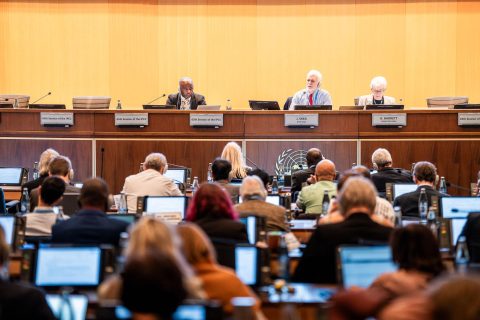
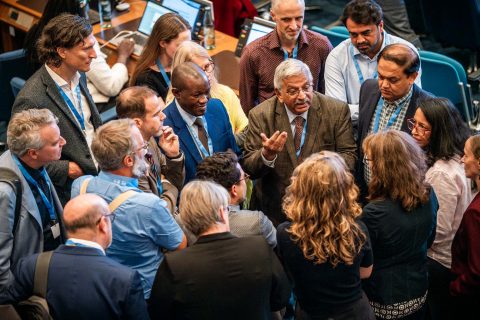
But the week-long meeting descended into fraught disagreements between governments, resulting in Skea “suspending” the talks on Friday evening with no decision made.
Countries were also unable to agree on the IPCC’s budget for the rest of the AR7 cycle, leaving the body with a “serious funding crisis”.
The IPCC has pledged to reconvene the meeting at the “earliest opportunity”; however, it has not yet given an indication of when this will be.
In his concluding remarks, Skea described the Addis Ababa summit as a “profound disappointment” and “among the most difficult IPCC meetings”, according to reporting from the Earth Negotiations Bulletin (ENB).
Some countries have reacted with dismay to the breakdown of negotiations, warning that a failure to have the IPCC’s latest assessments on climate adaptation and mitigation ready for the UN stocktaking exercise would undermine global climate action.
A climate envoy from a Pacific island state said it was a “travesty that a handful of countries continue to delay the IPCC’s reports – the science we need back home to help us save lives and livelihoods”.
Below, Carbon Brief explores the key developments, debates and disagreements at the IPCC meeting.
- What timeline options were delegates debating?
- How did the timeline discussions unfold?
- What were the main points of disagreement?
- Why is the IPCC in a ‘serious funding crisis’?
- How have scientists reacted?
- What other issues remain unresolved?
- How are the IPCC AR7 reports progressing?
- How might the IPCC use AI and enhance gender inclusivity?