

Welcome to Carbon Brief’s DeBriefed.
An essential guide to the week’s key developments relating to climate change.
This week
Earth’s first climate ‘tipping point’ reached
CORAL IN CRISIS: A new report warned that the world has reached its first climate “tipping point” as global warming pushes warm-water coral reefs towards an irreversible decline, the Press Association outlined. The report, co-authored by more than 160 scientists in 23 countries, also warned the world is “on the brink” of reaching other tipping points, including the dieback of the Amazon, the collapse of major ocean currents and the loss of ice sheets, the Guardian noted.
CO2 RECORD: Carbon dioxide (CO2) in the atmosphere reached the highest level ever recorded last year, according to a new report by the UN’s World Meteorological Organization (WMO) covered by the Associated Press, which said it was fuelling “more extreme weather”. On top of burning fossil fuels, an increase in wildfires contributed to the rise in CO2 levels over the last year, Reuters reported.
DECLINING SINKS: The Guardian said WMO scientists are also “concerned” that the natural land and ocean “sinks” that remove CO2 from the air are “weakening as a result of global heating”. Separate new research concluded that Australia’s tropical rainforests are among the first in the world to start emitting more CO2 than they absorb, Agence France-Presse reported, with the decay of dead trees emitting more than the growing trunks and branches can store.
INCREASED EMISSIONS: Wildfires burned an area of land larger than India during the 2024-25 “global fire season”, emitting more than 8bn tonnes of CO2, almost 10% above average. This is according to the annual “state of wildfires” report covered by Carbon Brief, which also finds that four of the most prominent extreme wildfire events were found to have been more likely to occur as a result of human-caused climate change.
October extremes
MEXICO MOURNING: At least 66 people have died and 77 people are still missing after five days of torrential rain caused “historic” floods and landslides in Mexico, Reuters reported. The Associated Press said that the extreme weather “cut off 300 towns…from the outside world” and the New York Times reported Mexican president Claudia Sheinbaum saying that 100,000 homes were affected.
TYPHOONS TOO: At least 14 gold mine workers have been killed in floods after heavy rainfall in Venezuela, according to Agence France-Presse. At least one person was killed, two are missing and more than 1,500 people have been displaced across Alaska due to Typhoon Halong, the Associated Press reported.
Around the world
- ‘HEADING FOR THE ROCKS’: US president Donald Trump’s plan to derail a global climate agreement for the shipping industry is “heading for the rocks”, as more than 100 nations gathered in London for talks to approve the legally binding regulation, with a decision expected today, the Financial Times reported.
- COP FLOTILLA: A group of Amazon Indigenous peoples have departed from Ecuador to attend COP30, planning to travel more than 3,000km on rivers and grow in size along the way, according to Folha de São Paulo.
- KIWI CONCERN: Scientists have warned that New Zealand’s decision to weaken its methane emissions reduction target, from a 24-47% cut on 2017 levels by 2050 to a 14-24% cut, sets a “worrying precedent”, said Bloomberg.
- DIPLOMACY DETOUR: The EU plans to cooperate with US local authorities and businesses to “bypass” the federal government on clean energy, the Financial Times detailed.
- VOTING VICTORY: After years of campaigning, citizens of Hamburg voted for stricter climate targets for the city during a referendum, reported Der Spiegel.
- ‘ENVIRONMENTAL FREEFALL’: A report on the environmental damage after nearly two years of conflict found that Gaza’s energy, water, food and ecosystems have been “devastated” and are “on the brink of a total collapse”, the Independent outlined.
582 gigawatts
The record amount of new renewable energy capacity added globally in 2024, reported Reuters.
Latest climate research
- Just seven African nations “would be able to satisfy their nutrient gaps” through production expansion, given water and land constraints | Nature Food
- An experiment finds that generative artificial intelligence “can alter the information diet [climate] sceptics consume” | Nature Climate Change
- While many frog species show “short-term resilience” to climate-induced wildfires, flooding poses an “underappreciated threat to frog biodiversity” in Australia | Biological Conservation
(For more, see Carbon Brief’s in-depth daily summaries of the top climate news stories on Monday, Tuesday, Wednesday, Thursday and Friday.)
Captured
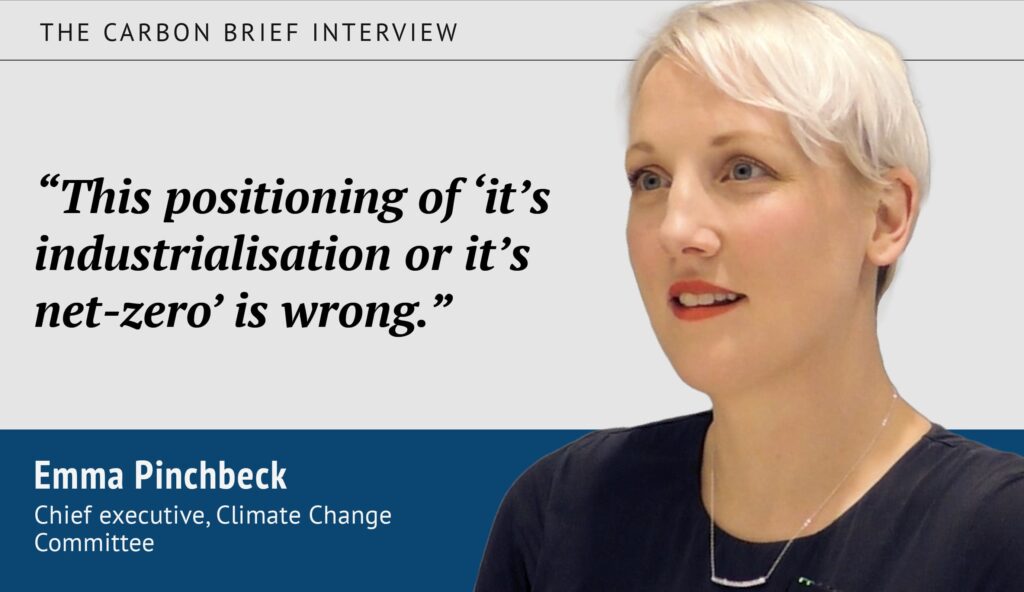
Carbon Brief sat down for an in-depth interview with Emma Pinchbeck, the chief executive of the UK’s Climate Change Committee (CCC). The CCC is a statutory body created under the Climate Change Act 2008 and is the official adviser to the UK government on climate change mitigation and adaptation. The conversation covered a range of topics from the UK’s high energy costs to talking to children about climate change.
Spotlight

Why paediatricians want climate action
This week, Carbon Brief speaks to Dr Helena Clements, a paediatrician who was appointed as the inaugural officer for climate change for the UK’s Royal College of Paediatrics and Child Health.
Carbon Brief: How does climate change risk children’s health?
Dr Helena Clements: In lots of ways. Partly it’s about the direct impacts of climate change on health and that might include air pollution as a really easy example here in the UK right now. We know about Ella Adoo-Kissi-Debrah who died of asthma induced [by] air pollution on her way to school and the little boy in [Rochdale], Awaab [Ishak], who died because of exposure to indoor air pollution. Those are two people that pediatricians have looked after and failed to save, who have been directly impacted by air pollution in this country. Of course it’s much worse in other parts of the world, particularly where people are cooking on open fires. It’s a global problem.
For children who are exposed to air pollution, the answer isn’t to lock them up inside. It’s to clean the air by addressing the burning of fossil fuels. It’s about creating green spaces and active transport, because that’s better for our mental health, our physical well-being and we’re also cleaning the air. All of the solutions are solutions for climate change, as well as for health, and it’s not anything that I can prescribe.
Only about 20-30% of your health is down to what a doctor can do. I can treat asthma, but I’m not in control of the causes.
CB: How do you engage the medical community – and external groups – with health risks facing children from climate change?
HC: What I find helpful is to paint that picture of health and wellbeing, because if we had healthy children and adults, we would reduce demand on our services. I sometimes talk about being a lazy pediatrician. If everybody had their immunisations and a healthy diet, and we had clean air and families who had better health literacy, there would be much less work for me to do because most of what children need is good conditions to grow and thrive in.
A healthy diet is high in fibre, fruit and vegetables, which is also a lower-carbon diet. Pediatricians spend a lot of time treating constipation because children don’t eat a healthy diet and it’s rarely more complicated than that. We need to help children and families to eat more healthily to avoid things that need treatment and become more complex.
So there’s lots of benefits to focusing on the health and wellbeing side, rather than necessarily talking lots about the climate, but I talk about the two things simultaneously. Healthy people have a lower carbon impact than unhealthy people who require lots of medicines and trips to hospital.
CB: What else does your work in this intersection of climate change and children’s health involve?
HC: We’ve got three things really. One is advocating about climate itself because climate change is a health crisis, a massive risk, because of changing demographics and vector-borne diseases coming our way. The second thing is the NHS [National Health Service] is a very carbon-dense business, so we need to decarbonise. There’s the “how do we get rid of all these anesthetic gases or single-use items” practical changes that we need to make. And then there’s the fact that health is expensive and, if we were all healthier through, not directly tackling climate change, but say, tackling air pollution, we’d make health cheaper and be addressing climate change. You can tackle it from different lenses, but the solutions are all the same.
This interview has been edited for length.
Watch, read, listen
TORY LEGACY: Imperial College London’s Grantham Institute released a new Youtube video offering the “inside story” of the UK’s net-zero target, featuring former prime minister Theresa May.
BIG IN BRAZIL: With one month to go until COP30 begins in Belém, Brazil, Agence France-Presse listed “four Brazilians to watch” at the conference.
COX QUIZZED: In a new A Question of Science podcast, Prof Brian Cox and a panel of experts answered listener’s questions on everything from carbon capture to climate sceptics.
Coming up
- 19 October: Bolivia presidential elections (2nd round)
- 20-23 October: Africa energy efficiency policy training week, Accra, Ghana
- 20-24 October: 27th meeting of the Convention on Biological Diversity Subsidiary Body on Scientific, Technical and Technological Advice, Panama City, Panama
Pick of the jobs
- Global Green Growth Institute, senior energy officer | Salary: $77,904. Location: Port Moresby, Papua New Guinea
- Mongabay, wire reporter | Salary: Unknown. Location: Remote in Asia
- London School of Economics Grantham Research Institute on Climate Change and the Environment, editorial manager | Salary: £43,277-£55,497. Location: London
- Centre for International Environmental Law, publications manager | Salary: $81,000-$110,000. Location: Remote (EST)
- UN Environment Programme, chief scientist and the director of the office of science | Salary: Unknown. Location: Nairobi, Kenya
DeBriefed is edited by Daisy Dunne. Please send any tips or feedback to debriefed@carbonbrief.org.
This is an online version of Carbon Brief’s weekly DeBriefed email newsletter. Subscribe for free here.


The post DeBriefed: Earth’s first ‘tipping point’; Climate adviser interview; How warming affects children’s health appeared first on Carbon Brief.

Three countries have been named by the Paris Agreement’s compliance committee for failing to submit a nationally determined contribution (NDC) and repeatedly snubbing offers of help with their climate plans.
After months of internal debate over whether to identify serial non-responders, the Paris Agreement’s Implementation and Compliance Committee (PAICC) named the three countries which have failed to engage with it over their NDCs on Friday.
It named Democratic Republic of Congo, Senegal and North Korea in a footnote of its annual report, adding that it decided to name them “with a view to facilitating engagement”, adding that representatives of the three nations had been invited to its meeting in early 2027 “with the purpose of identifying any challenges and constraints”.
“The Committee noted the importance of Parties engaging with the Committee in a timely manner, while noting that some delays may be due to the national capabilities and circumstances of the Parties”, the report said.
-
Under US pressure, World Bank says it will back gas “where appropriate”
The US wants the World Bank to expand its gas support while climate campaigners are pushing for it to end – its head spoke this week of limited backing for the fossil fuel -
IPCC scientists vow to press on with climate reports despite political deadlock
After governments again failed to agree a timeline, nearly 120 IPCC authors pledged to complete their assessment on time and with full scientific rigour -
Paris Agreement committee snubbed over missing NDC climate plans
Many governments have still not submitted a nationally determined contribution to the UN, breaching a key requirement of the Paris Agreement

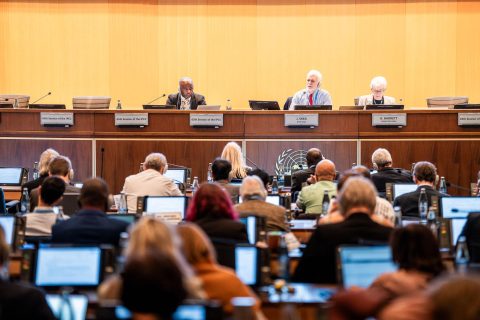

In July, PAICC said 12 countries had ignored its repeated attempts to discuss why they had not published an NDC as required every five years under the 2015 Paris accord.
Members of the committee had been divided over whether to name them, but at a September meeting decided to do so in their annual report to the annual climate COP summit.
By the time the report was published on Friday, only Congo, Senegal and North Korea “had not communicated an NDC or submitted a [Biennial Transparency Report] and had not yet responded to any of the Committee’s notifications, despite several reminders issued by the Committee in this regard”.
Rainforest and renewable energy ambitions
The silence from Congo and Senegal is notable because the former is home to much of the Congo Basin rainforest while the latter has sought billions of dollars in climate finance to support its renewable energy ambitions.
After Brazil, Congo has more rainforest than any country in the world. This forest, and the country’s peatlands, absorb huge amounts of greenhouse gas but are fast being lost to expanding farmland, charcoal production, logging and mining.
Senegal signed a Just Energy Transition Partnership with Canada and wealthy European nations in 2023, to help it meet its renewable energy targets under the-then government of Macky Sall. It was chair of the Least Developed Countries group between January 2022 and December 2023.

Tejas Rao, who is researching the PAICC as part of a doctoral thesis at Cambridge University, said the governments of the three countries should engage with the committee.
“Engagement costs these governments very little and the committee has shown it will listen,” he said.
“Silence leaves the committee with no basis to help, and it leaves the [governments] exposed to the narrative that they are simply disengaged,” he told Climate Home News.
Paris Agreement requirement
The 2015 Paris Agreement requires all parties to publish an NDC every five years outlining their emissions reduction targets, with each plan meant to be more ambitious than the country’s last NDC.
The latest set – the third round of plans, with new targets for 2035 – was due in February 2025. While most countries missed this deadline, all but around 30 – mostly small emitters but including Egypt, Vietnam and Argentina – have now submitted them.
Over the year, the PAICC – which is made up of government climate officials from developed and developing countries – has been communicating with governments that have not submitted NDCs and trying to overcome barriers to them doing so.
Some nations have cited exceptional circumstances as the reason for not submitting an NDC, a process that requires a significant amount of work in tracking emissions and consulting on how to curb them across the economy. For example, a letter from a Sudanese official to the PAICC, seen by Climate Home News, said that the country’s civil war had led to the suspension of its NDC preparation.
-
IPCC scientists vow to press on with climate reports despite political deadlock
After governments again failed to agree a timeline, nearly 120 IPCC authors pledged to complete their assessment on time and with full scientific rigour -
Under US pressure, World Bank says it will back gas “where appropriate”
The US wants the World Bank to expand its gas support while climate campaigners are pushing for it to end – its head spoke this week of limited backing for the fossil fuel -
Who shapes climate science? The equity question facing the IPCC
Early completion of the next global climate science assessment reports risks excluding research from the Global South, which is key to ensuring the findings are fair
The US and Iran are not signed up to the Paris Agreement and so do not have active NDCs, nor does Taiwan, which is not a UN member state.
Rao said that because the PAICC is “facilitative and non-punitive”, naming the countries “is meant to open a door, not close one – the invited consultation is the point”.
“In recent months, governments that explained their constraints, whether capacity, finance or domestic process, have been met with follow-up and support rather than sanction, and the number of silent governments has fallen sharply,” Rao said.
The post Paris Agreement committee names three countries snubbing it over NDCs appeared first on Climate Home News.
Paris Agreement committee names three countries snubbing it over NDCs