

Two weeks before Brazil hosts the COP30 summit in the Amazon city of Belém, its state-run oil firm Petrobras has been granted a licence to explore for oil in an offshore block in the mouth of the Amazon River, a move criticised by campaigners as undermining the country’s climate leadership.
After five years of discussions, Brazil’s government approved an environmental permit for Petrobras to drill an exploratory oil well in block FZA-M-59 in the Foz do Amazonas Basin, in Amapá state.
The offshore site is 540 kilometres from the mouth of the Amazon River, near the border with Guyana. As Climate Home News previously reported, almost 20% – 5.3 billion barrels of oil equivalent – of global oil reserves identified between 2022 and 2024 are located in the Amazon, primarily along South America’s northern coast between Guyana and Suriname.
-
At pre-COP in Brazil, climate finance roadmap to $1.3 trillion remains hazy
Ahead of COP30, Azerbaijan and Brazil provide scant details about a keenly awaited report on how to scale up finance for developing countries -
Global South campaigners question inclusivity of COP30 as some stay home
Civil society groups hoped to send large numbers to the UN climate talks in Brazil, but developing-country activists say it’s too expensive and they have received limited badges -
COP30 president hints Brazil may be open to a cover decision in Belém
André Corrêa do Lago tells Climate Home News the COP30 talks could conclude with an additional text on key outcomes if countries want it – something Brazil has so far resisted


The licence for block FZA-M-59 was earlier denied in 2023, when experts at environmental agency Ibama concluded that Petrobras had failed to present a solid impact mitigation and emergency response plan. But after the company made adjustments, it said on Monday it had been given permission to proceed.
The company said the drilling is expected to start right away and last around five months, adding that no oil will be produced for now.
Observatório do Clima, a coalition of Brazilian climate groups, said it is planning to challenge the decision in court and “denounce the illegalities and technical failures in the licensing process” in a bid to render the licence null and void.
Suely Araújo, the network’s coordinator of public policies, described the issuance of the license as “a double sabotage”.
“On the one hand, the Brazilian government acts against humanity by stimulating further fossil expansion, contradicting science and betting on more global warming. On the other hand, it hinders COP30 itself, whose most important delivery needs to be the implementation of the determination to phase out fossil fuels,” she said.
Ilan Zugman, Latin America and Caribbean Director at climate campaign 350.org, said that “authorising new oil licenses in the Amazon is not just a historic mistake – it’s doubling down on a model that has already failed”, adding that it produces profits for a few but can bring violence for locals.
“Brazil must take real climate leadership and break the cycle of extraction that has led us to the current climate crisis,” he said.
Brazilian energy ministry defends decision
Announcing the decision to grant the licence, Brazil’s Minister of Mines and Energy Alexandre Silveira said the oil in the Equatorial Margin region “represents the future of our energy sovereignty”.
He said Brazil had made “a firm and technical defence” to ensure that exploitation “is done with full environmental responsibility, within the highest international standards, and with concrete benefits for Brazilians and Brazilians”.
The Amazon rainforest emerges as the new global oil frontier
The ministry said in a press release that the FZA-M-59 block “has the potential to open a new exploratory frontier”, with the activity expected to generate more than 300,000 direct and indirect jobs, strengthen the local economy and boost royalty revenues.
Silveira also argued that Brazil’s oil “is one of the most sustainable in the world, with one of the smallest carbon footprints per barrel produced”, ahead of countries such as Canada, the UK and Russia.
ICJ warns on state support for fossil fuels
Campaigners said that the decision goes against recent rulings by the Inter-American Court of Human Rights and the International Court of Justice (ICJ), which reinforce countries’ commitments to protect the climate.
In a landmark advisory opinion issue in July, the ICJ mentioned granting fossil fuel exploration licenses as one example of state policies that could constitute “an internationally wrongful act”.
The International Energy Agency, meanwhile, has said that no new fossil fuel projects are needed if global emissions are to fall to net zero by 2050 in line with limiting warming to 1.5C, as governments said they would aim to do under the Paris Agreement.
Carlos Nobre, co-chair of the Amazon Scientific Panel, warned that ignoring such advice could see global warming hit 2C, threatening to push the Amazon rainforest across an irreversible tipping point.
“Beyond eliminating all deforestation, degradation and fires in the Amazon, it is urgent to reduce all fossil fuel emissions. There is no justification for any new oil exploration. On the contrary, rapidly phasing out existing fossil fuel operations is essential,” he said.

Luiz Inácio Lula da Silva, Brazil’s president, backs oil exploration in the country – already the world’s eighth-largest producer – arguing that the profits could be used to finance the transition to clean energy. “I dream of a day when we no longer need fossil fuels, but that day is still far away. Humanity will depend on them for a long time,” he said in a speech back in February in Pará, the state that will host COP30.
After the licence was approved, Clara Junger, campaign coordinator for Brazil at the Fossil Fuel Non-Proliferation Treaty Initiative, refuted Lula’s perspective. “This decision undermines commitments to the energy transition and puts communities, ecosystems, and the planet at risk. Contrary to official claims, oil revenues contribute almost nothing to the transition – only 0.06%,” she said in a statement.
Banks pour billions into Amazon oil and gas
Back in 2023, at COP28 in Dubai, countries agreed to “transition away from fossil fuels in energy systems”. Earlier this year, Brazil’s Environment Minister Marina Silva suggested COP30 could result in a roadmap to guide a “planned and just transition” to end fossil fuels, although there has been little advance since.
Livia Duarte, a congresswoman from Pará State, said a global agreement to phase out fossil fuels is needed, especially in the Amazon. “Corporate profit should never take precedence over life on the planet. Granting a license in Block FZA-M-59, in the Amazon River estuary basin, is a dangerous choice for Brazil,” she added.
On Tuesday, new data published in the Banks vs. the Amazon scorecard, showed that Brazilian and international banks have extended an additional $2 billion in direct financing for Amazon oil and gas projects – including to Petrobras – since the beginning of 2024.
In a statement, green group Stand.earth said that by financing these projects, “banks are fuelling both the climate crisis and the destruction of the Amazon, instead of backing the just energy transition urgently needed”. It called on them to implement Amazon oil and gas financing exclusion policies to protect Indigenous communities and “help avert Amazon’s imminent tipping point”.
The post Ahead of COP30, Brazil grants Petrobras a licence to drill for oil in Amazon region appeared first on Climate Home News.
Ahead of COP30, Brazil grants Petrobras a licence to drill for oil in Amazon region

When the Turkish COP31 presidency presented its priorities to international business leaders for the first time in New York in September, among those invited to give the private sector’s first response was Ali Koç, scion of one of Türkiye’s wealthiest families.
On stage, the vice chair of the board of Koç Holding said the family company, which weeks earlier had been announced as one of the top sponsors for the UN climate summit, can be seen as “quite exemplary” for its climate record.
What Koç did not mention was that the group’s biggest money-making arm – Türkiye’s largest oil refiner Tüpraş – plans to keep running its refineries “at maximum potential”. Nor did he say that, in 2025, both parent company and subsidiary cut their 2030 climate targets to a level they had already nearly achieved, as Climate Home News’ analysis of company records reveals.
The decision to hand Koç Holding a prominent role at COP31 – the company is also the summit’s “Global Business Partner” – has reignited a long-running controversy over the platforming of fossil fuel interests at the annual UN climate conference.
It has also thrown into question how COP sponsors are chosen and screened. The hosting agreement between the Turkish government and the UN climate secretariat (UNFCCC) says that a partner company’s “climate integrity” should be taken into account.
COP31 electrification pledge leaves out clean power commitment
But how that test is applied is unclear and the process for picking sponsors remains largely opaque. The Turkish COP31 presidency has not published its selection criteria, nor the financial terms of any of its partnership agreements, including Koç’s. The UNFCCC declined to clarify how it advises on such deals.
Campaigners have long argued that accepting sponsorship from polluting companies is wrong because it gives them a global stage, visibility and access to policymakers at talks that are meant to move the world away from fossil fuels, and tarnishes the reputation of the COPs.
Koç’s energy division, which is dominated by oil refiner Tüpraş, accounted for three-quarters of the parent firm’s income in the first half of 2026.
“How was Koç Holding ever chosen as a COP31 sponsor? Any corporation that makes most of its money from oil refining should not qualify as sustainable,” said Pascoe Sabido, a campaigner at Corporate Europe Observatory, which exposes company lobbying. “This is hugely embarrassing for the UNFCCC and its climate integrity check, which doesn’t appear to be worth the paper it’s written on.”
Koç Holding “is not just standing still but walking backwards”, he told Climate Home News.
Koç Holding and Tüpraş did not reply to multiple requests for comment. The UNFCCC secretariat and the Turkish COP31 presidency declined to respond to questions from Climate Home News on the sponsorship agreement.
Oil refining windfall
Türkiye’s biggest industrial group, Koç Holding has stakes in several key sectors of the economy, spanning vehicle manufacturing in a joint venture with Ford to electronics, home appliances and banking.
But the conglomerate’s crown jewel is oil refiner Tüpraş, which Koç controls. Last year its four refineries turned crude oil into 26.8 million tonnes of petrol, diesel, jet fuel and other products, enough to fill about 36 Olympic swimming pools every day.
The company plans to raise its production to 29 million tonnes in 2026 – already a bumper year so far with soaring profits, thanks to sky-rocketing refining margins driven by a crunch in global oil processing capacity caused by the Middle East crisis.
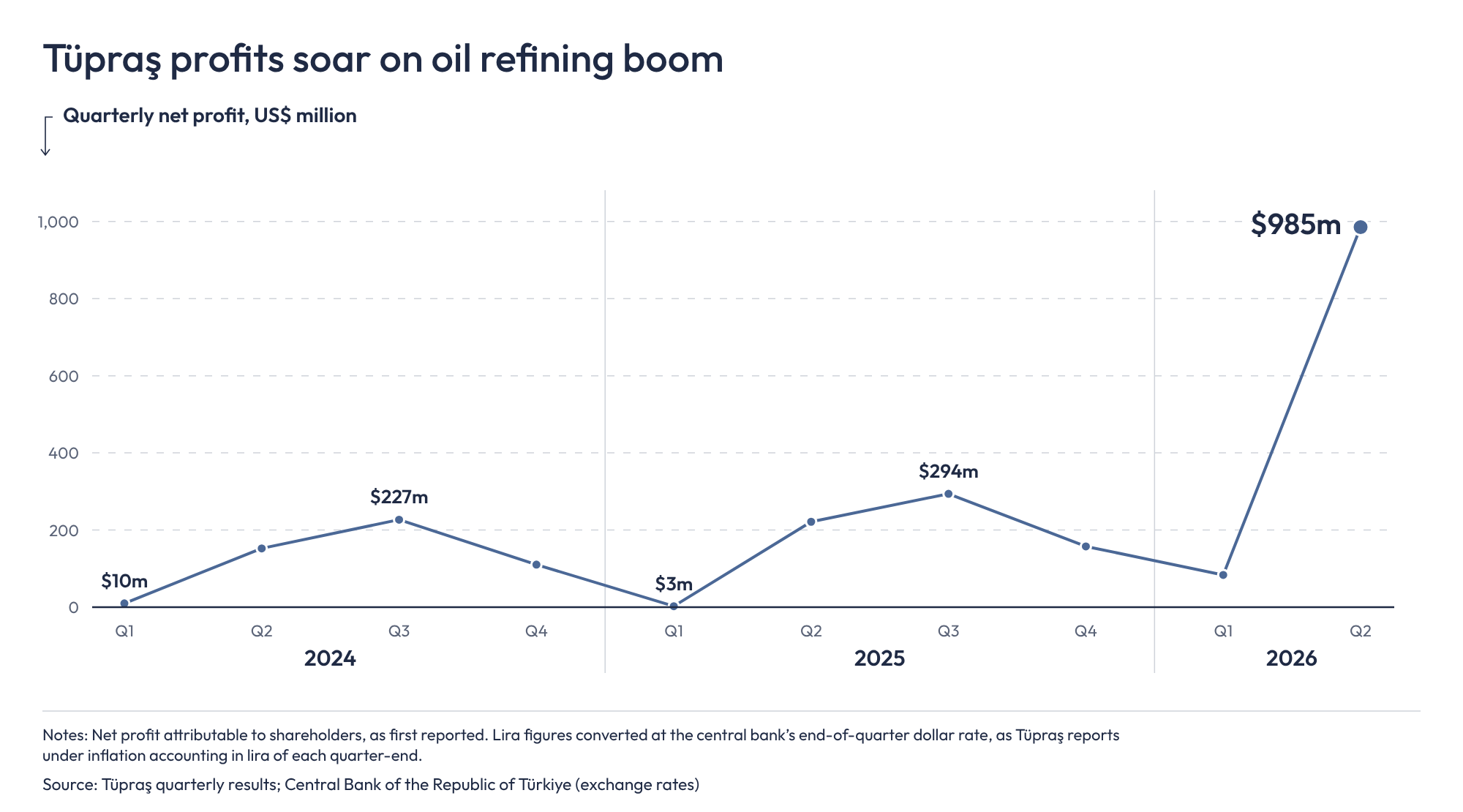
The oil business boom sits awkwardly with the climate and energy transition plans Koç and Tüpraş unveiled in 2021, when both pledged to become carbon neutral by 2050. Then, Tüpraş set out its aim to become “a leading carbon-neutral energy company”.
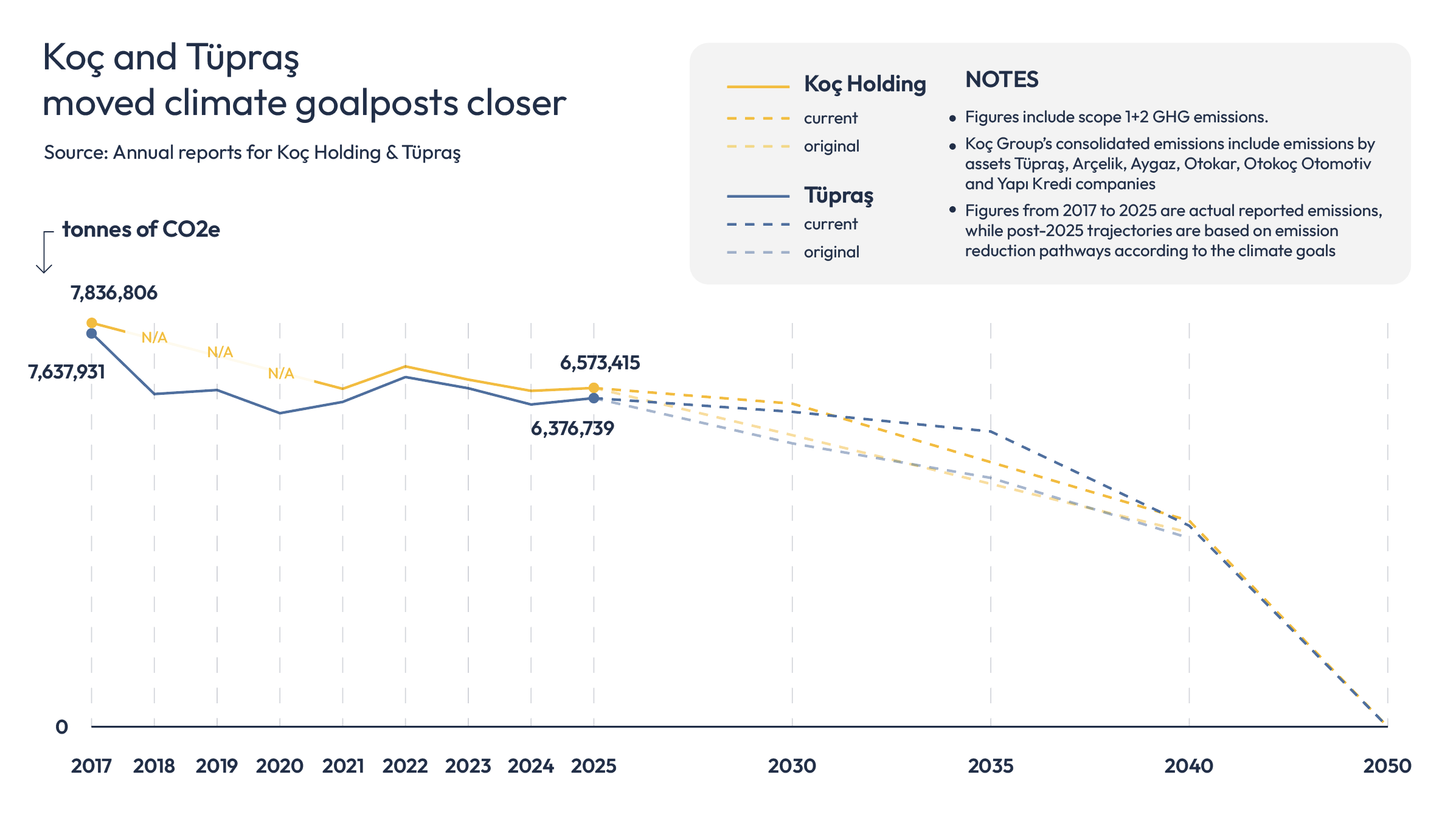
Despite these promises, in 2025, both companies lowered their targets for cutting emissions from their own operations by 2030, from 27% to 20% below 2017 levels. Tüpraş also cut its 2035 goal from 35% to 25%. The company still technically retains its long-term target of carbon neutrality by 2050, but the new plan will require much more drastic cuts after 2035.
Lowering the climate bar
Tüpraş blamed its weakening of climate ambition on “changing market dynamics, economic conditions and technological developments”. In a presentation announcing the revision to investors, the refiner said the energy outlook had changed since 2021.
The reasons it listed included elevated geopolitical tensions, increased investment in oil and gas extraction, which it said showed refined fuels remain vital for energy security – and even the depletion of the carbon budget to keep global warming to 1.5C.
Its parent company Koç pointed the finger at the slow pace of green hydrogen development, which the group said now had a “low feasibility” of transforming the energy sector after it had previously pinned much of its transition plan on the sustainable fuel.
The Turkish company’s new 2030 targets are certainly within reach. Tüpraş had already cut its operational emissions by 17% from 2017 levels by 2025, with nearly all of that progress achieved before the transition plan was unveiled, while Koç had reduced them by 16%.
The softer targets also exclude the bulk of the group’s climate impact. Most of its emissions come not from its own refineries and factories but from the products it sells: petrol, diesel and jet fuel burned in the engines of cars or planes.
These so-called Scope 3 emissions make up about 97% of Koç’s carbon footprint. They rose by around a sixth between 2019 and 2024, and neither Koç nor Tüpraş has set a target to cut them.
Efe Baysal, Türkiye team lead at campaign group 350.org, said there is a “clear contradiction” between talking about climate action while weakening emission targets and seeing emissions from the use of petroleum products keep rising.
“If the company is serious about the transition, it needs a clear plan to wind down fossil fuel operations, rather than relying on efficiency measures and technologies that let business as usual continue,” she told Climate Home News.
‘Sustainable refining’ push
Tüpraş’s updated transition plan rules out expanding its oil refineries, but commits to “maintaining the existing capacity” and running it “at maximum potential”. Oil refining is expected to remain its main source of earnings for years to come. Koç listed “growing oil demand and diesel deficit” in Türkiye as a competitive advantage for its energy business in a pitch to investors last month.
The biggest component of the Tüpraş transition plan is what the company calls “sustainable refining”. It plans to invest $3.9 billion between 2025 and 2035 in programmes to modernise its refineries, improve their energy efficiency and bring down the direct emissions they generate. The company is also shifting some of its production to petrochemicals, which it expects to reduce its Scope 3 emissions.
Australia says COP31 co-presidency will work on a cover decision
Alongside these “sustainable refining” efforts, Tüpraş is also investing in renewable power.
Four years ago, it bought Entek, which produces electricity primarily from six hydropower plants and one gas plant. Since the acquisition, Tüpraş has started building a utility-scale solar farm in Romania and a wind power plant with storage in Türkiye, alongside smaller solar energy installations at some of its refineries. A dozen more renewable energy projects are currently in the pipeline, according to its latest annual report.
In a self-declared bid to become “Türkiye’s leading producer of zero-carbon electricity”, Tüpraş wants to reach installed capacity of 1.6 gigawatts (GW) by 2030 – a target it raised in its updated plan – and 2.5GW by 2035. The Turkish government has committed to rolling out 120GW of wind and solar capacity nationwide by then.
Setback for green fuels
Tüpraş plans to supply most of its low-carbon electricity to run its future production plants for green hydrogen, an alternative fuel that can replace fossil fuels in some heavy industries and long-distance transport.
A few years ago, green hydrogen looked set to become a key pillar of the global energy transition, with companies pitching visionary projects and governments rolling out strategies for the fuel to decarbonise economies. But inflated forecasts, high costs and weak demand have led to a reality check for prospective producers like Tüpraş.
The Turkish refiner significantly scaled back its green hydrogen plans last year. While it originally hoped to start producing the clean fuel in 2025, it now targets a first pilot project by 2030 with commercial large-scale production not expected before 2035. That’s primarily because the cost of electrolysers, the machines that split water into hydrogen and oxygen, has risen fourfold since its original projections, the company said.
Is the world’s big idea for greener air travel a flight of fancy?
Tüpraş’s ambition to become Türkiye’s leading producer of sustainable aviation fuel (SAF) has also seen a partial rethink. The firm originally said it would convert by 2026 a unit in its sprawling oil refinery in the port city of Izmir into a plant that would produce SAF from waste cooking oil into “green” jet fuel.
But it is now planning to build a dedicated plant which is expected to be commissioned towards the end of 2028. That means its SAF output will be added to its existing fossil fuel refining capacity rather than replacing any of it.
Dividends dwarf green spending
Under its updated blueprint, Tüpraş plans to invest $4.35 billion in zero-carbon power, SAF and green hydrogen by 2035. Last year, it spent $137 million on activities that qualify as green under EU rules, leaving much ground to make up in the next 10 years. Most of its green investment in 2025 went on solar and wind farms, and a quarter on a unit making propylene, a refinery by-product used to produce plastic packaging and bottle caps.
Over the same year, it paid out about five times as much – roughly $740 million – to shareholders, under a policy of distributing around 80% of its profits. About half went to Koç Holding, which in turn paid its own shareholders some $460 million. The Koç family and companies it controls hold the majority of the group.
Kelly Trout, research director at energy think-tank Oil Change International, said a company like Koç should not be the face of the COP31 climate summit as it doesn’t pass the test of “climate integrity” the UN requires of a sponsor.
The hosting agreement struck between Türkiye and the UNFCCC says that the government has to consult the secretariat of the UN body to obtain advice on which “entities of concern” it should not conclude sponsorship or partnership agreements with. The document adds that the advice should give appropriate consideration to the partner’s climate integrity, but it does not specify how that should be judged.
‘Climate integrity’ mystery
Climate Home News asked the UNFCCC and the Turkish COP31 presidency if this process was followed for the Koç Holding sponsorship, but had not received a response at the time of publication.
The same provision featured in the host country agreement for COP29 in Azerbaijan, according to a leaked copy published by Human Rights Watch.
COP31 attendees told not to interfere in Türkiye’s “internal affairs”
The clean energy arm of state-owned oil and gas company SOCAR was named “Energy Transition Partner” for that summit, alongside other firms which an investigation from the Organized Crime and Corruption Project (OCCRP) found were owned by the country’s ruling family or people associated with them.
Koç is not the first fossil fuel-linked company to bankroll a UN climate summit. At COP24 in the Polish coal-mining city of Katowice in 2018, sponsors included the state coal power company PGE and the coking coal miner JSW.
‘A real story to tell’
COP sponsors typically get the right to promote themselves inside the conference venue and appear at official events. When it unveiled the agreement, the COP31 presidency called Koç Holding a “vital partner” in its efforts to unite the public and the private sector “to demonstrate Türkiye’s unwavering commitment to global climate action”.
The presidency declined to answer Climate Home News’ questions on how Koç Holding will be involved in the summit.
Koç itself has revealed little about its plans for the Antalya talks. When the deal was announced, the group said it would use the summit to share its experience of turning climate solutions into “concrete business results” and to forge new partnerships.