

Panama’s environment minister has joined a growing push for reform of the UN climate change negotiations, proposed by campaigners and academics in recent years – one of the first such calls by a minister directly involved in the talks.
Juan Carlos Navarro told Climate Home in a recent interview on the sidelines of Climate Week in New York that the current system for approving decisions – which requires all countries to agree by consensus – has not delivered good enough results and should instead use a majority or super-majority decision-making process.
“By consensus, you cannot get 186 nations to agree on anything. It’s a miracle we have come so far,” said Navarro. “We need to change the rules so we have a basic, rational, majority or super-majority decision-making process where we can do things better and faster.”
The comments follow pressure from civil society and academics to reform the UN climate process. In June, more than 200 campaign groups issued a joint call to reform the decision-making process, which they argued can be blocked by oil and gas-producing countries and has reached a “breaking point”.
Andreas Sieber, policy director with climate advocacy group 350.org, said he was sympathetic to Panama’s proposal, but added “it would just be part of a puzzle” to make the UN climate talks work more efficiently.
He added that it could be hard to get over the line as earlier efforts to secure a rule on voting as a last resort had met with fierce opposition from oil-producing countries – and decisions reached by consensus have the weight of having all the countries behind them, he noted.
-
Turkey’s new climate pledge would control emissions growth, not offer real cuts
The world’s 15th-largest emitter has made progress in boosting clean energy, but it could do much more to decarbonise -
Mottley’s “legally binding” methane pact faces barriers, but smaller steps possible
A group of countries acting nationally on methane is more likely than a global Montreal Protocol-style deal as proposed by Barbados’ leader – at least to start -
Colombia proposes expert group to advance talks on minerals agreement
A draft resolution aimed at advancing talks on a global minerals treaty will be discussed at a major UN environment meeting later this year


Erika Lennon, Senior Attorney at the Center for International Environmental Law, celebrated that more people are talking about potential changes to the UNFCCC, as “being totally beholden to consensus-based decision making is not leading to the outcomes that we need”.
She also agreed that voting is just part of the solution, and suggested possible reforms could include increased transparency in the negotiation rooms, inclusion of civil society and indigenous groups, and a conflict of interest rule that blocks fossil fuel companies from participating.
During last year’s COP29 in Baku, a group of experts known as the Club of Rome – among them the former UN climate chief Christiana Figueres and former UN Secretary-General Ban Ki Moon – issued an open letter proposing ways to modernise the climate process.
The current structure of COPs “simply cannot deliver the change at exponential speed and scale, which is essential to ensure a safe climate landing for humanity”, the letter said. They argued instead for “smaller, more frequent, solution-driven meetings” where countries can discuss progress and be held accountable.
At that same COP in Azerbaijan, Saudi Arabia managed to block all mentions of fossil fuels in text summarising discussions on cutting greenhouse gas emissions. It was able to do this despite all countries having agreed to transition away from fossil fuels in energy systems just one year earlier at COP28.
UN Climate Change consults on COP process
In a speech at Climate Week in New York, Simon Stiell, the executive secretary of UN Climate Change, noted that recent COPs have delivered “concrete results and global steps forward”, adding that cooperation under the process has lowered expected global warming from 5C to closer to 3C.
But, he conceded, it is “imperfect”. “As this new era of implementation gathers pace, we must also keep evolving, and striving towards faster, fully-inclusive, higher-quality decisions that tie the formal process ever-closer to real economies and real lives,” he said.
Senior experts have been asked to examine how the UN climate process could be improved and will deliver their ideas to Stiell later this year. The secretariat will consult with countries on any potential reforms it wants to pursue in 2026, the UN’s climate chief added.
Brazil, the host country of this year’s COP, has put the focus on global mobilisation to implement in practice what governments signed up to in the 2015 Paris Agreement. Last year it proposed setting up a UN Climate Change Council in order to support that work, but this proposal does not seem to have gained much traction amid geopolitical tensions and Trump’s attacks on multilateral climate action.

Downsizing COPs?
Panama’s Navarro added that the UN climate summit has grown too big, making its scope “ridiculous”. In 2023, over 83,000 people attended COP28 in Dubai, while COP29 in Baku saw fewer, with 66,778 registered participants.
Navarro said the COP meetings had become an anachronism. “You have thousands and thousands of people who are living off the story,” he said. “They’re living off these meetings, just sitting around the world on expense accounts, creating a bigger carbon footprint for the planet, and we’re not achieving anything.”
In April 2024, UNFCCC head Stiell said personally he “would certainly like to see future COPs reduce in size”, telling an audience at London’s Chatham House think-tank that “bigger doesn’t necessarily mean better”.
This year, COP30 will be held in the Amazon city of Belem, which poses “self-evident” financial and logistical limitations, according to Navarro, who praised Brazil for being open to hearing the complaints from the Global South countries on this topic.
After many delegations complained over the high costs of accommodation and difficult access, Brazil offered cruise-ship rooms and price caps, and the UN has increased the daily subsidy for diplomats from most developing nations to attend the summit.
Landmark ICJ climate ruling must be turned into concrete action on shipping
‘Less hypocrisy, more concrete results’
“Having said that, and coming back to the point of what COPs have become, I wish that COPs were less bullshit, more concrete results,” Navarro told Climate Home.
His own country – which is judged to be carbon-negative, thanks to its extensive carbon-storing forests – recently published its “Nature Pledge”, combining climate, biodiversity and conservation pledges. Those include restoring 100,000 hectares of ecosystems such as degraded mangroves by 2035, maintaining 30% of Panama’s land and seas under protection and absorbing 5 million tons of CO₂.
Practical measures to achieve that include new equipment for park rangers, more radars to monitor and catch illegal fishing, and fines for polluting industries.
Panama has also set up a Nature Fund, which aims to collect $150 million-$200 million for conservation projects using resources like blue carbon bonds, debt-for-nature swaps and a national carbon market backed by blockchain with revenues going to the public sector to ensure “transparency and accountability”.
Without specifying which, Navarro called out “countries that do an incredible job of greenwashing, talking about conservation and talking about the environment – and they’re either oil producers or plastics producers, or kill whales or are destroying our fisheries, or keep building coal power plants or keep polluting”.
“We’ve run out of time for all of these hypocritical individuals, corporations – or even nations,” he added.
The post Panama environment minister backs calls for reform of UN climate process appeared first on Climate Home News.
Panama environment minister backs calls for reform of UN climate process

For the first time, new-energy vehicles (NEVs) made up 67% of new car sales in China in September, according to the latest data from the China Passenger Car Association (CPCA).
The figures show that NEVs, which include battery electric cars and plug-in hybrids, captured a record share of sales, even though fewer were sold than last year.
This is because sales of combustion-engine cars are falling steeply, a trend that the CPCA has attributed to rising petrol prices following the start of the Hormuz crisis.
Indeed, sales of fuel-only cars were down 31% year-on-year in the first nine months of 2026, with plug-in hybrid sales down 26% – whereas battery EV sales were only down 4%.
One analyst tells Carbon Brief that China’s rapidly growing EV fleet has offset demand for 143m barrels of oil since the start of the Hormuz crisis.
Another says that the crisis is “reinforcing China’s electrification of road transport”.
Meanwhile, amid slowing domestic sales, Chinese carmakers’ exports of NEVs more than doubled [in 2026 to date / in September] from a year earlier.
NEV record
A record two out of every three cars sold in September in China were NEVs, according to CPCA data, as shown in the figure below.
(NEVs predominantly include battery electric vehicles – BEVs – and plug-in hybrids – PHEVs. BEVs only run on electricity, whereas PHEVs also have a combustion engine.)
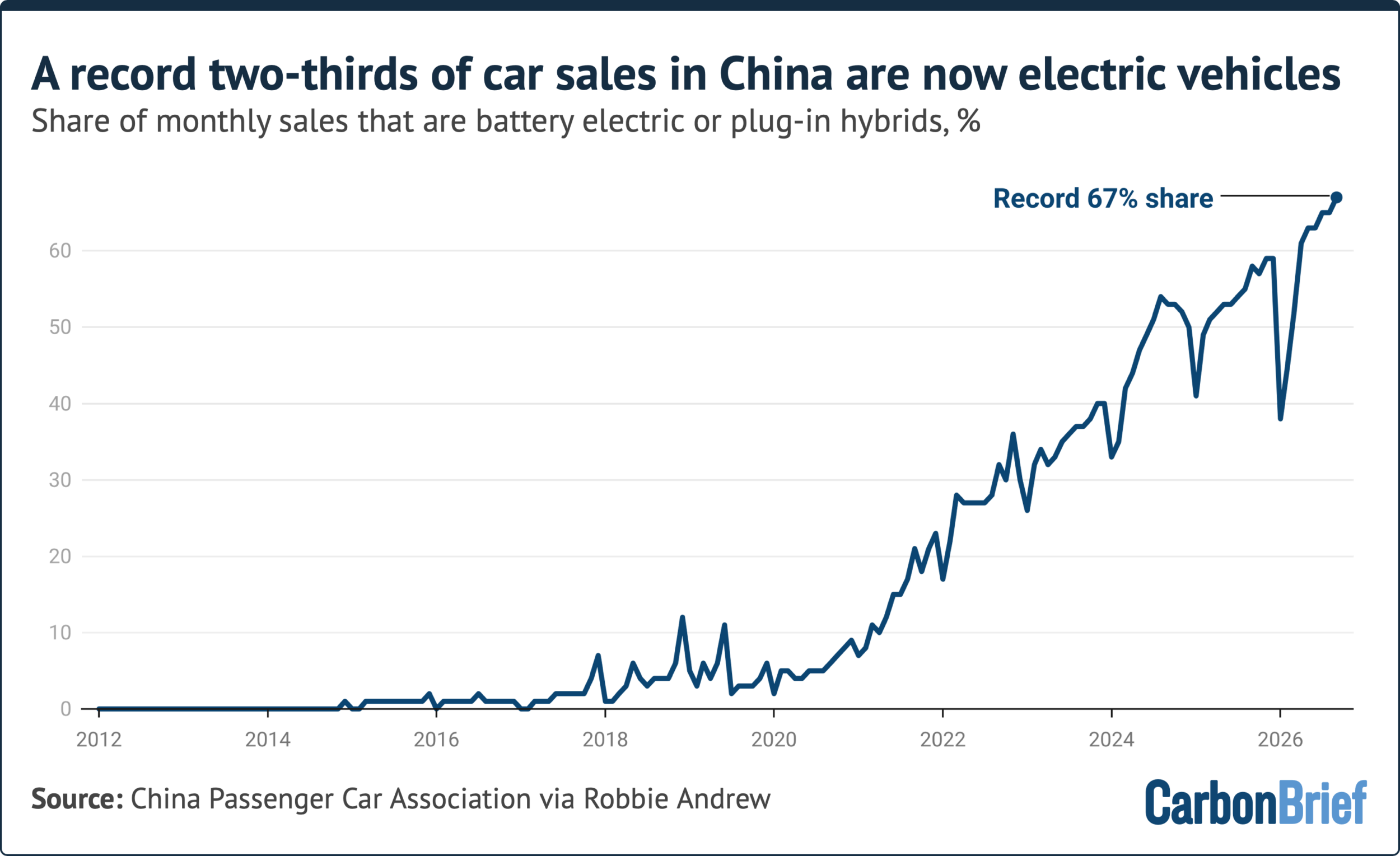
This marks a rapid rise for NEVs from just 6% of new car sales in 2020 up to 58% in 2026 to date – and a record 67% in the month of September.
This year, NEVs’ share of sales has also bounced back from a low of 39% in January, after the full purchase tax exemption that had been in place for more than a decade came to an end in December 2025.
The gain in NEV share in 2026 has come amid a slowdown across the wider domestic passenger-car market, which has hit sales of combustion-engine vehicles particularly hard.
This September, passenger-car retail sales across all categories declined, with overall sales volumes falling 28% year-on-year.
The contraction was led by combustion-engine vehicles, which saw sales fall 43% year-on-year in September and 31% in 2026 to date.
However, sales of PHEVs also fell by 36% year-on-year in September and by 26% in 2026 to date. By comparison, BEVs performed better, although sales still declined 8.5% from a year earlier in September and 4% in 2026 to date.
As a result, NEV sales overall fell by 17% in September and 13% in 2026 to date.
While the market changes in 2026 to date were particularly dramatic, they reflect a broad continuation of trends seen over the past decade.
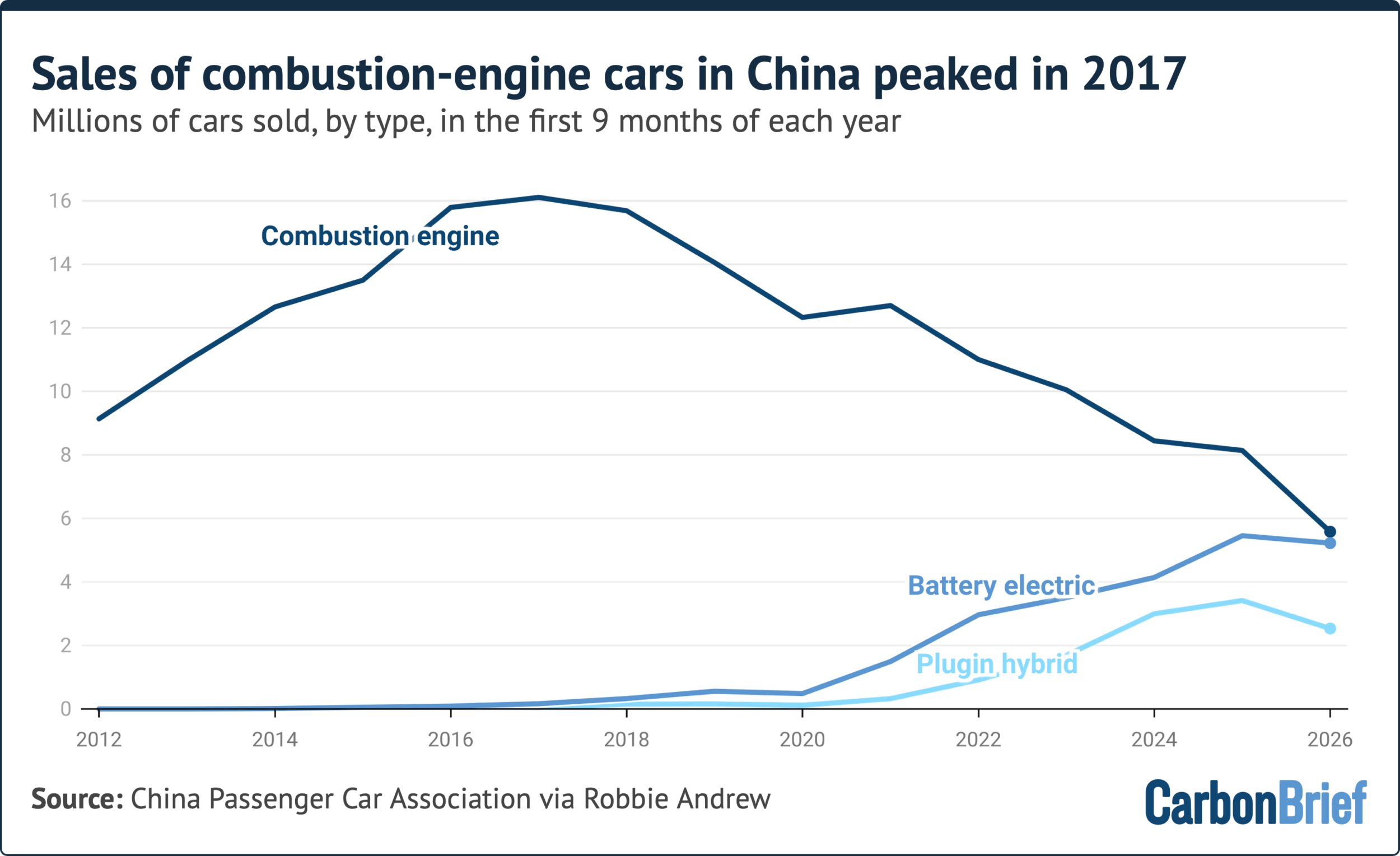
Indeed, sales of combustion-engine cars in China peaked in 2017 and they have been declining ever since, shown in the figure below.
Impact of Hormuz
Part of the reason for the advance of NEVs in 2026, said Chinese technology news outlet OFweek, was petrol cars “giving up market share” as they were outperformed by electric alternatives.
Cui Dongshu, secretary-general of the CPCA, cited higher petrol prices as an explanation for September’s weak combustion-car sales, in comments to financial news outlet National Business Daily.
Imports of oil into China in January-September have fallen 15% compared to 2025, equivalent to 470m barrels, as ongoing conflict tightened supply and drove up prices.
China’s passenger-car NEV fleet has displaced 143m barrels of oil so far during the strait of Hormuz crisis, Euan Graham, senior energy analyst at thinktank Ember, tells Carbon Brief.
EVs “accounted for 12% of the decrease in China’s oil use post-Hormuz”, according to an estimate provided to thinktank the Brookings Institute by an unnamed analyst.