

This week’s pledges by the EU, China and other large countries for emissions cuts by 2035 are not ambitious enough to get global climate targets back on track, climate experts say.
With the US withdrawing from the Paris Agreement and President Donald Trump pouring scorn on climate action in his speech to the UN General Assembly on Tuesday, climate campaigners had hoped to see the European Union and China in particular step up. But many were disappointed by their announcements at the UN climate summit in New York on Wednesday.
“The US is absent. China and the EU have not raised each other’s ambition enough and even Australia, which is bidding to host COP31, has presented a weak target,” said Tracy Carty, a climate change politics specialist from Greenpeace International.
Chinese President Xi Jinping told the summit that China – the world’s top emitter – would cut emissions by between 7% and 10% by 2035 against peak levels. Its previous goal was for emissions to peak by around 2030.
-
China unveils underwhelming emissions-cutting target for 2035
Experts say China’s new 2035 goal to cut emissions by 7-10% from “peak levels” does not fully reflect its expansion of clean energy on the ground -
At climate summit, UN chief urges countries to go “much further, much faster” on NDCs
With about 120 leaders and ministers speaking in New York, the pressure is on for stronger climate action plans to rein in global warming, with the world off track to meet Paris Agreement goals -
Nigeria gives fossil gas a bigger role as “transition fuel” in climate plan
Officials say the country needs time and money to ramp up renewables, but critics say betting on gas is a risky strategy that could prolong the “oil curse”


Xi also appeared to make a dig at Trump’s climate scepticism. “While some country is acting against it, the international community should stay focused on the right direction,” he said.
His comments were echoed by European Commission President Ursula von der Leyen, who said “the clean transition is moving on” and “Europe will stay the course”.
“Timid” Chinese goal
But some climate change experts said the substance of their announcements was underwhelming and did not match their rhetoric, calling China’s goal “timid” and too easy to meet given the country’s rapid rollout of renewables and electric vehicles.
Von der Leyen, meanwhile, announced only that the EU’s 2035 reduction target would be somewhere between 66% and 72% on 1990 levels – unable to be more specific because EU member states have yet to agree a target, with several pushing to weaken the European Commission’s ambitions.
A few big countries including Nigeria and Pakistan announced new targets. Nigeria said it would aim to cut emissions 32% below 2018 levels by 2035 – with four-fifths of this target dependent on foreign help. Pakistan will aim for 17% below a business-as-usual projection by 2035.
But many other major economies, among them India, Indonesia, Mexico, Saudi Arabia, South Africa and South Korea, have yet to file their plans – despite an end of September deadline for them to be included in a UN progress report.
“Dangerously off track”
The nonprofit research group World Resources Institute (WRI) calculates that 53 governments – representing a quarter of the world’s emissions – have filed their NDCs, though that figure did not include China or the EU. The group’s CEO, Ani Dasgupta, said the new NDCs “do not put us anywhere near on track for a safe future”.
“The lack of ambition so far from most major emitters, barring a few, underscores the immense political challenge countries face in transforming their entire economy. Yet vulnerable countries continue to step up with bold climate leadership,” Dasgupta said.
-
Lula says he is “optimistic” about US support for new rainforest fund
The Brazilian president says that for COP30 to be successful, it needs the commitment of all world leaders -
Planet’s health in rising danger, as ocean acidification crosses safety limit
A new annual scientific report on the state of the Earth shows oceans are being harmed by fossil fuel burning and other environmental stresses -
Fact-checked: Trump’s UN tirade against renewables, climate deals and environmentalists
The US president’s outspoken speech was littered with a string of misleading or false statements – many about efforts to fight climate change


Greenpeace’s Carty agreed that the NDCs are “dangerously off track and without a serious shift, we’ll soar past 1.5C”.
At ActionAid, Teresa Anderson accused governments of “running scared from the corporations that care only for short-term profits over long-term survival of the planet”.
A few voices were more positive about the new round of NDCs. Gina McCarthy, former climate adviser to then U.S. President Joe Biden, said the America Is All In coalition that she co-chairs “applauds world leaders submitting updated climate plans that align with the targets of the Paris Agreement”, and there were bright spots in leaders’ speeches.
Solar booms and legal moves
Announcing Pakistan’s new NDC, Prime Minister Shehbaz Sharif described how solar energy has grown seven-fold since 2021 as Pakistanis embrace rooftop solar panels to keep their lights on during frequent power cuts. Similar solar booms are happening in several blackout-afflicted African nations.
And government decisions on the NDCs may not be the final word. Leaders of the Marshall Islands and Tuvalu – both Pacific island nations that are among the most vulnerable to climate change – warned their fellow politicians that a recent International Court of Justice (ICJ) advisory opinion could mean courts force them to ramp up their climate targets and policies.
“Fellow leaders and especially those of you from the G20, if the Marshall Islands can deliver an ambitious NDC, so can you,” said Marshall Islands President Hilda Heine. “In fact, as the ICJ decision confirms, you are legally required to. You must deliver stronger NDCs that can meet 1.5C and can say how you will transition away from fossil fuels.”
On Monday, Ralph Regenvanu, the climate minister of fellow Pacific island nation Vanuatu, announced his country was drafting a UN General Assembly resolution to turn the ICJ advisory opinion into “political action”.
Regenvanu said individual governments opposed to the step would not be able to block it because the UN General Assembly votes by majority.
“There is no veto power to block this resolution going through,” Regenvanu said.
The post As China and EU disappoint, prospects of meeting 1.5C climate target fade appeared first on Climate Home News.
As China and EU disappoint, prospects of meeting 1.5C climate target fade

Three countries have been named by the Paris Agreement’s compliance committee for failing to submit a nationally determined contribution (NDC) and repeatedly snubbing offers of help with their climate plans.
After months of internal debate over whether to identify serial non-responders, the Paris Agreement’s Implementation and Compliance Committee (PAICC) named the three countries which have failed to engage with it over their NDCs on Friday.
It named Democratic Republic of Congo, Senegal and North Korea in a footnote of its annual report, adding that it decided to name them “with a view to facilitating engagement”, adding that representatives of the three nations had been invited to its meeting in early 2027 “with the purpose of identifying any challenges and constraints”.
“The Committee noted the importance of Parties engaging with the Committee in a timely manner, while noting that some delays may be due to the national capabilities and circumstances of the Parties”, the report said.
-
Under US pressure, World Bank says it will back gas “where appropriate”
The US wants the World Bank to expand its gas support while climate campaigners are pushing for it to end – its head spoke this week of limited backing for the fossil fuel -
IPCC scientists vow to press on with climate reports despite political deadlock
After governments again failed to agree a timeline, nearly 120 IPCC authors pledged to complete their assessment on time and with full scientific rigour -
Paris Agreement committee snubbed over missing NDC climate plans
Many governments have still not submitted a nationally determined contribution to the UN, breaching a key requirement of the Paris Agreement

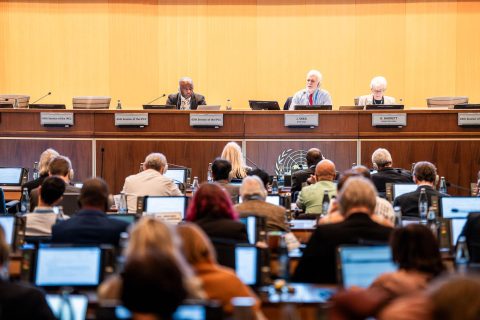

In July, PAICC said 12 countries had ignored its repeated attempts to discuss why they had not published an NDC as required every five years under the 2015 Paris accord.
Members of the committee had been divided over whether to name them, but at a September meeting decided to do so in their annual report to the annual climate COP summit.
By the time the report was published on Friday, only Congo, Senegal and North Korea “had not communicated an NDC or submitted a [Biennial Transparency Report] and had not yet responded to any of the Committee’s notifications, despite several reminders issued by the Committee in this regard”.
Rainforest and renewable energy ambitions
The silence from Congo and Senegal is notable because the former is home to much of the Congo Basin rainforest while the latter has sought billions of dollars in climate finance to support its renewable energy ambitions.
After Brazil, Congo has more rainforest than any country in the world. This forest, and the country’s peatlands, absorb huge amounts of greenhouse gas but are fast being lost to expanding farmland, charcoal production, logging and mining.
Senegal signed a Just Energy Transition Partnership with Canada and wealthy European nations in 2023, to help it meet its renewable energy targets under the-then government of Macky Sall. It was chair of the Least Developed Countries group between January 2022 and December 2023.

Tejas Rao, who is researching the PAICC as part of a doctoral thesis at Cambridge University, said the governments of the three countries should engage with the committee.
“Engagement costs these governments very little and the committee has shown it will listen,” he said.
“Silence leaves the committee with no basis to help, and it leaves the [governments] exposed to the narrative that they are simply disengaged,” he told Climate Home News.
Paris Agreement requirement
The 2015 Paris Agreement requires all parties to publish an NDC every five years outlining their emissions reduction targets, with each plan meant to be more ambitious than the country’s last NDC.
The latest set – the third round of plans, with new targets for 2035 – was due in February 2025. While most countries missed this deadline, all but around 30 – mostly small emitters but including Egypt, Vietnam and Argentina – have now submitted them.
Over the year, the PAICC – which is made up of government climate officials from developed and developing countries – has been communicating with governments that have not submitted NDCs and trying to overcome barriers to them doing so.
Some nations have cited exceptional circumstances as the reason for not submitting an NDC, a process that requires a significant amount of work in tracking emissions and consulting on how to curb them across the economy. For example, a letter from a Sudanese official to the PAICC, seen by Climate Home News, said that the country’s civil war had led to the suspension of its NDC preparation.
-
IPCC scientists vow to press on with climate reports despite political deadlock
After governments again failed to agree a timeline, nearly 120 IPCC authors pledged to complete their assessment on time and with full scientific rigour -
Under US pressure, World Bank says it will back gas “where appropriate”
The US wants the World Bank to expand its gas support while climate campaigners are pushing for it to end – its head spoke this week of limited backing for the fossil fuel -
Who shapes climate science? The equity question facing the IPCC
Early completion of the next global climate science assessment reports risks excluding research from the Global South, which is key to ensuring the findings are fair
The US and Iran are not signed up to the Paris Agreement and so do not have active NDCs, nor does Taiwan, which is not a UN member state.
Rao said that because the PAICC is “facilitative and non-punitive”, naming the countries “is meant to open a door, not close one – the invited consultation is the point”.
“In recent months, governments that explained their constraints, whether capacity, finance or domestic process, have been met with follow-up and support rather than sanction, and the number of silent governments has fallen sharply,” Rao said.
The post Paris Agreement committee names three countries snubbing it over NDCs appeared first on Climate Home News.
Paris Agreement committee names three countries snubbing it over NDCs