

We handpick and explain the most important stories at the intersection of climate, land, food and nature over the past fortnight.
This is an online version of Carbon Brief’s fortnightly Cropped email newsletter. Subscribe for free here.
Key developments
UN food insecurity report
HUNGER DECLINES: The prevalence of hunger dropped in most parts of the world in 2024, according to a new report covered by Carbon Brief – but rates are still rising in much of Africa and western Asia. The UN’s annual report on food security and nutrition found that around 673 million people experienced hunger in 2024. Other key findings were that the cost of a “healthy” diet increased in 2023 and 2024 and that food price inflation “significantly” outpaced general inflation over the past five years. The price inflation was mostly driven by global factors, but also by localised shocks such as “climate extremes” disrupting food production, the report said.
‘UNEVEN’ PROGRESS: Global progress on tackling hunger is “encouraging”, but “uneven”, the director-general of the UN Food and Agriculture Organization, Dr Qu Dongyu, said in a statement. The new report found that the entire population in Gaza faced “high levels of acute food insecurity” in 2024, alongside more than half of people in Sudan, South Sudan, Yemen and Haiti. Elsewhere, the UN World Food Programme said that hunger levels in Gaza are “catastrophic”, while Reuters reported warnings from a global hunger monitor that a “worst-case scenario of famine is unfolding” there. UN chief António Guterres told the UN Food Systems Summit Stocktake this week in Ethiopia: “We must never accept hunger as a weapon of war.”
‘CLIMATEFLATION’: Elsewhere, a thinktank report said the UK faces “climateflation” impacts that could “drive up food prices by more than a third by 2050”, the Guardian said. The Autonomy Institute said that “increasing numbers of heatwaves and droughts would imperil staple crops, disrupt supply chains and intensify inflationary pressures”, the outlet added. UK food price inflation increased in July for the sixth consecutive month, partly driven by “rising meat and tea prices”, BBC News reported. Carbon Brief mapped out the findings of a new study showing links between extreme weather and food price spikes around the world.
Africa’s clean-cooking and nature goals
‘UNREACHABLE GOAL’: Sub-Saharan Africa will not reach the UN 2030 goal of providing clean cooking for all, according to a report from the International Energy Agency (IEA). “Large gaps” in financing and infrastructure mean universal access by 2040 is “more realistic”, it continued. The number of Africans without access to clean cooking “has continued to grow” and is currently around 1 billion people, Climate Home News reported. The report stated that $37bn in investment is required to achieve universal access. In a statement, IEA’s executive director, Fatih Birol, said that lack of clean cooking “remains one of the great injustices in the world”.
-
Sign up to Carbon Brief’s free “Cropped” email newsletter. A fortnightly digest of food, land and nature news and views. Sent to your inbox every other Wednesday.
WILDLIFE BONDS: The Global Environment Facility (GEF) has planned a new wave of wildlife conservation bonds to provide up to $1.5bn to “help African countries” save endangered species and ecosystems, Reuters reported. The GEF’s head of programming told the newswire that the bonds, which provide low-cost funding in return for curbing poaching or other conservation measures, will be issued for every country in Africa. The bonds will help poorer countries receive funding without adding to government debt. While such bonds usually target “emblematic” species, the GEF hopes to use the bonds to cover entire ecosystems, such as wetlands, Reuters said.
CONGO’S BIOFUELS: Italian oil company Eni has closed one biofuels pilot project in the Republic of Congo, but two other such projects remain in an experimental phase, InfoNile reported. Eni previously signed a 50-year agreement with the Congolese government to develop the country’s agro-biofuel sector, with a plan to cover 150,000 hectares of agricultural land by 2030. However, local farmer Chris Nsimba told InfoNile that, although Eni has brought economic development to his district, the company has made “little contribution” to local food security.
‘DRAMATIC EXPANSION’: Tenders for oil development are now available across “more than half” of the Democratic Republic of the Congo, a new report from Earth Insight and other groups found. The government recently launched a licensing round for 55 oil blocks, the report said – a “dramatic expansion” which poses “major threats” to forests and protected areas. The oil blocks overlap with 8.6m hectares of “key biodiversity areas” and 66.8m hectares of intact tropical forests. This decision highlights “stark contradictions between the DRC’s fossil-fuel agenda and its stated commitments to biodiversity protection, climate action and community rights”, the report said.
Spotlight
‘Unprecedented’ marine heatwaves gripped the globe in 2023
This week, Carbon Brief covers a new study, published in Science, which found that 96% of the global ocean experienced a marine heatwave during 2023.
More than 95% of the world’s expanse of oceans experienced a marine heatwave – a period of abnormal ocean warming lasting at least five days – in 2023, according to new research.
The study, published in Science, used an ocean model that incorporates satellite and observational data to identify marine heatwave events and investigate the drivers of the unusual ocean heating.
It found that 2023 was an “unprecedented” year for marine heatwaves in terms of duration, extent and intensity of the events.
Many of the events had “immediate ecological and societal consequences”, the authors wrote.
‘Comprehensive investigation’
In 2023, marine heatwaves bleached corals in the Florida Keys, boosted the prevalence of a giant-clam-killing parasite in the Mediterranean and even intensified heatwaves on land during Europe’s “hellish” summer that year.
Using satellite data and an ocean model that incorporates different streams of data, the team of researchers “conducted a comprehensive investigation” of the global ocean’s state in 2023, they wrote. Together, the authors wrote, that year’s marine heatwaves had the “longest durations, widest extents and highest intensities on record”.
They found that the average duration of marine heatwaves in 2023 was 120 days, compared to an average duration of just under 36 days between 1982-2022. Spatially, the 2023 heatwaves covered 96% of the global ocean, compared to a historical average extent of around 74%.
Prof Regina Rodrigues, a physical oceanographer at Brazil’s Universidade Federal de Santa Catarina, told Carbon Brief that, while the science underlying the study is “sound”, the study itself “does not bring many new aspects”. Rodrigues, who was not involved in the new research, added:
“The results are not different from those of many previous studies, except for the analysis of these regions together and for the same year.”
Driving factors
The researchers identified four main “hotspots” of the ocean that had the highest marine heatwave “cumulative intensity”: the tropical eastern Pacific, the south-west Pacific, the north Pacific and the north Atlantic. (Cumulative intensity is a metric that accounts for both intensity and duration of a heatwave.)
The researchers then used the ocean model to investigate the underlying drivers of marine heatwaves in each hotspot.
For example, in the north Pacific, they found that a combination of low cloud cover – allowing more sunlight to reach and warm the ocean’s surface – and weak winds resulted in around 1C of average warming throughout the year. A lack of cloud cover also contributed significantly to the heatwaves in the north Atlantic and south-west Pacific, they wrote.
It is “no surprise at all” to find that marine heatwaves have increased in frequency, intensity, duration and extent, “given that the ocean absorbs 90% of the heat from manmade climate change”, Rodrigues told Carbon Brief.
She pointed to a Nature study published earlier this year that examined the global record sea-surface temperatures of 2023-24. That study concluded:
“Without a global warming trend, such an event would have been practically impossible.”
News and views
WETLANDS SUMMIT: More than 3,000 delegates met in Zimbabwe for the 15th conference of the Ramsar Convention (COP15) to discuss the future of the world’s wetlands. Opening the event, Zimbabwe’s president, Emmerson Mnangagwa, called for the implementation of “collaborative approaches” towards wetlands protection, Down To Earth reported. Several southern African countries officially launched the Southern Africa Ramsar Regional Initiative to promote wetland conservation and sustainable use across borders, EnviroNews Nigeria reported. Additionally, China Daily reported that nine more Chinese locations were awarded “wetland city accreditation” at the conference, which concludes this Thursday.
‘DEVASTATION BILL’: Politicians in Brazil approved a bill to ease environmental licensing, a move criticised as the country’s “most significant environmental setback in nearly 40 years”, Mongabay said. The so-called “devastation bill” includes rule changes which would allow projects to be approved “by simply filling out an online form”, the outlet reported. It would also create a “special environmental licence” for “strategic” projects, “such as oil exploration on the Amazon coast”. Mongabay noted that President Luiz Inácio Lula da Silva can block or enact the bill, but “congress would likely overturn a veto”. It added: ”The law is bound to be challenged in the Supreme Court.”
SEABED STRIFE: Members of the International Seabed Authority (ISA) condemned the move earlier this year by a deep-sea mining company to “bypass the authority’s protocols by applying for a permit to mine in international waters under US law”, Inside Climate News reported. Oceanographic said that the ISA has “launched an official investigation” into contracting companies “over action taken to circumvent” existing protocols. The outlet said the decision was a “critical step in protecting the deep sea”. However, delegates at the recently concluded ISA meeting once again “failed” to reach an agreement on whether or not to allow seabed mining to proceed in international waters, reported Common Dreams.
FARMER FUNDS: The EU’s new long-term budget proposal featured cuts to agricultural spending, but the European Commission “insists” farmers will not be impacted, Euronews reported. The proposal outlined plans to combine agricultural subsidies and regional development funds into one “mega-fund worth €865bn”, the outlet said. Politico reported that the proposed changes mean “biodiversity goals have no earmarked funding at all – and will have to compete with the EU’s other environmental aims, including climate change, water security, the circular economy and pollution”.
‘TOXIC’ ALGAE: A toxic algal bloom along South Australia’s coastline has shown “no sign of abating” four months in, after killing sharks, rays, fish, dolphins and seals, the Sydney Morning Herald reported. The algae grew and spread due to a marine heatwave in September 2024, which caused ocean temperatures to be 2.5C warmer than usual. Marine ecologist Dr Scott Bennet told CNN: “This is symptomatic of climate-driven impacts that we’re seeing across Australia due to climate change.” Meanwhile, Reuters reported on a “revolution” in farm management that has boosted Australia’s wheat production “despite hotter, drier conditions”.
Watch, read, listen
CLOUD COVER: The New York Times profiled the scientists attempting to save the Great Barrier Reef by increasing cloud cover to cool the Pacific Ocean.
SYCAMORE SENTENCE: In Bloomberg, Josie Glausiusz argued that prosecuting the men who felled the Sycamore Gap tree in northern England in 2023 “mean[s] little” without stronger action to protect the natural world.
DECLINING SUPPLY: The Guardian visualised how Donald Trump’s “assault” on immigrants in the US could affect the country’s food supplies.
AN ICONIC TREE: Mongabay explored whether the Joshua Tree – a yucca plant native to the south-western US – can survive in the face of increasing drought, fires and development.
New science
- A Nature Communications study found that lands managed by Afro-descendant communities in Brazil, Colombia, Ecuador and Suriname experience up to 55% less deforestation than lands managed by others. The study highlighted the adaptation of African knowledge, the authors said, calling for a greater inclusion of Afro-descendants in environmental decision-making.
- Fewer than 10% of predicted “hotspots” of a type of fungi around the world are currently contained in protected areas, according to a Nature study. The findings can benefit conservation, monitoring and restoration of the “largely hidden component of Earth’s underground ecosystems”, the study authors wrote.
- New research, published in Science Advances, found that the prioritisation of creating “biodiversity-friendly landscapes” through conservation activities may actually accelerate biodiversity loss by improving conditions for invasive alien species. The authors called for a “shift” towards “landscape-wide strategies to stop the ongoing decline of farmland biodiversity”.
In the diary
- 5-14 August: Fifth session of the Intergovernmental Negotiating Committee on plastic pollution (part two) | Geneva
- 9 August: UN international day of the world’s Indigenous peoples
- 13-15 August: African Union-AIP water investment summit 2025 | Cape Town, South Africa
Cropped is researched and written by Dr Giuliana Viglione, Aruna Chandrasekhar, Daisy Dunne, Orla Dwyer and Yanine Quiroz. Svetlana Onye also contributed to this issue. Please send tips and feedback to cropped@carbonbrief.org
The post Cropped 30 July 2025: ‘Unprecedented’ ocean heatwaves; ‘Uneven’ hunger progress; Brazil’s ‘devastation bill’ appeared first on Carbon Brief.

Drought and heatwaves occurring together – known as “compound” events – have “surged” across the world since the early 2000s, a new study shows.
Compound drought and heat events (CDHEs) can have devastating effects, creating the ideal conditions for intense wildfires, such as Australia’s “Black Summer” of 2019-20 where bushfires burned 24m hectares and killed 33 people.
The research, published in Science Advances, finds that the increase in CDHEs is predominantly being driven by events that start with a heatwave.
The global area affected by such “heatwave-led” compound events has more than doubled between 1980-2001 and 2002-23, the study says.
The rapid increase in these events over the last 23 years cannot be explained solely by global warming, the authors note.
Since the late 1990s, feedbacks between the land and the atmosphere have become stronger, making heatwaves more likely to trigger drought conditions, they explain.
One of the study authors tells Carbon Brief that societies must pay greater attention to compound events, which can “cause severe impacts on ecosystems, agriculture and society”.
Compound events
CDHEs are extreme weather events where drought and heatwave conditions occur simultaneously – or shortly after each other – in the same region.
These events are often triggered by large-scale weather patterns, such as “blocking” highs, which can produce “prolonged” hot and dry conditions, according to the study.
Prof Sang-Wook Yeh is one of the study authors and a professor at the Ewha Womans University in South Korea. He tells Carbon Brief:
“When heatwaves and droughts occur together, the two hazards reinforce each other through land-atmosphere interactions. This amplifies surface heating and soil moisture deficits, making compound events more intense and damaging than single hazards.”
CDHEs can begin with either a heatwave or a drought.
The sequence of these extremes is important, the study says, as they have different drivers and impacts.
For example, in a CDHE where the heatwave was the precursor, increased direct sunshine causes more moisture loss from soils and plants, leading to a drought.
Conversely, in an event where the drought was the precursor, the lack of soil moisture means that less of the sun’s energy goes into evaporation and more goes into warming the Earth’s surface. This produces favourable conditions for heatwaves.
The study shows that the majority of CDHEs globally start out as a drought.
In recent years, there has been increasing focus on these events due to the devastating impact they have on agriculture, ecosystems and public health.
In Russia in the summer of 2010, a compound drought-heatwave event – and the associated wildfires – caused the death of nearly 55,000 people, the study notes.

The record-breaking Pacific north-west “heat dome” in 2021 triggered extreme drought conditions that caused “significant declines” in wheat yields, as well as in barley, canola and fruit production in British Columbia and Alberta, Canada, says the study.
Increasing events
To assess how CDHEs are changing, the researchers use daily reanalysis data to identify droughts and heatwaves events. (Reanalysis data combines past observations with climate models to create a historical climate record.) Then, using an algorithm, they analyse how these events overlap in both time and space.
The study covers the period from 1980 to 2023 and the world’s land surface, excluding polar regions where CDHEs are rare.
The research finds that the area of land affected by CDHEs has “increased substantially” since the early 2000s.
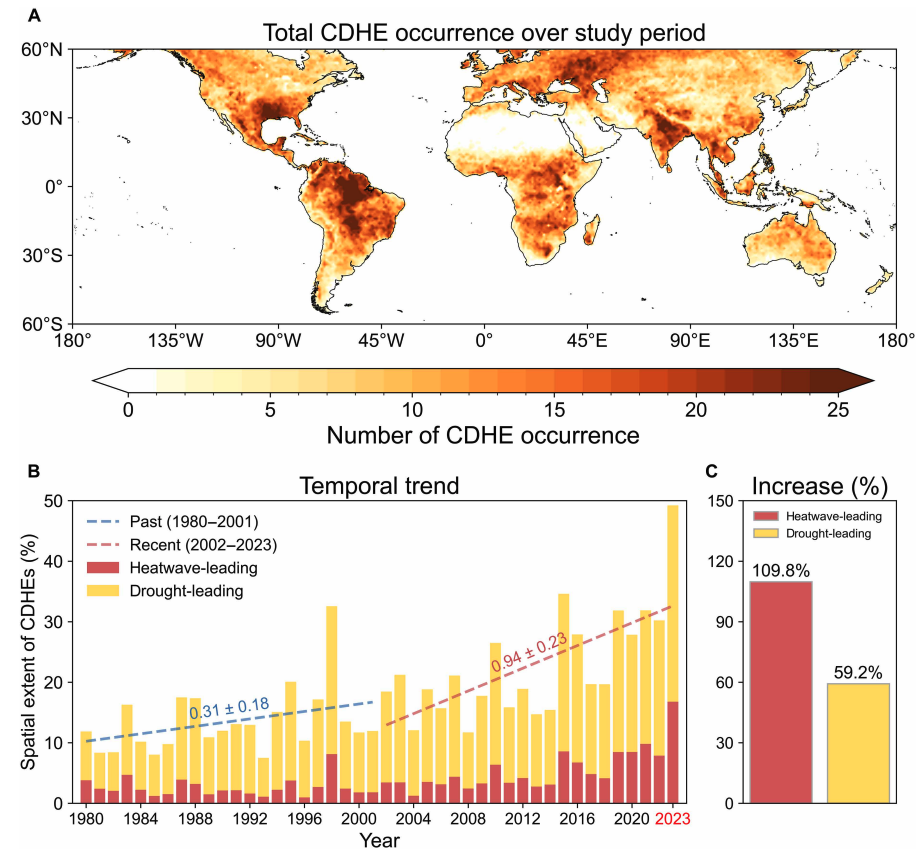
Heatwave-led events have been the main contributor to this increase, the study says, with their spatial extent rising 110% between 1980-2001 and 2002-23, compared to a 59% increase for drought-led events.
The map below shows the global distribution of CDHEs over 1980-2023. The charts show the percentage of the land surface affected by a heatwave-led CDHE (red) or a drought-led CDHE (yellow) in a given year (left) and relative increase in each CDHE type (right).
The study finds that CDHEs have occurred most frequently in northern South America, the southern US, eastern Europe, central Africa and south Asia.
Threshold passed
The authors explain that the increase in heatwave-led CDHEs is related to rising global temperatures, but that this does not tell the whole story.
In the earlier 22-year period of 1980-2001, the study finds that the spatial extent of heatwave-led CDHEs rises by 1.6% per 1C of global temperature rise. For the more-recent period of 2022-23, this increases “nearly eightfold” to 13.1%.
The change suggests that the rapid increase in the heatwave-led CDHEs occurred after the global average temperature “surpasse[d] a certain temperature threshold”, the paper says.
This threshold is an absolute global average temperature of 14.3C, the authors estimate (based on an 11-year average), which the world passed around the year 2000.
Investigating the recent surge in heatwave-leading CDHEs further, the researchers find a “regime shift” in land-atmosphere dynamics “toward a persistently intensified state after the late 1990s”.
In other words, the way that drier soils drive higher surface temperatures, and vice versa, is becoming stronger, resulting in more heatwave-led compound events.
Daily data
The research has some advantages over other previous studies, Yeh says. For instance, the new work uses daily estimations of CDHEs, compared to monthly data used in past research. This is “important for capturing the detailed occurrence” of these events, says Yeh.
He adds that another advantage of their study is that it distinguishes the sequence of droughts and heatwaves, which allows them to “better understand the differences” in the characteristics of CDHEs.
Dr Meryem Tanarhte is a climate scientist at the University Hassan II in Morocco, and Dr Ruth Cerezo Mota is a climatologist and a researcher at the National Autonomous University of Mexico. Both scientists, who were not involved in the study, agree that the daily estimations give a clearer picture of how CDHEs are changing.
Cerezo-Mota adds that another major contribution of the study is its global focus. She tells Carbon Brief that in some regions, such as Mexico and Africa, there is a lack of studies on CDHEs:
“Not because the events do not occur, but perhaps because [these regions] do not have all the data or the expertise to do so.”
However, she notes that the reanalysis data used by the study does have limitations with how it represents rainfall in some parts of the world.
Compound impacts
The study notes that if CDHEs continue to intensify – particularly events where heatwaves are the precursors – they could drive declining crop productivity, increased wildfire frequency and severe public health crises.
These impacts could be “much more rapid and severe as global warming continues”, Yeh tells Carbon Brief.
Tanarhte notes that these events can be forecasted up to 10 days ahead in many regions. Furthermore, she says, the strongest impacts can be prevented “through preparedness and adaptation”, including through “water management for agriculture, heatwave mitigation measures and wildfire mitigation”.
The study recommends reassessing current risk management strategies for these compound events. It also suggests incorporating the sequences of drought and heatwaves into compound event analysis frameworks “to enhance climate risk management”.
Cerezo-Mota says that it is clear that the world needs to be prepared for the increased occurrence of these events. She tells Carbon Brief:
“These [risk assessments and strategies] need to be carried out at the local level to understand the complexities of each region.”



The post Heatwaves driving recent ‘surge’ in compound drought and heat extremes appeared first on Carbon Brief.
Heatwaves driving recent ‘surge’ in compound drought and heat extremes
Greenhouse Gases
DeBriefed 6 March 2026: Iran energy crisis | China climate plan | Bristol’s ‘pioneering’ wind turbine
Welcome to Carbon Brief’s DeBriefed.
An essential guide to the week’s key developments relating to climate change.
This week
Energy crisis
ENERGY SPIKE: US-Israeli attacks on Iran and subsequent counterattacks across the Middle East have sent energy prices “soaring”, according to Reuters. The newswire reported that the region “accounts for just under a third of global oil production and almost a fifth of gas”. The Guardian noted that shipping traffic through the strait of Hormuz, which normally ferries 20% of the world’s oil, “all but ground to a halt”. The Financial Times reported that attacks by Iran on Middle East energy facilities – notably in Qatar – triggered the “biggest rise in gas prices since Russia’s full-scale invasion of Ukraine”.
‘RISK’ AND ‘BENEFITS’: Bloomberg reported on increases in diesel prices in Europe and the US, speculating that rising fuel costs could be “a risk for president Donald Trump”. US gas producers are “poised to benefit from the big disruption in global supply”, according to CNBC. Indian government sources told the Economic Times that Russia is prepared to “fulfil India’s energy demands”. China Daily quoted experts who said “China’s energy security remains fundamentally unshaken”, thanks to “emergency stockpiles and a wide array of import channels”.
‘ESSE