

Welcome to Carbon Brief’s DeBriefed.
An essential guide to the week’s key developments relating to climate change.
This week
Deadly Texas floods
EXTREME FLOODING: At least 120 people died and 173 remain missing one week after flash floods in Texas, NBC News reported. The floods were “one of the deadliest weather events in recent American history”, the New York Times said. The newspaper said it is “too early to say with certainty” the role of climate change, but this type of extreme rainfall is “precisely the kind of phenomenon that scientists say is becoming more common because of global warming”.
STORM CONDITIONS: Bloomberg noted that drought, the “abnormally hot Gulf of Mexico” and other factors fuelled the “storm that spawned the floods” in Kerr county. Climate scientists told Inside Climate News that the “torrential downpours on 4 July exemplify the devastating outcomes of weather intensified by a warming atmosphere”.
CUTS QUESTIONED: The Guardian reported on a warning from experts that such floods could become the “new normal” as “Donald Trump and his allies dismantle crucial federal agencies that help states prepare and respond to extreme weather and other hazards”. E&E News reported that “forecasts and warnings largely worked during the catastrophe in Texas”, but that “those systems are expected to degrade as Trump’s cuts take hold”.
HIMALAYAN FLOODS: Elsewhere, heavy rainfall “battered” two Himalayan states in India, “leading to widespread damage, disruption and loss of life”, India Today reported. Pakistan’s Dawn newspaper reported that “record high summer temperatures” have “accelerated the melting of glaciers”, leading to deadly flooding in some parts of the country.
Europe heat deaths
RAGING HEAT: Around 1,500 of the 2,300 heat deaths during the heatwave that “seared Europe at the end of June” can be attributed to climate change, according to World Weather Attribution analysis covered by the Guardian. The newspaper said that Milan was the “hardest-hit city” and that 88% of the “climate-driven deaths” were in people aged over 65.
MORE EXTREMES: Extreme heat continued to affect much of Europe this week. In Catalonia, Spain, more than 18,000 people were ordered to remain indoors as a “wildfire raged out of control, consuming almost 3,000 hectares of vegetation”, Reuters said. Marseille airport closed as a major wildfire encroached on the southern French city, Le Monde reported.
‘CLIMATE DELAYERS’: Meanwhile, a “far-right” political group successfully outbid other groups to lead negotiations for the EU’s next climate target on behalf of the European parliament, according to Politico. This role for the Patriots for Europe group “give[s] the far right unprecedented influence” over the 2040 target, the outlet said, adding that it “strongly opposes the EU’s climate policies”. An early attempt to curb the bloc’s influence failed, Reuters said.
Around the world
- LIBYAN OIL: BP and Shell have “signed agreements to assess new opportunities in Libya”, the Financial Times reported, joining several oil majors resuming exploration following the country’s civil war.
- SOLAR POWER: Trump issued an executive order targeting “unaffordable and unreliable ‘green’ energy sources”, reported Inside Climate News. But the outlet said it is unclear whether this will “have much of an effect”.
- CLIMATE MOTION: The UN Human Rights Council passed a motion on climate change and human rights – but only after the Marshall Islands withdrew a “divisive amendment” calling on states to recommit to a fossil fuel phase-out, Reuters said.
- BELÉM INCOMING: Meanwhile, the president of COP30 told Climate Home News that countries “already decided” to transition away from fossil fuels and climate negotiations can now focus on a “timeline or rules for how this transition will be made”.
- LAW: The International Court of Justice will issue a major opinion on the legal obligation of countries to address climate change on 23 July, reported Reuters. Although it is nonbinding, experts told the newswire that it “could set a precedent in climate change-driven lawsuits” around the world.
74%
The percentage of global wind and solar projects under construction that are located in China, according to a Global Energy Monitor report.
Latest climate research
- Annual meltwater from the Greenland ice sheet “significantly increased” in the past three decades | Nature Climate Change
- The wealthier and more democratic a nation, the less their citizens engage in climate activism | Journal of Environmental Psychology
- Climate change has “played an important role” in genetic and demographic changes in Tibetan macaques | Science Advances
(For more, see Carbon Brief’s in-depth daily summaries of the top climate news stories on Monday, Tuesday, Wednesday, Thursday and Friday.)
Captured
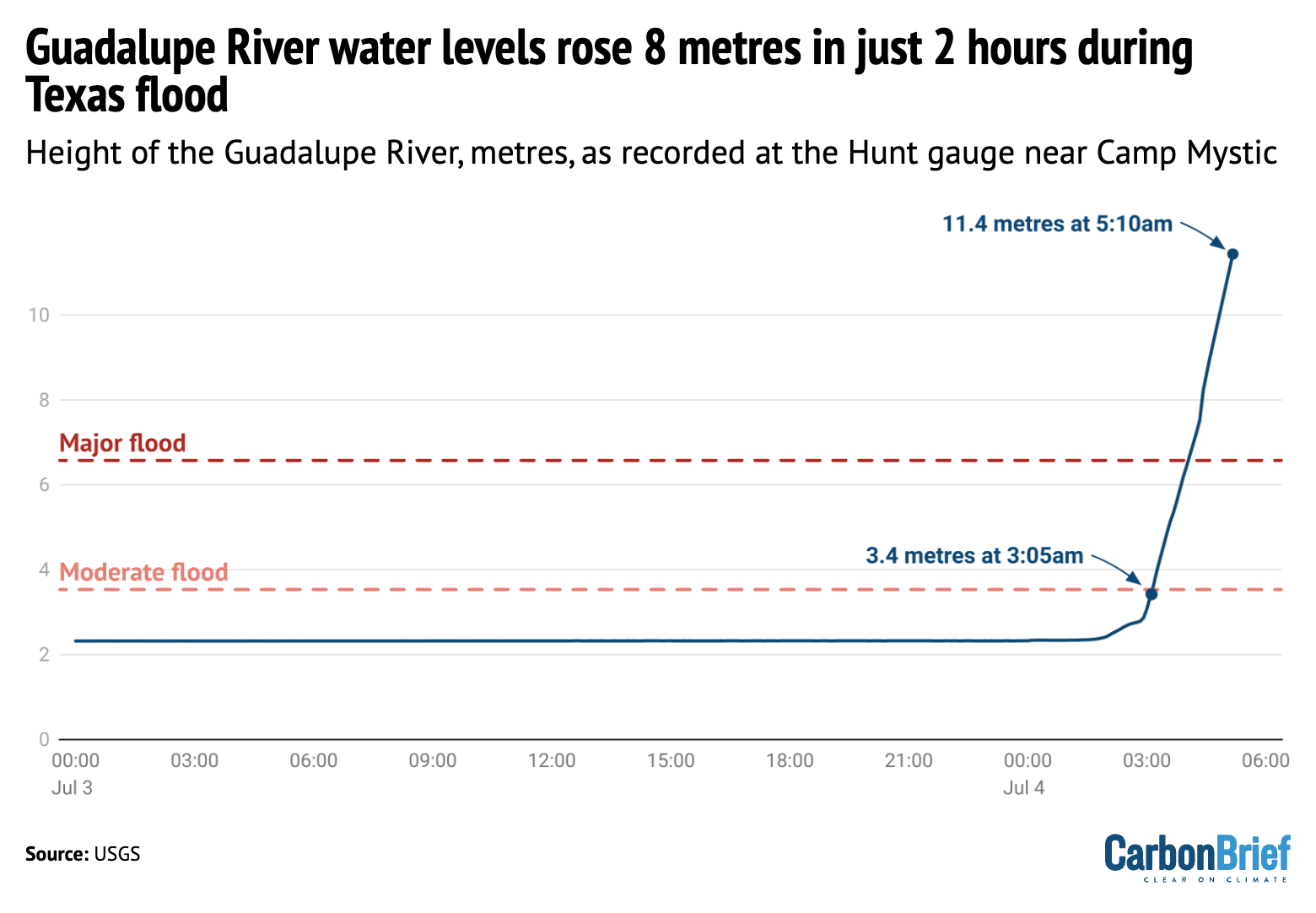
Water levels soared by more than eight metres in just over two hours on the Guadalupe River within an area known as “flash flood alley” in Texas on 4 July. The resulting floods caused devastation for people in nearby homes and summer camps. Satellite imagery in NBC News showed the scale of the impact. Carbon Brief examined the potential role of climate change in the flood and how it was covered by global media.
Spotlight
Ireland exits coal
This week, Carbon Brief looks at the significance of Ireland becoming the latest European country to end coal-powered electricity.
Ireland has joined the UK and a slew of other nations in burning its last lump of coal – the most polluting fossil fuel – to generate electricity.
Coal use ceased on 20 June at Moneypoint, the country’s last coal-burning power station, in line with a 2019 government pledge.
Spain and Italy are expected to become the next European countries to leave behind coal power, according to Beyond Fossil Fuels.
Ireland’s move offers an important “signal” for the country’s energy transition, said Margie McCarthy, the director of research and policy insights at the Sustainable Energy Authority of Ireland (SEAI). She told Carbon Brief:
“We’ve put in place a lot of really ambitious legislation and climate action plans, but we are still more than 80% reliant on fossil fuels across all of our energy demands…Coal is a particularly carbon-intensive fossil fuel, so any movement away from that is a good step forward.”
Coal controversies
Gas (42.1% in 2024) and renewables (39.6%) generate the vast majority of Ireland’s electricity. Coal, despite its overall decline, experienced a mini-comeback in 2021 and 2022 – broadly in line with EU trends when gas prices soared as Russia restricted supplies and countries later dropped Russian fossil fuels following the country’s invasion of Ukraine.
The share of Ireland’s electricity coming from coal increased from 4% in 2020 to 14% in 2021. This fluctuated again in recent years, dropping to 4.6% in May 2025.

The ESB, the state-owned energy company that runs Moneypoint, was criticised in 2022 for resuming shipments from a controversial Colombian mine as an alternative to Russian coal. The company had stopped buying coal from the Cerrejón mine in 2018.
Cerrejón is “Latin America’s largest open-pit coal mine” – six times the size of Manchester, a recent article from the Bureau of Investigative Journalism said. Ireland’s national broadcaster RTÉ reported in 2024:
“According to local communities, lawyers’ organisations and court rulings, in its four decades of operation it has driven an environmental crisis that has destroyed the health, lives and culture of many thousands of Indigenous people.”
An ESB spokesperson told Carbon Brief that it sourced a “limited amount of coal from Cerrejón between April 2022 and August 2023”.
Next steps
Now that coal use has wound down, Moneypoint will remain available to generate electricity using oil on a back-up basis until 2029.
The ESB “expects low levels of running of the plant going forward”, a spokesperson said.
The company plans to turn Moneypoint into a “green energy hub”, with a major offshore windfarm, a wind turbine construction hub and a green hydrogen facility on site.
Looking at Ireland’s ongoing energy transition, McCarthy said that, although gas still plays a “significant” role, increases in wind, solar and electricity interconnection are “good signals to move in the right direction”. She added:
“We just need to keep the pace going. We need to accelerate quicker…and that we make sure we’re managing demand while we are trying to accelerate that pace.”
Data centre dilemma
A major cause of Ireland’s growing electricity demand is data centres, which consumed more than one-fifth of the country’s electricity supplies in 2024 – more than all urban households.
Ireland has become an “EU pioneer of data centres” thanks to “its low taxes, temperate climate and fibre cable access to the US and Europe”, according to the Financial Times.
McCarthy highlighted the importance of ensuring that “data centre demand is not undoing the renewable energy share, or the final energy consumption reductions that are required as part of our targets and obligations”. She added:
“It’s very fair to say that the efficiency measures in data centres have been significant…But the issue is that the demand is outpacing any efficiency measures that are being introduced.”
Watch, read, listen
OIL TO LITHIUM: A Climate Home News article looked at the challenges facing Nigeria’s efforts to “supply refined lithium to the electric vehicle battery industry”.
PODCAST CHAT: The Rest is Politics podcast spoke to the UK Climate Change Committee chief executive, Emma Pinchbeck, about net-zero and the energy transition.
BRRR: A BBC News “in depth” article explored the growing “battle” for control over the Arctic, along with the security challenges from climate change and other issues in “one of the world’s coldest places”.
Coming up
- 7-25 July: 30th session of the International Seabed Authority (part II), Kingston, Jamaica
- 14-23 July: UN high-level political forum on sustainable development, New York
- 17 July: UN General Assembly third informal dialogue on the Pact for the Future, New York
- 14-18 July:20th ordinary session of the African ministerial conference on the environment, Nairobi, Kenya
Pick of the jobs
- New Scientist, environment news reporter | Salary: £40,000-£50,000 (pro rata). Location: London
- Environmental Defense Fund, senior analyst, mission finance | Salary: €56,000-£61,000. Location: Belgium, the Netherlands or UK
- Daily Telegraph, environment editor | Salary: Unknown. Location: London
- United Nations Human Settlements Programme, junior nature-based solutions and climate consultant | Salary: Unknown. Location: Kenya
- Brookline.News, freelance environmental reporter | Salary: Unknown. Location: Massachusetts, US
DeBriefed is edited by Daisy Dunne. Please send any tips or feedback to debriefed@carbonbrief.org.
This is an online version of Carbon Brief’s weekly DeBriefed email newsletter. Subscribe for free here.


The post DeBriefed 11 July 2025: Texas floods; Global warming ‘tripled’ Europe heat deaths; Ireland exits coal appeared first on Carbon Brief.

Drought and heatwaves occurring together – known as “compound” events – have “surged” across the world since the early 2000s, a new study shows.
Compound drought and heat events (CDHEs) can have devastating effects, creating the ideal conditions for intense wildfires, such as Australia’s “Black Summer” of 2019-20 where bushfires burned 24m hectares and killed 33 people.
The research, published in Science Advances, finds that the increase in CDHEs is predominantly being driven by events that start with a heatwave.
The global area affected by such “heatwave-led” compound events has more than doubled between 1980-2001 and 2002-23, the study says.
The rapid increase in these events over the last 23 years cannot be explained solely by global warming, the authors note.
Since the late 1990s, feedbacks between the land and the atmosphere have become stronger, making heatwaves more likely to trigger drought conditions, they explain.
One of the study authors tells Carbon Brief that societies must pay greater attention to compound events, which can “cause severe impacts on ecosystems, agriculture and society”.
Compound events
CDHEs are extreme weather events where drought and heatwave conditions occur simultaneously – or shortly after each other – in the same region.
These events are often triggered by large-scale weather patterns, such as “blocking” highs, which can produce “prolonged” hot and dry conditions, according to the study.
Prof Sang-Wook Yeh is one of the study authors and a professor at the Ewha Womans University in South Korea. He tells Carbon Brief:
“When heatwaves and droughts occur together, the two hazards reinforce each other through land-atmosphere interactions. This amplifies surface heating and soil moisture deficits, making compound events more intense and damaging than single hazards.”
CDHEs can begin with either a heatwave or a drought.
The sequence of these extremes is important, the study says, as they have different drivers and impacts.
For example, in a CDHE where the heatwave was the precursor, increased direct sunshine causes more moisture loss from soils and plants, leading to a drought.
Conversely, in an event where the drought was the precursor, the lack of soil moisture means that less of the sun’s energy goes into evaporation and more goes into warming the Earth’s surface. This produces favourable conditions for heatwaves.
The study shows that the majority of CDHEs globally start out as a drought.
In recent years, there has been increasing focus on these events due to the devastating impact they have on agriculture, ecosystems and public health.
In Russia in the summer of 2010, a compound drought-heatwave event – and the associated wildfires – caused the death of nearly 55,000 people, the study notes.

The record-breaking Pacific north-west “heat dome” in 2021 triggered extreme drought conditions that caused “significant declines” in wheat yields, as well as in barley, canola and fruit production in British Columbia and Alberta, Canada, says the study.
Increasing events
To assess how CDHEs are changing, the researchers use daily reanalysis data to identify droughts and heatwaves events. (Reanalysis data combines past observations with climate models to create a historical climate record.) Then, using an algorithm, they analyse how these events overlap in both time and space.
The study covers the period from 1980 to 2023 and the world’s land surface, excluding polar regions where CDHEs are rare.
The research finds that the area of land affected by CDHEs has “increased substantially” since the early 2000s.
Heatwave-led events have been the main contributor to this increase, the study says, with their spatial extent rising 110% between 1980-2001 and 2002-23, compared to a 59% increase for drought-led events.
The map below shows the global distribution of CDHEs over 1980-2023. The charts show the percentage of the land surface affected by a heatwave-led CDHE (red) or a drought-led CDHE (yellow) in a given year (left) and relative increase in each CDHE type (right).
The study finds that CDHEs have occurred most frequently in northern South America, the southern US, eastern Europe, central Africa and south Asia.

Threshold passed
The authors explain that the increase in heatwave-led CDHEs is related to rising global temperatures, but that this does not tell the whole story.
In the earlier 22-year period of 1980-2001, the study finds that the spatial extent of heatwave-led CDHEs rises by 1.6% per 1C of global temperature rise. For the more-recent period of 2022-23, this increases “nearly eightfold” to 13.1%.
The change suggests that the rapid increase in the heatwave-led CDHEs occurred after the global average temperature “surpasse[d] a certain temperature threshold”, the paper says.
This threshold is an absolute global average temperature of 14.3C, the authors estimate (based on an 11-year average), which the world passed around the year 2000.
Investigating the recent surge in heatwave-leading CDHEs further, the researchers find a “regime shift” in land-atmosphere dynamics “toward a persistently intensified state after the late 1990s”.
In other words, the way that drier soils drive higher surface temperatures, and vice versa, is becoming stronger, resulting in more heatwave-led compound events.
Daily data
The research has some advantages over other previous studies, Yeh says. For instance, the new work uses daily estimations of CDHEs, compared to monthly data used in past research. This is “important for capturing the detailed occurrence” of these events, says Yeh.
He adds that another advantage of their study is that it distinguishes the sequence of droughts and heatwaves, which allows them to “better understand the differences” in the characteristics of CDHEs.
Dr Meryem Tanarhte is a climate scientist at the University Hassan II in Morocco, and Dr Ruth Cerezo Mota is a climatologist and a researcher at the National Autonomous University of Mexico. Both scientists, who were not involved in the study, agree that the daily estimations give a clearer picture of how CDHEs are changing.
Cerezo-Mota adds that another major contribution of the study is its global focus. She tells Carbon Brief that in some regions, such as Mexico and Africa, there is a lack of studies on CDHEs:
“Not because the events do not occur, but perhaps because [these regions] do not have all the data or the expertise to do so.”
However, she notes that the reanalysis data used by the study does have limitations with how it represents rainfall in some parts of the world.
Compound impacts
The study notes that if CDHEs continue to intensify – particularly events where heatwaves are the precursors – they could drive declining crop productivity, increased wildfire frequency and severe public health crises.
These impacts could be “much more rapid and severe as global warming continues”, Yeh tells Carbon Brief.
Tanarhte notes that these events can be forecasted up to 10 days ahead in many regions. Furthermore, she says, the strongest impacts can be prevented “through preparedness and adaptation”, including through “water management for agriculture, heatwave mitigation measures and wildfire mitigation”.
The study recommends reassessing current risk management strategies for these compound events. It also suggests incorporating the sequences of drought and heatwaves into compound event analysis frameworks “to enhance climate risk management”.
Cerezo-Mota says that it is clear that the world needs to be prepared for the increased occurrence of these events. She tells Carbon Brief:
“These [risk assessments and strategies] need to be carried out at the local level to understand the complexities of each region.”




The post Heatwaves driving recent ‘surge’ in compound drought and heat extremes appeared first on Carbon Brief.
Heatwaves driving recent ‘surge’ in compound drought and heat extremes
Greenhouse Gases
DeBriefed 6 March 2026: Iran energy crisis | China climate plan | Bristol’s ‘pioneering’ wind turbine
Welcome to Carbon Brief’s DeBriefed.
An essential guide to the week’s key developments relating to climate change.
This week
Energy crisis
ENERGY SPIKE: US-Israeli attacks on Iran and subsequent counterattacks across the Middle East have sent energy prices “soaring”, according to Reuters. The newswire reported that the region “accounts for just under a third of global oil production and almost a fifth of gas”. The Guardian noted that shipping traffic through the strait of Hormuz, which normally ferries 20% of the world’s oil, “all but ground to a halt”. The