

- Formal negotiations
- Turkish and Australian leadership
- Cover decision
- COP reform
- Adaptation
- Finance
- Just transition work programme
- Loss and damage
- Gender
- Article 6
- Agriculture and food security
- Mitigation work programme
- Response measures
- Action for climate empowerment
- Trade
- Second global stocktake
- Long-term goal review
- Around the COP
- Fossil fuels
- Action agenda
- Global leaders
- Electrification
- China at COP31
- Ocean
- Deforestation
- Methane
- New climate science
- Food and water
- NDCs
- Protests and access
- Road to COP32 and beyond

Franziska Mager is senior researcher and advocacy lead for climate and inequalities at the Tax Justice Network.
As the climate crisis accelerates, global fault lines widen. Wealthy nations gut aid budgets while pouring fortunes into their militaries. Their climate finance commitments ring hollow, hidden behind claims that public funds have run dry.
But the money is there – and a bold tax justice agenda can unlock it. Reclaiming tax sovereignty – the power to decide how wealth is taxed and where it goes – can shift resources from billionaires and corporate giants to real climate solutions.
Tax Justice Network analysis shows governments could raise an extra US$2.6 trillion a year by applying a modest wealth tax on the richest 0.5% and ending corporate tax abuse. This would more than cover global climate finance needs and still leave most countries with billions to invest in care, education and green jobs at home.
Coalition set sights on taxing luxury air travel to fund climate action
The climate crisis is accelerating. Floods, heatwaves and crop failures are pushing more people into precarity. Climate adaptation, mitigation, and loss and damage could cost US$9 trillion a year by 2030. Yet the global community is still scrambling to honour a US$100 billion pledge made over 15 years ago.
As attention turns from the Bonn climate talks to the fourth Financing for Development conference in Seville, climate finance remains a structural void that policy declarations alone cannot fill.
On the road to COP30 in Belém, governments face a critical choice: keep chasing inadequate voluntary climate finance handouts, or finally confront the rigged tax systems that let the super-rich and big polluters amass obscene wealth while the planet burns.
Plugging leaky tax systems
As our research shows, fair taxes on extreme wealth and curbing multinational tax abuse could raise more than double the UN’s US$1.3 trillion annual climate finance goal for 2035. The real issue isn’t where new money comes from, but why governments let public resources leak through a broken tax system.
Applying a modest annual wealth tax of 1.7-3.5% and reclaiming tax from multinationals that underpay could unlock revenue equal to 2.4% of global GDP. This money could be raised today if governments closed loopholes and took action.
Our modelling based on countries’ historic emissions responsibility shows striking results: with a US$300 billion global climate finance fund, 89% of countries could cover their share and still have billions left for public services. Even with a US$1.5 trillion fund, 58% would contribute their fair share and have money to spare.
Take the United States. It could raise enough additional revenue to contribute US$365 billion a year towards climate finance and still be left with US$412 billion to spend at home. China, India, the United Kingdom and Brazil follow the same pattern.
This is the core message of our climate finance slider tool. Taxing extreme wealth and curbing tax abuse does not pit climate justice against development. It enables both. The interactive tool shows how much countries could raise and how much they could contribute if tax rules were rebalanced in favour of people and planet.
Governments lose tax control
So why are countries still acting like climate finance is unaffordable?
The answer lies in decades of eroded tax sovereignty. Governments have signed away their taxing rights through unfair treaties, handed out corporate tax breaks under economic coercion, and let wealth pour into secrecy jurisdictions. In doing so, they’ve stripped themselves of the power – and the will – to tax the richest and biggest polluters driving the climate crisis.
Brazil’s environment minister suggests roadmap to end fossil fuels at COP30
Today, 61% of countries have an “endangered” level of tax sovereignty or worse — meaning they are failing to collect tax revenue worth at least 5% of what they already raise, largely from their richest households and from multinational corporations that underpay tax.
Nearly a fifth of countries fall into the “negated” category, missing out on the equivalent of 15% or more of their annual tax revenue. These are not natural constraints. They are political outcomes shaped by an unequal global financial system.
Across the Global South, the consequences are especially severe. Governments face impossible tradeoffs between education and adaptation, debt service and disaster response. Climate finance cannot be separated from this wider fiscal injustice.
When forced to borrow for every disaster or rely on aid pledges, governments lose both agency and time. The race to build resilience becomes a race against the clock – one they cannot win without revenue.
Wealth taxes popular with voters
It’s time to reframe the debate. Climate finance can’t rely on broken promises or voluntary pledges. It must come from fair, redistributive tax systems that reflect both capacity to pay and responsibility for emissions.
The upcoming UN Tax Convention is a once in a generation opportunity to rebalance global tax rules. Done right, it could help countries tax their richest residents and corporations fairly, ending tax havens, profit-shifting and billionaire impunity.
Comment: A global wealth tax is needed to help fund a just green transition
But we do not need to wait for negotiations to conclude. Countries can act now by introducing wealth taxes, renegotiating exploitative tax treaties, increasing transparency and aligning fiscal policies with climate goals.
These reforms are not only possible. They are popular. Polling consistently shows widespread support for taxing extreme wealth to fund public goods.
Extreme wealth fuels climate inaction, rising debt and inequality. In a world on fire, refusing to tax those who profit most is no longer neutral – it’s a global risk.
The post There is no climate finance gap – only a tax sovereignty gap appeared first on Climate Home News.
There is no climate finance gap – only a tax sovereignty gap
Continue Reading
The COP31 climate talks in Antalya, Turkey, have failed to reach agreement on a “pact” that lacked clear references to curbing fossil fuels or scaling up climate finance.
The “Antalya pact”, proposed by the joint Turkish-Australian presidency, was rejected in the final hours by the EU, the UK and several climate-vulnerable nations.
Meanwhile, many developing countries criticised the lack of progress on climate finance and indecision on a proposed $120bn target for funding climate adaptation.
With stark divisions preventing agreement on the presidency-led pact, UNFCCC chief Simon Stiell expressed “deep disappointment”, speaking of “scope to improve, modernise and reform” the UN climate process.
Despite a chaotic endgame that saw the overrunning COP become the longest in history, it did not end in complete failure, with many items adopted in the closing plenary.
These included fairly limited or procedural outcomes on a new “mechanism” for global “just transitions”, plus support for countries struck by climate disasters.
There was some progress beyond the negotiations, though, with growing coalitions of nations championing “roadmaps” for “transitioning away” from fossil fuels.
With the presidency promoting “electrification” as a key theme, around 80 nations also signed up to a global target of securing 35% of final energy consumption from electricity by 2035.
Here, Carbon Brief provides in-depth analysis of all the key outcomes from Antalya, both inside and outside the COP31 negotiations.
(See Carbon Brief’s coverage of COP30, COP29, COP28, COP27, COP26, COP25, COP24, COP23, COP22, COP21 and COP20.)
- Formal negotiations
- Turkish and Australian leadership
- Cover decision
- COP reform
- Adaptation
- Finance
- Just transition work programme
- Loss and damage
- Gender
- Article 6
- Agriculture and food security
- Mitigation work programme
- Response measures
- Action for climate empowerment
- Trade
- Second global stocktake
- Long-term goal review
- Guidance on NDCs
- Rio synergies
- Around the COP
- Road to COP32 and beyond
Formal negotiations
Turkish and Australian leadership
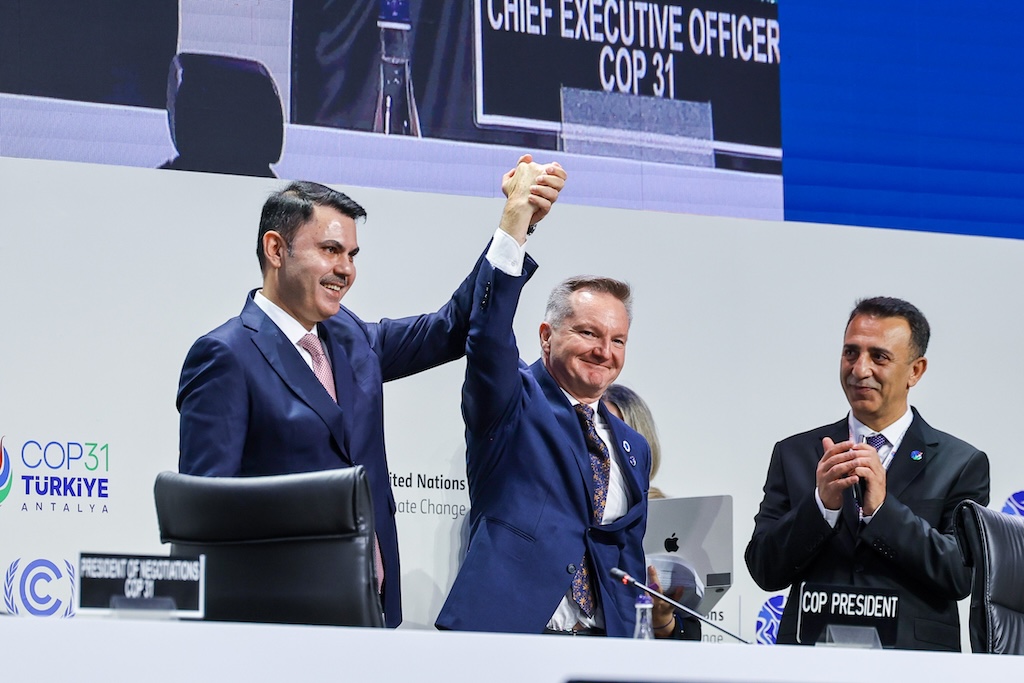
Turkey and Australia presided over the longest COP in history – and failed to find consensus on their proposed “cover decision”, exposing deep fractures between countries on key issues such as fossil fuels and the need for developed nations to meet climate-finance pledges.
Experts told Carbon Brief that, strictly, the talks did not “collapse” as several negotiated items were still adopted.
Rather, the rejection of the cover decision represented, for the first time, “those who want a higher level of ambition actively reject[ing] the lowest common denominator on offer”, said one veteran observer.
Dispute over who would host COP31 – representing the “western Europe and other states” region – had gone on for three years.
In the end, the two main rivals, Turkey and Australia, agreed to a deal last year at COP30 that the summit would take place in Antalya, Turkey, with Australia acting as “president of negotiations”.
Critics questioned whether either country was well-placed to host, given their ongoing fossil-fuel expansion.
Turkey faced criticism for announcing the discovery of two new oil fields on the eve of the summit, while recent Carbon Brief analysis found that Australia is the third-largest CO2 exporter in history because of its fossil-fuel production.
Ahead of the summit, the presidency released four official letters outlining a vision for COP31.
The first letter, written by COP31 president Murat Kurum in April 2026, confirmed the appointment of Australian climate minister Chris Bowen as “president of the negotiations” and announced that a pre-COP would be held in Fiji in October.
The second letter, authored by both Kurum and Bowen from the Copenhagen climate ministerial in May, said that “COP31 presents a vital opportunity to further accelerate…in the areas of clean energy, electrification and resilient infrastructure”.
The third letter, published in August 2026, gave more details on the presidency’s plans for the “action agenda” – the part of the UN process that mobilises coalitions of nations and non-state actors to push climate action further.
This letter also introduced a key aim from the presidency to get countries to agree to increase electricity’s share of final energy consumption to 35% by 2035 (often referred to as “35 by 35”). (See: Electrification.)
The final letter, published in October ahead of the pre-COP in Fiji, said that the presidency would centre on “delivering a COP focused on accelerating implementation, electrification and resilience in an uncertain world”.
It added that “many parties have emphasised the importance of reviewing and continuously improving UNFCCC processes, to ensure it remains fit for purpose, sustainable and focused as negotiations evolve over time”, adding:
“At COP31, we will hold presidency consultations to hear parties’ views on how to strengthen UNFCCC processes, to ensure growing demands are met and to effectively deploy resources.”
The pre-COP in Fiji was held from 5-8 October and was attended by 3,000 people.
In this somewhat intimate setting, Bowen announced that Turkey and Australia had agreed to negotiate a “presidency-led” cover decision at COP31.
He added that revealing this before COP was part of the presidency’s “upfront, transparent and consultative approach”.
Later that month, the presidency named the five ministerial pairs from developed and developing countries that would take key negotiation issues forward at COP31. These issues were mitigation, adaptation, finance, just transition and oceans.
COP31 kicked off on 9 November, with climate negotiations scholar (and Carbon Brief contributing editor) Dr Joanna Depledge noting that it was clear from the summit’s opening ceremony that “Australia [was] the junior partner” in the presidency.
COP’s opening day ran late into the night as the presidency worked to avert a fight over proposed changes to the summit’s negotiations agenda.
Agenda adopted! Moments ago in Antalya, Turkey, COP31 president Murat Kurum outlined how an “agenda fight” has been averted, despite various proposals for additions to proceedings. This came after a short delay, while a series of huddles took place on…
 Simon Evans
COP31: Agenda adopted!

The next day, in plenary, Kurum announced that a resolution had been found.
He said that calls for new agenda items on adaptation finance and trade were rejected, whereas an item on a new climate finance “work programme” had been added. (The EU expressed “deep concern” about the addition.)
Kurum added that two extra proposed items on mountains and climate change – made more poignant by recent catastrophic floods in Nepal – were also not added to the agenda. However, he said that the presidency would instead hold consultations on the topic.
Though an early scrap over the agenda was avoided, the summit’s opening days were plagued with logistical problems.
Attendees were forced to spend hours navigating traffic and queues just to get into the venue – sparking serious access concerns.
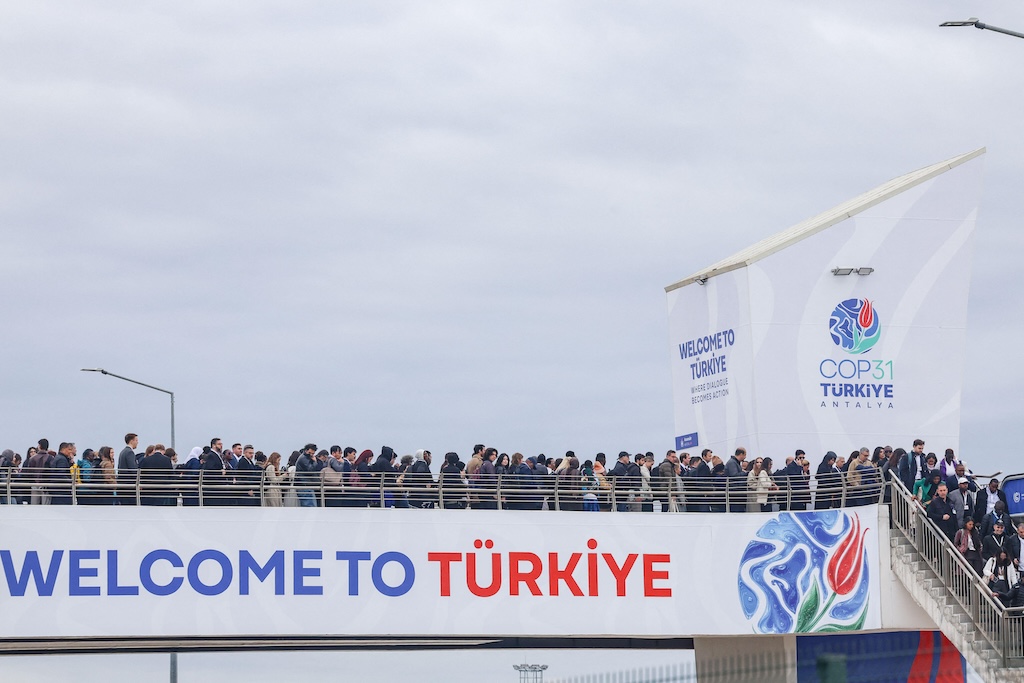
The problems persisted into the first day of the world leaders’ summit on 11 November, when delegates were informed that they should travel between the hours of 5-7am to secure access to the venue. Ire only grew when security staff still let people in after this time.
On Friday morning, the presidency released a “reflections” text from its consultations with countries on what they would like to see in a cover decision. This was an “informal note” with a bullet-pointed list of topics that might be included.
On Saturday evening, Kurum told a press conference that “around 30 countries” had indicated support for the 35 by 35 pledge.
However, he had little to share on progress in the negotiations and eluded questions on how he planned to include “fossil fuels” in the cover decision.
In the small hours of Sunday morning, half-way through the summit, Kurum announced presidency and ministerial consultations on “outstanding political issues”.
He also invited ministers to a “divan” – a group meeting, not a daybed – to discuss cross-cutting issues.
On Monday afternoon, the presidency dropped an 18-page first draft of its proposed cover decision – along with a short “presidency note” explaining that all elements were still in play, including whether or not they should appear in a final text. (See: Cover decision.)
At a press conference, Bowen told journalists that the presidency decided to release the text “early” to allow parties to debate on it for as long as possible and acknowledged that it would need to be “refined” down.
On Wednesday evening, the presidency held its divan, where delegation heads sat in a circle and were asked to share their priorities for finding consensus in the negotiations.