

Welcome to Carbon Brief’s DeBriefed.
An essential guide to the week’s key developments relating to climate change.
This week
US budget bill ‘would kill IRA’
WAYS AND MEANS: The future of Joe Biden’s signature climate policy, the Inflation Reduction Act (IRA), is in doubt after Republicans on two key Congressional committees passed budget proposals that “would effectively kill” it, reported Heatmap News. The proposals would end clean-energy tax credits and rebates for electric vehicle (EV) purchases, “claw back” climate grants and “slash” related spending, said Reuters.
DEFENCE DOUBTS: While a “small subset” of House Republicans have been trying to defend the IRA, it is unclear if they would block passage of the wider budget bill to get their way, according to E&E News. In the Senate, Politico said “some” Republicans are “pushing back” on the current proposals. A New York Times feature said Republican districts “have the most to lose” if all of the IRA tax credits are repealed. Semafor reported Republicans were “wrestling with possible failure” of the bill, in the face of opposition from Democrats and their own ranks. (Law firm Grant Thornton said policymakers were hoping to pass the bill by 4 July.)
SOCIAL COST: Meanwhile, a new White House memo directed US government agencies to disregard economic damages from climate change, reported E&E News. Under a headline asking, “What’s the cost of pollution? Trump says zero”, the New York Times explained that the “social cost of carbon” had been used for more than two decades to help weigh the costs and benefits of federal policies and regulations. It said the move could face legal challenges.
Around the world
- DOWNPOUR DEATHS: More than 100 people were killed by floods in the Democratic Republic of the Congo, Agence-France Presse reported. Extreme rainfall also killed at least seven people in Somalia, the Associated Press said.
- PARIS PERIL: A UK opposition minister falsely attacked climate science and said his party could exit the Paris Agreement if elected, the Guardian said. The Guardian also reported on how Australia’s new opposition leader “could abandon net-zero”.
- GERMAN GAS: New economy minister Katharina Reiche wants more gas-fired power plants, according to Die Zeit. The country’s climate council warned the new government’s plans could breach climate goals, said Clean Energy Wire.
- DENGUE DANGER: Colombia’s El Espectador reported on rising climate-driven risks from dengue fever in Brazil, Costa Rica, Ecuador, Mexico and Panama.
- COP30 CREW: The Brazilian COP30 presidency has appointed 30 envoys, including “key liaisons” for strategic regions such as China’s Xie Zhenhua, Jonathan Pershing from the US and former UNFCCC chief Patricia Espinosa, Climate Home News said.
60%
The yearly rise in EV sales in emerging markets in Asia and Latin America in 2024, according to new data from the International Energy Agency.
Latest climate research
- Even passing 1.5C of global warming temporarily would trigger a “significant” risk of Amazon forest “dieback”, said research covered by Carbon Brief.
- Rapidly rising emissions from China’s agricultural machinery could “hinder” the country’s push towards net-zero, according to a study covered by Carbon Brief.
- Findings in Environmental Research Letters found that the benefits of CO2 “fertilisation” on forests are likely to be constrained by warming.
(For more, see Carbon Brief’s in-depth daily summaries of the top climate news stories on Monday, Tuesday, Wednesday, Thursday and Friday.)
Captured

For the first time on record, China’s CO2 emissions have fallen as a result of clean energy expansion rather than weak growth in electricity demand, according to new analysis for Carbon Brief. The analysis, which has been covered by outlets including AFP, Semafor and the New York Times, found that China’s emissions from fossil fuels and cement fell 1.6% in the first quarter of 2025 and are now 1% below the peak reached in March 2024. The months ahead will be critical for what comes next, as Beijing is working to finalise its next international climate pledge for 2035 and its five-year plan for 2026-2030.
Spotlight
How Poland started speeding away from coal power
This week, Carbon Brief reports on coal falling to barely half of Poland’s power supplies.
The first round of Poland’s presidential election is on Sunday and Rafał Trzaskowski, from prime minister Donald Tusk’s centre-right party Civic Platform, is favoured to win.
Long seen as one of the world’s most coal-reliant countries, Poland’s electricity system is in the midst of dramatic and increasingly rapid change.
When Poland joined the EU in 2004, coal-fired power stations supplied 93% of the country’s electricity. Coal accounted for more than three-quarters of the total as recently as 2018, the year the country hosted COP24 in Katowice.
Since then, a gradual shuffle away from coal has turned to a sprint.
In 2024, coal generated little more than half of Poland’s electricity, according to data from thinktank Ember – and a coal power phaseout by 2035 is now seen as a realistic prospect.
While the topic has not played a big role in the election campaign, there is now broad public acceptance that “coal is over in Poland”, said Joanna Maćkowiak-Pandera, president of Polish thinktank Forum Energii. She told Carbon Brief:
“The extreme rightwing tries to claim that coal is the future and there is coal for [another] 400 years…[But] even the coal-mining sector does not believe it.”
As of 2024, coal contributed just 53.5% of electricity generation in Poland, with wind and solar making up 23.5%, gas power 12.1% and other renewables another 6.3%.
Coal ‘death spiral’
The “death spiral” for coal power is due to the high cost of coal mining in Poland, the old age of coal power plants, pressure from climate policies such as the EU emissions trading system (EUETS) and a loss of market share to renewables, said Maćkowiak-Pandera:
“You can be pro-coal, but you will not change the economics, physics, geology and the reality of the financial market.”
Until 2023, the right-wing Law and Justice party (PiS) had held the reins of government, having won the 2015 election after promising to protect the coal industry.
Following power cuts that summer, however, PiS increasingly accepted that renewbles – particularly solar power – could support energy security, explained Maćkowiak-Pandera.
(Renewables enjoy broad public support and are associated with energy security, she said.)
With backing from government policy, Poland’s solar capacity leapt from just 200 megawatts in 2015 to more than 20 gigawatts in 2024 – a 100-fold increase.
Still, PiS strongly resisted calls to phase out coal. In 2020, it struck a deal with unions to subsidise the Polish coal-mining industry until 2049. The subsidies remain in place.
After winning parliamentary elections in 2023, Tusk promised a “much faster energy transition” based on renewables and nuclear power, said Maćkowiak-Pandera.
While utility firms would “really love” to phase out coal plants within as little as three to five years, there is a growing consensus around 2035 as a more achievable end date, she said:
“It’s really not controversial any more…I speak with politicians, with utilities, with [electricity] transmission system operators, even with miners. Everybody is aware of the situation.”
Instead, there is a practical conversation around how best to replace coal at the lowest cost, explained Maćkowiak-Pandera.
This will mean more renewables, but also the flexible capacity needed to manage the grid – including some new gas-fired power plants – as well as energy storage and market reforms, she said.
Poland’s rapid transition may not have made many headlines, but other major coal-burning countries are starting to pay attention.
Maćkowiak-Pandera has welcomed delegations from China, South Africa, Mexico and Brazil, eager to learn about Poland’s experience. She added:
“For Chinese partners, it’s interesting because they like [our] pragmatic approach…they like that Poland [is] sometimes not mentioning climate, [but] is doing it anyhow.”
Watch, read, listen
CHINESE CROWING: A widely shared blog post on nationalist media outlet Guancha said China was taking climate action to “win the future energy revolution” and, among other things, to “save at least $600bn” on imported oil by shifting to EVs.
‘RUNNING BLIND’: For the Bulletin of Atomic Scientists, climate scientist Peter Gleick said the Trump administration’s “purges” of climate research were “threats to national security”.
‘REALISM’ REJECTED: The Wicked Problems podcast discussed the “defeatism” behind a recent initiative calling for “climate realism”, as well as the “abundance agenda”.
Coming up
- 18 May: Poland presidential election
- 19 May: EU-UK summit, London
- 19-23 May: First UN climate week 2025, Panama City, Panama
- 19-27 May: World Health Assembly 2025, Geneva, Switzerland
Pick of the jobs
- European Commission, programme manager (climate change and sustainable energy) | Salary: Unknown. Location: Brussels, Belgium
- Dialogue Earth, southeast Asia editor | Salary: £43,370. Location: London
- Royal Botanic Gardens Kew, postdoctoral research associate in genomics and climate change | Salary: £43,751. Location: London
DeBriefed is edited by Daisy Dunne. Please send any tips or feedback to debriefed@carbonbrief.org.
This is an online version of Carbon Brief’s weekly DeBriefed email newsletter. Subscribe for free here.

The post DeBriefed 16 May 2025: Has China’s CO2 peaked?; US bill ‘would kill IRA’; Poland’s coal collapse appeared first on Carbon Brief.
DeBriefed 16 May 2025: Has China’s CO2 peaked?; US bill ‘would kill IRA’; Poland’s coal collapse

Drought and heatwaves occurring together – known as “compound” events – have “surged” across the world since the early 2000s, a new study shows.
Compound drought and heat events (CDHEs) can have devastating effects, creating the ideal conditions for intense wildfires, such as Australia’s “Black Summer” of 2019-20 where bushfires burned 24m hectares and killed 33 people.
The research, published in Science Advances, finds that the increase in CDHEs is predominantly being driven by events that start with a heatwave.
The global area affected by such “heatwave-led” compound events has more than doubled between 1980-2001 and 2002-23, the study says.
The rapid increase in these events over the last 23 years cannot be explained solely by global warming, the authors note.
Since the late 1990s, feedbacks between the land and the atmosphere have become stronger, making heatwaves more likely to trigger drought conditions, they explain.
One of the study authors tells Carbon Brief that societies must pay greater attention to compound events, which can “cause severe impacts on ecosystems, agriculture and society”.
Compound events
CDHEs are extreme weather events where drought and heatwave conditions occur simultaneously – or shortly after each other – in the same region.
These events are often triggered by large-scale weather patterns, such as “blocking” highs, which can produce “prolonged” hot and dry conditions, according to the study.
Prof Sang-Wook Yeh is one of the study authors and a professor at the Ewha Womans University in South Korea. He tells Carbon Brief:
“When heatwaves and droughts occur together, the two hazards reinforce each other through land-atmosphere interactions. This amplifies surface heating and soil moisture deficits, making compound events more intense and damaging than single hazards.”
CDHEs can begin with either a heatwave or a drought.
The sequence of these extremes is important, the study says, as they have different drivers and impacts.
For example, in a CDHE where the heatwave was the precursor, increased direct sunshine causes more moisture loss from soils and plants, leading to a drought.
Conversely, in an event where the drought was the precursor, the lack of soil moisture means that less of the sun’s energy goes into evaporation and more goes into warming the Earth’s surface. This produces favourable conditions for heatwaves.
The study shows that the majority of CDHEs globally start out as a drought.
In recent years, there has been increasing focus on these events due to the devastating impact they have on agriculture, ecosystems and public health.
In Russia in the summer of 2010, a compound drought-heatwave event – and the associated wildfires – caused the death of nearly 55,000 people, the study notes.

The record-breaking Pacific north-west “heat dome” in 2021 triggered extreme drought conditions that caused “significant declines” in wheat yields, as well as in barley, canola and fruit production in British Columbia and Alberta, Canada, says the study.
Increasing events
To assess how CDHEs are changing, the researchers use daily reanalysis data to identify droughts and heatwaves events. (Reanalysis data combines past observations with climate models to create a historical climate record.) Then, using an algorithm, they analyse how these events overlap in both time and space.
The study covers the period from 1980 to 2023 and the world’s land surface, excluding polar regions where CDHEs are rare.
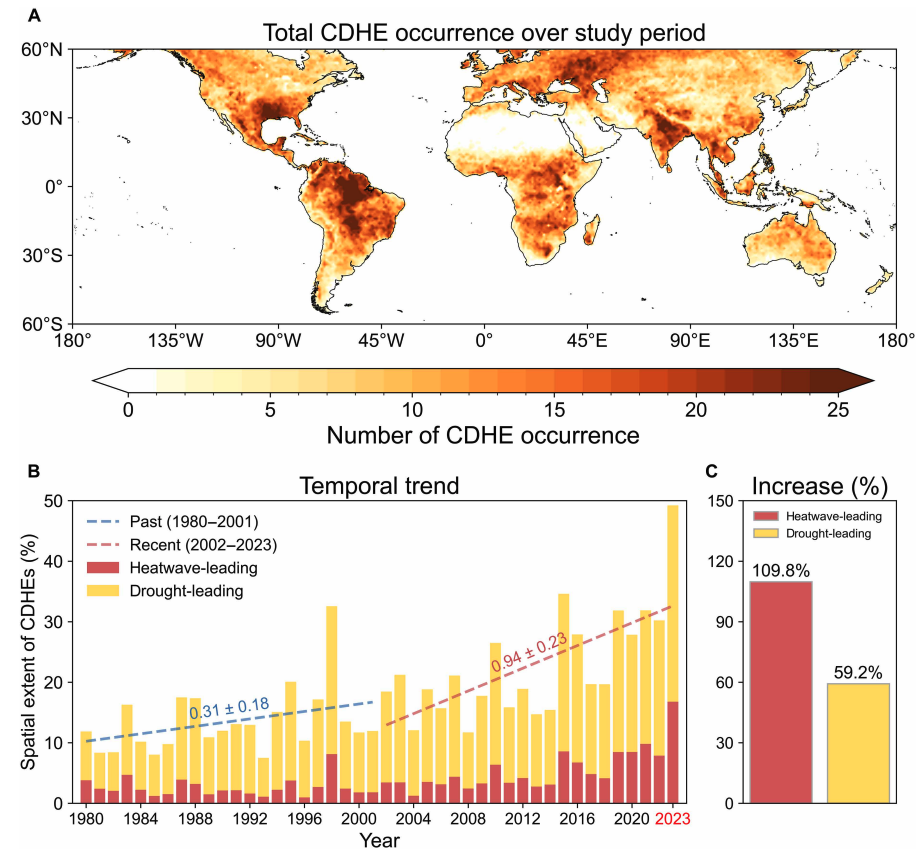
The research finds that the area of land affected by CDHEs has “increased substantially” since the early 2000s.
Heatwave-led events have been the main contributor to this increase, the study says, with their spatial extent rising 110% between 1980-2001 and 2002-23, compared to a 59% increase for drought-led events.
The map below shows the global distribution of CDHEs over 1980-2023. The charts show the percentage of the land surface affected by a heatwave-led CDHE (red) or a drought-led CDHE (yellow) in a given year (left) and relative increase in each CDHE type (right).
The study finds that CDHEs have occurred most frequently in northern South America, the southern US, eastern Europe, central Africa and south Asia.
Threshold passed
The authors explain that the increase in heatwave-led CDHEs is related to rising global temperatures, but that this does not tell the whole story.
In the earlier 22-year period of 1980-2001, the study finds that the spatial extent of heatwave-led CDHEs rises by 1.6% per 1C of global temperature rise. For the more-recent period of 2022-23, this increases “nearly eightfold” to 13.1%.
The change suggests that the rapid increase in the heatwave-led CDHEs occurred after the global average temperature “surpasse[d] a certain temperature threshold”, the paper says.
This threshold is an absolute global average temperature of 14.3C, the authors estimate (based on an 11-year average), which the world passed around the year 2000.
Investigating the recent surge in heatwave-leading CDHEs further, the researchers find a “regime shift” in land-atmosphere dynamics “toward a persistently intensified state after the late 1990s”.
In other words, the way that drier soils drive higher surface temperatures, and vice versa, is becoming stronger, resulting in more heatwave-led compound events.
Daily data
The research has some advantages over other previous studies, Yeh says. For instance, the new work uses daily estimations of CDHEs, compared to monthly data used in past research. This is “important for capturing the detailed occurrence” of these events, says Yeh.
He adds that another advantage of their study is that it distinguishes the sequence of droughts and heatwaves, which allows them to “better understand the differences” in the characteristics of CDHEs.
Dr Meryem Tanarhte is a climate scientist at the University Hassan II in Morocco, and Dr Ruth Cerezo Mota is a climatologist and a researcher at the National Autonomous University of Mexico. Both scientists, who were not involved in the study, agree that the daily estimations give a clearer picture of how CDHEs are changing.
Cerezo-Mota adds that another major contribution of the study is its global focus. She tells Carbon Brief that in some regions, such as Mexico and Africa, there is a lack of studies on CDHEs:
“Not because the events do not occur, but perhaps because [these regions] do not have all the data or the expertise to do so.”
However, she notes that the reanalysis data used by the study does have limitations with how it represents rainfall in some parts of the world.
Compound impacts
The study notes that if CDHEs continue to intensify – particularly events where heatwaves are the precursors – they could drive declining crop productivity, increased wildfire frequency and severe public health crises.
These impacts could be “much more rapid and severe as global warming continues”, Yeh tells Carbon Brief.
Tanarhte notes that these events can be forecasted up to 10 days ahead in many regions. Furthermore, she says, the strongest impacts can be prevented “through preparedness and adaptation”, including through “water management for agriculture, heatwave mitigation measures and wildfire mitigation”.
The study recommends reassessing current risk management strategies for these compound events. It also suggests incorporating the sequences of drought and heatwaves into compound event analysis frameworks “to enhance climate risk management”.
Cerezo-Mota says that it is clear that the world needs to be prepared for the increased occurrence of these events. She tells Carbon Brief:
“These [risk assessments and strategies] need to be carried out at the local level to understand the complexities of each region.”




The post Heatwaves driving recent ‘surge’ in compound drought and heat extremes appeared first on Carbon Brief.
Heatwaves driving recent ‘surge’ in compound drought and heat extremes
Greenhouse Gases
DeBriefed 6 March 2026: Iran energy crisis | China climate plan | Bristol’s ‘pioneering’ wind turbine
Welcome to Carbon Brief’s DeBriefed.
An essential guide to the week’s key developments relating to climate change.
This week
Energy crisis
ENERGY SPIKE: US-Israeli attacks on Iran and subsequent counterattacks across the Middle East have sent energy prices “soaring”, according to Reuters. The newswire reported that the region “accounts for just under a third of global oil production and almost a fifth of gas”. The Guardian noted that shipping traffic through the strait of Hormuz, which normally ferries 20% of the world’s oil, “all but ground to a halt”. The Financial Times reported that attacks by Iran on Middle East energy facilities – notably in Qatar – triggered the “biggest rise in gas prices since Russia’s full-scale invasion of Ukraine”.
‘RISK’ AND ‘BENEFITS’: Bloomberg reported on increases in diesel prices in Europe and the US, speculating that rising fuel costs could be “a risk for president Donald Trump”. US gas producers are “poised to benefit from the big disruption in global supply”, according to CNBC. Indian government sources told the Economic Times that Russia is prepared to “fulfil India’s energy demands”. China Daily quoted experts who said “China’s energy security remains fundamentally unshaken”, thanks to “emergency stockpiles and a wide array of import channels”.
‘ESSENTIAL’ RENEWABLES: Energy analysts said governments should cut their fossil-fuel reliance by investing in renewables, “rather than just seeking non-Gulf oil and gas suppliers”, reported Climate Home News</