


Article Contents

Welcome to Carbon Brief’s DeBriefed.
An essential guide to the week’s key developments relating to climate change.
This week
UK considers cuts
EMISSIONS ADVICE: New recommendations from the UK’s climate advisers, the Climate Change Committee, said the nation should reduce its emissions to 87% below 1990 levels by 2040. This would keep the country on track for reaching net-zero by 2050 and take £1,400 off household bills by the same year, according to the advice. Read Carbon Brief’s in-depth summary of the findings, which show that the estimated cost of reaching net-zero is now 73% lower than thought just five years earlier.
‘Y BOTHER’: Despite not being a major focus of the new analysis, much of the UK media coverage zoned in on how achieving the emissions cut might affect people’s lives. The Guardian reported that the average person might need to skip “two kebabs’ worth of meat a week”, while a frontpage Daily Telegraph story raged at the idea that frequent fliers may need to pay a higher rate of tax, which was not a recommendation. It comes shortly after a satirical Private Eye piece by correspondent Y Bother reported that “getting net-zero done might be a massive faff”, asking: “Shall we just not do it?”
UK AID CUT: Elsewhere, prime minister Keir Starmer announced plans to cut the UK aid budget from 0.5% to 0.3% of national income and spend more on defence, the Guardian reported, just as officials entered international finance negotiations in Rome (more on this below). The newspaper said it understood the UK’s £11.6bn climate finance would be “ringfenced” from cuts, but Climate Home News reported that climate groups were “dismayed” by the move.
Around the world
- BIG VOTE: The centre-right Christian Democrats party won Germany’s federal election, with far-right Alternative for Germany in second place, Al Jazeera reported. Clean Energy Wire said the future government would still be committed to climate neutrality by 2045 but is likely to have a “reduced focus on climate policies”.
- REGULATORY REVERSAL: The US Environmental Protection Agency is aiming to reverse the “endangerment finding”, a key legal ruling that required the agency to regulate CO2 and other greenhouse gas emissions, according to the Washington Post.
- SETBACK: Energy company BP announced it will slash investment in renewables, while boosting oil and gas spending by 20%, the Associated Press reported.
- UKRAINE-US PACT: Ukraine made an agreement with the US to jointly explore its mineral resources – including oil and gas, according to a frontpage story in the Financial Times.
45%
The proportion by which Tesla’s electric vehicle sales have fallen in Europe since Elon Musk’s “political meddling”, reported Bloomberg.
Latest climate research
- A new Nature study suggested that the Atlantic Meridional Overturning Circulation (AMOC) – a system of ocean currents that moves water, heat and nutrients around the Atlantic Ocean and the globe – is unlikely to collapse this century. The research has promoted discussion around what AMOC “collapse” means.
- Climate change could lead to the creation of new carbon sinks in some ice-free areas of Antarctica, according to a study in Communications Earth and Environment.
- Peatland fires in the UK released 800,000 tonnes of carbon from 2000-21, a study in Environmental Research Letters found, accounting for 90% of the country’s total fire emissions.
(For more, see Carbon Brief’s in-depth daily summaries of the top climate news stories on Monday, Tuesday, Wednesday, Thursday and Friday.)
Captured
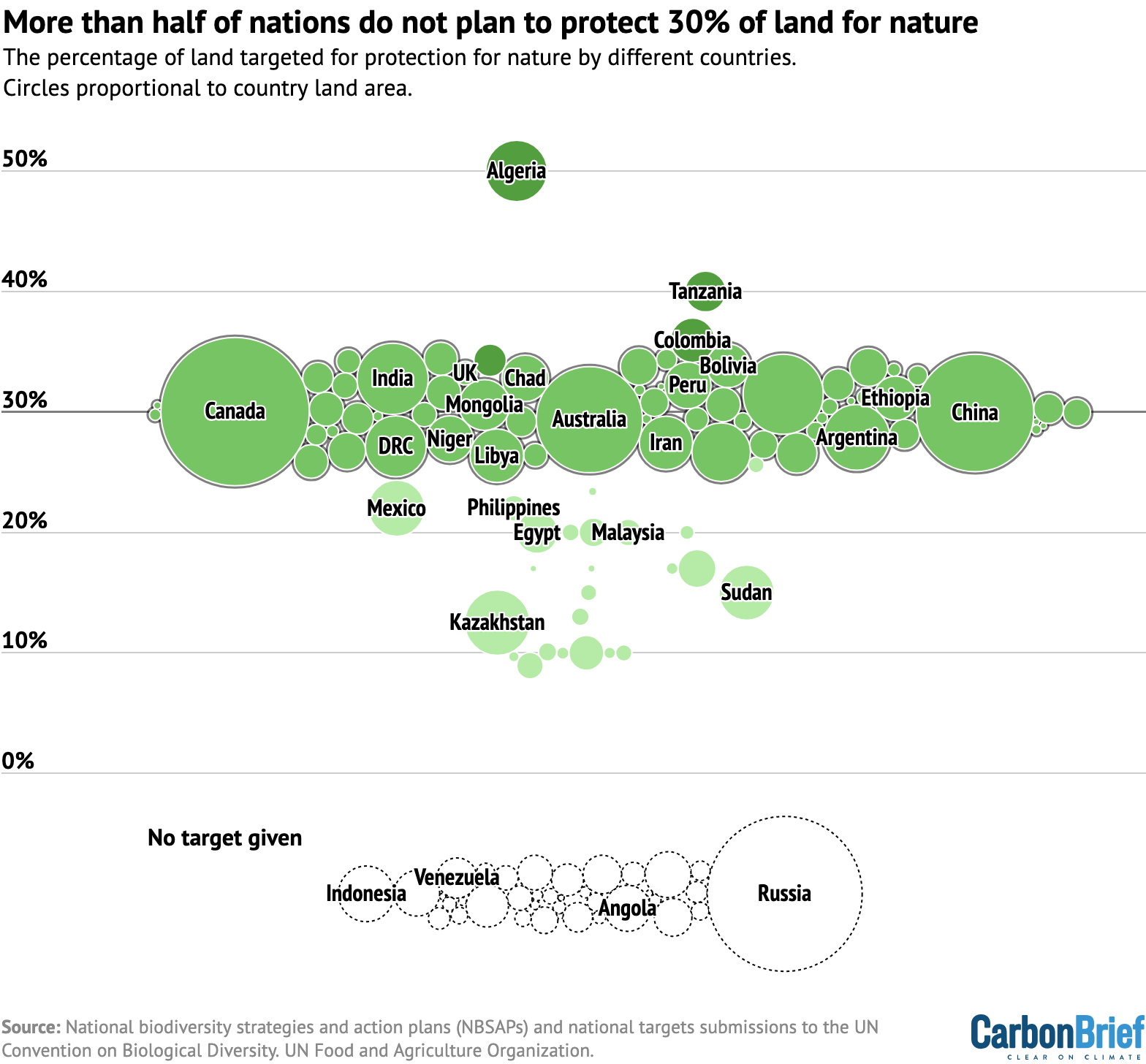
In December 2022, nearly all countries agreed to a flagship global target to protect 30% of Earth by the end of the decade. But a new investigation of hundreds of country plans submitted to the UN by Carbon Brief and the Guardian found that more than half of nations are not willing to commit to protecting 30% of their own land and seas. It comes as nations met in Rome this week to try to find agreement on outstanding biodiversity issues (more on this below). The chart above shows the various pledges made by countries when it comes to protecting a proportion of their land for nature, illustrating how less than half have committed to the key 30% figure.
Spotlight
COP16 talks reach finance deal
This week, Carbon Brief reports from COP16 nature talks in Rome, where countries landed a landmark finance deal in the early hours of Friday morning.
Last year saw a run of fraught and fractious environmental talks play out around the world.
Talks on reversing biodiversity loss, plastic pollution and desertification all ended in failure, while a UN climate summit in Azerbaijan produced a finance deal that was bitterly disappointing for many developing countries.
However, in the early hours of Friday morning at the Food and Agricultural Organization (FAO) headquarters in Rome, countries delivered what they described as a signal of hope for multilateralism in uncertain times.
Against a backdrop of foreign aid freezes and cutbacks in the US and Europe, nations agreed to a “permanent arrangement” to pay to help developing countries conserve biodiversity and a strategy to “mobilise” at least $200bn per year by 2030.
Striking a deal
The decision came after finance dominated discussions during the three-day resumed session of COP16 in Rome. Countries agreed to meet again in the Italian capital after failing to reach consensus at COP16 in Colombia in October 2024.
Different versions of the financing texts were negotiated throughout the week. Most countries agreed on the need to find a solution, but key disagreements still fractured the path to a deal until the summit’s final plenary.
In the end, two proposals – one from the COP16 presidency and another from Brazil on behalf of the BRICs – were merged to enable countries to find consensus on finance.
A UK official told Carbon Brief that Brazil’s leading role in the negotiations is a “very positive sign” of its commitment to working with countries ahead of hosting the COP30 climate summit in November.
Biodiversity in the balance
Colombian politician and COP16 president Susana Muhamad received a lengthy standing ovation for her role in guiding parties to consensus in the early hours of Friday morning in Rome.
But, amid celebrations, some speakers noted that nations are still far off track for meeting the targets of the Kunming-Montreal Global Biodiversity Framework (GBF). The GBF is a landmark deal, first made in 2022, aiming to halt and reverse biodiversity loss by 2030.
Some three-quarters of nations have still not submitted their UN biodiversity plans for how they will achieve the targets of the GBF – four months after the deadline.
And a recent investigation by Carbon Brief and the Guardian revealed that more than half of nations that have submitted UN biodiversity plans do not commit to the GBF’s flagship target of protecting 30% of land and seas for nature by 2030.
Carbon Brief’s in-depth summary of all of the key outcomes from the COP16 talks in Rome has just been published.
Watch, read, listen
CLIMATE DATA: A short video report by ABC News explained how the US National Oceanic and Atmospheric Administration uses automated techniques to record climate data.
‘FIRE AND FURY’: An editorial in Nature urged the global science community to resist Donald Trump’s “assault on science and international institutions”.
UNLOCK LOVELOCK: A BBC Sounds podcast told the life of James Lovelock, the co-author of the Gaia scientific theory and a former advisor to Shell who in 1966 warned the company about the risks of fossil fuels.
Coming up
- 3-4 March: First G20 agriculture working group meeting | South Africa
- 3-14 March: International Seabed Authority 30th session, legal and technical commission meeting | Kingston, Jamaica
- 4-6 March: Regional workshop on Biodiversity Beyond National Jurisdiction (BBNJ) | Mombasa, Kenya
Pick of the jobs
- Associated Press, climate social video producer | Salary: $52,046-$82,934. Location: New York
- Imperial College London, deputy director of Undaunted | Salary: £68,005-£77,703. Location: London (hybrid)
- Asian Infrastructure Investment Bank, senior economist, climate policy | Salary: Unknown. Location: Beijing
DeBriefed is edited by Daisy Dunne. Please send any tips or feedback to debriefed@carbonbrief.org.
This is an online version of Carbon Brief’s weekly DeBriefed email newsletter. Subscribe for free here.
The post DeBriefed 28 February 2025: COP16 lands finance deal; More than half of nations skip key nature pledge; UK eyes cost-saving emissions plan appeared first on Carbon Brief.
Continue Reading
An older teaching about land acknowledgement
As I have come to understand the spirit and intention of land acknowledgement, I often return to fond memories of my grandmother and her words of wisdom. She taught that the health of the places we call home comes first, because the wellbeing of the people depends on it.
In her teaching, land acknowledgement began with the land. Long before it became a paragraph read at the start of a meeting, it was a way of recognizing a homeland: its waters, its species, its seasons, and the spirit that revealed whether the place was well.
Her teaching echoes a practice found across many Indigenous Nations. Haudenosaunee gatherings, for example, have long opened with the Ohén:ton Karihwatéhkwen, the Thanksgiving Address, often translated as “the words that come before all else.” The speaker greets and gives thanks to the people, the earth, the waters, the plants, the animals, the winds, the sun, the moon and the stars. Only after everything that sustains life has been acknowledged does the gathering turn to its own business.
That order changes what an acknowledgement is for. Its purpose was to share the story of a place with neighbours and to draw them into the work of tending it. People entered the story second, as the ones responsible for what had just been named.
Understood this way, an acknowledgement does more than open a meeting. It asks us to reconsider where we stand, and what we owe the ground beneath us.
Nations among nations
In her teaching, people are one nation among many. The salmon are a nation. So are the cedars, the bison, the medicine plants, and the pollinators. Each belongs to a place, carries its own responsibilities, and offers gifts no other nation can give.
This idea of kinship runs through many Indigenous philosophies. The phrase “all my relations,” heard in ceremonies and gatherings across Turtle Island, is a reminder that family extends beyond people to the animals, plants, waters and lands that make life possible. Some Indigenous languages carry the same understanding in their grammar, speaking of many plants, animals and natural forces as living beings rather than objects.
Sovereignty, understood through this relationship, is a kind of standing more than a form of control. Each nation belongs fully to its place and carries its share of that place’s life. No nation thrives alone, and none thrives by taking over the whole.
The land is also the source of instruction. Over generations, people watched how a river valley or a stretch of prairie kept itself well: who arrived when, who fed whom, and how much could be taken before the giving stopped. In my grandmother’s telling, those observations became instructions, and those instructions helped shape law and protocol. They guided when to harvest, where to camp, how to enter a neighbour’s territory, and what was owed in return.
Indigenous legal scholars today often describe this as law that comes from the land itself, learned by watching how living systems sustain one another. A plainer name for it is knowing how to live somewhere.
The host and the guest
One of the clearest teachings in this understanding of the world is the relationship between host and guest. My grandmother invited us to recognize that relationship in the lives of plants and animals.
A host prepares the place before anyone arrives. A beaver family dams a stream, and the pond becomes a home for fish, frogs, birds and plants. A fallen tree becomes a nurse log, feeding the next generation of seedlings as it returns to the soil.
A host offers first. A flowering plant sets out nectar. A berry bush ripens fruit. These provisions come in their own season, not whenever a visitor happens to want them.
A host also makes its presence known. Birdsong, scent and the marks left along a trail tell newcomers that a place is already inhabited. The visitor does not arrive in an empty world.
The guest has responsibilities too. A guest attends to the season and to what the place can offer. A guest does not assume that everything within reach is theirs to take. A guest leaves something that helps sustain the relationship.
A bee takes nectar and carries pollen. Read through this teaching, that exchange offers an image of visiting well: receiving a gift while helping the host continue its life.
Many Indigenous harvesting protocols carry the same ethic into daily practice: ask before taking, take only what is needed, offer thanks, and leave enough for others and for the plant or animal to recover.
None of this suggests that every relationship in nature is peaceful or generous. These are ways of seeing responsibilities that people can learn to carry.
Everyone is both
No being is only a host or only a guest.
A tree makes room for other life while depending on soil, water, sunlight, fungi, and relationships beyond itself. People, too, may welcome others into their homes while remaining dependent on the larger homeland that sustains them.
The distinction between host and guest is therefore about roles, not ranks. Everyone receives. Everyone has something to give.
The question is whether the exchange sustains the place.
A visitor who takes without restraint leaves less for those who come next. A host who neglects the place has less to offer. Both have responsibilities, and neither can fulfil them alone.
This is the heart of reciprocity, a principle found across Indigenous philosophies: relationships stay healthy when gifts move in both directions. The Haudenosaunee teaching of the seventh generation extends that exchange across time, asking that decisions made today leave the place well for those not yet born.
Mutual benefit begins here, with the recognition that different beings carry different gifts and obligations.
What people carry forward
My grandmother’s teaching connects these relationships to the ways people meet their neighbours.
The host prepares a place, offers food and rest, and explains where the visitor has arrived. The guest makes themselves known, explains why they have come, listens to the terms of the visit, and brings something in return. The gift may be material. It may also be labour, knowledge, news, or a commitment to help.
Nations around the Great Lakes carried this ethic into treaty. The Dish with One Spoon, an agreement among the Haudenosaunee, Anishinaabe and allied Nations, describes shared hunting grounds as a single dish. Everyone eats from it with one spoon, takes only what they need, leaves enough for others, and keeps the dish clean. The Two Row Wampum, between the Haudenosaunee and European newcomers, shows two vessels travelling side by side on the same river, each keeping its own ways and neither steering the other.
In this understanding, acknowledgement is more than naming the people associated with a territory. It is learning enough about a homeland to behave responsibly within it.
Whose home is this? What sustains it? What laws and agreements guide our presence? What can we receive, and what must we return?
These questions make acknowledgement a relationship rather than a recital.
They also make it diplomatic. A guest who recognizes the host’s homeland recognizes that they have entered a place with its own relationships and responsibilities. A host who welcomes the guest makes room for an encounter governed by those relationships.
Neither arrives without standing. Neither arrives without obligations.
Beginning with place
I write from the shores of the Bay of Quinte. Here, the teaching asks me to begin with the water, the shoreline, and the life they sustain. Before I describe myself, I must attend to where I am.
That does not make people or history less important. It places them within the homeland that gives them meaning. The people, their laws, their agreements, and their responsibilities all belong to the place.
In a time of longer fire seasons, troubled waters, and uncertainty about what the next season will bring, this teaching asks something difficult and useful of us: pay attention before you speak.
An acknowledgement cannot tell the story of a place if the speaker has stopped noticing it.
The land came first. Beginning there again means learning to name what sustains us, and accepting that what sustains us also asks something of us.
By Rye Karonhiowanen Barberstock
Photo by Andrik Langfield on Unsplash
The post The Land Came First appeared first on Indigenous Climate Hub.
Carbon dioxide (CO2) emissions from fossil fuels and cement are projected to fall by around 0.4% in 2026 to 38.2bn tonnes of CO2 (GtCO2), according to new figures from the Global Carbon Project.
This guest post is by:
- Dr Zeke Hausfather, Carbon Brief’s climate science contributor
- Prof Pierre Friedlingstein, chair of mathematical modelling of climate systems at the University of Exeter and part of the Global Carbon Project team.
Carbon dioxide (CO2) emissions from fossil fuels and cement are p