




- What happened at COP31?
- What has the reaction to the presidency been?
- How has the role of oil-rich nations been portrayed?
- How has the role of developed nations been portrayed?
- How has the role of developing nations been portrayed?
- How has the role of China been portrayed?
- What does this mean for the consensus process and reform?
- Could COP31 send a ‘positive signal’?

A “resurgence” in construction of new coal-fired power plants in China is “undermining the country’s clean-energy progress”, says a new joint report by the Centre for Research on Energy and Clean Air (CREA) and Global Energy Monitor (GEM).
The country began building 94.5 gigawatts (GW) of new coal-power capacity and resumed 3.3GW of suspended projects in 2024, the highest level of construction in the past 10 years, according to the two thinktanks.
The accelerated buildout, fuelled by investment from the coal-mining sector, “raises critical concerns” about China’s ability to transition away from the fossil fuel, the report warns.
Analysts expect China’s huge clean-energy capacity additions to slowly squeeze coal’s share of electricity generation, as China works towards its “dual-carbon” goals of peaking carbon emissions by 2030 and reaching carbon neutrality by 2060.
As things stand, rapid coal-power expansion is posing a “challenge” to China’s high-level climate commitments, including on reducing coal use, CREA and GEM argue.
They point to a range of policies that could help China get back on track, including ending new coal plant approvals, as well as power market and grid reform.
Construction fever
Construction started on 94.5GW of new coal-fired power plants in 2024, according to the study. It says this is a sign of continued momentum in developing new coal projects, despite government pledges to “strictly” control the use of the fossil fuel. The report adds that 3.3GW of suspended projects also resumed construction in 2024.
Approvals for new coal construction rebounded in the second half of the year to 66.7GW, after permitting only 9GW in the first half.
Taken altogether, the report says this signals a substantial amount of new capacity will come online in the next few years, “solidifying” coal’s place as a major source of electricity.
As shown in the chart below, China’s new or resumed construction of coal-power plants declined steadily from 84.3GW in 2015 to 32.1GW in 2021. However, it has since risen from 2022, driven by a wave of new projects.
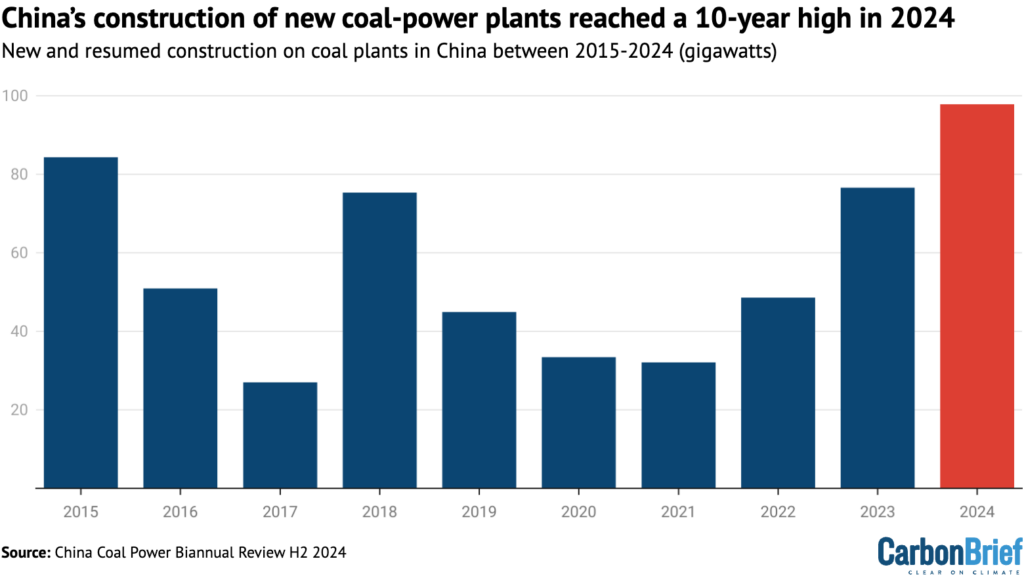
From 2022 onwards, new and revived proposals to initiate coal-power projects also surged, reaching 146GW in 2022 and 117GW in 2023 – well above pre-pandemic levels.
However, the report notes, new proposals fell to 68.9GW in 2024, which could point to “potential cooling in project initiation”. In 2023, China accounted for 95% of the world’s new coal construction.
Meanwhile, retirement and mothballing of old coal plants remains “low”, the report says. This is particularly pronounced in recent years, with the amount of capacity being closed down each year dropping sharply from around 13GW in 2020 to 2.5GW in 2024.
All of this stands in “direct conflict” with Chinese president Xi Jinping’s pledge in 2021 to “strictly limit the increase in coal consumption” between 2021 and 2026, the report says, as well as China’s 2030 carbon-peaking action plan. It adds:
“The policy direction set in China’s updated climate targets for 2035 under the Paris Agreement and the upcoming 15th five-year plan [2026-2030] will be critical to determining the trajectory of China’s coal-power sector and with that, its emissions trajectory.”
This echoes recent analysis published by Carbon Brief.
Fuelled by industry interests
The renewed coal drive is largely being pushed by the mining industry, according to the report, with coal-mining companies increasingly investing in coal-power projects.
More than three-quarters of all newly approved coal power projects were financed by “coal mining companies or energy groups with coal-mining operations”, the study says.
It suggests this may be partly driven by China’s “dual-carbon” goals, which have pushed those companies to diversify in order to “secure stable demand for their output through 2030 and beyond”.
These investments include integrated coal mine-to-power and “pithead” plants, as well as typical coal-fired power plants developed by energy groups with coal-mining operations.
The report notes that many regional coal and energy companies have “intensified” coal-power investments, “aligning their strategies to sustain coal’s dominance at the provincial level”.
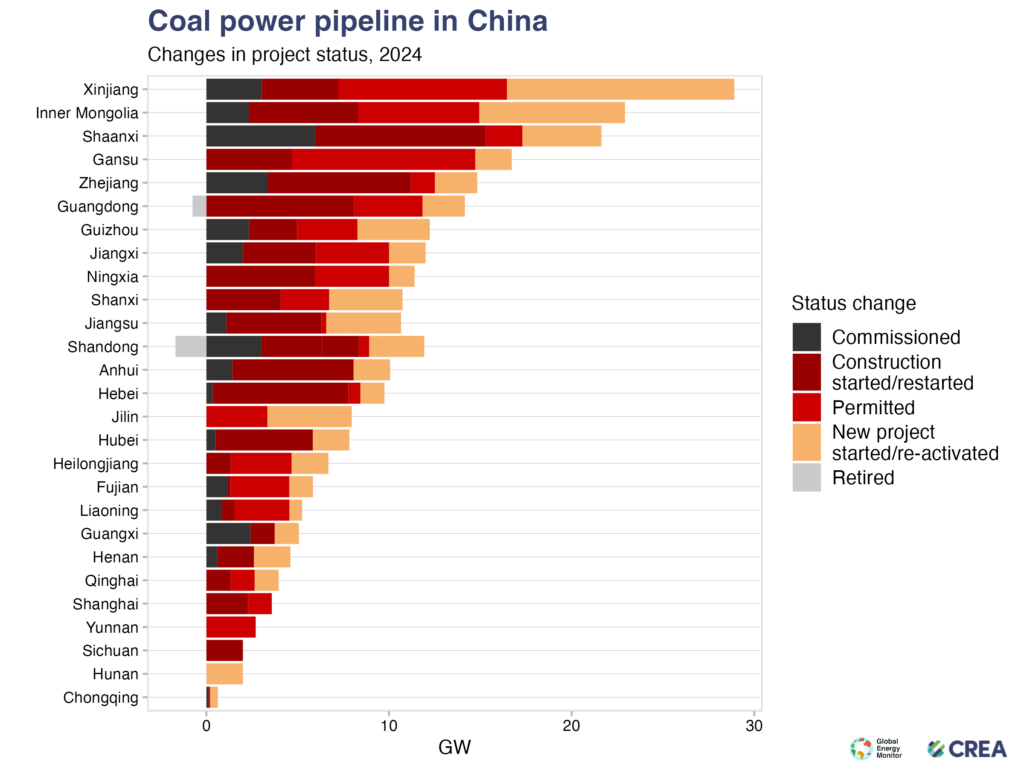
It adds that major coal-producing provinces – such as Xinjiang, Inner Mongolia, Shaanxi and Gansu – were also commissioning and building the most new coal power, as shown in the map below. However, China’s biggest coal-producing province, Shanxi, was not among the provinces with the most activity around new coal power in 2024.
‘Undermining’ the energy transition
The rapid buildout of coal could combine with structural features of the power system that favour the coal industry, the report says, to limit renewables’ ability to become China’s main provider of electricity.
China installed record amounts of renewable energy capacity in 2024, bringing total solar and wind capacity up to 890GW and 520GW, respectively. Coal capacity in 2024 was 1,200GW.
The growing amount of low-carbon electricity in China’s mix was expected to cover new demand and reduce coal’s importance in the system, in a policy known as “establish [new systems] before breaking [old ones]” (先立后破).
However, the report notes, the flurry of new coal construction “makes it increasingly difficult to achieve” this. Instead, it says there is a risk that renewable energy will be treated as a supplementary power source “layered on top” of coal.
This is partly due to several policy structures that prioritise the use of coal power and protect the industry’s interests, it explains.
Most power grids lock in coal-power supply through mechanisms such as medium- to long-term contracts for purchasing power and long-term coal supply agreements, obligating provinces to use a certain amount of the fuel, even when other sources of electricity are more cost-effective.
Provincial governments are also moving away from requiring power purchase agreements (PPAs) to include a minimum share of solar and wind, the report says, resulting in “an uneven playing field where coal power remains insulated from risk while wind and solar developers face price fluctuations and uncertain demand”.
The development of new coal-power plants will “further limit grid space for renewables”, it adds, making it harder for solar and wind power generators to gain significant market share.
Coal’s predominance in the system may have also led to a substantial recent uptick in curtailment of renewable energy. According to calculations in the report, the final quarter of 2024 likely saw a curtailment rate of around 5.5%, rather than the officially reported 3.2%.
The report attributes this to “structural constraints”, rather than weather-driven availability of solar and wind resources.
Opportunity for change in 2025
Forecasts by the coal industry signal that it expects the coal-power sector to continue growing, causing “increasingly unsustainable conflict” between China’s energy security and low-carbon policies, the report notes.
The report suggests strong policy direction in 2025 would be needed to counteract coal’s dominance in the energy system.
This could be achieved, firstly, by reducing the amount of coal in the energy system, such as by setting “ambitious and measurable” targets for reducing coal consumption, phasing down coal plants, utilisation of coal plants in operation and uptake of renewables.
Other potential levers could include ending new coal-power plant approvals and accelerating the retirement of older units.
Secondly, the report points to reform of the mechanisms that steer power providers towards coal – including reducing the amount of coal covered in long-term PPAs and coal supply agreements – and prioritising grid reform and the development of spot markets.
These steps, it argues, would “help implement China’s ambition to phase down coal, create space for renewables, and drive a cleaner, more efficient energy system”.
The post China’s construction of new coal-power plants ‘reached 10-year high’ in 2024 appeared first on Carbon Brief.
China’s construction of new coal-power plants ‘reached 10-year high’ in 2024
Continue Reading
Dan Ioschpe is the Climate High-Level Champion for COP30.
A year ago at COP30 in Belém, we said this would be the decade of implementation for climate action. Simply put, implementation is the fastest way to promote sustainable socio-economic development. But implementation is not about words. It is about action, on the ground, at speed and scale.
COP31 in Antalya demonstrated why the implementation of the Paris Agreement must extend well beyond the two weeks of a climate conference. Despite political divisions, businesses, investors, governments, cities and communities came with results and remained committed to scaling climate action, showing that the real economy does not wait.
That is why continuity matters. In Belém, the Global Climate Action Agenda was given a new structure, with six thematic axes, and Plans to Accelerate Solutions (PAS). Because that structure carries work from one COP to the next, progress can compound. And progress is now something we can measure.
This year’s Yearbook of Global Climate Action shows that 87% of PAS reported progress, while 38% of the 40 with quantitative targets are on track or ahead of their goals. It highlights where the gaps remain.
Grids stretching halfway around the world
The strongest signal from Antalya came from electrification. The Electrification Delivery Package brings together more than 200 actions from over 180 organisations, involving over 150 countries plus the European Union – together over two-thirds of global GDP – and more than 260 businesses with over $4 trillion in annual revenue.
The results are already visible on the ground. Members of the Utilities for Net Zero Alliance built more than 21,000 kilometres of grid in 2025, up from 14,000 km the year before – enough to stretch halfway around the world. From grids, storage and renewable power to energy access, the foundations of a modern, interconnected system are coming together at speed and scale.
-
Australia and South Korea’s clean energy deal could boost low-carbon trade
The deal aims to connect Australia’s renewable resources with Korean industries’ clean energy demand, potentially transforming a relationship built on coal and gas -
After COP31, our chance to save climate diplomacy lies in global shipping
If COP31’s high ambition countries can show the same resolve at London shipping talks, a climate breakthrough is possible next week
The Global Climate Action Agenda is helping connect these investments and shift from individual solutions to economy-wide transformation. Electrification is simply the fastest way to foster sustainable socioeconomic development – efficiently, affordably, and securely.
On transport, 13 zero-emission freight corridors are now in development across six continents, covering more than 29,000 km of roads. That is already ahead of the Global Green Road Corridors Initiative’s goal of ten corridors by 2026.
Sustainable aviation fuel starts to take off
Progress is also visible on sustainable aviation fuel (SAF), a solution approaching a positive tipping point. One in three new sustainable industry investment decisions this year was for SAF, a sign of how quickly the market is developing, including through an Action Agenda plan to decarbonise aviation.
Projects that have reached final investment decision represent around 7 million tonnes of SAF a year, or 3% of today’s jet fuel use. But the wider pipeline stands at 31 million tonnes – around 11% of the existing market. Once sustainable solutions capture 5-10% of an established market, growth can become self-reinforcing as costs fall, supply chains mature and investors gain confidence. Across heavy industry more broadly, 36 deep decarbonisation projects reached final investment decision this year – a record.

On nature, the Tropical Forest Forever Facility has reached $8.3 billion in commitments towards its $10-billion initial target, and the Global Fund for Coral Reefs announced $30 million in new reef financing across 22 developing countries.
With the launch of the Rio Synergies Group for Action, implementation will be at the centre of the three Rio Conventions on climate, biodiversity and land, and 17 governments are now backing the Intergovernmental Land Tenure Commitment to strengthen the rights of Indigenous Peoples and local communities.
On food and agriculture, solutions range from methane-reducing practices reaching more than 5,000 smallholders to food recovery initiatives now reaching 40.5 million people, cutting food waste and emissions at the same time. Some 66 million hectares are now under regenerative landscape projects.
Accelerator to support two solutions per year
Antalya also laid the groundwork for progress. Mandated by the Mutirão Decision in Belém, the Global Implementation Accelerator established its governance and operational framework at COP31. Each year, two solutions – one on mitigation and one on adaptation – will be selected for coordinated support, informed by independent expert assessment and mobilising the capabilities of a dedicated partner network.
The Accelerator builds on the Action Agenda, bringing governments, businesses, finance and technical expertise together to accelerate solutions with the potential to reach positive tipping points.
None of this happened by accident. It was possible because a structure is in place that allows progress to compound – connecting political guidelines with investments, infrastructure and sustainable socio-economic development.
This is the Global Climate Action Agenda at work: a multi-year engine for the implementation of the Paris Agreement, guided by a shared vision towards 2030. And I am optimistic about what comes next.
In Belém, we collectively revamped its structure and strengthened its foundations. In Antalya, we demonstrated the value of continuity. The opportunity now is to deepen its reach across regions, strengthening implementation on the ground with speed and scale.
From Antalya to Addis Ababa and beyond, the work continues 365 days a year, 24 hours a day.
The post Despite political divisions, COP31 showed the real economy does not wait appeared first on Climate Home News.
https://www.climatechangenews.com/2026/11/26/despite-political-divisions-cop31-showed-the-real-economy-does-not-wait/
COP31 came to a dramatic close last weekend when a coalition of nations rejected the proposed “Antalya pact”, citing its failure to mention fossil fuels.
The tense final moments and lack of a much-anticipated “pact” have sparked extensive media coverage around the world.
Many commentators have rushed to label the COP31 outcome a “failure”, questioning what it means for the future of the UN climate process and a “divided world”.
There has been much finger-pointing, with some outlets attributing COP31’s “collapse” to “oil-rich nations”, while others blame Europe’s “reluctance” to provide more climate finance.
While it is not accurate to say there was “no agreement” at COP31, the media response demonstrates the complexity of the divergent views