


Shrink Your Footprint, Expand Your Impact: Practical Ways to Reduce Your Carbon Emissions
Climate change is an undeniable reality, and our individual actions play a crucial role in shaping its future.
Reducing our carbon footprint, the amount of greenhouse gases we emit, is essential to combatting this global challenge. But where do we begin? This article dives into practical strategies you can implement today to shrink your footprint and make a positive difference.
Transportation:
- Embrace green travel: Opt for walking, cycling, or public transportation whenever possible. If driving is unavoidable, carpool, choose fuel-efficient vehicles, and practice eco-driving techniques like smooth acceleration and avoiding rush hour traffic.
- Explore alternative travel: For longer distances, consider trains, buses, or carpooling instead of airplanes. If flying is necessary, choose direct flights and airlines with carbon offset programs.
Food:
- Reduce meat consumption: Animal agriculture generates significant greenhouse gas emissions. Consider incorporating more plant-based meals into your diet and opting for sustainable meat sources when you do indulge.
- Shop local and seasonal: This minimizes transportation emissions and supports local farmers. Choose fruits and vegetables that are in season for peak freshness and reduced environmental impact.
- Fight food waste: Plan your meals, buy only what you need, and compost food scraps to reduce waste and its associated emissions.
Energy:
- Conserve at home: Simple steps like switching to LED lights, unplugging unused electronics, and lowering your thermostat can significantly reduce energy consumption and your carbon footprint. Invest in energy-efficient appliances whenever possible.
- Harness renewable energy: Consider installing solar panels or supporting renewable energy providers to power your home.
- Embrace sustainable products: Look for energy-efficient and eco-friendly options when purchasing new appliances, electronics, and other household items.

Carbon Footprint Statistics: A Glimpse into Our Impact
Understanding the scale and impact of our carbon footprint is crucial for taking effective action. Here’s a glimpse into some key statistics:
Global Emissions:
- Total CO2 emissions (2021): 34.8 billion tonnes (IEA)
- Global CO2 emissions since 1750: Increased by over 800% (Our World in Data)
- Top global emitters (2021): China (10.7 Gt), United States (5.2 Gt), India (2.4 Gt) (IEA)
Individual Footprints:
- Average global CO2 footprint (2020): 4.3 tonnes per person (IEA)
- Significant variations exist: Depending on factors like country, lifestyle, and consumption habits.
- Highest emitters: Individuals in North America and Europe have footprints exceeding 10 tonnes per year (World Bank)
Sectoral Breakdown:
- Energy: Responsible for around 70% of global greenhouse gas emissions (IEA)
- Transportation: Accounts for approximately 25% of global emissions (IEA)
- Food: Represents roughly 25% of global greenhouse gas emissions (World Resources Institute)
Impact and Trends:
- Climate change: Rising global temperatures, extreme weather events, sea level rise (IPCC)
- Economic costs: Estimated at trillions of dollars annually (World Bank)
- Positive trends: Declining emissions intensity in some countries, growth of renewable energy

Carbon Footprint Statistics: Key Data in a Table
| Category | Statistic | Source |
|---|---|---|
| Global Emissions | Total CO2 emissions (2021) | 34.8 billion tonnes |
| Increase since 1750 | 800% | |
| Top emitters (2021) | China (10.7 Gt), United States (5.2 Gt), India (2.4 Gt) | |
| Individual Footprints | Average global CO2 footprint (2020) | 4.3 tonnes per person |
| Variations | Significant, depends on country, lifestyle, etc. | |
| Highest emitters | North America & Europe (10+ tonnes/year) | |
| Sectoral Breakdown | Energy | 70% of global emissions |
| Transportation | 25% of global emissions | |
| Food | 25% of global emissions | |
| Impact & Trends | Climate change | Rising temperatures, extreme weather, sea level rise |
| Economic costs | Trillions of dollars annually | |
| Positive trends | Declining emissions intensity in some countries, growth of renewable energy |
Additional Notes:
- Gt = Gigatonne (billion tonnes)
- This table represents a condensed selection of key statistics.

Beyond Individual Actions
- Spread awareness: Talk to your friends, family, and community about the importance of reducing their carbon footprint. Share tips and encourage collective action.
- Support sustainable businesses: Choose companies committed to environmental responsibility and ethical practices. Look for certifications like B Corp or LEED.
- Advocate for change: Contact your local representatives and urge them to support policies that promote climate action and renewable energy development.
Remember, even small changes can have a big impact when multiplied by millions of individuals. By making conscious choices and taking action in our daily lives, we can collectively shrink our carbon footprints and expand our positive impact on the planet. Let’s start today!
Additional Tips:
- Calculate your carbon footprint: Understanding your impact is the first step to reducing it. Use online calculators to assess your emissions across different areas of your life.
- Offset your emissions: While not a replacement for reduction, carbon offset programs can help compensate for unavoidable emissions by supporting projects that remove greenhouse gases from the atmosphere.
- Stay informed: Keep up-to-date on climate change issues and solutions. Numerous resources and organizations are dedicated to providing information and empowering individuals to take action.
Together, we can build a more sustainable future for ourselves and generations to come. Let’s start shrinking our footprints and expanding our impact, one step at a time.
https://www.exaputra.com/2024/02/practical-ways-to-reduce-your-carbon.html


 Well, if I had the IQ of a squirrel and believed that Fauci colluded with hundreds of other top scientists around the world to enslave the planet’s population, I would jump right on board.
Doesn’t work for me, though.
Today, however, belief in science and reason makes me a communist.
If you want a steady stream of information about the supposed value that ExxonMobil is bringing to the world, you may want to sign up for this.
These people are playing for keeps, btw. They’re destroying a little piece more of this planet every day, and they understand that completely.
But there is money at stake. Lots of it.
ExxonMobil Has a PR Campaign that Will Appeal to Some People
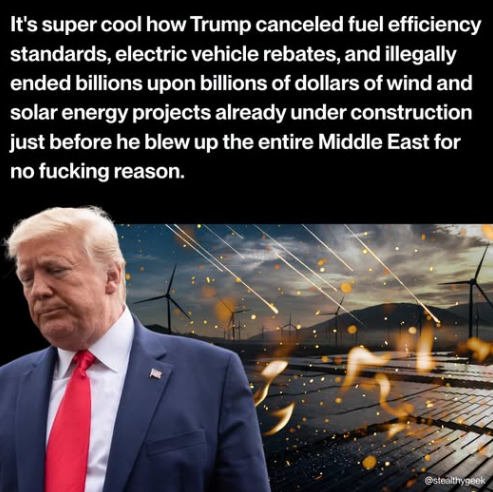 To the reader who sent me this meme:
I wouldn’t say that Trump’s illegal invasion of Iran was done for “no … reason.”
What he did created world chaos and caused most Americans in particular to suffer. The more desperate we become, the more likely we’ll be to accept his repeated claims that “Only I can fix it.”
Chaos also helps to justify a claim of a “national emergency” that Trump could use to cancel the 2026 midterms. If November happens as everyone predicts, this will the end of his political and legal future.
Destroying renewable energy to further enrich his Big Oil megadonors makes Trump that much more powerful.
We’re in a pathetic position.
I’m not one to say, “I told you so,” but since my adolescence, I predicted that big money in government would soon ruin this country.



-

 Greenhouse Gases2 years ago
嘉宾来稿:满足中国增长的用电需求 光伏加储能“比新建煤电更实惠”
-
Climate Change1 year ago
Guest post: Why China is still building new coal – and when it might stop
-
Greenhouse Gases1 year ago
Guest post: Why China is still building new coal – and when it might stop
-

 Climate Change2 years ago
嘉宾来稿:满足中国增长的用电需求 光伏加储能“比新建煤电更实惠”
-

 Renewable Energy11 months ago
Sending Progressive Philanthropist George Soros to Prison?
-
Climate Change2 years ago
Bill Discounting Climate Change in Florida’s Energy Policy Awaits DeSantis’ Approval
-
Greenhouse Gases1 year ago
嘉宾来稿:探究火山喷发如何影响气候预测
-

 Carbon Footprint2 years ago
US SEC’s Climate Disclosure Rules Spur Renewed Interest in Carbon Credits