

- What happened at COP31?
- What has the reaction to the presidency been?
- How has the role of oil-rich nations been portrayed?
- How has the role of developed nations been portrayed?
- How has the role of developing nations been portrayed?
- How has the role of China been portrayed?
- What does this mean for the consensus process and reform?
- Could COP31 send a ‘positive signal’?

With a years-long backlog in the U.S. government’s risk assessments of thousands of potentially hazardous chemicals, the new law requires companies to disclose what chemicals are used in their products.
A new act implemented earlier this year in Washington has banned five chemical classes in 10 product categories throughout the state, making it the nation’s strongest law regulating toxic chemicals in products. The Safer Products for Washington program, an outgrowth of the Pollution Prevention for Our Future Act signed by Gov. Jay Inslee in 2019, is setting a precedent for other states and changing the game for the U.S. chemical industry.
Washington Law Attempts to Fill the Void in Federal Regulation of Hazardous Chemicals
Continue Reading
COP31 came to a dramatic close last weekend when a coalition of nations rejected the proposed “Antalya pact”, citing its failure to mention fossil fuels.
The tense final moments and lack of a much-anticipated “pact” have sparked extensive media coverage around the world.
Many commentators have rushed to label the COP31 outcome a “failure”, questioning what it means for the future of the UN climate process and a “divided world”.
There has been much finger-pointing, with some outlets attributing COP31’s “collapse” to “oil-rich nations”, while others blame Europe’s “reluctance” to provide more climate finance.
While it is not accurate to say there was “no agreement” at COP31, the media response demonstrates the complexity of the divergent views on display at the Antalya conference.
In this article, Carbon Brief draws together media reactions from around the world to show the diversity of responses to the COP31 outcome.
- What happened at COP31?
- What has the reaction to the presidency been?
- How has the role of oil-rich nations been portrayed?
- How has the role of developed nations been portrayed?
- How has the role of developing nations been portrayed?
- How has the role of China been portrayed?
- What does this mean for the consensus process and reform?
- Could COP31 send a ‘positive signal’?
What happened at COP31?
COP31 ended without agreement on a proposed “Antalya pact”, which had been pushed by the Turkey-Australia presidency.
The final text was rejected by at least 32 countries, including the EU, the UK and some climate-vulnerable countries, in chaotic scenes as the talks overran by two days.
An Irish Times editorial said the outcome was an “unprecedented ending of a COP without any agreement or roadmap forward”.
This view, while commonly expressed in the media, is incorrect.
As veteran “COP-watchers” explained for an article on CB Connect, the summit reached agreement on many decisions, even though the presidency’s “cover decision” failed.
Referring to the rejection of the cover decision, Melbourne University climate researchers Prof Jacqueline Peel and Prof Kathryn Bowen wrote in the Conversation that “these texts have always been add-ons to the formal negotiation process”.

They noted that there was “progress in a few areas” at COP31, including negotiations on supporting a just transition via a “phased approach” and “improving alignment in climate adaptation”.
For a full overview of what happened at COP31 – both inside and outside the negotiations – see Carbon Brief’s “key outcomes” article.
What has the reaction to the presidency been?
In the aftermath of COP31, commentators have critiqued decisions made by the presidency. An editorial in the Hindu noted that “usually, cover texts evolve as a final synthesis of deliberations”, but said the COP31 leadership “thought it fit to push for a cover text early in the proceedings”.
Australian “president of negotiations” Chris Bowen has also faced criticism over how he managed competing interests at the summit. An editorial in the climate-sceptic Australian said:
“One thing is clear: Chris Bowen, who presided over Australia’s $150m investment in the conference, has some explaining to do. International reporting has raised questions about Australia and Turkey, the two nations that co-hosted the summit. Some negotiators have criticised their handling of the talks.”
Similarly, climate-sceptic journalist Graham Lloyd wrote in the Australian that “globally, Bowen has embarrassed himself and diminished Australia’s reputation”.
For Australian news outlet Crikey, journalist Royce Kurmelovs said that Bowen “tried to run the world’s climate talks the way Labor [Australia’s ruling party] runs climate policy at home: quiet, pragmatic and without mentioning fossil fuels”, adding that “in Turkey, it didn’t work”.
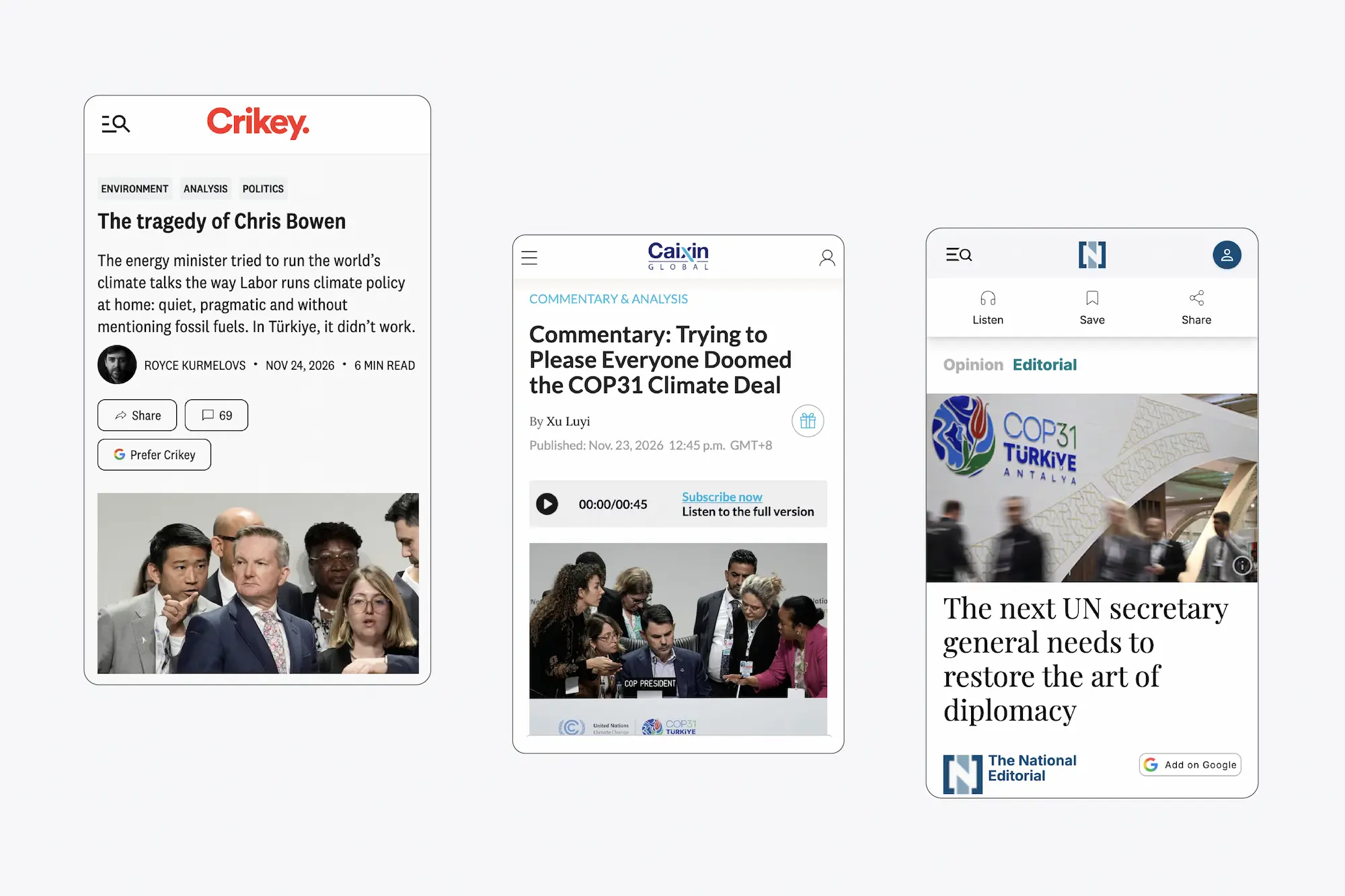
A commentary by journalist Xu Luyi in Chinese financial news outlet Caixin said that future COP presidencies should “distinguish achievable implementation measures from ambitions that lack a coalition capable of delivering them”.
Separately, an editorial in the National – a UAE state-owned English-language daily newspaper – said “the next UN secretary general needs to restore the art of diplomacy”.
How has the role of oil-rich nations been portrayed?
In media coverage, much of the blame for the perceived failure of COP31 has been placed on oil-producing nations – particularly with the final cover decision draft containing no mention of fossil fuels.
Even before the summit had finished, Panama’s minister of environment Juan Carlos Navarro warned that the COP process was being “held hostage by the petroleum mafia”.
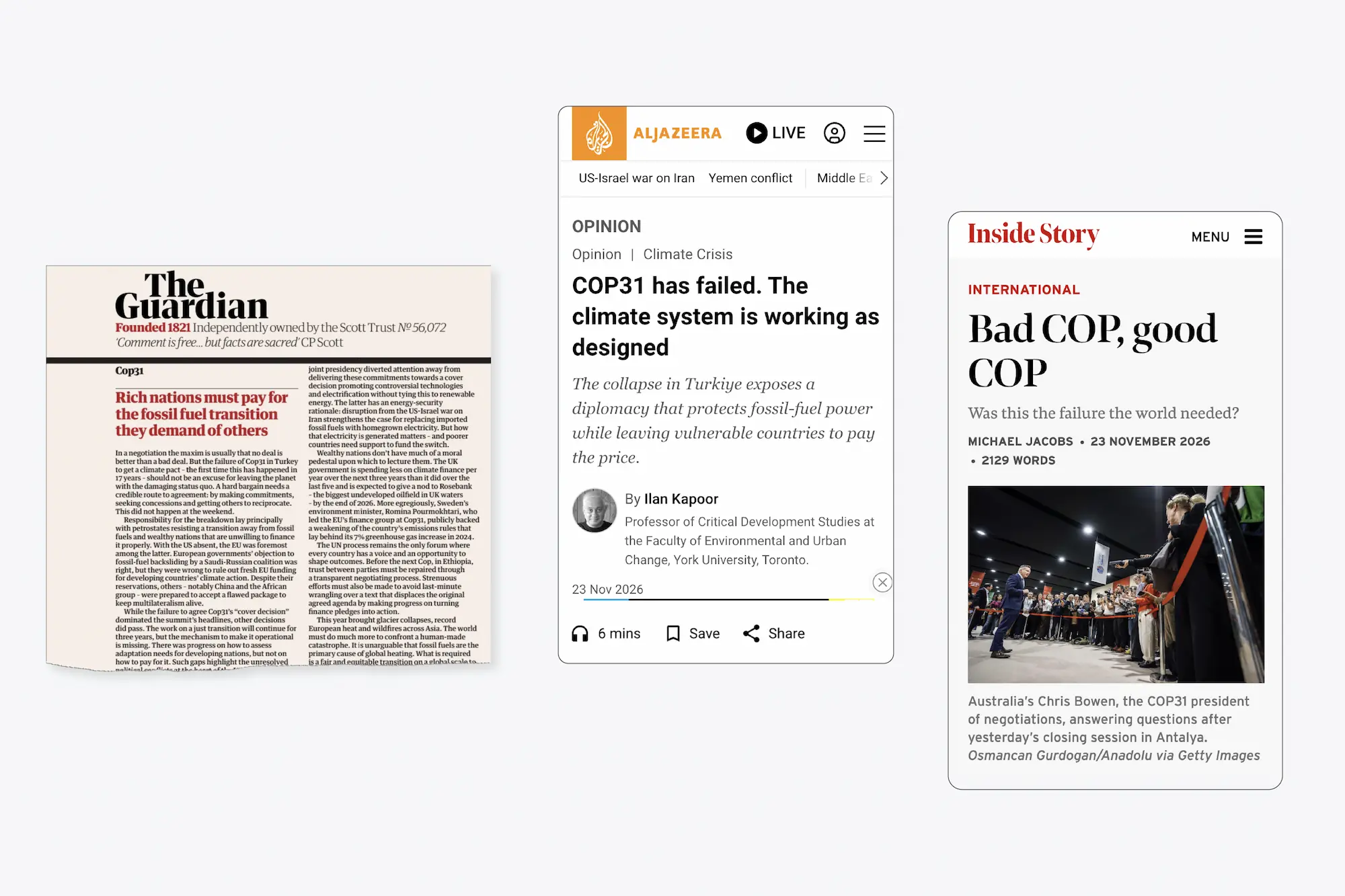
After the talks had closed without a deal on the Antalya pact, a Guardian editorial said that responsibility lay with “petrostates resisting a transition away from fossil fuels”, along with a lack of climate finance. The “fossil-fuel backsliding” was being led by a “Saudi-Russian coalition”, it said.
A Bloomberg editorial also noted that the omission of fossil fuels from the decision text came “amid pressure from Russia, Saudi Arabia and other fossil fuel producers”. A Times editorial described oil-rich nations, “led by Saudi Arabia”, as the “culprits” for the lack of an agreement, because they “insisted on dropping a reference to phasing out hydrocarbons”.
In the i newspaper, David Shukman, a former BBC News science editor, described a “deception” at the “heart” of the COP process:
“This pattern of lobbying by oil-rich nations has become increasingly blatant and aggressive over more than three decades.”
Despite signing up to the UN Framework Convention on Climate Change (UNFCCC) at the 1992 Earth Summit in Rio de Janeiro, the participation of the “oil-rich minority” has been “in name only”, wrote Shukman:
“At more than a dozen of the UN’s giant conferences, I’ve seen for myself the tactics of trench warfare and how well they’ve worked. It’s why fossil fuels remain so dominant and why the climate is turning so hostile.”
Writing for the Guardian, University College London’s Prof Bill McGuire warned that the COP process had been “deeply compromised” by the “major fossil-fuel producers”. For Al Jazeera, York University’s Prof Ilan Kapoor added that “fossil-fuel power operates well beyond the conference hall”.
(Reuters reported that, according to negotiators from Europe, small-island states, Latin America, Asia and Africa, Saudi officials had “regular access” to the summit’s presidents, “allowing them disproportionate influence”.)
In Australian outlet Inside Story, the University of Sheffield’s Prof Michael Jacobs wrote that since “transitioning away from fossil fuels” language was included in COP28, fossil-fuel producers “have been determined to ensure the phrase would never be used again”.
Nick O’Malley, national environment and climate editor for the Sydney Morning Herald, noted:
“The tension between the action the world knows it must take on climate change and that which a handful of oil-rich nations will allow it to take has been growing for years.”
At the summit itself, shortly after rejecting the cover decision on behalf of the EU, Irish environment minister Darragh O’Brien told Agence France-Presse that the talks had been “hijacked by some oil states”.
The Backchannel substack collated reactions from negotiators and o