

- What timeline options were delegates debating?
- How did the timeline discussions unfold?
- What were the main points of disagreement?
- Why is the IPCC in a ‘serious funding crisis’?
- How have scientists reacted?
- What other issues remain unresolved?
- How are the IPCC AR7 reports progressing?
- How might the IPCC use AI and enhance gender inclusivity?

As we enter the second and decisive week of Cop28 in Dubai, an agreement to phase out all fossil fuels and scale up renewables is edging close to a pivotal decision.
In these kind of talks just a couple of years ago, very few people at the table were able to even entertain conversations on the phasing out of fossil fuels.
But at the outset of Cop28, 106 countries jointly advocated for the fast decline of fossil fuels, a notable increase from the 80 countries demanding the same at Cop27 in Sharm el Sheikh. Over 120 countries have so far committed to tripling global renewable energy capacity by 2030.
The energy transition has finally been dragged centre stage. The Overton window has shifted significantly, and this is in no small part thanks to the resolve and determination of global south negotiators and their allies in the movement for climate justice.
Adaptation and justice
If we land an ambitious energy package in Dubai, it will once again be thanks to climate vulnerable nations, namely small islands states and Latin American countries in the Ailac grouping.
Wealthy blocs like the European Union must urgently address the adaptation concerns voiced by groups like the African group.
Insisting that the just transition work program exclusively focuses on in-country workforce issues while disregarding the global inter-country dimension is a pitfall that affluent nations must evade.
Negotiations for a global decision to phase out fossil fuels and a renewable energy target are above the paygrade of the mid-level diplomats that do the negotiating in the first week of Cops.
Ministers arriving today, at the start of the second week, is like Champions League football after watching non league.
Like football, the higher league doesn’t always reflect a difference in the quality of performances, but the sophistication of tactics applied, and the stakes that are on the table.
The Cop28 presidency will continue with a double layer of ministerial pairs between them and the energy negotiations, as Denmark and South Africa are facilitating discussions on the Global Stocktake. At the same time, discussions will be further outsourced to ministers from Singapore and Norway.
A significant portion of the UAE team comprises of Cop26 presidency staff, who were the first to apply a strategy of engaging countries in one-on-one negotiations rather than collective ones.
This approach undeniably furnishes the presidency with a knowledge advantage. The UAE could strike a backroom deal with big powers like the US and China rather than driving a transparent process and working with the champions of this process, the small island states and vulnerable countries to land the most ambitious outcome possible.
Different paces
Beyond navigating the broader landscape, achieving such an ambitious outcome demands a closer examination of critical issues within the substance of the energy package: Differentiation, urgency, and support.
At the heart of the fossil fuel phase-out and renewable energy target deal lies the need for fairness. This fairness must be reflected in language that unequivocally states developed countries take the lead, phasing out at a faster pace than lower income countries.
Currently, some developed nations propose a 2050 timeline for the energy transition, without a corresponding earlier hard timeline for developed countries – a clear incongruity.
A potential solution involves introducing qualitative language emphasizing the leadership role of developed countries while respecting the distinct starting points of low-income nations.
Instead of a 2050 timeline, countries should prioritise immediate progress in this decade. Finally, the energy package necessitates an integrated support plan, acknowledging the investment and support requirements in the global south outside China.
It should establish processes to ensure necessary support, potentially including direct links to the new collective quantified goal on finance and Cop29.
EU and US action needed
Climate-vulnerable nations have once again demonstrated leadership, but a pivotal political question looms: Will some developed countries align with them and form a progressive coalition?
At Cop27 last year, a few countries — Iran, Saudi Arabia, and Russia — opposed language on the phase-out of all fossil fuels.
The Egyptian presidency at the time was complicit in hiding behind these blockers. The signals from Cop28 President Sultan Al Jaber are inconsistent at best.
So far, more countries than at Cop27 in Egypt have voiced support for phasing out fossil fuels, but closer coordination among those countries fighting for an ambitious energy outcome will be needed.
To achieve this, Europeans, especially, must be more forthcoming and move beyond mere lip service on adaptation and support for the energy transition.
Don’t be fooled: CCS is no solution to oil and gas emissions
The global goal on adaptation remains a pressing concern, with negotiators making minimal progress. Ministers must transcend indicators and dimensions to expedite resilience preparedness.
This is EU negotiator Wopke Hoekstra’s first Cop. It will not only test his ambition but also his grasp of global climate politics and ability to collaborate with climate-vulnerable nations.
Positive actions could create a promising foundation, with the Canadian minister Steven Guilbeault expected to play a crucial role in fossil fuel discussions as a bridge builder.
A potential starting point for the US delegation would be to broaden their focus beyond coal to avoid alienating India, China, and other emerging economies.
Whether the European Union heeds the call of vulnerable nations will be a central question as we enter the decisive days. The prospect of bidding farewell to fossil fuels and embracing renewables gives real hope in our battle against climate chaos.
Andreas Sieber is the associate director of global policy & campaigns at 350.org.
The post To land fossil phase-out deal, rich nations must add fairness appeared first on Climate Home News.
To land fossil phase-out deal, rich nations must add fairness
Continue Reading
Countries have failed – for the sixth time running – to agree on the timeline for publishing the Intergovernmental Panel on Climate Change’s (IPCC) next set of influential reports.
The IPCC’s 65th session (IPCC-65) was seen by many to be the final opportunity for countries to agree on a schedule where its seventh assessment report (AR7) would be published in time for the UN’s second “global stocktake” of climate action.
Before last week’s meeting in Addis Ababa, Ethiopia, IPCC chair Prof Sir Jim Skea had warned that releasing the reports in time for the stocktake in 2028 would depend on a timelines being agreed by the end of 2026.
But the week-long meeting descended into fraught disagreements between governments, resulting in Skea “suspending” the talks on Friday evening with no decision made.
Countries were also unable to agree on the IPCC’s budget for the rest of the AR7 cycle, leaving the body with a “serious funding crisis”.
The IPCC has pledged to reconvene the meeting at the “earliest opportunity”; however, it has not yet given an indication of when this will be.
In his concluding remarks, Skea described the Addis Ababa summit as a “profound disappointment” and “among the most difficult IPCC meetings”, according to reporting from the Earth Negotiations Bulletin (ENB).
Some countries have reacted with dismay to the breakdown of negotiations, warning that a failure to have the IPCC’s latest assessments on climate adaptation and mitigation ready for the UN stocktaking exercise would undermine global climate action.
A climate envoy from a Pacific island state said it was a “travesty that a handful of countries continue to delay the IPCC’s reports – the science we need back home to help us save lives and livelihoods”.
Below, Carbon Brief explores the key developments, debates and disagreements at the IPCC meeting.
- What timeline options were delegates debating?
- How did the timeline discussions unfold?
- What were the main points of disagreement?
- Why is the IPCC in a ‘serious funding crisis’?
- How have scientists reacted?
- What other issues remain unresolved?
- How are the IPCC AR7 reports progressing?
- How might the IPCC use AI and enhance gender inclusivity?
What timeline options were delegates debating?
Top of the agenda during the Addis Ababa meeting was a decision on the timeline of the publication of AR7’s three working group reports – also known as the “work plan”. The three reports cover climate science (WG1), impacts and adaptation (WG2) and mitigation (WG3).
Countries failed to reach a resolution on the scheduling of the influential reports at five consecutive IPCC meetings since 2024 – despite drafting being well underway.
(For more, see Carbon Brief’s write-up of discussions in Istanbul, Sofia, Hangzhou, Lima and Bangkok.)
Reporting from the ENB from inside these meetings has highlighted that countries are split, broadly, into two groups – those that want all three reports to be published in time for the UN’s second “global stocktake” in 2028, and those that one, or more, to be published afterwards.
A key pillar of the Paris Agreement, the global stocktake is a formal assessment of the world’s collective progress on tackling climate change. The exercise is designed to guide future global climate action, including decisions on national emissions targets and climate finance.
The second global stocktake is due to culminate in late 2028 at the COP33 climate summit.
The Addis Ababa meeting was the final IPCC plenary where countries would be able to agree on a stocktake-aligned timeline. In April, Skea told Carbon Brief that publishing reports by the end of 2028 would only be possible if a decision was taken before the end of 2026.
India, Kenya, Russia and Saudi Arabia have emerged as among the loudest voices calling for a timeline where the IPCC’s latest assessment of climate impacts and mitigation are published after the stocktake. They have argued that developing countries need more time to prepare, review and approve working group reports.
A coalition of developed nations and small-island developing states, meanwhile, have argued in favour of all three reports being published in time for the stocktake, so that the latest climate science can inform future climate action.
(For more on the standoff around the reports and why it matters for climate action, read Carbon Brief’s explainer.)
Ahead of the Addis Ababa meeting, the IPCC’s secretariat, on behalf of Skea, published a document setting out three options for a timeline for the working group reports. These are summarised below.
| Option 1 | Option 2 | Option 3 | ||||
| Proposal set out by working group co-chairs at IPCC-61 in Sofia. | Revisited proposal presented by working-group co-chairs at IPCC-63 in Lima. | Submissions by India and Saudi Arabia to a survey sent out by IPCC in 2026. | ||||
| Report approval | Plenary | Proposed month of approval | Plenary | Proposed month of approval | Plenary | Proposed month of approval |
| Working Group 1 | IPCC-69 | May 2028 | IPCC-69 | May 2028 | IPCC-69 | May 2028 |
| Working Group 2 | IPCC-70 | June 2028 | IPCC-70 | July 2028 | IPCC-71 | April 2029 |
| Working Group 3 | IPCC-71 | July 2028 | IPCC-71 | Sept 2028 | IPCC-72 | July 2029 |
Source: Table 1 and Appendix A in “Work plan of the IPCC seventh assessment report”, IPCC.
Over several days of fraught talks in Addis Ababa, the number of timeline options in contention ballooned to seven – before being reduced down to four.
How did the timeline discussions unfold?
On Monday, Skea established a “contact group”, chaired by Brazil and Ireland, to focus on the timeline issue.
By Friday morning, the group reported back to the plenary that they were still a “long way from consensus”, according to the ENB.
By that afternoon, four options still remained – the three set out by the IPCC ahead of the meeting and a fourth, proposed by Haiti, which would see WG1 approval in April 2028, WG2 in July 2028 and WG3 in October 2028.
The IPCC’s secretariat subsequently presented a “draft decision” for the timeline issue to plenary, informed by the contact group’s work. The text did not establish a formal decision on the timeline, but presented a number of options for how the IPCC could move forward on the issue, as well as proposals for addressing inclusivity concerns.
Two out of three options suggested that IPCC co-chairs to continue work on reports in 2027 “without prejudging the panel’s agreement on the timing of the respective approval sessions” and for timeline discussions to be continued at a future session.
Another suggestion was that the IPCC fund a second delegate for developing countries and “economies in transition” for future approval sessions.
After one delegation said they were uncertain how to engage with the draft text, Skea clarified the text had three elements – a preamble, the timeline and a section on inclusivity and avenues for providing input.
He said that “it was clear the panel would not be able to take a decision on the timeline at IPCC-65” and explained the idea was to include the four timeline options that emerged from the contact group in an annex “in order to capture progress made during IPCC-65”.
After countries were not able to agree on the draft decision, Skea suspended the meeting at 8:29pm on Friday.
He noted that it would no longer be inclusive for the meeting to continue, given that a number of delegations from developing countries had left.
Earlier in the plenary, Antigua and Barbuda’s delegation had emphasised that 6pm was its deadline and noted that representatives of other small-island developing states had departed. Nepal’s negotiating team had also stated it was leaving.
What were the main points of disagreement?
The ENB’s report details how the five-day meet was beset by disagreements between country delegations on the timeline issue.
As proceedings kicked off on Monday, a significant number of countries set out their position on whether publication of the reports should occur before, or after, the global stocktake.
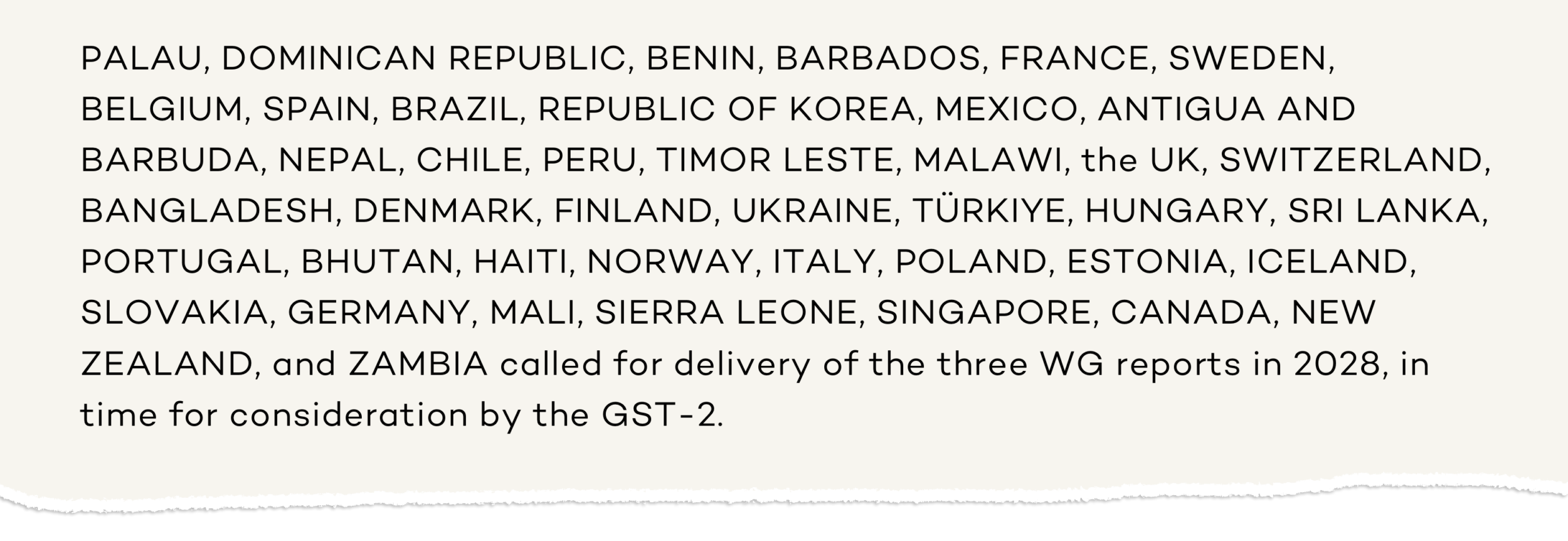
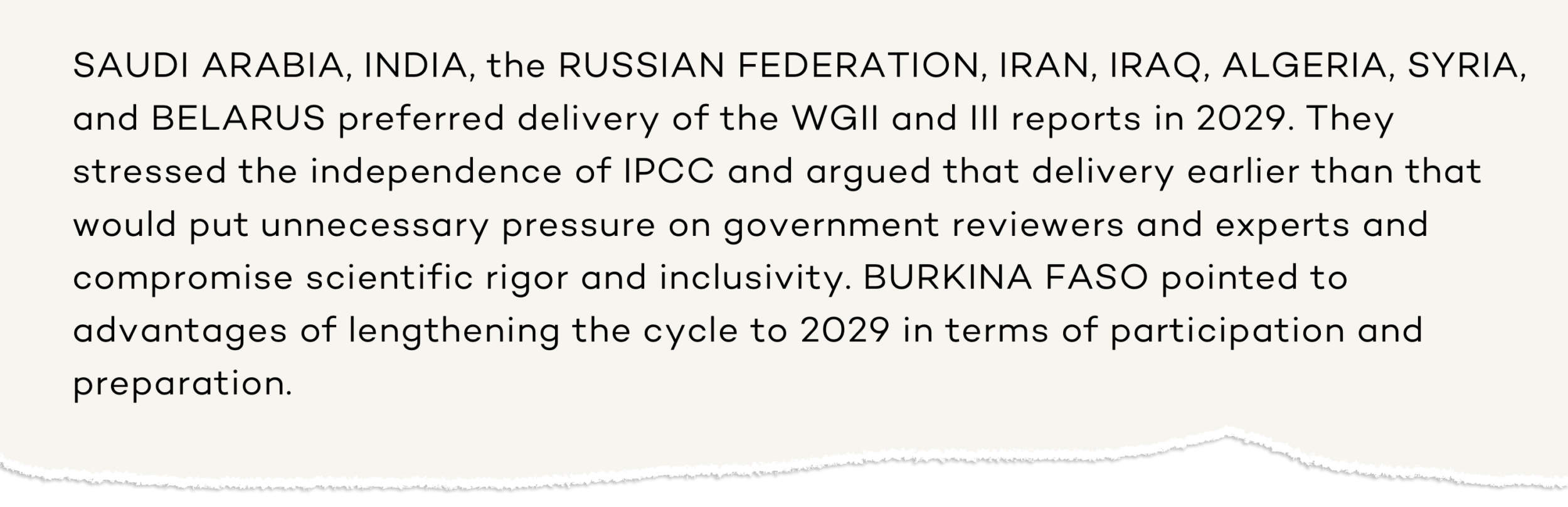
Both camps cited inclusivity concerns. Those in favour of a stocktake-aligned timeline said that “inclusivity is a priority and should be addressed, but said delaying delivery of the report would further disadvantage the countries most vulnerable to climate change”, according to the ENB.
In discussions on Monday, the Pacific island nation of Vanuatu underscored th