

新数据显示,继过去几年的低迷之后,2023年中国对非洲可再生能源项目的投资出现反弹。
中国和非洲之间的气候合作是中非合作论坛的一个重点议题。论坛每三年举行一次。本次峰会于9月6日闭幕,有数十位领导人齐聚北京。

上届中非合作论坛于2021年举行,论坛发表了一项具有里程碑意义的宣言,将气候合作“定位为”未来合作的“重要支柱”。同年,中国政府宣布停止为煤电项目提供资金。
随之而来的是对能源项目的政策性银行贷款出现暂停,这引发了人们对中国在非洲能源贷款前景的担忧。然而,波士顿大学全球发展政策中心(Boston University Global Development Policy Center)的最新数据显示,随着银行调整战略,以遵循投资低碳能源和“小而美”项目的要求,这种暂停只是一种重置。
本文分析了这一转变,并探讨了中国为非洲未来可再生能源建设提供融资所面临的挑战。
“既有”利益
中国一直是非洲的能源项目,尤其是化石燃料项目的重要融资方。非洲约75%的电力来自化石燃料,尽管其能源相关的碳排放量占全球总排放量的不到3%,电气化率也是所有有人居住的大洲中最低的。
过去,中国的大部分融资都是由中国两家政策性银行——中国进出口银行和国家开发银行——支持推动的,而且主要针对燃煤电厂。
这两家银行在非洲各地发放了1820亿美元的贷款,主要投向了能源行业。波士顿大学全球发展政策中心的数据显示,从2000年到2023年,政策性银行贷款总额的15%流向了化石燃料行业,12%流向了水电站。
相比之下,发放给太阳能、风能或地热项目的贷款按价值计算不到1%。
这在很大程度上是由于中国官方出资者与国企之间既有联系。根据中南项目(China Global South Project)的数据,从历史上看,大多数中国国企都专注于煤炭和水电等传统电力领域。
英国开放大学(Open University)国际发展教育讲师弗兰顿·奇耶穆拉(Frangton Chiyemura)博士告诉Carbon Brief,中国在2000和2010年代的国际发展活动反映了当时中国自身的“内部发展轨迹”,因为中国也发展了以煤炭为主导的电力系统,而水电是最大的低碳能源。
他表示,在这个“走出去”的时期,非洲的大多数能源项目开发商——主要是中国国企——都专长于水电和煤炭,这导致更多此类项目获得融资并得以建设。
他补充说,这些国企“在保险、融资和与非洲各国政府接触方面都有国家支持……(而且)没有做太多试图建立市场的基础工作”。
“小而美”
2023年,中国进出口银行和国家开发银行承诺向三个能源项目注资5.02亿美元,包括布基纳法索的一个太阳能发电厂和马达加斯加的一个水电站,结束了2021年和2022年能源贷款的“中断”,如下图所示。

中国政策性银行在非洲的能源贷款暂停了两年,部分原因可能是新冠大流行期间的经济压力。
不过,波士顿大学全球发展政策中心认为,在中国国家主席于2021年承诺停止资助煤电,转而建设“小而美”的项目后,这些银行似乎也暂停了活动,以对其投资战略作出“必要的调整”。
2021年中非合作论坛气候变化宣言也确认,中国将进一步增加对非洲可再生能源和其他低碳项目的投资,“不会在国外建立新的燃煤发电项目”。
奇耶穆拉告诉Carbon Brief,这两年间的贷款减少并非中国政策性银行的“独有”现象。他补充称,在疫情期间,西方国家向非洲提供的贷款也有所下降。
他还同意,中国贷款机构将重点从“数量”转向“质量”,更多地考虑与新项目相关的投资风险和社会影响,这加速了投资的转变。
在此期间,中国的其他利益相关者——从中国电建集团和三峡集团等国企到晶澳科技等私企——都同意为可再生能源项目提供资金或参与项目建设。
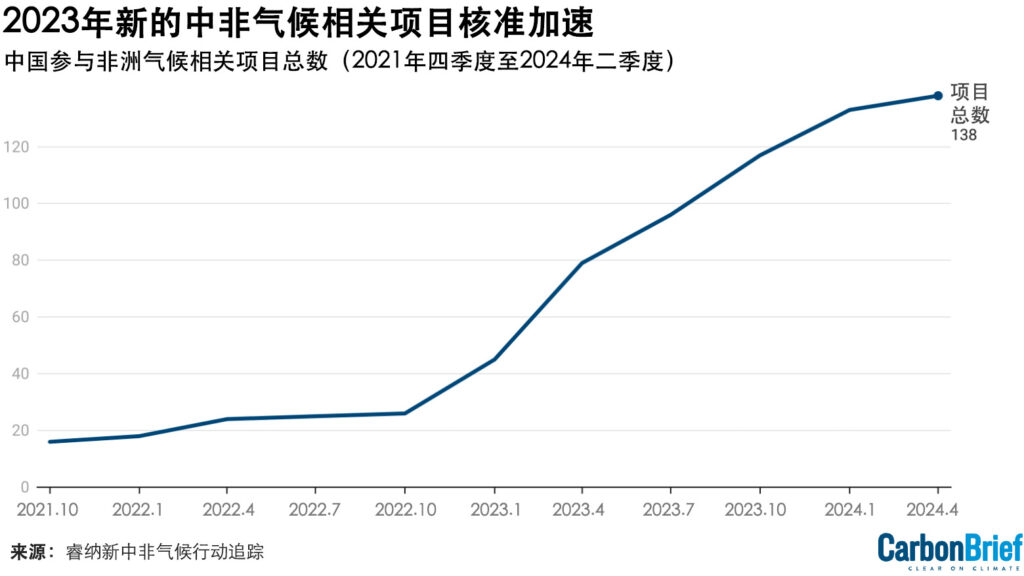
根据睿纳新国际咨询公司(Development Reimagined)整理的独立数据(如下图所示),自2021年中非论坛以来,已有138个新的气候相关项目达成协议,而且在过去18个月里,这一数字还在加速增长。
数据库中记录的项目包括超过20吉瓦(GW)的太阳能项目、9吉瓦的水电项目以及1吉瓦的风电项目,如下图所示。
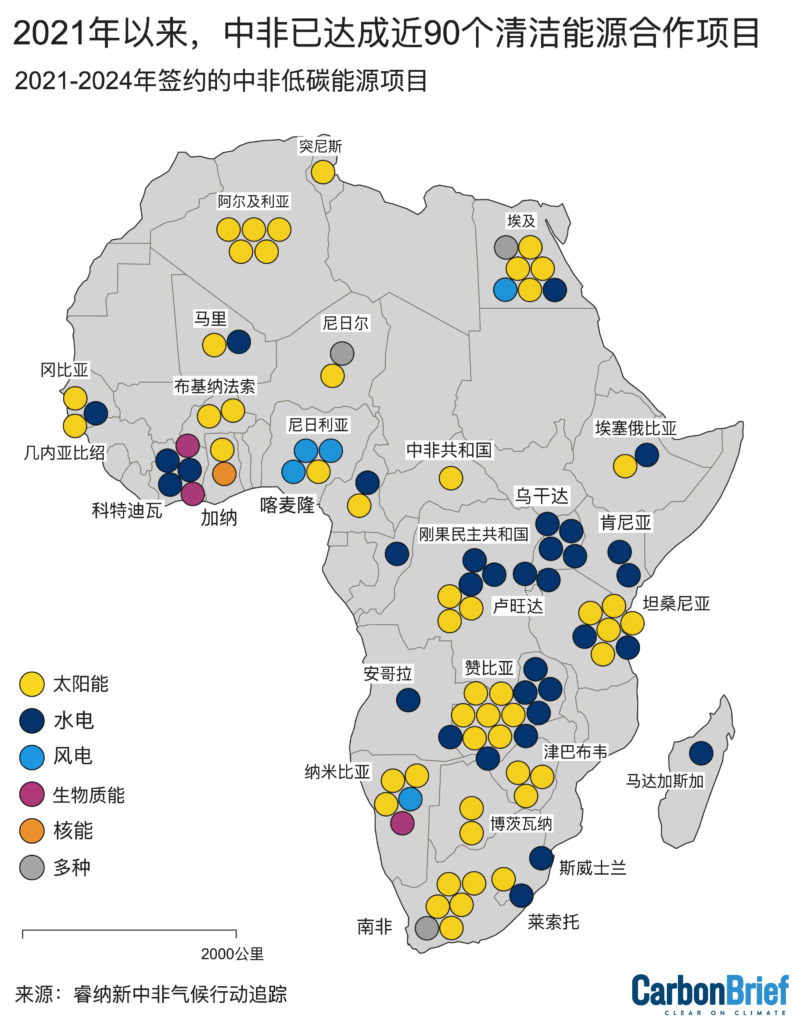
这些项目的资金来源广泛,包括中国和非中国企业、非洲和其他非中国金融机构,以及多边开发银行。
该咨询公司的项目经理兼中国气候融资政策负责人付亦可(Fu Yike;音译)对Carbon Brief说,在中国国家主席习近平2021年作出承诺后,中国国企已表示有兴趣“探索在非洲开展项目的新方式”,包括参与太阳能项目。
在数据库中列出的55个太阳能和风能项目中,国有企业分别参与了46个和5个。
根据睿纳新的分析,到2030年,中国在非洲的清洁能源项目装机可达224吉瓦,这意味着中国参与非洲的能源转型对于非洲实现2030年300吉瓦的目标至关重要。
付亦可补充说,特别是太阳能发电装机预计将成为中国未来在非洲能源部署的一大特色。
陡峭的“学习曲线”
总部设在伦敦的智库海外发展研究所(ODI)认为,中国“一带一路”倡议所建立的机制可以协助在非洲部署平价低碳技术,如同其促进了铁路和港口等中国国内基建产能向非洲“溢出”一样。
然而,奇耶穆拉告诉Carbon Brief,许多习惯于开发煤炭和水电的国企在转向可再生能源方面面临着巨大挑战。
此前,这些国企通过由政策性银行贷款资助的EPC总承包合同(即设计、采购和建造合同)来开发能源基础设施,这种合同只要求它们建设基础设施,而不负责运营和维护。
现在,非洲的决策者越来越多地推动采用股权融资模式,鼓励中国企业投资可再生能源项目并持有股份。
然而,奇耶穆拉表示,这种模式涉及到国企不太习惯的业务流程。
例如,埃塞俄比亚正在通过股权融资开发一座风力发电厂,从而减轻该国的债务压力。奇耶穆拉说,这意味着中国企业将不得不参与公开招标系统,而不是他们所习惯的闭门谈判。
“我记得一位(公司代表)说:‘为什么我要为一个(价值)可能只有8000万至9000万美元的项目浪费金钱和时间呢?’……企业认为,把时间花在(编写)招标文件上没有任何价值……但这表明它们在理解监管要求方面缺乏经验,而非洲的市场监管正在迅速变化。”
此外,付亦可认为,一些公司还对非洲的投资风险表示担忧。
大多数非洲国家在世界银行的“营商便利度”排名中靠后,这意味着监管环境不利于在当地创办和运营公司。
付亦可补充说,中国民营企业更愿意与国企合作,这可以将它们的参与与中国政府的利益更紧密地联系起来,从而限制它们的风险敞口。
奇耶穆拉与他人共同撰写的一篇论文也提到了这一点:“最近的趋势是在这些私营企业和国有企业之间建立一个联合体……很明显,在现有的政策群体中,新的联盟或利益集团正在形成,它们更加致力于促进风能和太阳能活动。”
奇耶穆拉称,部分原因是非洲在能源法规方面“快速变化”的环境。
非洲经济研究联合会(African Economic Research Consortium)合作研究经理戴安娜·恩吉·穆查伊(Dianah Ngui Muchai)认为,促进非洲投资的关键是针对可再生能源项目的“灵活和创新的(金融)工具”,以及“明确和现实”的政策目标。
奇耶穆拉告诉Carbon Brief,南非和埃塞俄比亚一直在尝试通过开发股权融资风电项目来实现这一目标。
“这是一条学习曲线,但我们相信也许在未来五到十年内……我们很可能会看到一些中国公司通过股权融资来开发这些项目。”他说。
中非论坛强调转向投资
这些主题在今年中非论坛的成果中得到了呼应。在主旨演讲中,习主席承诺向非洲提供价值3600亿元人民币(510亿美元)的资金支持。其中,2100亿元人民币(300亿美元)将通过信贷资金额度支付,700亿元人民币(100亿美元)将通过投资支付。
其中部分资金将用于资助一系列“清洁能源”项目,而“绿色发展”在会后的官方宣传中占据了重要位置。习主席在主旨演讲中指出,中方愿在非洲实施30个具体的清洁能源项目。
会后发表的宣言指出:“中方支持非洲国家更好利用光伏、水电、风能等可再生能源,进一步扩大在节能技术、高新技术产业、绿色低碳产业等低排放项目的对非投资规模。”
此外,与宣言同时发布的还有一份涵盖2025至2027年中非合作的行动计划,其中列出了指导未来三年中非合作的十大“伙伴行动”,包括“贸易繁荣”、“产业链合作”和“绿色发展”。
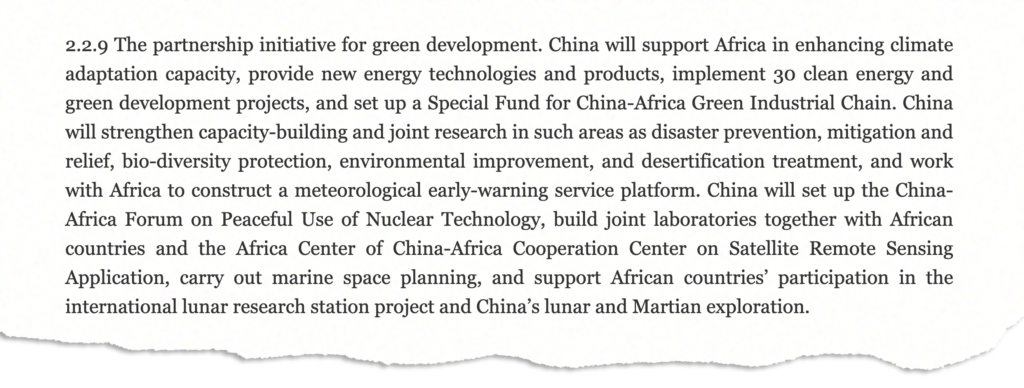
双方还将进行更广泛的能源合作,中方“将鼓励对非洲包括太阳能、风能、绿氢、水力发电、地热等可再生能源项目投资”。
习主席还告诉中非论坛代表,中国将“鼓励中非企业‘双向奔赴’投资创业……把产业附加值留在非洲,为非洲创造不少于100万个就业岗位。”
南非总统西里尔·拉马福萨(Cyril Ramaphosa)在新闻发布会上说,他“对习主席今天宣布的资金数额持非常积极的态度”,并补充说“这将是非洲大陆的一大福音”。
中南项目的分析则不那么乐观,认为报道标题上的数字“极具误导性”。
分析称,300亿美元的信贷额度“很可能………将更多地惠及中国企业,而非非洲利益相关者”,而100亿美元的投资数字“不应被视为政府财政承诺的一部分……因为(这笔资金)将由中国民营企业,尤其是采矿业企业提供”。
中南项目联合创始人埃里克·奥兰德(Eric Olander)告诉彭博社,这笔信贷可能会被用于“资助从中国购买大量太阳能电池板、电池和电动汽车”,以供非洲使用。
但非中政策咨询中心(Africa-China Centre for Policy and Advisory)高级研究员艾萨克·安克拉(Isaac Ankrah)博士告诉Carbon Brief,习主席对在整个非洲发展“绿色增长引擎”的关注凸显了中国“转向更具结构化的气候适应项目融资模式,重点关注技术转让、产能建设和可持续基础设施”。
他补充说,“这些承诺可能导致资金流的重新调整,使其更加符合非洲能源转型的具体需求”。
中非论坛对投资的关注是否会导致其切实远离贷款驱动型项目还有待观察,但一些非洲决策者将推动这种转变发生视为首要任务。
正如安哥拉财长维拉·戴维斯·德索萨(Vera Daves De Sousa)在接受路透社采访时所说:“我们需要打破常规思维: “我们需要跳出思维定式,因为‘你给我钱,我给你抵押品’的简单解决方案已经过时了。”

The post 深度报道:中国对非洲可再生能源的投资在沉寂两年之后反弹 appeared first on Carbon Brief.

Anne Jellema is executive director of 350.org; Mads Christensen is executive director of Greenpeace International; and Amitabh Behar is executive director of Oxfam International.
On Monday, global petitions with a collective total of more than 2 million signatures were presented to the United Nations, calling on governments to introduce binding mechanisms to make fossil-fuel companies and the super-rich contribute to the costs of the damage they have created.
The petition signatures were received by Selwin Hart, the UN Assistant Secretary-General for Climate Action, in New York during the UN General Assembly, sending a clear message to governments: there is no more room for excuses.
If governments are serious about resilience, energy security and protecting people from an increasingly unstable world, they must make the companies profiting from the fossil-fuel economy pay their fair share. Because the crisis we are facing is no longer some distant threat. It is unfolding in real time, and it is exposing the extraordinary costs of an economy still built around fossil fuels.
-
Climate change and energy transition rise up national security agenda
Leaders highlighted the national security risks posed by global warming and fossil fuel dependency at New York Climate Week -
COP31 presidency announces AI pledge as UN climate chief says Big Tech ‘on thin ice’
Turkish minister Murat Kurum said AI companies should be transparent about their energy use and power their data centres with clean energy
For more than six months, the Strait of Hormuz, the channel through which a fifth of the world’s oil once flowed without a second thought, has been closed, contested or effectively unusable. Tankers sit at anchor. Insurance premiums have gone through the roof. Petrol pumps from Los Angeles to Lagos have felt the tremor. It has taken a war to remind the world just how much of our daily lives still rests on a single, fragile artery of fossil fuels.
At the other end of the same emergency, a glacier came down on the Nepal–China border in the last week of August. A wall of ice, rock and water tore through the Bhote Koshi and Langtang valleys. It has been described as one of the deadliest disasters in the region’s modern history, unfolding in a landscape where the world’s glaciers are retreating and destabilising at a pace scientists have been warning about for years.
And this came only weeks after hundreds of thousands of people were displaced — not by ice, but by fire. Europe has experienced its worst wildfire season in more than a decade. Homes have been lost across Spain, Portugal, France, Greece and the UK. Firefighters and civilians have been killed battling the blazes, while damage and reconstruction costs continue to reach extraordinary levels.
These are not separate crises. They are different expressions of a world becoming more volatile, while the fossil-fuel economy continues to generate enormous profits for those at the top and pushes the costs onto everyone else.
Communities absorbing cost
Because the crisis we are facing is no longer some distant threat. It is unfolding in real time, and it is exposing the extraordinary costs of an economy still built around fossil fuels. One thread runs through all of these events: a global economy still organised around the profits of a fossil fuel industry that has known, for decades, exactly what it was doing to the planet.
At a moment when governments are gathering in New York for the UN General Assembly to talk about security, resilience and economic competitiveness, it is worth spelling out what “security” – or the lack of it, driven by our economy’s dependence on oil – actually means this year for ordinary people around the world: 35,000 excess deaths in Europe due to heat; the highest food prices in three and a half years; $700 billion in economic losses, threatening countless jobs and livelihoods, from a war and a closed oil chokepoint whose consequences are nowhere near over.
Meanwhile the companies that extracted, refined, shipped and sold the fuel behind all of this continue to report extraordinary profits. Households are paying more for energy. Governments are spending billions on disaster response, on reconstruction, on emergency deployments of firefighters and aid. Communities are absorbing the cost of a system they didn’t design and don’t control. We pay. They profit.
This is not a coincidence, and it is not inevitable. It is a political choice, repeated year after year, to let the companies most responsible for the climate crisis hoard the wealth they generate while the rest of us carry the risk.
Taxes and fines needed
That is why, together with communities and campaigners in dozens of countries have spent the last three years building the case for a simple, overdue idea: polluters should pay for the damage they have caused. Not through voluntary pledges or distant net-zero promises, but through binding mechanisms, climate damages taxes, surtaxes on fossil fuel profits, and fines ring-fenced for recovery and adaptation that put real money where the harm actually is. This is how we take the profit out of destruction and protect the generations to come.
The response has told us we are not alone in thinking this. Our petitions calling on governments to make polluters pay have now gathered a collective total of over 2 million signatures from people across every region of the world.
The case for making polluters pay has moved into the mainstream
That is not a fringe demand. It is what happens when people watch a choke-point war spike their fuel bill, watch a glacier take a thousand lives, watch their own summer holidays rearranged by fire. They draw the obvious conclusion: the people who caused this should be paying for it – not profiting from it.
We hear the objection already forming: that this is not the moment, with wars underway and economies fragmenting, to burden industry further. We would say the opposite is true. If governments can mobilise trillions for war, for bailouts and for new fossil fuel infrastructure, they can mobilise the political will to tax the companies that caused this crisis.
Money for clean energy and resilience
That money can go straight to the people paying for it, through cheaper, cleaner, more secure energy, and through funding for communities on the frontline of floods, fires and glacial collapse. There isn’t an excuse left. There is only a choice about where power and money go next. Every dollar we don’t spend now on adaptation, resilience and cutting emissions, we burn many times over later: on disasters we could have prevented and economies we scramble to fix too late.
This year’s UNGA should be the moment that choice gets made in public. Governments arriving in New York will talk about resilience, about energy security, about protecting their citizens from an unstable world. Let them explain on the record why a fossil fuel industry that has spent decades profiting from that instability should not be the one paying to fix it so wrecking the planet no longer pays off.
The fires, floods and storms won’t just go away. The system that keeps producing these disasters, and keeps paying the same companies for the privilege, will not change itself unless political leaders step up. It is on all of us to make sure they hear, as loudly as possible, that the time for excuses has run out.
The post After Hormuz, Nepal and wildfires, people demand action to make polluters pay appeared first on Climate Home News.
After Hormuz, Nepal and wildfires, people want action to make polluters pay
(and why it matters for the Global Plastics Treaty)
Originally posted by Greenpeace International.
The gravest consequences of the war are borne by people in Iran and across the region: lives lost, families displaced and essential infrastructure damaged. Its fossil fuel shock has also carried economic consequences far beyond the battlefield.
The war on Iran triggered an oil market crisis that sent shockwaves far and wide, and some consequences are still unfolding. Impacts rippled beyond energy and transport into shops and supermarkets, pharmacies and homes. People everywhere are still paying.
Nearly everything we buy, from shampoo bottles to strawberry packaging, is made from or with petrochemicals, wrapped in plastic, or both. But it does not have to be, and most people do not want it to be.
The war exposed a hidden risk in the plastics economy. Plastic depends on fossil fuel feedstocks and global petrochemical supply chains. When oil and gas supplies are disrupted, the cost and availability of packaging, medical supplies and everyday goods are disrupted too. Households, public services and communities ultimately pay.
The war has changed the terms of the debate around the Global Plastics Treaty. It has revealed the real costs of being tethered to the plastics supply chain. At the next round of treaty negotiations, governments have a choice. They can lock in deeper vulnerability to future price and supply shocks, or build economies resilient enough to withstand them.
Here are six things the conflict has shown us.
1. Plastic supply chains are vulnerable to fossil fuel shocks
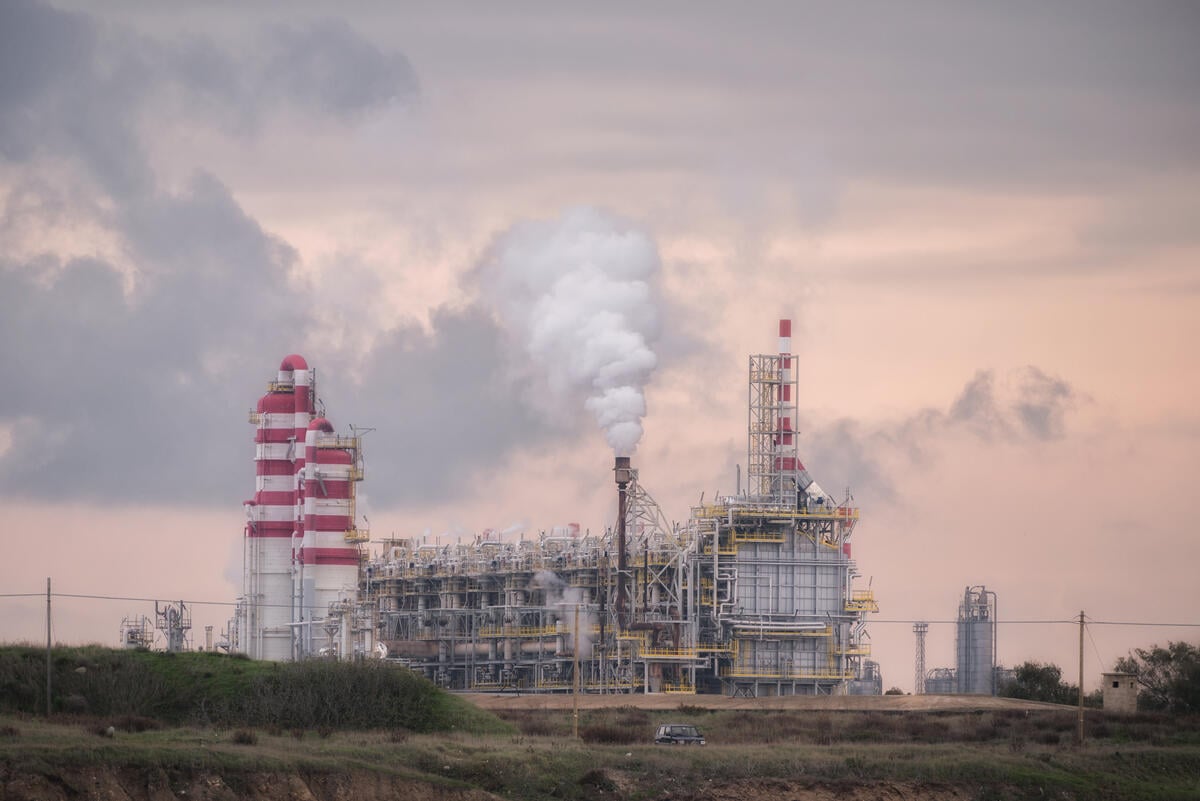
The war disrupted plastic production, imports, and exports at once, sending costs soaring worldwide. Formosa Petrochemical Corp (FPCC), one of the world’s largest plastic producers, was forced to declare force majeure. This is a legal term meaning it could not meet contractual obligations because of circumstances beyond its control.
In Japan, polyethylene production, a plastic widely used in shopping bags and packaging, reportedly fell 62% in March. Shortages then spread from factories to supermarket shelves.
The fallout reached beyond supply chains to hospitals, where South Korea had toban the hoarding of medical syringes. It reached household cupboards, where the price of body wash reportedly climbed 7.7% in a matter of weeks. It also reached children’s toy boxes. A US-based soft-toy manufacturer said its supplier in China had cited material cost increases of 10% to 15% within three weeks of the war starting.
Petrochemicals go into more than 6,000 everyday products, according to the US Department of Energy. The question is not whether every one of these products can change overnight. It is how many uses can be reduced, redesigned or replaced with safer, non-fossil-fuel alternatives.
2. The crisis created winners and losers
This conflict revealed new pressure points for countries whose industries depend heavily on plastics and petrochemical feedstocks. According to South Korean media, naphtha import prices rose 68% in a single month, while small and medium-sized manufacturers reported material shortages and cost increases of more than 20%.
As some producers were forced to scale back, China saw the conflict as a way to move beyond years of oversupply and low margins. Its own efforts to curb destructive overcapacity and price competition had struggled to resolve this problem. It increased exports to Asian markets, used accumulated inventory, ramped up idle capacity and absorbed demand left by disrupted competitors. One industry analyst has described this as a potentially lasting shift in market share.
Meanwhile, the US turned the same crisis into a windfall. Ethane-fed plants were less exposed to disruption at the Strait of Hormuz and kept input costs lower even as global prices climbed. Producers raised prices as markets tightened.Dow raised North American polyethylene prices by 10 cents a pound in March, then 15 cents in April, before doubling that increase days later. Another increase was announced in August.
LyondellBasell said its second-quarter earnings, excluding unusual items, rose nearly 600% year on year to US$1.4bn. Dow swung from a loss to a profitwithin a few quarters of the war’s start. This was not simply a story of market adjustment. Companies with less exposure to naphtha supply disruptions were better positioned to profit while producers and communities elsewhere absorbed the risks.
The benefits and harms of the petrochemical economy are not distributed fairly. Communities near extraction, refining and petrochemical facilities often carry pollution and health burdens, while countries dependent on imported fuel and feedstocks are exposed to prices they cannot control.
3. Households, public services and communities bear the costs

According to NielsenIQ data reported by Reuters, grocery prices in the US rose 2.9% year on year in the four weeks from the start of the war to 28 March. The same data showed bottled-water prices rising 5.8%, while nappies, pads and tampons, all of which contain plastics, rose by between 2% and 6%. School lunchboxes rose by more than 26%, the biggest increase of any school item, according to retail data.
Synthetic footwear could also become more expensive. With roughly 70% of synthetic shoe materials derived from petrochemicals, industry analysts project prices could rise by another 1.5% to 3% by late summer and autumn.
In Taiwan, the price of a basic plastic bag more than doubled, and Costco reportedly had to ration the number of food storage bags a single customer could buy. Companies and governments made the decisions that left economies exposed to this crisis, but it was ordinary people who paid for it. They paid through petrol, public transport, food, household goods and essential supplies.
The impacts are not shared equally. Lower-income households, small businesses, informal workers and countries reliant on imported fossil fuels and petrochemical feedstocks have far less room to absorb higher costs or shortages of essential goods.
4. Some governments are choosing reuse and resilience
In March, just weeks into the conflict, South Korea’s president, Lee Jae Myung, told his cabinet that the country’s deep reliance on petrochemicals made it difficult to predict where the next disruption would hit. He warned it ‘poses a serious threat to people’s daily lives’.
By April, he had moved from emergency response to longer-term reform, calling for a ‘plastics-free economy’. Taiwan’s government expanded reuse infrastructure to build a more resilient economy and reduce exposure to market fluctuations.
The lesson is not that scarcity or rationing is desirable. It is that planned, publicly supported reuse and reduction systems can protect people better than an economy dependent on volatile virgin plastic supply chains.
The question is whether enough governments act in time to avoid the next shockwave.
5. Reuse and reduction can work at scale

Industry has long argued that plastic is too convenient, too cheap and too embedded in everyday life to be meaningfully cut back. But when Taiwan’s plastic bags suddenly became scarce, the country continued to function. Retailers adjusted, the government expanded reuse programmes, and people brought their own bags.
As virgin plastic prices climbed, French retailer Carrefour committed to removing 5,000 tonnes of plastic from its packaging through refill formats and packaging reductions. It said it would pass the savings on to customers through lower prices.
This does not mean responsibility should fall on individuals. It means governments and businesses can build systems that make reuse, refill and less packaging easy, accessible and affordable.
Single-use plastic is embedded in retail systems, but it is not as indispensable as the industry claims. Cutting back is possible, and it can reduce costs as well as pollution.
6. Without structural change, the next shock is inevitable
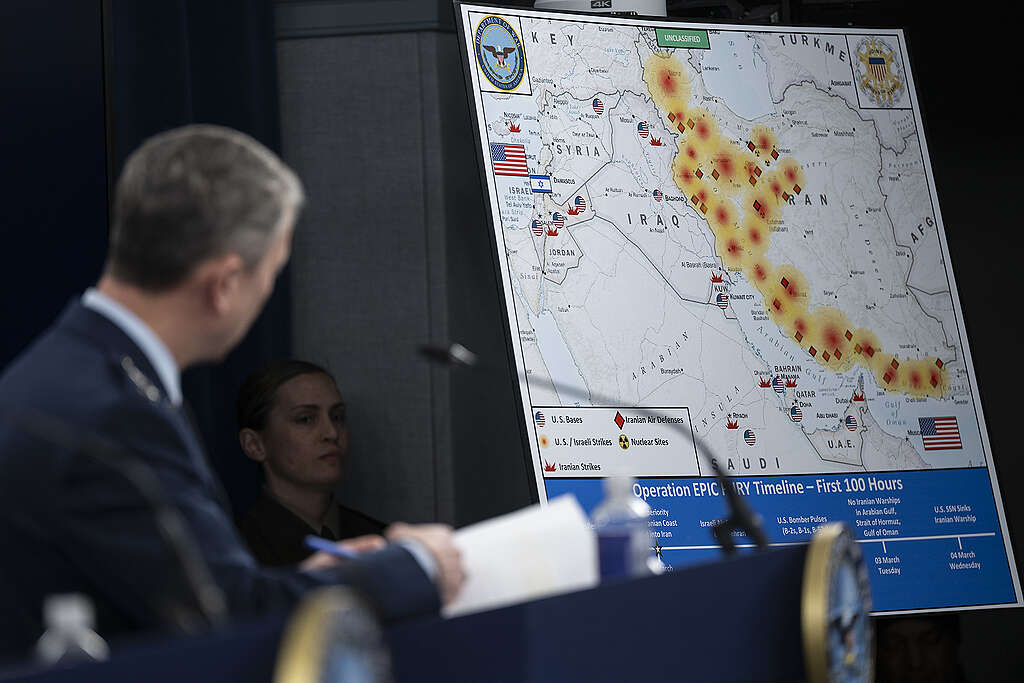
The conflict is not over, and even when it is, disruptions will come again. A similar pattern played out in 2021, when the Ever Given blocked the Suez Canal for six days, disrupting global trade and adding to existing pressures on plastics supply chains.
Exposure is also set to grow. The IEA predicts that plastics and petrochemicals are on track to become the single largest driver of growth in global oil demand through 2050.
Plastic producers are not separate from the fossil fuel economy. Petrochemicals are made from fossil fuel feedstocks, so continued growth in virgin plastic production deepens demand for oil and gas. It also locks communities and economies into exposure to future price shocks.
At the next round of Global Plastics Treaty negotiations, governments have a critical opportunity to cut dependence on fossil fuels, reduce the health harms caused by plastics and build systems more resilient to the next disruption.
A binding treaty that meaningfully cuts plastic production is not only a win for public health, ecosystems and the climate. It could be a turning point for economic security, geopolitical stability and the resilience of the systems we all depend on.
A Global Plastics Treaty can help break the cycle
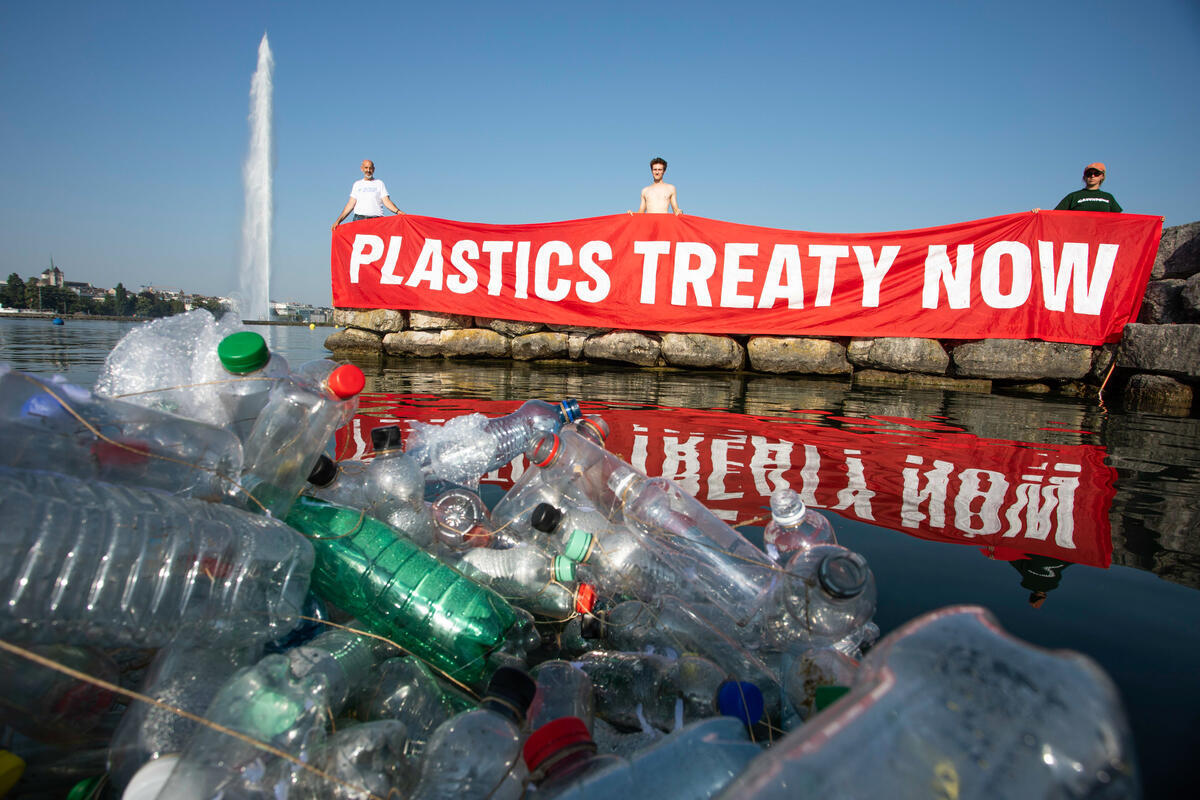
The lesson of the war on Iran is not that people should learn to live with shortages. It is that economies built around fossil fuels and ever-growing virgin plastic production are exposed to shocks they cannot control.
A strong, binding Global Plastics Treaty can help change that. By cutting plastic production, expanding accessible reuse systems and supporting a just transition away from fossil fuel dependence, governments can reduce pollution and help protect people from the next price shock.
Governments should protect people now while reducing future exposure. They should support reuse systems, invest in accessible refill and public services, and shift public investment away from fossil fuel and petrochemical expansion.
The people and communities least responsible for this system should not be the ones left paying for it. Governments must put public wellbeing, resilience and a liveable future ahead of the profits of fossil fuel and petrochemical companies.
For a more in-depth analysis, read our brief.
Lindsey Jurca is a Senior Plastics Campaigner at Greenpeace USA.
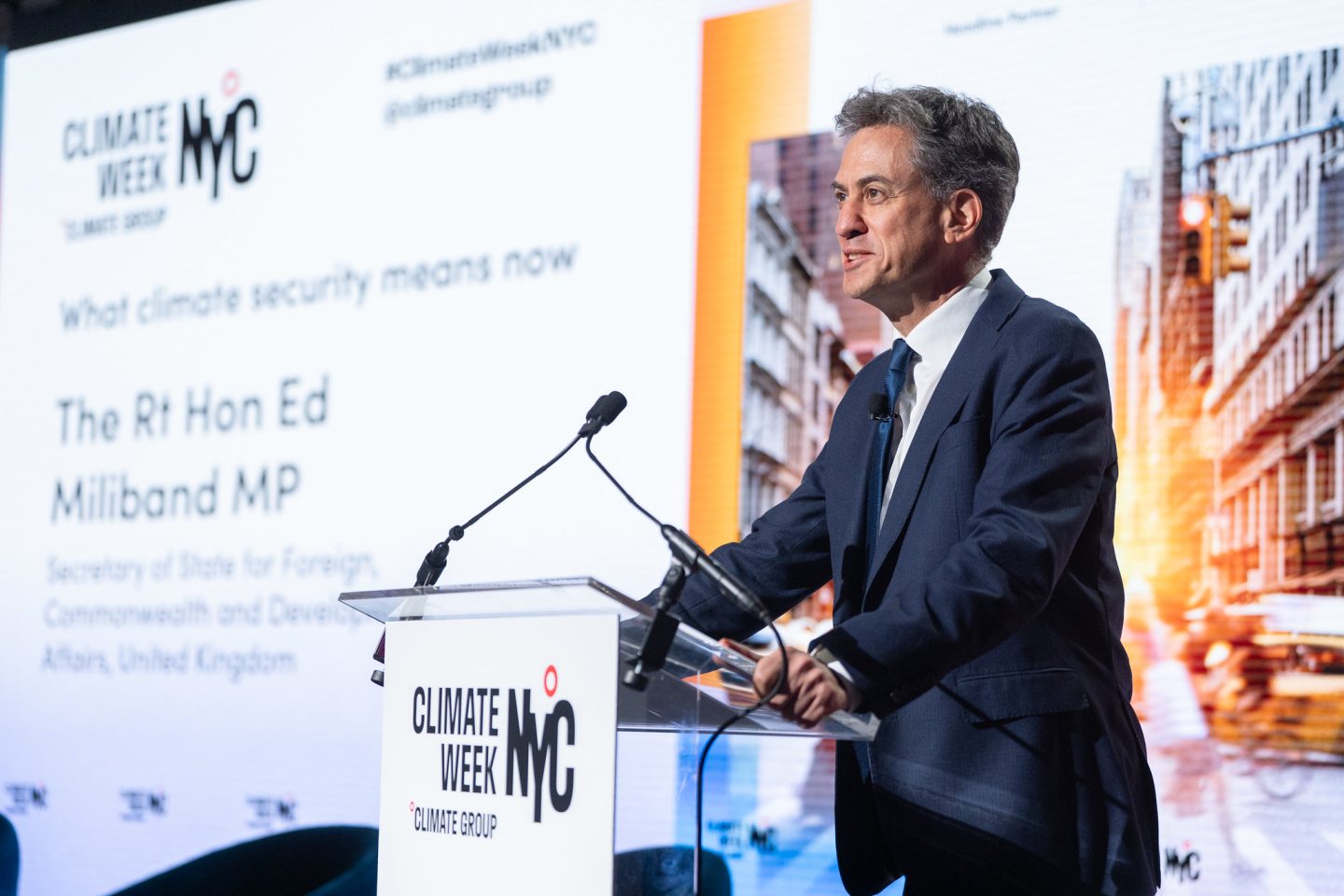
Governments need to start addressing climate change impacts and nature loss as a threat to national security and manage shocks before they hit rather than picking up the pieces afterwards, Britain’s foreign minister and other leaders told the opening of Climate Week NYC on Monday.
Ed Miliband – who was until July the UK’s energy minister – said the growing urgency and severity of extreme weather and related disasters require a shift in thinking, calling on governments to put the issues “front and centre”.
“Climate breakdown, in my view, must be an issue for foreign ministers and prime ministers, as well as energy and climate ministers – the security community, not just the activist community, the generals, not just the green campaigner,” he told an audience of policy and business leaders.
There is a need to assess risk differently, he added, by embedding climate and nature in national security systems, threat assessments and contingency planning. He also urged countries to pool information because climate shocks can travel fast through supply chains as well as influencing financial markets and migration patterns.
The framing of climate change as a threat to countries’ security and stability is not new, but it has gained greater emphasis as the impacts of global warming are biting harder in places like Europe, which is struggling with more intense heatwaves, drought and forest fires.
In mid-August, Miliband said in a social media post, reflecting on the UK’s hot and dry summer, that he would convene foreign ministers attending the UN General Assembly in late September to discuss how to respond to “this new national security threat” and build a coalition for action. But he did not give further details of that initiative on Monday.
-
Fossil fuel expansion threatens COP31 hosts’ credibility, experts warn
Türkiye and Australia are pushing coal, oil and gas at home with no national timeline for their own fossil fuel phase-out -
DR Congo’s power-hungry mining sector drives record solar surge
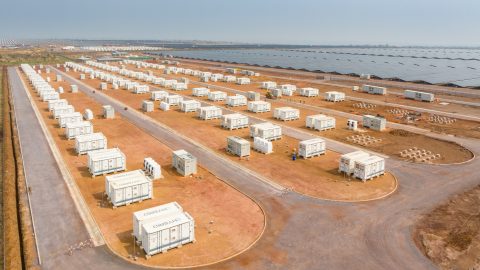
As solar deployment rapidly accelerates across Africa, miners in the DRC are driving significant demand for clean energy to replace expensive diesel
Australia calls for unified response
Other leaders in New York also reflected on the growing threat to their societies and economies from climate change impacts and exposure to volatile fossil fuel markets.
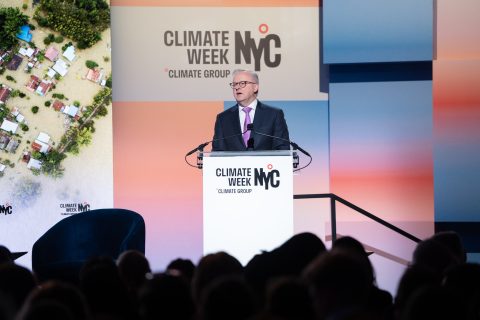
Australian Prime Minister Anthony Albanese said his country “understands the dangers of global warming and the urgency of climate action as well as any nation”.
“We have seen it up close – from increasingly intense bushfires and floods, to the damage warming oceans are wreaking on our vulnerable coastlines,” he said in a speech, adding that with a record-breaking El Nino forecast, Australia and Pacific nations are preparing for a potential summer of extreme heat, bushfires and floods.
With scientific forecasts of worsening impacts now coming to pass, “this means the global community cannot afford to be frozen in time as the world warms around us”, he added. People cannot be left to cope alone, he said, emphasising that as leaders, “we need to come together, to meet the problem head on”.
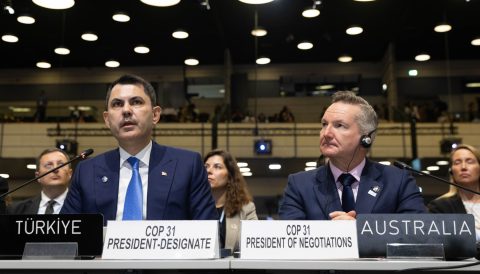
Australia will lead the negotiations at the upcoming COP31 climate summit, and has brought the existential threat to Pacific countries from sea level rise into the diplomatic limelight. The pre-COP gathering next month will be hosted in Fiji, with a visit by leaders to Tuvalu.
Speaking to Climate Home News in New York, Panama’s environment minister Juan Carlos Navarro said the small Central American country faces hundreds of millions of dollars in losses from drought in the Panama Canal due to El Niño.
The Panama Canal Authority estimates income could be reduced by between $225 million and $400 million due to slower maritime traffic passing through the strait.
“What a great irony,” Navarro said. “Panama being a small, carbon-negative country pays the price for the big carbon-emitting countries.”
Climate investment “critical” to stability
Amina J. Mohammed, deputy secretary-general of the United Nations, said there was a need for countries to stick with multilateral approaches to problems including climate change, despite the difficult geopolitical times the world is going through. She added, however, that it “does require your voices. It won’t happen by itself. We have to lean into it.”
The rest of the high-level UNGA week in New York will show the extent to which multilateral efforts to resolve the world’s problems – from climate change to poverty – have top-level support as leaders give their speeches, including the Brazilian and US presidents on Tuesday.
Kaysie Brown, associate director for climate diplomacy and geopolitics with think-tank E3G, said the statements by Miliband and other leaders at Climate Week NYC had underlined the political and government case to integrate climate considerations into security thinking and institutions at the highest level.
“In a world of escalating climate impacts and the record El Niño expected to heighten risks worldwide alongside energy volatility and geopolitical tensions, investing in global climate resilience and the clean energy transition are critical to credible strategies to enhance stability and national security,” she added in a statement.
Suneeta Kaimal from the Natural Resource Governance Initiative (NRGI) said that, while in previous years governments heavily focused their speeches on climate action, this year’s focus on energy security does not change the underlying challenge.
“The fact that the framing has changed from energy transition to energy security doesn’t change the reality that this transition needs to occur in energy systems. It’s just a different framework. It’s a more transactional framework, but it all points to the need for resilience,” she said.
Speaking at the opening session of Climate Week, Iceland’s Prime Minister Kristrún Frostadóttir described how her country had reacted to the spiralling costs it faced from the 1970s oil price crisis by investing in a large-scale district heating system fuelled instead by its abundant geothermal energy.
“Resilience wasn’t built while the crisis was happening. It was built in the years after – deliberately, patiently, as a national mission – so that the next shock wouldn’t hit as hard, if at all,” she said.
New COP goal on electrification
Speaking at a separate event on Monday, UN climate chief Simon Stiell pointed to a new voluntary target expected to be adopted at COP31 for 35% of global energy use to come from electricity by 2035 as a strategy that can help cushion countries, families and businesses from fossil fuel supply shocks and rising costs.
At the United Nations, the Turkish COP presidency gave more details of the electrification goal it first announced at the Bonn climate talks in June, including sharing with governments a final text of the pledge it wants them to get behind.
The pledge sets out a global ambition to advance electrification, highlighting the importance of supporting developing countries to identify their grid investment needs and access finance for electrification.
“It is a development strategy, an industrial strategy, a health strategy, and a security strategy,” Stiell said.
The post Climate change and energy transition rise up national security agenda appeared first on Climate Home News.
Climate change and energy transition rise up national security agenda



-

 Greenhouse Gases2 years ago
嘉宾来稿:满足中国增长的用电需求 光伏加储能“比新建煤电更实惠”
-
Climate Change1 year ago
Guest post: Why China is still building new coal – and when it might stop
-
Greenhouse Gases1 year ago
Guest post: Why China is still building new coal – and when it might stop
-

 Climate Change2 years ago
嘉宾来稿:满足中国增长的用电需求 光伏加储能“比新建煤电更实惠”
-

 Renewable Energy11 months ago
Sending Progressive Philanthropist George Soros to Prison?
-
Climate Change2 years ago
Bill Discounting Climate Change in Florida’s Energy Policy Awaits DeSantis’ Approval
-
Greenhouse Gases1 year ago
嘉宾来稿:探究火山喷发如何影响气候预测
-

 Carbon Footprint2 years ago
US SEC’s Climate Disclosure Rules Spur Renewed Interest in Carbon Credits