Since its last major famine more than a decade ago, Somalia has received well over a billion dollars a year in humanitarian aid. But that spending – aimed at meeting immediate basic needs for food and water in the conflict-ravaged Horn of Africa country – has not reduced demands for help, which are instead rising as climate change brings more frequent and severe floods and droughts.
With supplies of international aid increasingly falling short around the world as the number and scale of crises and disasters grows, humanitarian groups are trying out new approaches to close the gap, including “anticipatory action” which pushes small amounts of cash to those in the path of a looming disaster, to help them better protect themselves and their assets.
In countries such as Bangladesh, with strong early warning systems and disaster-reduction mechanisms in place, such efforts have been shown to cut losses by about $7 for each $1 invested. But in the world’s most fragile and conflict-affected states – from Somalia to Afghanistan, and Iraq to Chad – systems like this are often missing.
Reducing humanitarian needs and boosting resilience there will require building basic infrastructure, something that can only happen if development, peace-building and relief groups – and their funders – get out of their comfort zones and overcome obstacles to working together, resilience researchers say.
“The only way to get ahead of a disaster is not by mitigating its effects but by avoiding it happening in the first place – by investing in disaster-risk reduction and climate adaptation,” said Mauricio Vazquez, who leads work on climate change and conflict at ODI Global, a London-based think-tank.
“You don’t need to wait for a bad weather forecast to do something. Anticipatory action done by humanitarians doesn’t create opportunities for people, it just helps make the best of a situation,” he said in an interview with Climate Home.
Weak governance exposes people
Abdihakim Ainte, director of climate change for Somalia’s prime minister, agreed that “vulnerability primarily stems from the dysfunction of key institutions.”
“The weaker the institutions, the more susceptible people are to every shock and disruption,” he told Climate Home.
At last year’s COP28 climate talks, more than 100 countries, banks and other organisations issued a call for “collective action to build climate resilience at the scale and speed required in highly vulnerable countries and communities, particularly those threatened or affected by fragility or conflict.”
Innovative efforts to make that happen are ramping up. Financiers including the African Development Bank, for instance, are increasingly trying to move development cash through peace-building and humanitarian groups on the ground in conflict-hit areas.
The bank has signed an agreement with the International Federation of Red Cross and Red Crescent Societies (IFRC), an organisation that “has the ability to operate in very insecure environments. They stay there – they’ve been there for decades,” said Fredrick Teufel, the bank’s lead coordinator of efforts to boost its investments in fragile contexts.
The IFRC focuses on using humanitarian grants to deliver short-term aid. But in places like conflict-plagued Goma, in the eastern Democratic Republic of Congo, or in Somalia, “there’s no reason they cannot use that delivery capacity there to also advance irrigation (or) community-based solar,” Teufel said in an interview with Climate Home.
Humanitarian groups can give funders crucial and otherwise unavailable insights into what communities affected by conflict themselves see as the most useful investments, he said, noting that “they all want development solutions, not another bag of rice.”
But significant institutional obstacles stand in the way of scaling up such cooperation, including a need by humanitarian groups to be seen as neutral in conflict zones, and accounting rules that require different types of development and climate funding to be kept in separate pots to avoid double counting.
Humanitarian action limited
In Goma, in the Democratic Republic of Congo, the International Committee of the Red Cross (ICRC), which focuses on protecting victims of armed conflict, is working with development partners and funders over seven years to rehabilitate and expand the Goma West water system – a project that serves both development and humanitarian needs.
But such projects don’t lead to meeting broad country-level needs, warned Catherine-Lune Grayson, head of policy at the ICRC.
In order to protect their ability to access conflict-hit communities, humanitarian groups need to carefully avoid taking sides in political disputes – and choices about partners and where to spend development money are often political.
“We have to tread a fine line. Where do we join forces, and where do we need to keep a healthy distance so it’s not read as too political?” Grayson asked, emphasising the need for “complementary” rather than “joint” work.
Scale is another issue. “We can help rehabilitate the water system in Goma, but you cannot ask the ICRC to restore and expand all water systems across the country. We will say we’re not equipped to do this,” she said.
Still, the view that countries struggling with conflict are not the sole responsibility of humanitarian agencies is fortunately growing, she said.
“A few years ago, there would not even have been a discussion about this. There’s been a real shift,” she added.
Maladaptation?
The different time horizons of humanitarian groups – focused on meeting short-term needs – and development actors – focused on longer-term aims – are another area that needs attention as groups try to work together, said Manisha Gulati, a global risks and resilience researcher with ODI Global.
In Somalia, for instance, wells and water storage are often being built to meet immediate humanitarian demand – but analysis by ODI researchers suggests the money is not being spent where it will be most needed in the future, as climate change impacts strengthen, she said.
“We have mapped where water insecurity is now and where it will get worse – and that’s where we should be thinking about. That’s how we prevent the next drought and humanitarian crisis,” Gulati said.
Today “we’re digging wells that won’t work in the long term. It’s maladaptation and we’re not using finance well if we’re using it in a manner where in the next 5-10 years we create a problem,” she said.
Simply improving communication among those working to solve problems in armed conflict areas is one way to move ahead, Gulati said. “How do we talk about collective action when agencies have no idea what the others are doing?” she asked.
Ainte, of Somalia, said efforts to win resources for crucial development in conflict-hit countries – a challenge as development aid stagnates – can often come into conflict with appeals for humanitarian aid, which keep the focus on vulnerability.
“The humanitarian narrative has to change to a development narrative. Somalia has resources that need to be invested in. We need that kind of mentality, that we are a country that has potential and deserves investment, rather than a country that has a problem,” he said.
Need to fix systems
But winning funding to boost development and create resilient systems in fragile countries will also require the countries themselves to step up, including cutting corruption and building stronger guardrails to ensure funds are used effectively, Gulati said.
“They need to understand it’s not a one-way street – they have to make an equal effort and adjustments,” she said. “You might get $100 million – but you won’t get more unless you fix the basics in your systems.”
With climate impacts surging and almost two-thirds of the world’s extreme poor expected to live in countries that are fragile or conflict-affected by 2030, the stakes for getting this cooperation right are growing, she added.
“We can keep throwing money at the humanitarian problem, but we’re not reducing the caseload,” she said. “We need to address the basic vulnerabilities that are leading to this situation. If we don’t do that, we’re not going to solve the problem.”
Sponsored by ODI Global and the Climate, Peace and Transboundary Resilience Pavilion at COP29. See our supporters page for what this means.
Laurie Goering is a freelance writer and editor based in London, UK.
The Climate, Peace and Transboundary Resilience Pavilion at COP29 will host 30 events with world-leading experts, including heads of state and other leading representatives from governments, climate funds, aid agencies, civil society organisations, and more. All events will be livestreamed. For more information visit the Pavilion page here.
The post Aid agencies grapple with climate adaptation in fragile states appeared first on Climate Home News.
Aid agencies grapple with climate adaptation in fragile states

A milder winter can sound like welcome news. But for a community waiting for a winter road to carry fuel and building supplies, or a family relying on safe ice to reach harvesting areas, warmer conditions can bring difficult trade-offs. The significance of the coming El Niño is not simply how much temperatures might rise, but what changing winter conditions could mean for food, travel, health, and community life.
One of the strongest El Niño events in the modern record may be developing in the tropical Pacific. NOAA’s October 8 assessment placed an 83% probability on its October–December three-month Relative Oceanic Niño Index reaching at least +2.5°C—a threshold it identifies with an event stronger than previous El Niños in its record dating back to 1950.
For First Nations, Inuit, and Métis communities, the implications will depend on location, local conditions, and the systems people rely on. This is not a forecast of the same experience everywhere: it is an opportunity to consider how a large-scale climate event could interact with existing community priorities and risks.
El Niño, not La Niña
El Niño and La Niña are the warm and cool phases of the El Niño–Southern Oscillation, or ENSO. During El Niño, unusual warming in the central and eastern tropical Pacific changes atmospheric circulation, influencing weather far beyond the Pacific.
El Niño is a naturally occurring climate pattern, distinct from long-term human-caused climate change, although the two can combine to influence temperatures and extreme-weather risks. A strong event changes the odds of particular conditions; it does not determine the weather in any individual community.
What the forecasts suggest
NOAA’s October assessment indicated that a strong-to-very-strong El Niño was likely through January–March 2027. The World Meteorological Organization’s September update also anticipated a very strong event peaking near the end of 2026, with impacts continuing into 2027.
Environment and Climate Change Canada’s August assessment pointed toward a milder winter across much of Canada, with the possibility of drought and wildfire risks extending into the following spring and summer. Its August-issued winter outlook favoured above-normal temperatures across much of British Columbia, the Yukon, Manitoba, Ontario, Quebec, and Atlantic Canada, while parts of western Canada were more likely to be drier than normal.
These are seasonal outlooks, not predictions of conditions on a particular day or travel route. Cold spells, heavy snow, freezing rain, and other dangerous weather can still occur during an otherwise mild winter.
Winter roads, essential connections
For some remote First Nations, winter roads provide a limited seasonal window for moving heavy freight that supports daily life and planned construction. When conditions prevent trucks from carrying full loads, the consequences can reach well beyond transportation.
In February 2024, Nishnawbe Aski Nation Chiefs-in-Assembly declared a winter-roads state of emergency after unusually warm conditions restricted freight movement. NAN identified fuel and construction deliveries among the essential supplies at risk. That experience illustrates why another potentially warm winter deserves attention, although it does not establish what the 2026–27 road season will bring.
The practical planning question is therefore larger than whether a road will open: it includes how essential deliveries and community projects will be supported if the operating season is disrupted. Seasonal forecasts can inform contingency planning, but decisions about road access and load limits must remain grounded in actual local conditions.
Food, culture, and seasonal relationships
Changing winter conditions can also affect access to harvested foods and the relationships sustained through harvesting and sharing. Inuit Tapiriit Kanatami identifies country food as central to Inuit well-being and sharing practices, while highlighting climate-related pressures on access to locally harvested foods. Safe travel is therefore about more than reaching a destination; it also supports food systems and connections between generations.
These concerns take different forms elsewhere. Along the British Columbia coast, El Niño-associated ocean warming can affect fisheries and shellfish, creating another reason to monitor conditions important to harvesting and livelihoods. In Ontario, the Métis Nation of Ontario has identified increasingly unpredictable harvesting seasons among the climate changes affecting Métis citizens.
These are existing climate concerns, not proof that a particular harvest will fail in 2027. The connection to El Niño is the possibility that another season of unusual conditions could add pressure to food systems already adapting to environmental change.
Looking beyond winter
Some of the most consequential risks may emerge after the snow melts. Reduced snowpack, limited spring runoff, and warm, dry conditions can contribute to drought and a more favourable environment for wildfire. ECCC’s August-issued outlook for spring 2027 indicated a high probability of above-normal temperatures across much of western Canada.
For communities facing wildfire, preparedness involves more than protecting buildings. Fires can threaten harvesting areas and medicinal plants, while evacuations require continuity of health care, access to medications, mental-health support, and culturally safe services.
The First Nations Health Authority’s wildfire response resources reflect that broader understanding of safety through support for clean-air spaces, health-service access, counselling, and cultural supports. These considerations belong in early planning wherever local assessments identify elevated risk—not because El Niño guarantees a severe fire season, but because preparation takes time.
Different places, different risks
A national headline about a warmer winter can obscure important regional differences. ECCC’s review found that parts of Nunavut experienced colder-than-normal winters during previous very strong El Niño events, even while much of the country was warmer. The historical sample is small, so that pattern should be treated as a tendency rather than a community-level prediction.
Coastal communities may also face a different combination of concerns, including heavy rain, storm surge, and coastal flooding. Neither a warm national outlook nor an expectation of colder conditions elsewhere can establish whether local ice is safe: community observations and current conditions remain essential.
Indigenous leadership already at work
Indigenous communities are not approaching these risks without knowledge, experience, or solutions. First Nations, Inuit, and Métis climate strategies identify their own priorities for preparedness, food systems, infrastructure, and community well-being.
SmartICE provides one practical example of locally grounded adaptation. Its community-based services bring Indigenous and local ice knowledge together with monitoring technology to support travel decisions. Information is shared through tools including SIKU, as well as local communication channels. Monitoring supports knowledge and decision-making; it does not replace the judgement of experienced ice users.
Land stewardship offers another example. In spring 2026, Gitanyow Land Guardians and Firekeepers carried out cultural burns intended, in part, to support food and medicinal plants. Such initiatives should not be presented as responses to the coming El Niño; they demonstrate stewardship and adaptation work already underway.
The Assembly of First Nations’ National Climate Strategy places First Nations jurisdiction, knowledge systems, and self-determined priorities at the centre of climate action. Inuit Tapiriit Kanatami similarly calls for Inuit-led decisions and partnerships that support Inuit priorities. Preparing for the coming season should build on that leadership rather than treat communities only as recipients of emergency advice.
Preparing on community terms
A useful starting point is to connect updated forecasts with the decisions communities already make about transportation, harvesting, water, health, and emergency readiness. Depending on local priorities, planning could include:
- Reviewing essential deliveries. Identify supplies and projects exposed to winter-road disruption, and discuss contingency arrangements before shortages develop.
- Supporting local monitoring. Resource community-selected approaches to observing ice, snow, water, and travel conditions, alongside current weather information.
- Protecting food access. Consider support for harvesters, food sharing, storage, and alternative supplies where access may be disrupted.
- Preparing for smoke and evacuation. Review clean-air spaces, transportation, medication access, health-service continuity, and culturally safe supports.
- Following regional updates. Revisit plans as ECCC’s monthly seasonal forecasts and local assessments provide a clearer picture.
Planning also requires resources and clear responsibilities beyond the community itself. The AFN’s climate strategy calls for sustained funding and direct partnership with First Nations rights and title holders, including action on infrastructure and emergency-management capacity. Inuit climate priorities likewise identify infrastructure gaps and the need for partnerships shaped by Inuit decisions.
A very strong El Niño does not guarantee a particular winter-road season, harvest, drought, or wildfire outcome. Its value as an early warning lies in the time it provides to prepare—and in whether that time is matched with the resources and decision-making authority communities need to act on their own priorities.
By:Rye Karonhiowanen Barberstock
Photo by: Goran Vinko at Unsplash
The post A Supersized El Niño: What Winter 2026–27 and 2027 Could Mean for Canada appeared first on Indigenous Climate Hub.
A Supersized El Niño: What Winter 2026–27 and 2027 Could Mean for Canada
Australia is looking to South Korea to help turn its vast renewable energy and mineral resources into new export industries supplying low-emissions materials to Korean manufacturers – a deal which campaigners hope will shift trade between the two nations away from fossil fuels.
In an agreement signed on the sidelines of the COP31 climate summit in Antalya, Türkiye, the two countries established a cooperation framework to connect South Korea’s growing industrial power demand with Australia’s clean energy resources.
The deal also aims to support investment in power grids, clean energy supply chains, and greening industries to accelerate emissions cuts.
Analysts say the agreement can help build competitive clean energy supply chains and attract long-term investment into decarbonising industrial processes.
Richie Merzian, CEO of the Clean Energy Investor Group (CEIG), an Australian industry body representing institutional investors in clean energy, told Climate Home News this was “a great example” of a government-to-government agreement that would give investors confidence to invest in green technologies.
-
SE Asia speeds up plan for connected clean power grid after oil shock
Countries are redoubling efforts to link their grids to bolster energy security and reduce their dependence on fossil fuels – but many challenges remain -
As COP31 weighs 35×35 pledge, IEA says Hormuz crisis driving electrification
The report estimates that a planned transition away from fossil fuels and into renewables can add energy jobs and cut energy bills -
Southeast Asia’s fragile grids threaten billions in clean energy investment
Renewables developers need reliable electricity infrastructure and stable policies to help the region meet climate goals and surging demand for power
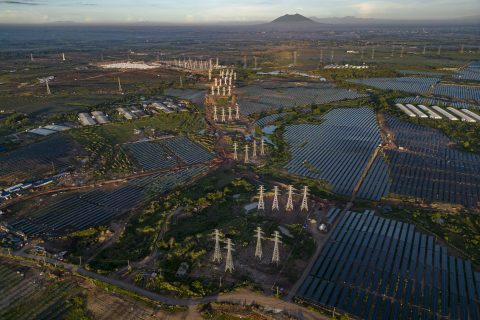

For example, the deal could support Australian exports of green iron and other low-emissions materials, while giving Korean manufacturers access to cleaner inputs for steelmaking, batteries and other industries.
That in turn could help attract investments in Australian renewable power projects, hydrogen production and industrial infrastructure if developers know Korean customers are willing to pay for greener products.
“The high levels of capital for green iron and steel need certainty on demand and a credible path to offtake before it commits,” said Merzian. The partnership, he added, “will help smooth out the path for Korea’s significant industrial policy and capital to come down under”.
A model for cooperation
The Australian government described the partnership with one of its largest trading partners as “a significant economic opportunity“, opening new markets for its energy and mineral resources.
The agreement will also support the delivery of South Korea’s $750 billion energy transition strategy through 2035 to expand renewable energy capacity by 100 GW by 2030, bolster clean industries and decarbonise high-emissions sectors, such as steel, petrochemicals and cement.
South Korea’s climate and energy minister Kim Sungwhan said in a statement: “This cooperation will serve as an important opportunity for our two countries to combine their respective strengths and jointly pursue industrial decarbonisation, energy security and economic growth.”
In addition, both parties submitted a joint proposal to UN Climate Change to share best practice and lessons learnt on how bilateral cooperation “can serve as a practical and replicable model for broader international cooperation and collective action in addressing the global crisis crisis”.
A group of five civil society groups across Australia and South Korea welcomed the partnership as an opportunity to accelerate the transition away from fossil fuels “in a bilateral relationship historically built on coal and gas”.
Australia was South Korea’s top supplier of liquefied natural gas (LNG) in 2025, while South Korean institutions have a record of financing Australian gas and coal projects. “Without a clear plan to reduce this dependence, the new partnership risks expanding clean energy cooperation without meaningful changes to the trade and reliance on fossil fuels,” the group said in a statement.
Greening iron production: a major opportunity
Greening iron production could offer one of the biggest opportunities for increasing the trade of low-carbon goods between two countries, according to analysts.
Using hydrogen produced with renewable electricity instead of coal to remove oxygen from iron ore for steel production could cut emissions by as much as 85% according to one study. If the resulting metallic iron is then melted in an electric arc furnace powered by green electricity, steel-making emissions can be further reduced.
Australia’s abundant iron ore and renewable energy resources could make it a competitive producer of green iron, while South Korea’s established steel industry offers a prospective market for the material.
A 2025 study, commissioned by CEIG and conducted by consultancy Baringa, identified green iron as one of Australia’s most promising green export industries.
-
We must strengthen trade cooperation to deliver on global climate goals
As governments turn to trade-related measures to deliver on their climate targets, cooperation is vital to reduce fragmentation, costs and build more resilient economies -