

SYDNEY, 26 JUNE 2024 — Greenpeace Australia Pacific has called for the Australian Parliament to vote in support of independent MP Sophie Scamps’ proposed forest protection amendments to the Albanese Government’s “stage 2” national nature law reform package.
The Member for MacKellar has proposed three key sets of amendments to the Environment Protection and Biodiversity Conservation Act 1999 (EPBC Act) that would drastically reduce deforestation in Australia and protect endangered wildlife like the koala. This includes removing exemptions for the native forest logging industry and the agricultural sector, and setting a 20-hectare threshold above which any instance of bulldozing must be referred to the Australian Government for assessment.
Glenn Walker, Head of Nature at Greenpeace Australia Pacific, said that amendments to protect Australia’s forests and wildlife were urgently needed.
“Australia has one of the worst rates of deforestation in the world. Forest destruction is fuelling the extinction crisis in Australia, and threatened animals like the koala are being left homeless, injured or killed by deforestation.
“Currently, the EPBC Act does little to address or regulate deforestation. This means rampant bulldozing of threatened species habitat is falling through the cracks.
“Australia urgently needs strong, new environmental laws that will halt nature destruction and end the extinction crisis. With the full promised reforms stalled, it’s critical that the most urgent issues are addressed in the interim, and deforestation is right at the top of the list for action.
“We congratulate Sophie Scamps for showing leadership on this issue and urge all parliamentarians to vote in support of these critical amendments.”
—ENDS—
Notes:
High res images and footage of deforestation can be found here
For more information or to arrange an interview please contact Kimberley Bernard on 0407 581 404 or kbernard@greenpeace.org


Carbon credit developers, corporate buyers and some leading conservation NGOs are challenging new proposed rules to stop UN carbon credits being wiped out by fire, drought or logging, in what critics have called a “coordinated lobbying campaign” to weaken the nascent market’s push for greater integrity.
According to documents seen by Climate Home News – including a briefing given to government officials – companies, NGOs and the UN Environment Programme (UNEP) have contested the scientific basis for the move, arguing that stronger protection for carbon reductions could hike project costs and restrict the supply of credits to the market.
The climate benefit of credits that claim to reduce or avoid greenhouse gas emissions by storing carbon is undone if that carbon is released back into the atmosphere – something known as reversal risk. To protect against such losses and preserve the credibility of the credits’ carbon-offsetting claims, projects are generally required to set aside a reserve of credits that cannot be sold, as a form of insurance.
How these “buffer pools” are calculated has long been a source of contention, especially in forest conservation projects, which many experts say have historically underestimated the risk of carbon losses.
In July, the technical UN panel tasked with drafting rules for the Article 6.4 mechanism, which underpins the credits that countries and companies can use to meet their climate goals, proposed a new system. It would require project developers to size these insurance pools of credits based on local risk values derived from new research published by a group of independent scientists.
UK’s budget juggling trick with rainforest loan for bus-fare cap needs transparency
Its supporters have hailed it as a more rigorous approach than current practice in the voluntary carbon market, which largely relies on expert guesswork and, in some cases, gives significant leeway for project developers to come up with their own data.
“The decision on the reversal risk assessment tool will be crucial,” said Federica Dossi, an expert at Brussels-based advocacy group Carbon Market Watch. “It would bring a new paradigm for calculating the number of units forwarded to the buffer pool based on empirical data.”
The technical panel is due to discuss the reversal risk tool and its application to a specific set of projects at a five-day meeting in Bonn this week. It is then expected to forward new recommendations to the mechanism’s regulator, the Supervisory Body, for a decision on whether to approve them at a meeting in early October.
The rules are set to be applied initially only to clean cookstove projects, one of the market’s most popular and heavily criticised credit types. They could then be extended to other activities, including programmes to protect forests.
Copy and paste?
More than 30 organisations aired their views in lengthy public submissions to the Article 6.4 mechanism, responding to a call from the UN secretariat for external feedback.
A Climate Home News review of those submissions found that there was significant overlap in their messages and, in several cases, sections of the text, or even entire submissions, were copied and pasted by different organisations. This points to a coordinated effort to flag concerns regarding the new rules.
In one instance, tech giant Apple, a large buyer of nature-based carbon credits, warned against relying on one scientific model and called for rules that let project developers use a variety of risk mitigation tools, rather than surrendering buffer credits, to cover the risk of carbon losses.
Apple’s submission is a lightly-edited version of a separate input presented by the Beyond Alliance, a coalition of corporate buyers and NGOs that promote market-based climate investments. In an apparent oversight in one paragraph, the Beyond Alliance’s name appears in Apple’s submission instead of the tech giant’s.
-
Most “zombie credits” locked out of new UN carbon market after China and India snub
Fears of a flood of environmentally-dubious carbon credits have faded, with most old projects not able to transition to new UN market -
UN’s first Paris Agreement carbon credits face human rights and climate concerns
Civil society groups allege the cookstove project in Myanmar exaggerated its climate impact while maintaining ties with military junta


The Beyond Alliance told Climate Home News that, after receiving input from its members, it shared its final submission, leaving them to decide if and how they wanted to use it. The coalition rejected any characterisation that its submission advocates for a weaker tool and only reflects business concerns.
The Beyond Alliance added that its members received briefings by UNEP, which Climate Home News understands has played an important role in wider efforts to influence the development of the rules underpinning the UN carbon market.
Three experts and a European Union diplomat told Climate Home News that the interventions of the UN agency overwhelmingly supported the views of those with a financial interest in carbon markets.
UNEP’s head of mitigation Gabriel Labbate rejected this accusation. He told Climate Home News that the UN agency contributes technical inputs from a “politically-neutral, science-based perspective” and its positions are grounded in an assessment of environmental integrity and are not shaped by, or aligned with, the financial interests of any market participant.
UNEP, NGOs criticise scientific basis
In mid-July, representatives from UNEP, Conservation International and The Nature Conservancy (TNC) briefed government officials from Canada, the UK, Germany, Costa Rica, Belgium, Nigeria and Peru, according to a webinar readout seen by Climate Home News.
The online event was organised by the Forest & Climate Leaders Partnership (FCLP), an initiative that brings together 41 countries plus the EU.
The speakers voiced strong criticism of the new proposed rules. A technical advisor to Conservation International, a US-based NGO that runs several large-scale carbon offsetting programmes, told participants the Article 6 panel’s approach was “based on bad science”. This, he said, is because it relies on a single model that he claimed is not appropriate to determine buffer pool contributions, according to a presentation seen by Climate Home News.
During a high-level discussion led by UNEP’s Labbate, speakers said the application of measures to manage reversal risk on cookstove projects could “impose disproportionate costs and undermine the financial viability of these activities”, according to the readout.

Cookstove programmes issue credits by calculating the greenhouse gas emissions prevented by burning less fuel – usually wood or charcoal – through the use of more efficient stoves. With the new reversal risk tool, these activities would be expected to guard against future carbon losses for the first time under the UN carbon market.
But UNEP, as well as leading NGOs and carbon credit firms, have pushed back against the requirement, arguing this type of credit represents a “flow” of avoided emissions rather than a “stock” of stored carbon that can be released. Scientists reject that distinction, noting that the wood left unburned is still standing in a forest exposed to the same risks as any other.
At the online briefing, speakers also raised concerns that the tighter approach would be replicated for nature-based carbon projects with a direct impact on the future of large-scale forest conservation credits. The Conservation International advisor called it a “bad precedent”.
Both Conservation International and TNC run carbon credit programmes that aim to protect trees from being cut down. Labbate leads the UN-REDD programme, which supports countries developing forest protection initiatives including through carbon credits, and is co-chair of the expert panel advising the Integrity Council for the Voluntary Carbon Market (ICVCM).
After the webinar, the organisers shared by email a series of “key messages” and draft submissions produced by the three organisations, which participants were invited to consider and adapt in their own inputs to the Article 6.4 consultation process.
Getting the rules ‘right’
In a statement to Climate Home News, Ghana, Paraguay and the UK – which are FCLP co-leads for its work on forest carbon credits – said members of the coalition welcomed expert views from a range of partners to help them understand the potential impact of Article 6.4 rules on the eligibility of forest carbon credits in international markets.
They added that the FCLP does not have a common position on the rules and its members are free to choose whether to attend webinars and use any of the materials circulated.
In a statement to Climate Home News, Conservation International said “getting these rules right is important to the environmental integrity of the carbon market, while ensuring all sectors have a place in it”. It added that the NGO does not dispute the validity of the scientific research underlying the proposed buffer pool, but recommends a broader approach including multiple models and datasets.
A spokesperson for TNC said the organisation had helped clarify complex materials and their potential implications, while decisions on how to respond remained entirely with participating countries.
‘Inconvenient science’
The scientific basis for the disputed reversal risk tool rests on two pieces of research. A peer-reviewed study, published in Nature in May and led by scientists at several US universities, modelled forest carbon-loss risk across the United States and found existing buffer pools there are undersized by an average factor of six.
To extend that approach worldwide, the Article 6.4 panel also drew on a second, global analysis by the same research team, which has not yet completed peer review. That study used satellite images, weather records and computer modelling to estimate a 31-42% chance of forests worldwide losing stored carbon within 100 years, depending on the scenario.
The panel picked one of these scenarios and turned its estimates into fixed risk percentages for individual countries, and in some cases provinces, which projects in those locations would need to apply.
Palestine: Israel’s bombing has left Gaza vulnerable to climate change
Critics say the peer-reviewed portion of the research was calibrated on North American forests, and that applying the same approach to other regions relies on a global study that is still going through academic checks.
But, for William Anderegg, professor of biological sciences at the University of Utah and one of the authors of that research, it is the best science currently available. He described it as “light-years better” than assumptions underlying the voluntary carbon market, where risk numbers are not generally based on independent evidence and tend to be incredibly low.
Scientific research, including by Anderegg, has found that buffer pools in forestry projects in the voluntary carbon market are substantially smaller than they should be to adequately protect against future releases of carbon.
“There really seems to be a fairly coordinated campaign to try to weaken the strength of these [Article 6.4] tools and their scientific underpinning,” he told Climate Home News. “It’s a little dispiriting to see folks attack science that’s inconvenient.”
Regulators under pressure?
An EU diplomat told Climate Home News that experts and negotiators working on the Article 6.4 mechanism have faced intense pressure from big carbon credit developers and large parts of the nature-based solutions community.
“It is very clear that they are lobbying against strong rules, and they want to align the Paris Agreement mechanism with the standards of the voluntary carbon market,” the diplomat said. “They have influence, time and money, even more than some governments, so they can be very effective in their efforts.”
Last year, the Article 6.4 Supervisory Body, the new market’s regulator, approved rules on the permanence of credits aiming to remove carbon from the atmosphere which critics said were watered down compared to the technical panel’s recommendations. This followed feedback from carbon market firms and conservation NGOs, which submitted dozens of critical views.
EU carbon credits could supercharge world’s clean cooking push, France says
Carbon Market Watch’s Dossi said decisions that strengthen environmental integrity are targeted in particular as they tend to reduce the number of credits that can be issued.
Then, as now, those who opposed tighter rules argued that overly strict safeguards would make some projects too expensive to carry out, with a negative impact on local communities and the climate.
But proponents argue that higher-integrity programmes will drive up market prices, ultimately benefiting everyone.
“If rules ensuring better-quality credits make them somewhat more expensive than they are today, that’s an acceptable consequence, not a reason to weaken the rules, especially since these credits will be used to offset continued emissions,” said Dossi.
Efforts to pull the rule-makers in different directions are expected to intensify in the coming weeks as a decision on the new credit protection system nears.
“I really don’t know how this will turn out in the end,” one veteran carbon market expert said. “What I am sure about is that it will be quite a battle.”
The post Industry and NGOs lobby to weaken UN carbon credit rules in “coordinated” push appeared first on Climate Home News.
Industry and NGOs lobby to weaken UN carbon credit rules in “coordinated” push
A relatively ambitious deal to reduce the shipping industry’s 3% of global emissions now looks more likely after four days of closed-door talks in London, observers say.
The International Maritime Organization (IMO), which oversees the negotiations, said there had been “constructive discussions” and “genuine willingness within the group to make concrete further progress”.
Em Fenton, senior director at the NGO Opportunity Green who attended the talks last week, said they “demonstrated a strong spirit of solidarity in the face of blatant attempts to undermine the credibility, ambition and equity of a hard-fought multilateral agreement”.
After several years of debate, governments provisionally agreed in April 2025 on a “Net-Zero Framework” (NZF) – a series of emissions reduction targets for shipowners aimed at incentivising them to use cleaner fuels, backed up with financial rewards for meeting the targets and fees for missing them.
But in October 2025, after a high-profile intervention by US President Donald Trump and threats of US sanctions and visa restrictions, the US convinced a majority of voting nations to postpone the adoption of the NZF for a year.
UCL analysis found that, of those who expressed a view at last week’s talks, 38 were in favour of an NZF-style solution while only 17 were against. Those opposed are “consistently composed of strongly fossil fuel-aligned governments”.
An observer of the talks, who did not want to be named, said the countries opposed include the US, Russia, India, Thailand, Argentina, Ecuador and Uruguay, as well as eight oil-rich Gulf nations and shipowner-reliant Liberia and Panama. Governments that support an NZF-style deal include China, Brazil, Mexico, Türkiye, Canada, Australia, Chile, nine African nations, most European countries and small islands.
A new framework to tackle shipping emissions could be adopted if two-thirds of countries that are present and signed up to a regulation called Marpol Annex VI – endorsed by just over 100 states – vote in favour of it, as they did in April 2025.
UCL’s analysis said it was “reassuring” that governments which had taken strong positions in the media against the NZF were being more compromising in the negotiations.
Tweaks are probable
While there is majority support for the NZF, UCL said adopting it would be difficult politically. “The process from here could therefore be as much about producing what appears to be a new package, but one that broadly ends up with similar outcomes in relation to objectives,” UCL argued.
But tweaking the NZF, which resulted from years of negotiations, comes with risks, it warned. For example, changes could reduce the new system’s planned support for low-income countries, turning them against it. Fenton said compromising should not mean “abandoning the principle of justice in the maritime transition”.
UCL said the speed at which shipowners must reduce their ships’ emissions or face fees is likely to be reduced in the short-term but raised in the long-term to meet a goal of net zero emissions by mid-century.
-
Palestine: Israel’s bombing has left Gaza vulnerable to climate change
With homes, hospitals and water storage destroyed, Palestine’s government says that Gazans have little protection from climate impacts and sets conditional emissions targets -
More support needed to power Africa’s food systems with renewables, experts say
Renewable energy could help African food businesses boost productivity and competitiveness, but the upfront cost, fragmented markets and limited financing stand in the way -
Loss and damage fund urged to hold crisis meeting on Nepal
The new fund is coming under pressure from developing nations to respond quickly to climate disasters rather than just financing longer-term projects



This was a compromise put forward by NZF-supporter Brazil. However, an analysis by the the Institute of Marine Engineering, Science and Technology (IMarEST) has found that this change would lead to more overall emissions than the original NZF trajectory.
UCL has warned it could incentivise liquefied natural gas as a shipping fuel over greener options, which include hydrogen-based methanol and ammonia.
Analysis by UCL and the Rocky Mountain Institute suggests that, while a slower start to the NZF would reduce transport costs in the short term, it would increase them later due to the costs involved in switching the industry over from more polluting fuel to cleaner fuel.
NZF won’t meet emissions goals
IMarEst’s analysis finds that even in its current form – the most ambitious deal on the table – the NZF will not be sufficient for shipping to meet its emissions reduction goals.
It says that only a Pacific proposal to place a levy on ships’ total emissions – rather than just those above a certain level – would meet the industry’s targets to reduce emissions 20% between 2008 and 2030, 70% by 2040 and then reach net zero “by or around, i.e. close to 2050”. This is highly unlikely to be adopted.
Additional talks will be held from November 23-27 and from November 30-December 3 before a potentially final round of official negotiations begins on December 4.
The post London talks raise hopes for green shipping deal appeared first on Climate Home News.
Climate Change
At regional summit, Pacific islands ask for COP31 support for clean energy and finance
At a key leaders’ summit in Palau, Pacific island nations burdened by worsening climate change impacts and costly fossil fuel imports called for November’s COP31 climate summit to deliver finance to help the region transition to renewable energy and build more resilient communities.
Heads of government from the 18-member Pacific Islands Forum (PIF) – which includes COP31 co-president Australia – met in Palau’s capital Koror for a week-long summit, where they demanded access to climate finance, ocean action and a regional boost for renewables at COP31.
Palau’s president Surangel Whipps Jr. said during a plenary session that the Pacific must focus on delivering climate and ocean commitments. “It will require greater regional leadership, stronger regional coordination and, above all, unity of purpose,” he said.
The meeting, which ended last Friday, was marked by the absence of some leaders – among them the heads of state of the Solomon Islands, Vanuatu and Fiji, which will host a preparatory session for COP31 in October (referred to as the pre-COP31). There were also tensions over Taiwan’s participation, with China objecting to its presence as an observer.
The forum’s final declaration, published after it ended and signed by all its members, reaffirms that climate change is the “single greatest threat to the security, livelihoods and wellbeing of Pacific peoples”, and notes “the importance of a focused, high-level declaration” at the pre-COP31 to build “political momentum towards COP31”.
-
Palestine: Israel’s bombing has left Gaza vulnerable to climate change
With homes, hospitals and water storage destroyed, Palestine’s government says that Gazans have little protection from climate impacts and sets conditional emissions targets -
More support needed to power Africa’s food systems with renewables, experts say
Renewable energy could help African food businesses boost productivity and competitiveness, but the upfront cost, fragmented markets and limited financing stand in the way -
Loss and damage fund urged to hold crisis meeting on Nepal
The new fund is coming under pressure from developing nations to respond quickly to climate disasters rather than just financing longer-term projects

Australia and Pacific islands have invited world leaders to attend the pre-COP31 gathering, which will be held in Fiji and Tuvalu from October 5 to 8. While usually a technical meeting for negotiators, the island nations aim to issue a political declaration at the gathering calling for strong outcomes in Türkiye.
Chris Bowen, Australia’s climate minister and COP31 president of negotiations, said in a speech during the Pacific forum that his country is “determined to use COP31 to progress the agenda to make it easier for countries to access the climate finance they need”.
“We won’t miss the opportunity to ensure COP31 is a Pacific COP. Not just because of the location of pre-COP but because of the agenda we are shaping through the Action Agenda at COP31,” he said.
The Action Agenda is a large portfolio of climate initiatives and coalitions uniting governments, businesses and civil society outside of the formal negotiations on everything from health to methane emissions.
Renewable energy investment plan
Announced a year ago, the island nations launched a $14-billion investment plan for a “100% Renewable Blue Pacific” at the forum in Palau. The plan lists strategic projects that would reduce the region’s high dependence on fossil fuel imports, whose soaring costs have become a major burden since the Iran war.
The projects include a $52-million programme managed by Australia to develop off-grid renewables in remote communities across the Pacific, as well as a $100-million blended finance fund aimed at supporting private-sector investments in wind and solar, among others.
Currently, some countries in the Pacific are spending up to a quarter of their GDP importing diesel to power electricity generation, according to a new report by the University of New South Wales in Australia. The investment plan launched at the forum aims to reduce these costs by adding 2.2 gigawatts of renewable generation and around 9 gigawatt hours of electricity storage.
To channel funds into the region, the plan also highlights the role of the recently established Pacific Resilience Facility (PRF), a regional fund that seeks to swiftly disburse funds to climate-vulnerable communities at the local level. Bowen said he would promote the facility to world leaders attending COP31 and “ask for their support”.
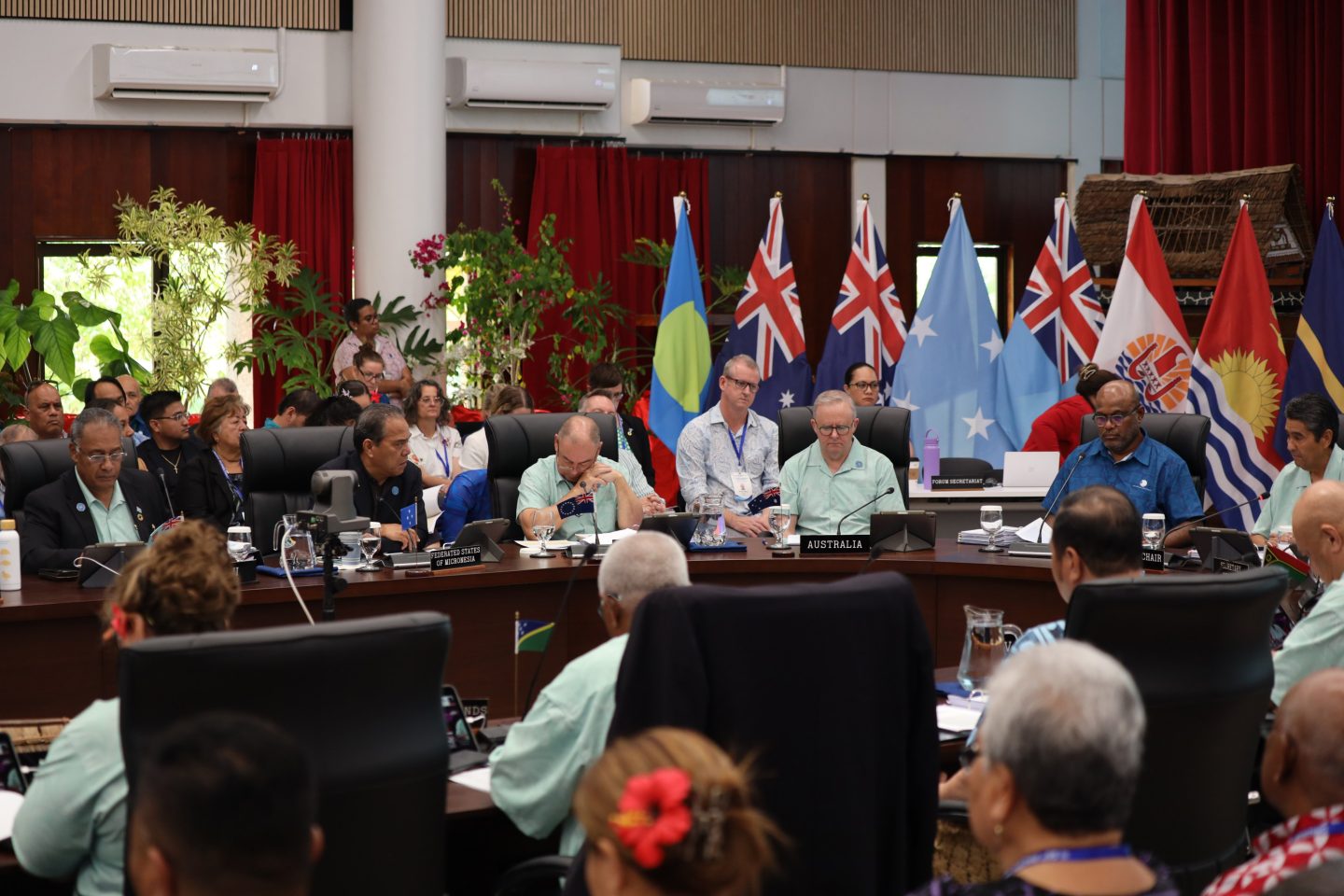
Call to transition away from fossil fuels
Separately, the forum endorsed the Belau Declaration which emphasises the need to keep the 1.5C Paris Agreement temperature goal alive. A UN report last week showed that overshooting this limit is now inevitable, but deep emissions cuts could still bring global temperatures back down by the end of the century.
Pacific nations expect to rally support for this declaration at the pre-COP, with Fiji’s climate minister Lynda Tabuya saying in a statement: “Palau is where we build the political mandate. Pre-COP is where we take it to the world.”
The political declaration also says that countries must accelerate the global transition away from fossil fuels “towards a renewable energy future”, and calls for greater recognition of the importance of ocean health in addressing climate change.
UN sets out narrow path back to 1.5C warming after inevitable overshoot
As part of the forum’s outcomes in Palau, countries also noted Tuvalu’s efforts to host the second global conference on transitioning away from fossil fuels, which will gather government representatives in April next year to follow up on this year’s inaugural conference in Santa Marta, Colombia.
Speaking to journalists at the forum, Vanuatu’s climate minister Ralph Regenvanu questioned Australia’s role in talks about phasing out fossil fuels at COP31, adding that “the very least a country like Australia should be doing is stopping future expansion, and it’s not doing that”. During the PIF, the country approved the extension of a major mine that digs and exports coal for steel-making, giving it permission to keep producing until 2055.
Rising seas trigger “development emergency”
As leaders met in one of the world’s regions most threatened by sea-level rise, UN Secretary-General António Guterres released a new report warning that rising seas are now “one of the most profound threats to populations around the world in developed and developing states alike”.
Presenting the report at UN headquarters in New York, Assistant Secretary-General for Economic Development Navid Hanif said rising sea levels are not a “future risk any more” but an accelerating “development emergency” that could hinder progress in vulnerable regions like the Pacific and least developed countries.
The report warns that seas are rising “faster than at any point in recorded history”, with 2024 setting a new record of 5.9 millimetres. This has been driven by human-induced climate change mainly through a process known as thermal expansion – where rising heat causes the ocean to expand – as well as the melting of ice sheets.
Pacific islands seek backing for new regional fund ahead of COP31
The report notes that about 1.2 billion people around the world are exposed to coastal flooding, and says some low-lying islands in Vanuatu, the Solomon Islands and Fiji are already facing forced relocations. Globally, rising seas could cost more than $1 trillion every year by 2050, it adds.
“We cannot stop sea level rise this century but we can determine how much worse it becomes. About half a metre of sea level rise is already locked in in this century because of warming that has already occurred, but beyond that our choices matter enormously,” Hanif told journalists.
Bill Hare, CEO of think-tank Climate Analytics, said the report was a “wake-up call” to the leaders of high-emitting countries that their failure to cut carbon emissions is “creating major risks for the future alongside the impacts we can already observe around us”.
Guterres is set to host a high-level meeting on addressing the threat of sea level rise this month during the UN General Assembly, where countries are expected to adopt a declaration that calls for stronger action, expanded access to finance and “ongoing dialogue” to tackle the issue.
The post At regional summit, Pacific islands ask for COP31 support for clean energy and finance appeared first on Climate Home News.
At regional summit, Pacific islands ask for COP31 support for clean energy and finance


-
Climate Change1 year ago
Guest post: Why China is still building new coal – and when it might stop
-

 Greenhouse Gases2 years ago
嘉宾来稿:满足中国增长的用电需求 光伏加储能“比新建煤电更实惠”
-
Greenhouse Gases1 year ago
Guest post: Why China is still building new coal – and when it might stop
-

 Climate Change2 years ago
嘉宾来稿:满足中国增长的用电需求 光伏加储能“比新建煤电更实惠”
-

 Renewable Energy11 months ago
Sending Progressive Philanthropist George Soros to Prison?
-
Climate Change2 years ago
Bill Discounting Climate Change in Florida’s Energy Policy Awaits DeSantis’ Approval
-
Greenhouse Gases1 year ago
嘉宾来稿:探究火山喷发如何影响气候预测
-

 Carbon Footprint2 years ago
US SEC’s Climate Disclosure Rules Spur Renewed Interest in Carbon Credits