

UK foreign secretary and COP veteran Ed Miliband spoke with Carbon Brief earlier today at COP31 in Antalya, Turkey, to answer readers’ questions.
Carbon Brief readers submitted questions via CB Connect on topics including the UK’s “climate leadership”, the COP31 electrification target, as well as the roadmaps on deforestation and fossil fuels.

Despite recent criticism over the approval of the Jackdaw gas field, Miliband argued that the UK is still seen as a climate leader, due to its “ambitious targets on net-zero”.
Pushing back on a question about COP reform, Miliband explained how he is “quite pro the institution of the COP”, given its role in bringing countries together for climate action.
He emphasised the importance of action on methane and the UK’s “support” for the “35×35” electrification pledge.
Carbon Brief: Well, thanks very much for joining us. I know you’re very busy and we’ve got some reader questions. It’s great that you’ve got time to answer some.
Ed Miliband: Can I just say how much I love Carbon Brief?
CB: Thanks. Lovely to hear.
EM: Like, comment and subscribe!
CB: How, in your experience at COP31 so far, has the UK’s decision to approve the Jackdaw gas field and the rumoured rollback of its EV targets affected the UK’s standing as a climate leader?
EM: People see us as showing leadership. People don’t see us as rolling back, and I think what people see is a government that is driving the agenda on electrification and clean power. Because after all, we have a clean power 2030 target, which is world-leading.
[We] have the most ambitious targets on net-zero, the [nationally determined contributions] NDCs, of frankly, any country in the world. [We] are legislating for no new oil and gas licences.
And what I’m trying to do here is also bring a new dimension to this, which is the whole national security dimension. Because I think, if you’re serious about national security, you need to be serious about climate. And those parties – and those people – who aren’t serious about climate, I don’t think they’re serious about national security. Because this is a national security issue for, I think – frankly – every government across the world.
So I think, look, people see British leadership. People are looking forward to our [presidency of the] G20 [in 2027], where climate resilience [and] debt development will be central to the agenda as well.
CB: Are you confident that the UK can still meet its 2030 NDC target [to cut emissions 68% below 1990 levels]?
EM: Absolutely, we’re going to go all out to meet it. I think that’s so important, and that is the whole principle of the NDCs, is [that] you drive towards seeking to meet them. Obviously, it’s stretching. We inherited, from 2024, a difficult situation from the previous government, but we’re going to go all out to do what we can.
CB: Great. With the UK and other developed countries facing increasing fiscal pressures, how can you go about ensuring developing countries receive the financial and technical support that they need?
EM: Look, I think the biggest thing we need to do, cognisant of those fiscal pressures and the situation facing developing countries, is multilateral development bank (MDB) reform. So making sure that the MDBs work to the maximum for developing countries.
There’s lots of evidence out there and I was speaking about this at the World Bank annual meetings about the fact that the MDBs could do more to leverage their balance sheets. You know, potentially hundreds of billions of pounds – dollars – more that could be helping developing countries. Helping developing countries with climate resilience, helping them with relieving the debt burden in terms of the financing of the debt.
And, you know, one of the things that we’re going to be doing as part of our G20 is convening those MDBs to, in a friendly way, you know, point to the best practice of some of them, push the others to do more. I feel from our discussions that this is absolutely possible – for us to do more.
So yes, there are more fiscal constraints in developed countries, including in Britain, but it doesn’t mean we can’t make a difference. And I think it’s really, really important to say to your viewers: we are serious about, not just our national leadership on climate, but our international leadership as well, and we believe we can make a difference.
CB: It’s become part of the narrative that the COP process has run its course, and that people should focus more on mini-coalitions, groups of middle powers. What would you say to that, and how would you like to see the COP process reformed?
EM: I mean, I’m quite pro the COP process – not the process, but I’m quite pro the institution of the COP – and I’d say that in two respects.
One, if you look at the sweep of history, I was at the Copenhagen COP of 2009, [which] ended in acrimony. We were heading for a 4C world back then. Now, we’re heading for a 2.5C, 2.6C world, according to the latest UNEP emissions gap report – one of my favourite publications.
And look, 2.6C is bad, right? And we’ve got to do a lot more as a world, but we have made progress. And why? Because of multilateralism, because of the institution, being part of the COP, driving people forward.
That’s one part of it. The second part of it is [that the COP is] a place where these “coalitions of the willing” are formed. If I think about what I’ve done while I’ve been here [in Antalya] – I was at an event on forests, coalitions of the willing acting on the forest leaders’ partnership, acting to protect the forest. An event on electrification, a big focus of the Turkish presidency. An event on industrial policy, green industrial policy. Countries working together. An event this morning on methane, really crucial. We’re trying to, with a coalition of the willing, get it onto the COP agenda. And then, an event on climate security.
So that gives people, your viewers, a sense of why I think this [COP process] matters. You know, it’s not simply a talking shop. I think it is also a place where action happens.
CB: You mentioned the electrification pledge put forward by the Turkish presidency. Is the UK a signatory to that yet?
EM: We support the electrification pledge, absolutely, and you know we want to drive forward. It’s stretching for the UK, but we think it’s the right thing to do. And why? Because – it’s really important to say this – because electrification is a way of getting off the fossil-fuel rollercoaster. Clean-energy electrification is the way I think about it.
[Three hours after Carbon Brief’s interview with Ed Miliband, the UK government confirmed its endorsement of the 35×35 electrification pledge.]
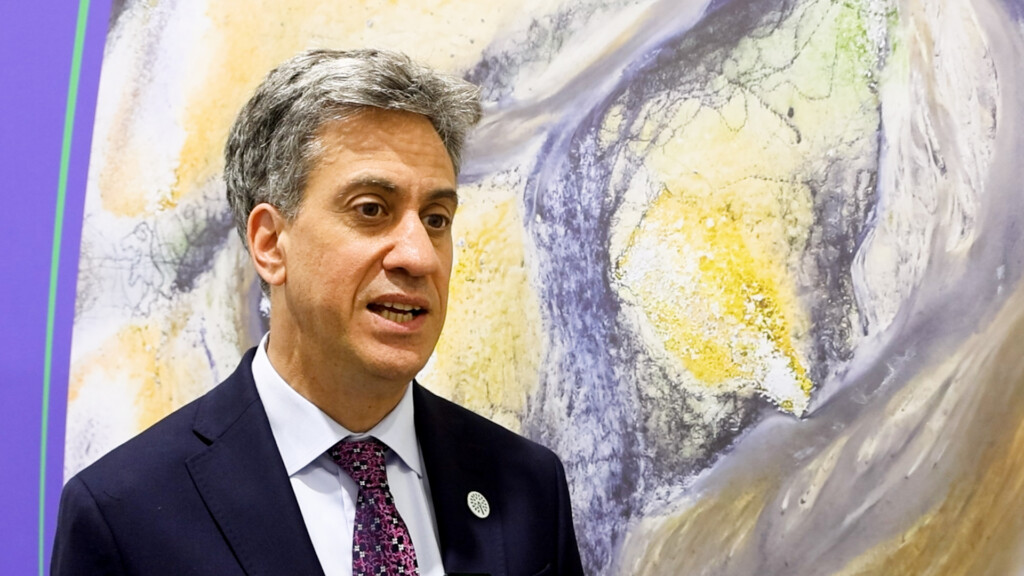
And if there’s one lesson we’ve got to learn from these two wars that we’ve seen – Russia’s invasion of Ukraine and the Iran war – it’s [that] you can’t have security on the basis of fossil fuels. It’s not even – even [for a] country like America, a massive fossil-fuel producer is affected by higher prices. But for fossil-fuel importers, covering 75% of the world’s population [including the UK], we are price takers. And you know the fossil-fuel rollercoaster is terrible for the cost of living. That’s why clean energy, clean electrification, is the answer. Electrify now!
CB: The UN climate convention and the Paris Agreement both commit countries, including the UK, to implement “climate-change education, training, public awareness and participation”. Why doesn’t the UK have a national programme on this, particularly given the flood of misinformation in this area?
EM: We need to do more. You’re completely right. Look, I am always ambitious to do more, and more climate education – well, more public information – is important.
I did the first annual climate and nature statement in 2025. It was repeated in 2026 by [environment secretary] Mary Creagh. I was in the House of Commons for that, and that whole institution was part of me believing, as energy secretary, that it was important to find ways to inform the public.
And I fully acknowledge we need to do more. We need to do more. But we need to do more to both tell people about what is happening, in terms of climate and nature, but also say there are answers, because it can’t just be a council of despair. It’s also got to be a council of hope – not false hope – but a council of honesty, but also hope.
CB: Great. How would you like to see the Brazilian roadmaps on fossil fuels and deforestation taken forward? Are you keen to see those as part of the formal negotiated outcome [at COP31]?
EM: I think what’s interesting about this goes back to your question about the coalition of the willing. Look, there’s obviously no secret that there are countries that are obstacles to the fossil-fuel roadmap being part of – central – to the COP decision. And we took a decision last year that there was a big enough coalition of the willing – I think there are 80 countries or more – to drive this forward.
I think the Brazilians are to be incredibly commended for having produced this fossil-fuel roadmap. I think we should now be thinking, as individual countries, how can we build on that work ourselves? Because it’s doing exactly what I hoped it would do, which is to grapple with the important issues that we face.
I think we have to accept there are some countries – in a world where you have to operate by consensus – where not every decision is going to get into the COP decision. But it doesn’t mean we can’t make progress on it, and I think that’s really true in this case.
CB: Great. One final question from my end, if I may. What’s an outcome that you’re going to be looking for at the end of this COP, that you’re going to be happy to take home to the UK?
EM: I think the most important thing is action to drive forward the climate agenda, and that’s what I want to see. You know, it goes back to the point about the cost. Some of it is about the formal decision-making, but a lot of it is about the real, tangible outcomes that have happened over a couple of weeks.
And if I think about what I’ve done here, you know, if we can get methane and the importance of methane – which, as you know, and as your viewers will know – is such an important short-term difference we can make in terms of preventing the rise in temperatures, and we can get that onto the agenda of the COP. If we can show progress on other aspects of the real economy – what’s happening in the real economy – all of those things are going to be important.
I think there’s something else, though, which is, these events of countries coming together. They contradict those people who say, you know, people are giving up on climate. Because you’ve got more than 190 countries that are coming together [at the COP], reaffirming their belief in the Paris Agreement, reaffirming their belief that they need to make efforts, as part of the Paris Agreement, to meet the climate goals – and working together on these issues.
It doesn’t mean they aren’t hard, but it does show that there is really important global commitment, which I’ve been hearing, to this agenda.
CB: Brilliant. Thanks very much, Ed.
EM: Thank you.
This interview was conducted by Simon Evans at the COP31 in Antalya, Turkey, on 12 November 2026. Filming by Leo Hickman, Josh Gabbatiss and Daisy Dunne, and editing by Joe Goodman.
The post COP31: How Ed Miliband answered Carbon Brief readers’ questions appeared first on Carbon Brief.
COP31: How Ed Miliband answered Carbon Brief readers’ questions

Australia’s much-anticipated session to help Pacific nations lift off a new regional fund went by without a single new cent pledged, despite it being a key moment to achieve its target of $500 million promised by the end of the year.
In only a year since its adoption, the island states have operationalised the Pacific Resilience Facility (PRF) – a regional fund that disburses small grants directly to local communities. The fund has approved 14 projects so far, including on water security, coastal restoration, renewable energy and community resilience.
The fund was launched in May seeking to enhance the region’s access to international finance, as large climate funds tend to have red tape which is hard for small governments, like those in the Pacific, to overcome. Palau’s president Surangel Whipps Jr said at the event that the PRF “bridges the gap in global finance”.
Yet at the pledging session – where developed countries were expected to ramp up their pledges to close the gap on the $500-million target – none of the participating countries announced new money. The Minderoo Foundation announced $5 million.
-
COP31 Bulletin Day 4: Emerging economies question need for COP31 cover decision
Russia, Saudi Arabia and others are questioning the legitimacy of the Australian-Turkish push for an overarching COP31 agreement -
COP31 Bulletin Day 3: With the people stuck outside, world leaders jet in
Around 40 leaders, including Lula, Erdoğan and Albanese, addressed the summit in Antalya, where the UN chief proposed a “climate justice compact” -
COP31 Bulletin Day 2: Momentum builds on electrification and fossil fuel transition
The COP31 presidency whips up support for its 35×35 electrification goal, while the UN chief calls on all countries to plan their shift away from fossil fuels
The Netherlands ($1m), the UK (£10m or $13m), Canada (CAD$7.5m or US$5m) and Ireland (€5.6m or $6.2m) all announced pledges they had already publicly announced before, leaving the total amount in the PRF pot at over $200 million – a gap of about $300m in this year’s target.
Fiji’s minister of Foreign Affairs Sakiasi Ditoka told Climate Home News after the event that he is still hopeful that developed countries will announce new funds by the end of COP31, either by getting commitments from new nations or ramping up commitments from existing donors.
“I believe that we have pulled on some heartstrings and that maybe helps them make their decision, maybe increasing their contributions if they’ve already given,” he said. “Even if not, we will press on ahead.”
The largest donors to the fund are Australia (US$67m) and Saudi Arabia (US$50m). Speaking at the event, Australia Prime Minister Anthony Albanese said “the PRF matters because it connects global finance with local action” and urged other nations to join.
Other developing countries have pledged to the fund, including Taiwan ($3m) and China ($1m). Some Pacific islands have pledged funds themselves, including Fiji ($10m) and Solomon Islands ($1m).
“We are putting our own skin in the game. We are investing in our own future,” said Whipps Jr during the pledging session.
The post Pacific leaves empty handed from COP31 “pledging event” for new fund appeared first on Climate Home News.
Pacific leaves empty handed from COP31 “pledging event” for new fund
A coalition of small island states, African countries, the European Union and other G20 nations is leading a push at COP31 in Antalya for a process that can deliver stronger ocean mandates in a key review of climate policies in 2028.
The group of countries is seeking to anchor the sprawling ocean agenda — which ranges from decarbonising transport and energy, adaptation of tourism and fisheries, and loss and damage — into the formal UN negotiations.
This year’s COP31 offers them a prime opportunity, experts say, as the Turkish and Australian co-presidency has signaled its intention to put oceans high in the summit’s agenda.
The ocean is the world’s largest carbon sink and it has absorbed 93% of excess heat in the atmosphere. An extreme El Niño event this year has led to record-breaking temperatures of over 30℃ in some parts of the Pacific, placing coastal communities and fisheries at risk.
While some initiatives have emerged to strengthen the ocean’s role in national climate plans, at formal UN negotiations it has been sidelined to a voluntary dialogue with no negotiated agreements.