

More than 92,000 people have registered to attend the COP31 climate summit in Antalya, Turkey, potentially making it the largest COP in history.
Carbon Brief analysis of the provisional lists of delegates, published by the United Nations Framework Convention on Climate Change (UNFCCC), reveals that more than 14,000 delegates have been registered as “host country guests”.
For comparison, the provisional list for COP30 in Belém, Brazil, last year included only around 1,000 delegates in this category.
As with COP30, Donald Trump’s US government has not sent a delegation. Other no-shows include Israel and Myanmar.
It was reported ahead of the summit that Taliban officials from Afghanistan had been registered for the event as observers; however, there are no delegates from observer states in the provisional lists.
With more than 3,000 “virtual” delegates signed up to attend the summit online, the total number of people registered for the event surpasses 95,000.
Further analysis of the participant lists will be added to this article in due course.
Party delegates
With 92,934 participants registered, COP31 is provisionally the largest COP in history – topping COP28 in Dubai, which was attended by more than 80,000 people.
This total is based on the delegates that have registered to be at the summit in person. The UNFCCC releases the final figures – based on participants collecting a physical badge at the venue – after the summit has ended.
The chart below shows how the provisional figures for COP31 compare to the final totals in previous COPs – going back to COP1 in Berlin in 1995.
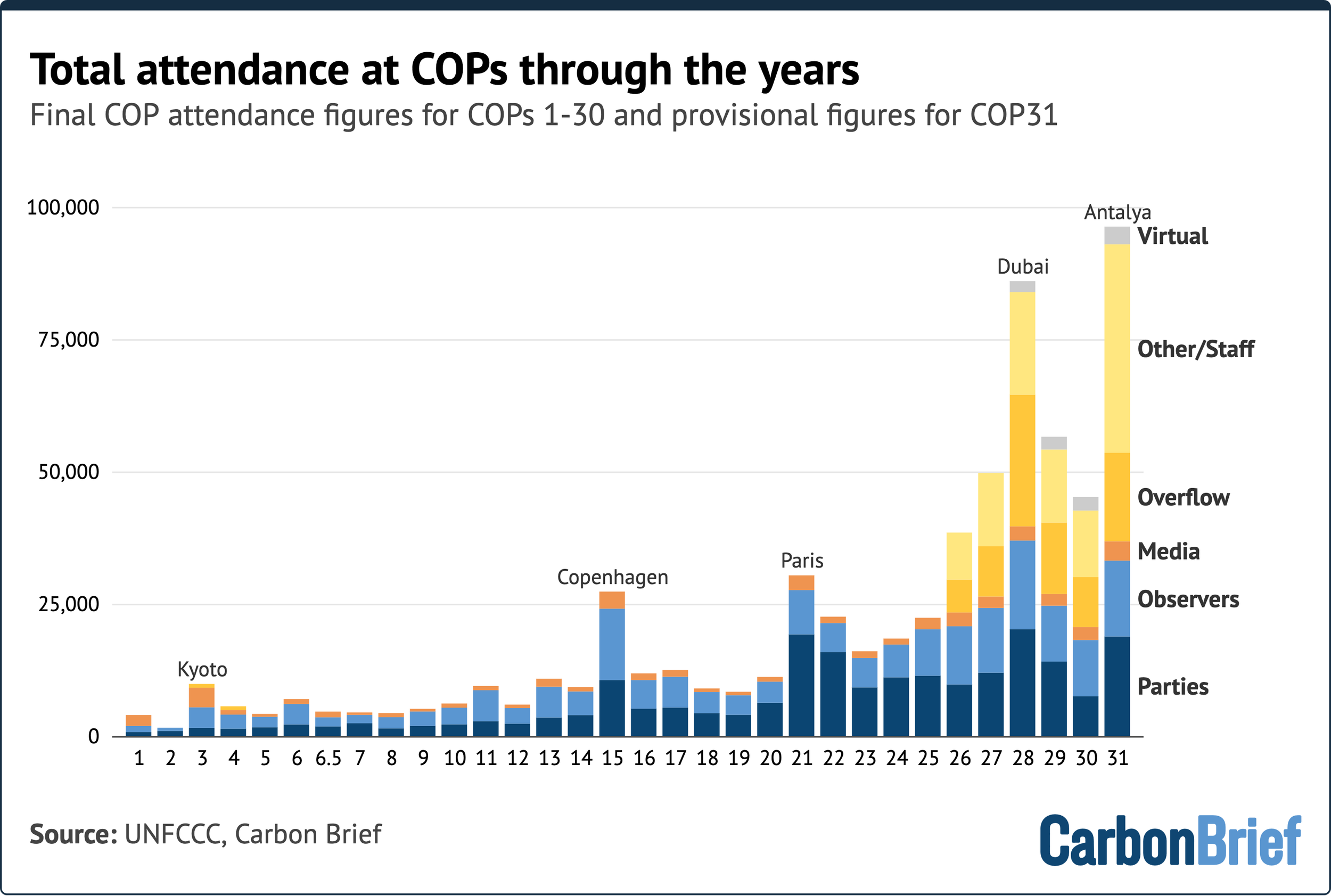
The participant lists provided by the UNFCCC are divided between the different types of groups and organisations attending the summit. The largest group at COP31 is for delegates representing parties. These are nation-states, plus the European Union, that have ratified the convention and play a full part in negotiations.
This group adds up to 18,812 delegates – the second largest after COP28.
Membership
Support award-winning climate journalism
(In keeping with recent COPs, the UNFCCC has published spreadsheets that name every single person that has registered for the summit – excluding support staff. Previously, COPs have typically included thousands of “overflow” participants in which countries and UN agencies could nominate delegates without their names appearing on their official lists.)
For consistency with Carbon Brief’s analysis of previous COPs, the above chart includes overflow delegates as a single group. However, the participant lists do divide the overflow delegates between parties and observer groups. Including the overflow numbers takes the total for party representatives to more than 34,000.
Nations
The map and table below present the delegation size – split between party and overflow badges – for all the countries registered for COP31. The darker the shading, the more delegates that country has signed up. Use the search box to find the data for a specific party.
Unsurprisingly, host nation Turkey has registered the largest delegation for COP31 – with 2,950 people.
Following behind are Brazil (1,994 people), Nigeria (1,506), China (1,021) and Indonesia (978).
The rest of the top 10 is made up of Australia (835), Uganda (627), Italy (607), Japan (588) and Kazakhstan (557).
The UK comes someway down the list with a delegation of 255.
The smallest delegation comes from North Korea (two), followed by Eritrea and Nicaragua (three) and San Marino and Trinidad and Tobago (four).
(It is worth noting that some countries – such as Brazil – allocate some of their party badges to NGOs, which can artificially inflate the size of their official delegation.)
The post Analysis: Which countries have sent the most delegates to COP31? appeared first on Carbon Brief.
Analysis: Which countries have sent the most delegates to COP31?

Some big fossil fuel-producing countries – among them India, Nigeria and Germany – have swung behind the Brazil-led roadmap to phase out coal, oil and gas, while the UN chief said on Tuesday that all countries should start to make progress on cutting fossil fuels by 2028.
COP30 President André Corrêa do Lago presented the newly published global roadmap on Transitioning Away from Fossil Fuels (TAFF) to a packed plenary room in Antalya, cheered on by rounds of applause from delegates and civil society.
Nigeria – an OPEC oil producer that participated in the Santa Marta conference on phasing out fossil fuels earlier this year – welcomed the roadmap and said its recognition that countries have different starting points is “fundamental”.
“As a developing country with significant energy resources, energy access challenges and growing industrial ambitions, we must industrialise and decarbonise simultaneously,” the Nigerian delegate told the event.
She welcomed the roadmap’s proposed system for nations to self-identify their fossil fuel demand, supply and exposure of their wider economies, but said the “real test of this roadmap” will be translating transition pathways into “investable opportunities”.
-
COP31 Bulletin Day 2: Momentum builds on electrification and fossil fuel transition
The COP31 presidency whips up support for its 35×35 electrification goal, while the UN chief calls on all countries to plan their shift away from fossil fuels -
Japan urged to ditch fossil fuel support to maximise clean-tech exports
Japan could be one of the big winners of Asia’s electrification push, but it must radically pivot its policies away from propping up fossil fuels, a new analysis says
India – the world’s third-largest oil consumer and its second coal user – also praised Brazil’s efforts to make the roadmap inclusive, saying it “strikes a delicate balance” and that the energy transition “must be co-created”.
Its representative added that cheap renewables are what makes the transition away from fossil fuels possible, and energy security can support the case as long as countries avoid swapping “one dependency with another”.
The new TAFF roadmap invites countries to draw up national plans to build clean energy systems by 2028, while envisaging the main push to cut coal, oil and gas supply and demand after 2031. Some European countries, including Germany, France and the Netherlands, have published their own national roadmaps this year, while Brazil is also working on one.
Germany, Netherlands, UK and Australia are among the countries that have publicly backed the COP30 roadmap.
Africa calls for talks on TAFF to focus on justice
The chair of the African Group of Negotiators (AGN), Ghana’s Antwi-Boasiako Amoah, told journalists in Antalya that “we need to transition, bearing in mind that it must be a just one”. That means fossil fuel-dependent African nations would be supported and have flexibility on the phase-out timeline.
“Big emitters have already developed and we have the right to develop, so we cannot allow those [fossil fuel] assets to be stranded. If you want us to be able to go the way you want us to, then give us the finance and technology for a just transition,” he said.
Comment: COP31 outcome needs to prioritise transition away from fossil fuels
COP30 president Corrêa do Lago told Climate Home News at a press conference that countries “that have some concerns about this debate recognise the effort that we made” so that it’s not “one group against another”.
“Normally in these discussions, it’s extremes on the two sides and we don’t advance so much. So I believe the structure proposed here allows us to start the debate from another basis in a much more constructive way,” he said.
Speaking at the plenary event, former US climate envoy John Kerry said the debate on roadmaps away from fossil fuels “is the prime discussion that we need to engage in”, given that current policies are leading the planet to warming of 2.8C.
Roadmap as key input for global stocktake
Several countries that spoke, including the Netherlands and Germany, urged Australia and Türkiye as COP31 co-presidents, and Ethiopia as COP32 president, to carry the debate forward into the next Global Stocktake in late 2028.
UN Secretary-General Antonio Guterres said countries should use the new roadmap to build their own concrete national plans including clear timelines, responsibilities and financing needs.
By the 2028 Global Stocktake, “every country should be able to show what it has done to cut fossil fuel use or production, what it will do next, and how it will measure progress,” he said, in a challenge to governments.
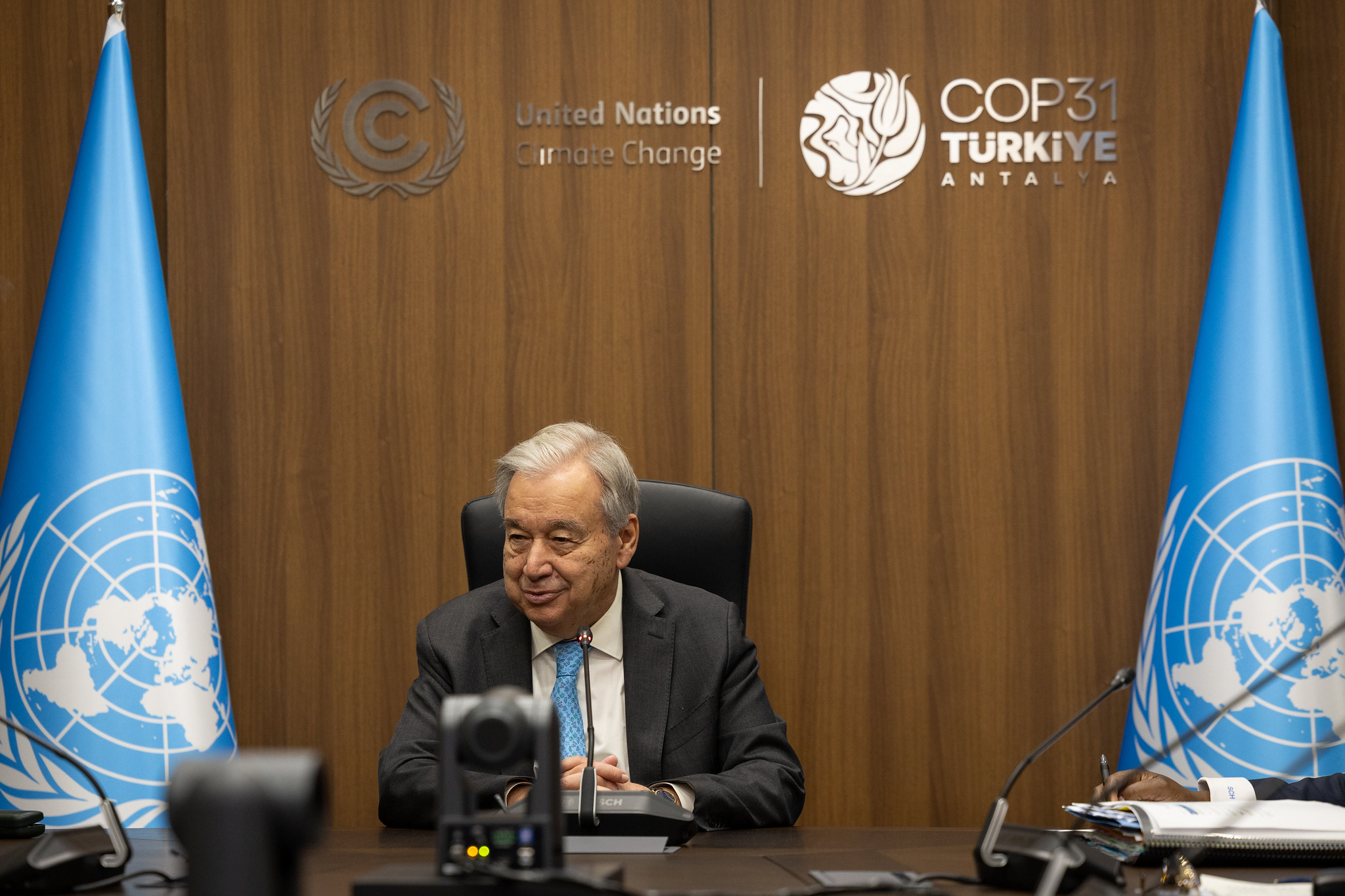
He added that it is “long past time to stop treating the transition away from fossil fuels as taboo or intractable” and called on COP31 to “move from discussing the transition to organising it, financing it, and delivering it”.
France’s COP21 president and one of the architects of the Paris Agreement, Laurent Fabius, stressed that 2028 is approaching fast, adding that “agreed commitments are agreed commitments” which have to be fulfilled.
COP presidencies keep extracting fossil fuels
Despite Türkiye’s COP31 co-presidency sending a representative to the roadmap event, the country’s leader, President Recep Tayyip Erdoğan, praised in a post on X the start of production at two new oilfields in his country last month as “good news” coming from the mountains of Gabar.
He added that with further development, daily production from 230 wells in the region will increase by 30% to reach more than 100,000 barrels a day in the second half of 2027, contributing billions of dollars a year to the Turkish economy.
Turkish giant sponsoring COP31 cut climate goals then cashed in on oil boom
COP31 co-pre