


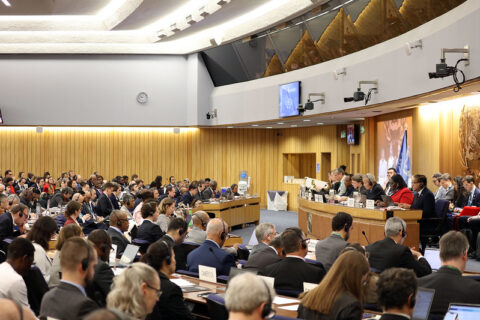
- What happened at COP31?
- What has the reaction to the presidency been?
- How has the role of oil-rich nations been portrayed?
- How has the role of developed nations been portrayed?
- How has the role of developing nations been portrayed?
- How has the role of China been portrayed?
- What does this mean for the consensus process and reform?
- Could COP31 send a ‘positive signal’?

The launch of the Africa Energy Bank (AEB) has been put back yet again, raising doubts about the institution’s future ability to finance fossil fuel projects – its main objective – as global lenders retreat from such investments over climate concerns, experts told Climate Home News.
The bank, which had been billed to launch in September after a series of delays, is now scheduled to begin operations in November, according to the head of the African Energy Chamber, an advocacy body for the continent’s oil and gas sector.
Even as the world aims to transition away from fossil fuels, many African leaders have made clear they want to continue exploring and extracting the continent’s large oil and gas deposits – estimated at around 125 billion barrels of crude and over 600 trillion cubic feet of gas – to boost economic development.
As a group, Africa sided with a number of powerful oil-and-gas producing nations in blocking progress on negotiations to craft a global roadmap to transition away from fossil fuels at last year’s UN COP30 climate talks, although some countries did individually support the proposal.
-
Campaigners oppose Dangote’s planned Kenya refinery over climate and ecological risks
Plans to build Africa’s second largest oil refinery in ecologically sensitive region criticised as “environmental recklessness” -
Tanzania pushed African nations to oppose fossil fuel transition at COP30
While chairing the African group at the summit, the gas-dependent nation advised the continent’s ministers to block language on transitioning away from fossil fuels
Meanwhile, major projects under development across the continent – including the 1,443-km East African Crude Oil Pipeline (EACOP) and Dangote’s 700,000-barrel-per-day Kenyan refinery – show that African governments see oil and gas as playing a significant role in meeting their energy and economic needs for many years to come.
In 2022, at a gathering of the African Petroleum Producers’ Organization (APPO) in oil-rich Angola, ministers from its member states adopted a resolution to create the Africa Energy Bank to finance projects for the production, use and trade of oil, gas and broader energy sources.
African control over energy resources
An article on the APPO website explains that the bank was conceived as a way to overcome “disenchantment” with fossil fuels among “the international community” which it said had crystallised around the “energy transition” concept.
“If Western countries, after having long taken advantage of the energy sources they now revile to develop, can afford the luxury of abandoning them, this is not the case in Africa,” it adds, noting that many of the continent’s economies are still largely dependent on oil and gas revenues.
A separate web page about the bank, also hosted on APPO’s website, says its objectives include financing the exploration, production and refining of oil and gas, as well as supporting member states in transitioning from fossil fuels to cleaner energy sources “while ensuring energy security”.
Said Addi, a former executive with Shell and energy commodities trading house Gunvor, said the new bank was judged necessary because financing for hydrocarbons from many traditional international lenders has become constrained.
In trying to fill this financing gap, Africa is not simply setting up another fund to support oil and gas, he added. “It is also an attempt to give African countries greater control over how their energy resources and infrastructure are financed,” he explained.
Nigeria to host the AEB
The energy bank – a joint initiative of APPO and the African Export–Import Bank (Afreximbank) – has so far suffered several delays and is almost two years behind schedule. The initial plan was to start operations in January 2025, with Nigeria as the host country, but the bank’s opening was delayed to June of that year to allow Nigeria time to finalise the construction of the bank’s headquarters in Abuja.
After the government announced the completion of the offices in late November 2025, a new launch date was set for January 2026, which was moved back to April, June and then September. Now it has shifted again to November, raising concerns that the institution may be losing momentum.
Former Shell executive Addi said that if the capital is eventually paid in, the bank becomes operational and its first projects are commercially credible, then the delays will be regarded as normal teething troubles in setting up a multilateral institution. But, he added, scepticism will be justified if it continues to stall.
Uganda may see lower oil revenues than expected as costs rise and demand falls
Baron Lamarré, an oil and gas expert and former Petronas oil trader, said that missing “three deadlines in a row is not normal”, and warned that if the timeline slips again, “the story flips from ‘ambitious institution finding its footing’ to ‘good idea that lost momentum before it found any’.”
The Nigerian government, APPO and Afreximbank did not respond to requests for comment by the time of publication.
The funding challenge
The Africa Energy Bank is targeting base capital of $5 billion, with plans to scale up to $120 billion within five years by mobilising private-sector funds. However, it is expected to start operations with initial seed capital of $500 million.
The funding plan is to have the 18 member countries of the APPO contribute $83 million each to the bank as equity for a combined $1.5 billion. Afreximbank, other non-APPO African countries and investors outside the continent are expected to provide the remaining $3.5 billion.
But even the initial $500 million has not been easy to mobilise. In May, APPO Secretary-General Farid Ghezali called on members to deliver on their pledges towards the startup goal before the end of June. But the delays suggest this may not have been met, with experts saying Africa may be finding it difficult to self-fund its oil and gas projects in the absence of international capital.
Lamarré said every extension of the deadline points to the fact that “raising fossil fuel capital in Africa without the majors and their financing networks is brutally hard”.
Why the global electrification agenda misses the point on Africa’s energy crisis
Since 2020, Western lenders, export credit agencies and insurers have been in steady retreat from African hydrocarbons, he said, while oil majors are divesting their African assets, handing over fields to smaller local operators whose credit ratings are not high enough to borrow cheaply.
Even capital from China and the Gulf, which has partially filled the gap, cannot match the volume, tenor or pricing that Western investors once offered, Lamarré argued.
“If mobilising the first $500 million of seed capital [for the AEB] has taken this long, that’s the clearest signal yet of how steep the climb to $120 billion looks,” he said, noting that the continent’s energy financing gap is as large as $30 billion-$45 billion per year.
Africa’s investment landscape, meanwhile, has been shifting. While foreign direct investment dropped from a 2024 peak, inflows remained roughly one-third above the continent’s long-term average in 2025, according to the 2026 World Investment Report from UN Trade and Development (UNCTAD). They are concentrated in a few sectors including critical minerals needed for renewable energy technologies, battery manufacturing and advanced industrial production.
At the same time, data on global energy investment from the International Energy Agency (IEA) shows that fossil fuel investment in Africa has declined over the last decade.

“Trojan horse” for fossil fuels
While the Africa Energy Bank struggles to get off the ground, climate campaigners have criticised its primary aim of financing oil and gas on the continent at a time when the world is starting to move away from high-carbon fuels to cleaner alternatives.
Bhekumuzi Dean Bhebhe, founder of Africa Change Lab, described the bank as a “Trojan horse”, arguing that its focus on fossil fuel financing runs counter to the global energy transition and the African Union’s Agenda 2063 goals of sustainable development and inclusive growth.
The energy bank, he warned, “risks locking Africa into a new cycle of debt, dependency and fossil fuel entrenchment”, adding that its financing blueprint does not pave the way for a climate-resilient future. “In truth, it is to deepen the same extractive, carbon-heavy pathways that the continent should be moving away from,” he added.
Ugandan farmers use British court to try to stop East Africa oil pipeline
Kenya-based climate and energy expert Joab Okanda said the AEB’s plan to finance oil and gas is “a misplaced priority” and it should instead back clean energy in line with the policies of some of Africa’s major export markets like Europe.
In addition, the new bank could struggle to mobilise enough resources to advance large-scale oil and gas projects, he added, noting that its proposed $5-billion initial capital is equivalent to the cost of the East African Crude Oil Pipeline alone.
The AEB’s aim of backing more fossil fuels should be flipped “to support countries that are oil-dependent to start working on their transition plans”, Okanda said.
The post Launch of Africa Energy Bank delayed again in blow to oil and gas hopes appeared first on Climate Home News.
Launch of Africa Energy Bank delayed again in blow to oil and gas hopes
Continue Reading
Dan Ioschpe is the Climate High-Level Champion for COP30.
A year ago at COP30 in Belém, we said this would be the decade of implementation for climate action. Simply put, implementation is the fastest way to promote sustainable socio-economic development. But implementation is not about words. It is about action, on the ground, at speed and scale.
COP31 in Antalya demonstrated why the implementation of the Paris Agreement must extend well beyond the two weeks of a climate conference. Despite political divisions, businesses, investors, governments, cities and communities came with results and remained committed to scaling climate action, showing that the real economy does not wait.
That is why continuity matters. In Belém, the Global Climate Action Agenda was given a new structure, with six thematic axes, and Plans to Accelerate Solutions (PAS). Because that structure carries work from one COP to the next, progress can compound. And progress is now something we can measure.
This year’s Yearbook of Global Climate Action shows that 87% of PAS reported progress, while 38% of the 40 with quantitative targets are on track or ahead of their goals. It highlights where the gaps remain.
Grids stretching halfway around the world
The strongest signal from Antalya came from electrification. The Electrification Delivery Package brings together more than 200 actions from over 180 organisations, involving over 150 countries plus the European Union – together over two-thirds of global GDP – and more than 260 businesses with over $4 trillion in annual revenue.
The results are already visible on the ground. Members of the Utilities for Net Zero Alliance built more than 21,000 kilometres of grid in 2025, up from 14,000 km the year before – enough to stretch halfway around the world. From grids, storage and renewable power to energy access, the foundations of a modern, interconnected system are coming together at speed and scale.
-
Australia and South Korea’s clean energy deal could boost low-carbon trade
The deal aims to connect Australia’s renewable resources with Korean industries’ clean energy demand, potentially transforming a relationship built on coal and gas -
After COP31, our chance to save climate diplomacy lies in global shipping
If COP31’s high ambition countries can show the same resolve at London shipping talks, a climate breakthrough is possible next week
The Global Climate Action Agenda is helping connect these investments and shift from individual solutions to economy-wide transformation. Electrification is simply the fastest way to foster sustainable socioeconomic development – efficiently, affordably, and securely.
On transport, 13 zero-emission freight corridors are now in development across six continents, covering more than 29,000 km of roads. That is already ahead of the Global Green Road Corridors Initiative’s goal of ten corridors by 2026.
Sustainable aviation fuel starts to take off
Progress is also visible on sustainable aviation fuel (SAF), a solution approaching a positive tipping point. One in three new sustainable industry investment decisions this year was for SAF, a sign of how quickly the market is developing, including through an Action Agenda plan to decarbonise aviation.
Projects that have reached final investment decision represent around 7 million tonnes of SAF a year, or 3% of today’s jet fuel use. But the wider pipeline stands at 31 million tonnes – around 11% of the existing market. Once sustainable solutions capture 5-10% of an established market, growth can become self-reinforcing as costs fall, supply chains mature and investors gain confidence. Across heavy industry more broadly, 36 deep decarbonisation projects reached final investment decision this year – a record.

On nature, the Tropical Forest Forever Facility has reached $8.3 billion in commitments towards its $10-billion initial target, and the Global Fund for Coral Reefs announced $30 million in new reef financing across 22 developing countries.
With the launch of the Rio Synergies Group for Action, implementation will be at the centre of the three Rio Conventions on climate, biodiversity and land, and 17 governments are now backing the Intergovernmental Land Tenure Commitment to strengthen the rights of Indigenous Peoples and local communities.
On food and agriculture, solutions range from methane-reducing practices reaching more than 5,000 smallholders to food recovery initiatives now reaching 40.5 million people, cutting food waste and emissions at the same time. Some 66 million hectares are now under regenerative landscape projects.
Accelerator to support two solutions per year
Antalya also laid the groundwork for progress. Mandated by the Mutirão Decision in Belém, the Global Implementation Accelerator established its governance and operational framework at COP31. Each year, two solutions – one on mitigation and one on adaptation – will be selected for coordinated support, informed by independent expert assessment and mobilising the capabilities of a dedicated partner network.
The Accelerator builds on the Action Agenda, bringing governments, businesses, finance and technical expertise together to accelerate solutions with the potential to reach positive tipping points.
None of this happened by accident. It was possible because a structure is in place that allows progress to compound – connecting political guidelines with investments, infrastructure and sustainable socio-economic development.
This is the Global Climate Action Agenda at work: a multi-year engine for the implementation of the Paris Agreement, guided by a shared vision towards 2030. And I am optimistic about what comes next.
In Belém, we collectively revamped its structure and strengthened its foundations. In Antalya, we demonstrated the value of continuity. The opportunity now is to deepen its reach across regions, strengthening implementation on the ground with speed and scale.
From Antalya to Addis Ababa and beyond, the work continues 365 days a year, 24 hours a day.
The post Despite political divisions, COP31 showed the real economy does not wait appeared first on Climate Home News.
https://www.climatechangenews.com/2026/11/26/despite-political-divisions-cop31-showed-the-real-economy-does-not-wait/
COP31 came to a dramatic close last weekend when a coalition of nations rejected the proposed “Antalya pact”, citing its failure to mention fossil fuels.
The tense final moments and lack of a much-anticipated “pact” have sparked extensive media coverage around the world.
Many commentators have rushed to label the COP31 outcome a “failure”, questioning what it means for the future of the UN climate process and a “divided world”.
There has been much finger-pointing, with some outlets attributing COP31’s “collapse” to “oil-rich nations”, while others blame Europe’s “reluctance” to provide more climate finance.
While it is not accurate to say there was “no agreement” at COP31, the media response d