

- What happened at COP31?
- What has the reaction to the presidency been?
- How has the role of oil-rich nations been portrayed?
- How has the role of developed nations been portrayed?
- How has the role of developing nations been portrayed?
- How has the role of China been portrayed?
- What does this mean for the consensus process and reform?
- Could COP31 send a ‘positive signal’?

NADI, FIJI Sunday 4 October 2026 — As leaders and delegates gather for the Pacific Pre-COP in Fiji and Tuvalu, Greenpeace Australia Pacific is calling on the Australian government to uphold Pacific priorities on fossil fuels and climate finance, and respond to the urgency of the climate and energy crisis by accelerating the just transition away from fossil fuels.
The Pre-COP meeting in Fiji and atoll nation Tuvalu is an important milestone on the road to the COP31 climate summit in Türkiye, where Climate and Energy Minister Chris Bowen will take the reins as President of Negotiations. But another coal mine approval in the days before the Pre-COP has left Pacific leaders and civil society exasperated at Australia’s perceived ‘double talk’ and overshadowed the start of talks.
Speaking from Nadi, Shiva Gounden, Head of Pacific at Greenpeace Australia Pacific, said:
“This week we must focus on why the Pre-COP is so important. We must listen to Pacific leaders and communities who are sick of Australia’s double talk on climate, and want to see the actions of the most polluting nations respond to the urgency and scale of the crisis we face.
“Every cyclone, every storm blows with the deadly force of accumulated emissions and gives a warning of what is to come. The Pacific must not become a sacrifice zone for major polluters and fossil fuel corporations.
“1.5°C remains the scientific, moral and legal temperature limit. The landmark Pacific-led ICJAO ruling is clear — continuing down the fossil fuel path, and failing to align efforts with limiting warming to 1.5°C, is a breach of our international legal obligations. Our communities, our cultures and our very existence are under threat.
“As Australia prepares to chair the upcoming COP31 talks in partnership with the Pacific, it must do much more to turn empty rhetoric into real action to end the fossil fuel chokehold.”
Also in Nadi, Dr Simon Bradshaw, COP31 Lead and climate expert at Greenpeace Australia Pacific, said: “The Pacific Pre-COP is a critical milestone on the road to COP31. The Australian government must rise to the moment with concrete plans to accelerate the global transition away from fossil fuels, and respond to communities across the region facing soaring cost of living and the escalating impacts of the climate crisis.
“This week, the Australian government must deliver more than empty rhetoric. The Prime Minister’s recent keynote address at New York Climate Week acknowledged the urgency of the climate crisis, but failed to mention its cause, fossil fuels. Just last week we saw another new coal mine approval in Australia. This is on top of the 37 fossil fuel approvals by the Albanese Government since elected, despite recognising through the Belém Declaration that returning to 1.5°C is incompatible with new coal, oil and gas.
“At the Pre-COP, words must be matched with real action to phase out fossil fuels. We can not help decarbonise the world without action at home to halt fossil fuel approvals and phase out coal and gas exports. Don’t waste this important moment to back Pacific leadership and turn commitments into real action, including an immediate end to new fossil fuel approvals, and following other nations in developing a national roadmap away from fossil fuels.”
ENDS
Media contact: Kate O’Callaghan in Nadi on +61 406 231 892 (Whatsapp/Signal)
Continue Reading
COP31 came to a dramatic close last weekend when a coalition of nations rejected the proposed “Antalya pact”, citing its failure to mention fossil fuels.
The tense final moments and lack of a much-anticipated “pact” have sparked extensive media coverage around the world.
Many commentators have rushed to label the COP31 outcome a “failure”, questioning what it means for the future of the UN climate process and a “divided world”.
There has been much finger-pointing, with some outlets attributing COP31’s “collapse” to “oil-rich nations”, while others blame Europe’s “reluctance” to provide more climate finance.
While it is not accurate to say there was “no agreement” at COP31, the media response demonstrates the complexity of the divergent views on display at the Antalya conference.
In this article, Carbon Brief draws together media reactions from around the world to show the diversity of responses to the COP31 outcome.
- What happened at COP31?
- What has the reaction to the presidency been?
- How has the role of oil-rich nations been portrayed?
- How has the role of developed nations been portrayed?
- How has the role of developing nations been portrayed?
- How has the role of China been portrayed?
- What does this mean for the consensus process and reform?
- Could COP31 send a ‘positive signal’?
What happened at COP31?
COP31 ended without agreement on a proposed “Antalya pact”, which had been pushed by the Turkey-Australia presidency.
The final text was rejected by at least 32 countries, including the EU, the UK and some climate-vulnerable countries, in chaotic scenes as the talks overran by two days.
An Irish Times editorial said the outcome was an “unprecedented ending of a COP without any agreement or roadmap forward”.
This view, while commonly expressed in the media, is incorrect.
As veteran “COP-watchers” explained for an article on CB Connect, the summit reached agreement on many decisions, even though the presidency’s “cover decision” failed.
Referring to the rejection of the cover decision, Melbourne University climate researchers Prof Jacqueline Peel and Prof Kathryn Bowen wrote in the Conversation that “these texts have always been add-ons to the formal negotiation process”.

They noted that there was “progress in a few areas” at COP31, including negotiations on supporting a just transition via a “phased approach” and “improving alignment in climate adaptation”.
For a full overview of what happened at COP31 – both inside and outside the negotiations – see Carbon Brief’s “key outcomes” article.
What has the reaction to the presidency been?
In the aftermath of COP31, commentators have critiqued decisions made by the presidency. An editorial in the Hindu noted that “usually, cover texts evolve as a final synthesis of deliberations”, but said the COP31 leadership “thought it fit to push for a cover text early in the proceedings”.
Australian “president of negotiations” Chris Bowen has also faced criticism over how he managed competing interests at the summit. An editorial in the climate-sceptic Australian said:
“One thing is clear: Chris Bowen, who presided over Australia’s $150m investment in the conference, has some explaining to do. International reporting has raised questions about Australia and Turkey, the two nations that co-hosted the summit. Some negotiators have criticised their handling of the talks.”
Similarly, climate-sceptic journalist Graham Lloyd wrote in the Australian that “globally, Bowen has embarrassed himself and diminished Australia’s reputation”.
For Australian news outlet Crikey, journalist Royce Kurmelovs said that Bowen “tried to run the world’s climate talks the way Labor [Australia’s ruling party] runs climate policy at home: quiet, pragmatic and without mentioning fossil fuels”, adding that “in Turkey, it didn’t work”.
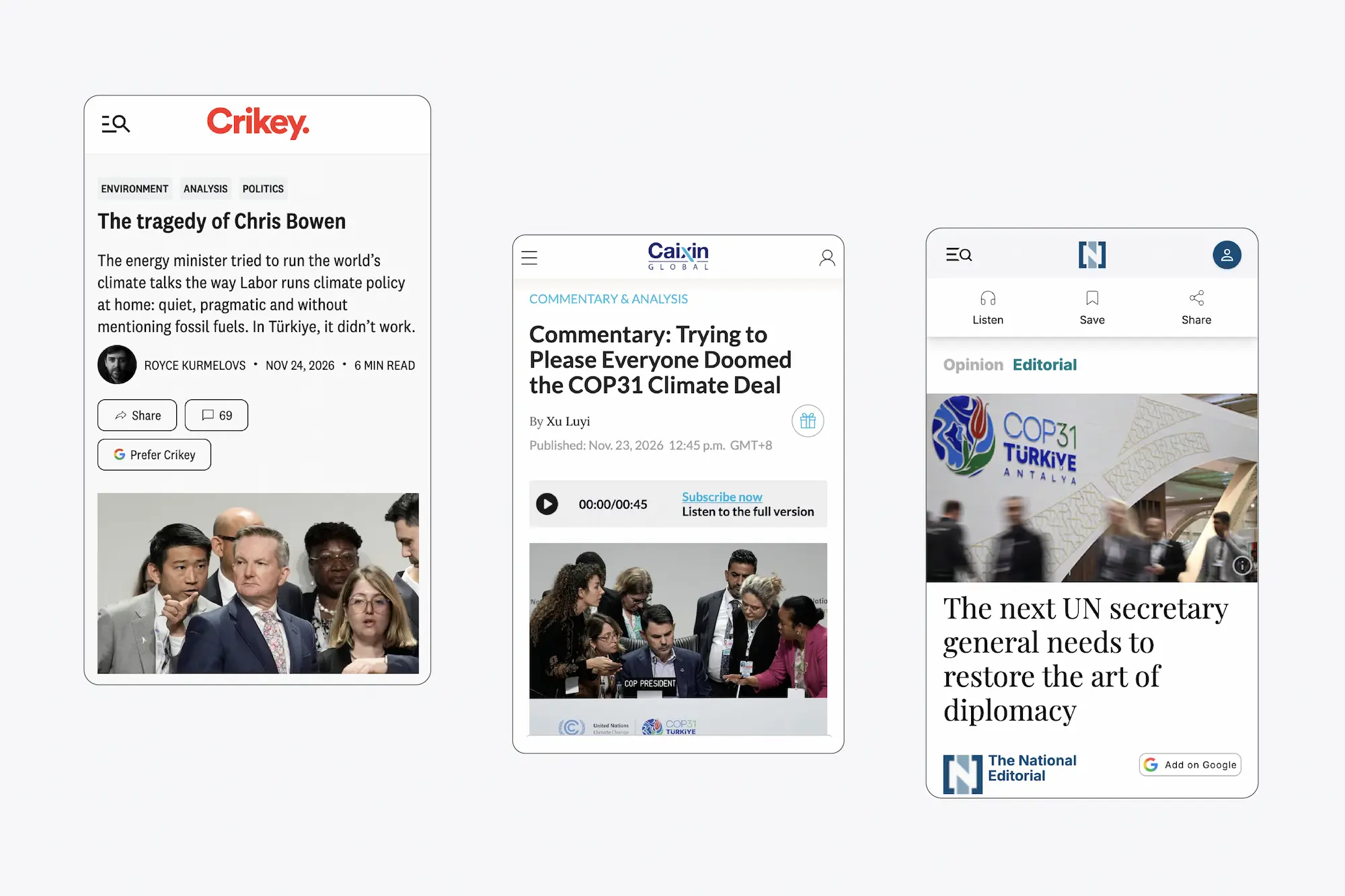
A commentary by journalist Xu Luyi in Chinese financial news outlet Caixin said that future COP presidencies should “distinguish achievable implementation measures from ambitions that lack a coalition capable of delivering them”.
Separately, an editorial in the National – a UAE state-owned English-language daily newspaper – said “the next UN secretary general needs to restore the art of diplomacy”.
How has the role of oil-rich nations been portrayed?
In media coverage, much of the blame for the perceived failure of COP31 has been placed on oil-producing nations – particularly with the final cover decision draft containing no mention of fossil fuels.
Even before the summit had finished, Panama’s minister of environment Juan Carlos Navarro warned that the COP process was being “held hostage by the petroleum mafia”.
After the talks had closed without a deal on the Antalya pact, a Guardian editorial said that responsibility lay with “petrostates resisting a transition away from fossil fuels”, along with a lack of climate finance. The “fossil-fuel backsliding” was being led by a “Saudi-Russian coalition”, it said.
A Bloomberg editorial also noted that the omission of fossil fuels from the decision text came “amid pressure from Russia, Saudi Arabia and other fossil fuel producers”. A Times editorial described oil-rich nations, “led by Saudi Arabia”, as the “culprits” for the lack of an agreement, because they “insisted on dropping a reference to phasing out hydrocarbons”.
In the i newspaper, David Shukman, a former BBC News science editor, described a “deception” at the “heart” of the COP process:
“This pattern of lobbying by oil-rich nations has become increasingly blatant and aggressive over more than three decades.”
Despite signing up to the UN Framework Convention on Climate Change (UNFCCC) at the 1992 Earth Summit in Rio de Janeiro, the participation of the “oil-rich minority” has been “in name only”, wrote Shukman:
“At more than a dozen of the UN’s giant conferences, I’ve seen for myself the tactics of trench warfare and how well they’ve worked. It’s why fossil fuels remain so dominant