

KOROR, PALAU, Friday 4 September 2026 – At the closing of the 55th Pacific Islands Forum Leaders Meeting in Palau overnight, Greenpeace Australia Pacific called out Australia for promising climate action while expanding fossil fuel production, and is urging Pacific leaders to unite ahead of the Pacific Pre-COP.
The meeting was rocked by the UN’s 1.5°C overshoot report a day before Australia approved the extension of one of the country’s largest coal mines.
Speaking from Palau, Shiva Gounden, Head of Pacific at Greenpeace Australia Pacific, said:
“Against the backdrop of the 1.5°C UNEP report, this Forum was a vital opportunity for Pacific leadership to shine by firmly calling out fossil fuels and banding together for our shared Pacific future. While the final communique reaffirmed the need to accelerate the transition away from fossil fuels, Pacific leaders missed the opportunity to hold the Australian government accountable for their continued approval of new coal and gas projects.
“At Pacific Pre-COP in Nadi, we are calling for Pacific priorities to be centred and respected by Australia and our global partners: they must support the ambition of a Fossil Fuel Free Pacific, ensure access to adequate climate finance and lead a global push to hold the line on 1.5°C as a matter of Pacific survival.
“Leaders fell short at the Pacific Islands Forum, and Pacific Pre-COP is the opportunity to match the ambition with urgency, and set the vaka on course toward a peaceful, just Pacific future.”
Speaking from Palau, Dr Simon Bradshaw, COP31 Lead and climate expert at Greenpeace Australia Pacific, said:
“The Pacific Islands Forum was an opportunity for Prime Minister Albanese to show real commitment to climate action and to its Pacific partnership. Instead, this week the Australian Government ‘celebrated’ the first extraction of polluting gas from the Beetaloo Basin and approved an extension of one of Australia’s largest coal mines. All amidst a still unfolding flood crisis in Nepal-Tibet and the devastating news that the world will blow through 1.5°C of warming — a survival line for Pacific communities.
“These are not the actions of a government aspiring to be a global climate leader and effective middle power in turbulent times, they are the actions of a government still beholden to the fossil fuel industry. Australia, get it together.
“As we head towards the Pacific Pre-COP, our Prime Minister and Government must remember the responsibility we have taken on. We must hold the line on returning warming to 1.5°C as our legal and moral obligation. This means doing everything possible to accelerate the global transition away from fossil fuels, starting at home.”
—ENDS—
Australia blows PIF climate opportunity as Pacific leaders urged to band together

Muhammad Zulfikar Rakhmat is director of the China-Indonesia Desk at the Center of Economic and Law Studies (CELIOS). Bhima Yudhistira Adhinegara is executive director of CELIOS.
Indonesia bills its plans to mix wood with coal at dozens of power plants as a way to cut electricity generation emissions as the country transitions towards clean energy. But look closer, and the biomass co-firing plan could do far more harm than good.
Biomass co-firing involves mixing a small amount of wood or other plant matter, usually wood chips or wood pellets, into the coal that a power plant burns.
State electricity company PLN wants to use it at 52 coal-fired plants across the Southeast Asian nation – a target set out in its national electricity supply business plan and tied to Indonesia’s pledge, under its Nationally Determined Contribution to the Paris Agreement, to raise renewables to 23% of the energy mix. PLN originally aimed to secure 10.2 million tonnes of biomass a year by 2025; that target has already slipped to 2031, as the country struggles to line up enough supply.
Most plants only mix in a small amount of wood, often between 1% and 5% of the fuel load, meaning they do not even have to change machinery. In truth, it lets coal plants keep doing what they have always done, just with a little wood added to the mix.
That presents two big problems.
-
SE Asia speeds up plan for connected clean power grid after oil shock
Countries are redoubling efforts to link their grids to bolster energy security and reduce their dependence on fossil fuels – but many challenges remain -
China keeps Indonesia’s battery dream afloat but future less certain
Chinese capital and technology turned Indonesia into the world’s top nickel supplier, but its dependence on China and the rise of nickel-free batteries could upset its battery ecosystem plans -
Southeast Asia’s fragile grids threaten billions in clean energy investment
Renewables developers need reliable electricity infrastructure and stable policies to help the region meet climate goals and surging demand for power


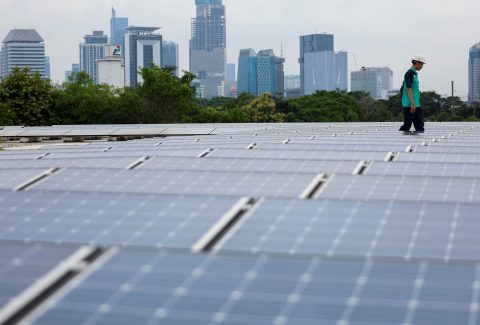
Firstly, creating additional demand for wood would put further deforestation pressure on the country’s thick and biodiverse tropical forests, already at risk from mining and palm oil plantations.
Secondly, by making old coal plants look a little greener on paper, the plan could hand them a reason to keep operating well beyond when they would otherwise be retired, meaning the fleet keeps emitting for longer than a genuine phase-out would allow.
This is not a real climate solution. It is coal wearing a green mask.
A threat to forests
To meet its co-firing mandate, Indonesia would need more than 10 million tonnes of wood pellets every year, an area of forest equivalent to 3.27 million football fields, according to a 2024 assessment by a group of NGOs.
The same report warned this could push deforestation as high as 2.1 million hectares a year, and found that a 10% cut in coal use through co-firing could threaten 10 million hectares of untouched forest in the areas where wood is collected. At Indonesia’s biggest power plants alone, switching just 10% of coal to wood could clear an area of forest roughly 35 times the size of Jakarta.
PLN and the forestry companies that supply it insist the wood comes from dedicated “energy plantation forests” – land set aside to grow fast-growing trees for fuel, not from clearing natural forest. But the same assessment found that of the 1.2 million hectares already designated for these plantations, more than 400,000 hectares still contain undisturbed tropical forest, which will come under growing pressure as demand rises. The claim that this wood comes from already-degraded land does not hold up to scrutiny.
Advocates of co-firing say wood is a clean fuel because trees can grow back. But when old natural forests are cleared to make way for fast-growing forestry plantations to grow trees for fuel, they release carbon that took decades or centuries to build up.
One study, by the Centre for Research on Energy and Clean Air (CREA), estimated that co-firing with just 10% wood across 52 power plants could create up to 26.5 million tonnes of carbon dioxide-equivalent emissions each year, once the clearing of land and the production of wood pellets are counted.
Wood pellets for export
Government rules have made this easier, not harder. Companies that already hold industrial timber plantation permits can convert them into energy plantations, giving them a ready-made legal route into the wood pellet business without applying for new forest land.
Indroyono Soesilo, chairman of the Indonesian Forestry Entrepreneurs Association (APHI), has publicly called on the government for tax breaks and relief from state forestry levies in exchange for making that switch.
Research by Trend Asia found that the push into energy plantations for biomass is dominated not by small or informal loggers but by large companies already notorious for deforestation, including APP Group, Korindo Group, Barito Pacific and Wilmar International. In short, some of the same companies long associated with clearing forests are being given an easier path and a green label to keep doing it.
-
COP30 roadmap to end deforestation will invite countries to draft domestic plans
After promising at COP30 to produce a voluntary global roadmap to stop forest loss by 2030, Brazil provided an update on the consultations this week -
Big banks’ lending to coal backers undermines Indonesia’s green plans
Foreign banks involved in Indonesia’s $20-billion Just Energy Transition Partnership have also funded companies working on coal power expansion, a TBIJ and Climate Home News investigation reveals -
Indonesia and Vietnam set for surge in coal use this decade despite transition deals
Rising demand in Southeast Asia and India is expected to prevent coal use from falling significantly this decade, the International Energy Agency predicts


Much of this wood does not even stay in Indonesia. Japan and South Korea have bought more than 99% of Indonesia’s wood pellet exports since 2021, using them to meet their own clean energy targets.
Perhaps the biggest risk in Indonesia’s co-firing plan is what it could do to the coal fleet itself. Mixing in a small amount of wood does not require a plant to shut down or upgrade. It simply gives the plant a reason to keep running, dressed up as progress. Every year a coal plant stays open because of a paper-thin green label is a year that real clean energy, such as solar and wind, is pushed further down the road.
None of this means biomass is always bad. Using leftover farm waste or city waste to make power can make sense.
But the scale of Indonesia’s co-firing plan cannot be met by leftovers alone, which is exactly why forests are being pulled into the supply chain. The countries and banks funding Indonesia’s energy transition, along with Japan and South Korea, should stop counting co-firing as a climate win.
Real progress means closing coal plants, not feeding them wood.
The post Coal in a green mask: Indonesia’s co-firing plan will harm, not help, the climate appeared first on Climate Home News.
Coal in a green mask: Indonesia’s co-firing plan will harm, not help, the climate
Climate Change
Loss and damage fund agrees $20m for Nepal but rich nations warn it should not set precedent
The board of the UN’s Fund for Responding to Loss and Damage agreed on Thursday to set aside $20 million to help Nepal recover from the devastating climate-driven flood it suffered in August.
At an extraordinary online meeting, board members unanimously invited Nepal’s government to submit a proposal for how to use the money, which will be considered at a future board meeting.
The board’s co-chair Camila Minerva Rodriguez described the decision as “truly historic” as it is the first time the new fund has allocated any money since it was set up three years ago. It is expected to approve its first set of projects at its next board meeting in December.
Maheshwar Dhakal, a senior official at Nepal’s climate ministry, told the meeting the decision was “a powerful expression of humanity, compassion, solidarity and hope” and, for the flood victims, a “recognition of their suffering, respect for their dignity and hope that they are not alone in their darkest hour”.
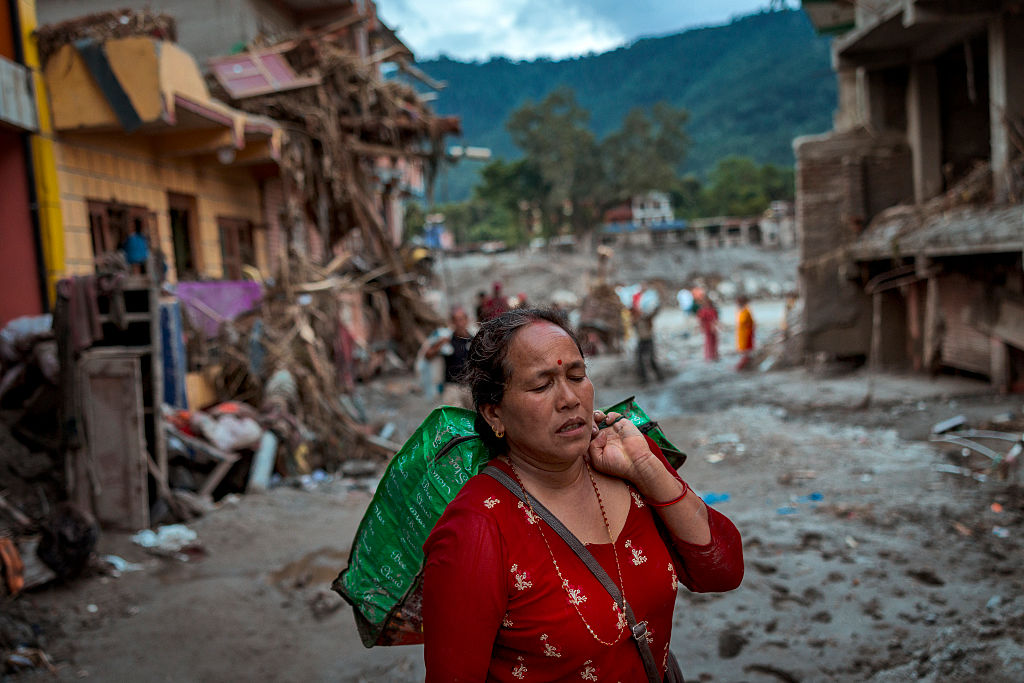
While board members were united in approving the $20 million, plus $1.6 million of administrative costs, representatives of developed and developed countries were divided over the extent to which the decision should set a precedent for the fund’s long-term way of operating.
Germany and Czechia’s board members said it should not set a “precedent” while Japan’s representative said the decision is “truly exceptional” and that the fund’s support must be “in accordance with established rule and procedure”.
Learning the lessons?
Responding, Pakistan’s Ali Sheikh said the lessons from the Nepal case should “feed the long-term model and its work on rapid disbursement” of funds.
He added that he had heard Jan Dusik, Czechia’s board member saying that “we are open for learning but not in setting precedent”. “Please do not define the boundaries for learning,” he emphasised.
Sheikh complained that the decision approved by the board – the result of negotiations between a group of four developed and four developing-country representatives – was narrower than developing countries had hoped for.
“We are saying it is a one-time and Nepal-only window, a sentiment against which many developed countries have raised their voice,” he said, adding there had been no time to review the decision.
Walter Schuldt from Ecuador echoed Sheikh, saying “we should not put limits on lesson learning”. He said the decision, which he was involved in negotiating through “intense exchanges”, tells the fund’s staff to assess the lessons learned.
The fund is currently in a start-up phase and the board will debate its long-term model – including whether and how to rapidly disburse funds in response to climate-driven disasters – at its next board meeting in the Philippines in December.
At Thursday’s meeting, several developing-country board members called for wealthy nations to put more money into the fund. Recovery and reconstruction from Nepal’s flood alone is estimated to cost $4.8 billion – in comparison, the fund has only around $350 million to allocate, with a current cap of $20 million per project.
The post Loss and damage fund agrees $20m for Nepal but rich nations warn it should not set precedent appeared first on Climate Home News.
Loss and damage fund agrees $20m for Nepal but rich nations warn it should not set precedent
Artificial intelligence (AI) is developing at a rapid pace and is increasingly being used by scientists to better understand climate change.
AI is perhaps best-known for its use in “large language models”, such as ChatGPT, Claude and Gemini.
However, the field is vast.
From weather forecasting to analysing satellite images, climate scientists are using various types of AI to develop faster and more efficient ways to study the warming planet.
However, the technology comes with no shortage of risks and challenges, including overreliance on unverified results, intensive energy use and exacerbating existing inequalities in climate science.
Carbon Brief spoke to 10 experts working across a range of climate-related fields – from developing climate forecasts to analysing changes in the energy grid – about how AI is being used.
Their answers are set out below, grouped by theme.
- What are the benefits and challenges of using AI in weather and climate forecasting?
- What are some other current uses of AI in climate science research?
- How is AI being used to advance climate policy and action?
- How could AI be used in climate research over the coming years?
- Are there any misconceptions about the use of AI in climate science?
- Could AI improve or exacerbate inequalities in climate research?
- What are some other risks and challenges of AI in climate change research?