

As efforts to expand energy access across Africa grow, experts and policymakers have called this week for greater coordination and investment to power food production with renewables, arguing the sector has been treated separately from energy policy and therefore faces barriers in going green.
Hailemariam Desalegn, former prime minister of Ethiopia, said energy is critical across the food value chain – from irrigation and processing to cold storage and transport – and should therefore be considered a key pillar of strengthening food systems for the future.
“Energy is not separate from the nutrition challenge. Irrigation needs energy. Cold storage, transport, processing, as well as markets – all need reliable energy,” Desalegn told a panel at the 20th session of the Africa Food Systems Forum in Kigali. He said investments in sustainable energy systems could help reduce post-harvest losses and make nutritious food more accessible and affordable.
Africa loses up to 30% of its food before it reaches markets annually, largely due to poor roads, weak storage and inadequate cold chains, according to a 2025 report by the Alliance for a Green Revolution in Africa (AGRA).
-
Climate adaptation helps African nations tackle rising conflict over resources
The growing overlap between insecurity and climate vulnerability is forcing governments and development agencies to rethink adaptation efforts

Akinyi Walender, Africa director at development charity Practical Action, said poor energy supply in rural communities – where much of Africa’s food is produced – is also limiting productivity. Across the continent, about 600 million people currently live without access to electricity.
“The lack of energy access goes well beyond the inconvenience of not having lighting at home,” Walender said, adding that renewable energy has the potential to power local economies. “When people can access this sort of energy, it can raise rural incomes, improve food security, improve resilience, empower women and stimulate enterprise while creating jobs,” she added.
Breaking down silos
Unlocking the potential of energy across food systems requires greater coordination, Walender argued, pointing to institutional fragmentation and isolated pilot projects as major barriers.
“Organisations working on agriculture and energy often operate according to different modalities and the interdependence between agricultural and energy markets is often overlooked,” Walender said, adding that finance institutions also tend to work in silos.

Dana Rysankova, global lead for energy access at the World Bank, told a separate event at the forum that the bank is working to break down those barriers through its newly established Productive Use of Energy (PUE) Centre of Excellence based in Nairobi, which has a mandate to foster collaboration and help develop and design programmes across different sectors.
Can giant batteries unlock Africa’s green industrial future?
In June, the World Bank Group and the African Development Bank Group said that over 50 million people had been connected to electricity across 40 African countries under their Mission 300 initiative, which aims to provide electricity access to 300 million Africans by 2030.
Rysankova said the programme has shown that energy access is just the foundation for linking with other sectors to deliver real economic transformation by boosting productivity and local incomes.
Mission 300 also aims to electrify schools and healthcare services, as well as bringing power to farmers so that they can use it for irrigation, cold storage and other agricultural activities, she added.
Bridging the finance and infrastructure gap
Experts said bigger investments are needed in infrastructure and finance to turn energy access into increased productivity and economic value.
AGRA’s 2026 foresight report, launched at the forum, puts the annual agrifood financing gap at $180 billion, while estimating that closing Africa’s yearly $67 billion-$108 billion shortfall in infrastructure finance could halve post-harvest losses and increase farmer incomes by up to 40%.
However, the cost of transitioning to clean energy is still a major barrier for farmers and agribusinesses.

Atinuke Lebile, CEO of Nigerian food processing company Cato Foods, told Climate Home News she would like to switch to using renewables but has been held back by the upfront cost of setting up the systems the firm needs.
Rwandan farmer Gezel also said she would like to invest in a solar irrigation pump, but “it is so expensive”.
Practical Action’s Walender said the challenge is no longer whether solutions exist, but how financial support can reach the communities and businesses where it could have the greatest impact.
“Customers are dispersed and have low incomes. Markets are fragmented, and there are high upfront costs for much energy equipment,” Walender said, adding that financial institutions also often perceive agriculture as a high-risk sector.
Egypt seeks to unlock renewable potential to power regional clean energy hub
For food processing, the business case for using cleaner energy more efficiently is particularly strong, said Vivian Maduekeh of Partners in Food Solutions, which has worked with more than 2,000 companies across Africa.
Maduekeh said food processing firms account for between 42 and 70% of energy use across food systems, while energy represents 15-22% of their total production costs. African food businesses also use roughly twice as much energy per kilogramme of product as their global competitors, putting them at a competitive disadvantage.
The problems they face in shifting to clean energy are “risk, perception of risk and the cost”, she explained, adding that financial mechanisms are needed to help businesses overcome those issues.
Maduekeh encouraged policymakers to consider measures like tax rebates on imported equipment and spending more on research and development to bring down the cost of productive-use technologies.
Making a range of affordable equipment available – such as smaller irrigation pumps – could also help make the transition more accessible, she said. The evidence in favour “is very clear”, she added. “We just need to package it and communicate it to the priorities of investors.”
The post More support needed to power Africa’s food systems with renewables, experts say appeared first on Climate Home News.
More support needed to power Africa’s food systems with renewables, experts say

For the first time, new-energy vehicles (NEVs) made up 67% of new car sales in China in September, according to the latest data from the China Passenger Car Association (CPCA).
The figures show that NEVs, which include battery electric cars and plug-in hybrids, captured a record share of sales, even though fewer were sold than last year.
This is because sales of combustion-engine cars are falling steeply, a trend that the CPCA has attributed to rising petrol prices following the start of the Hormuz crisis.
Indeed, sales of fuel-only cars were down 31% year-on-year in the first nine months of 2026, with plug-in hybrid sales down 26% – whereas battery EV sales were only down 4%.
One analyst tells Carbon Brief that China’s rapidly growing EV fleet has offset demand for 143m barrels of oil since the start of the Hormuz crisis.
Another says that the crisis is “reinforcing China’s electrification of road transport”.
Meanwhile, amid slowing domestic sales, Chinese carmakers’ exports of NEVs more than doubled [in 2026 to date / in September] from a year earlier.
NEV record
A record two out of every three cars sold in September in China were NEVs, according to CPCA data, as shown in the figure below.
(NEVs predominantly include battery electric vehicles – BEVs – and plug-in hybrids – PHEVs. BEVs only run on electricity, whereas PHEVs also have a combustion engine.)
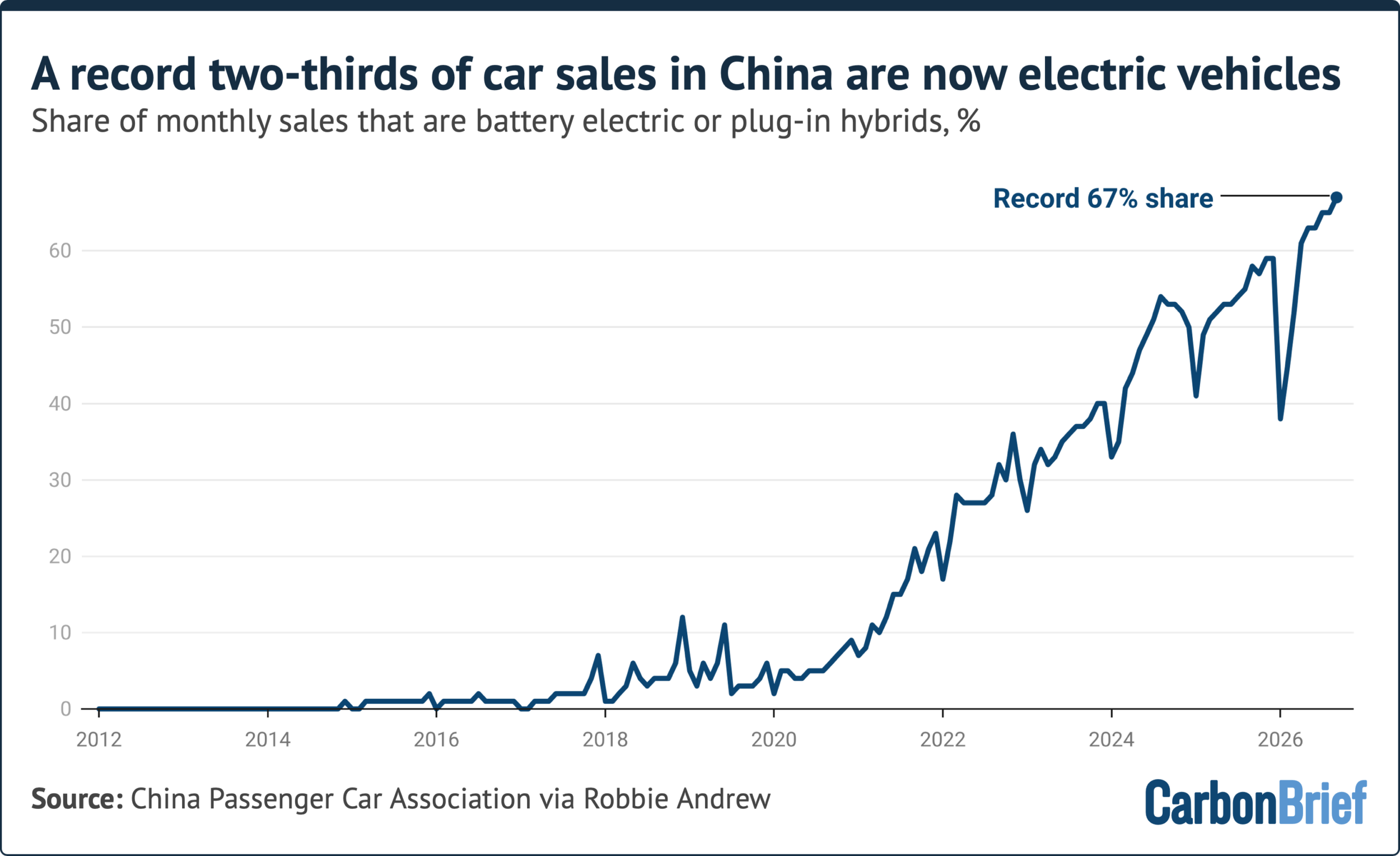
This marks a rapid rise for NEVs from just 6% of new car sales in 2020 up to 58% in 2026 to date – and a record 67% in the month of September.
This year, NEVs’ share of sales has also bounced back from a low of 39% in January, after the full purchase tax exemption that had been in place for more than a decade came to an end in December 2025.
The gain in NEV share in 2026 has come amid a slowdown across the wider domestic passenger-car market, which has hit sales of combustion-engine vehicles particularly hard.
This September, passenger-car retail sales across all categories declined, with overall sales volumes falling 28% year-on-year.
The contraction was led by combustion-engine vehicles, which saw sales fall 43% year-on-year in September and 31% in 2026 to date.
However, sales of PHEVs also fell by 36% year-on-year in September and by 26% in 2026 to date. By comparison, BEVs performed better, although sales still declined 8.5% from a year earlier in September and 4% in 2026 to date.
As a result, NEV sales overall fell by 17% in September and 13% in 2026 to date.
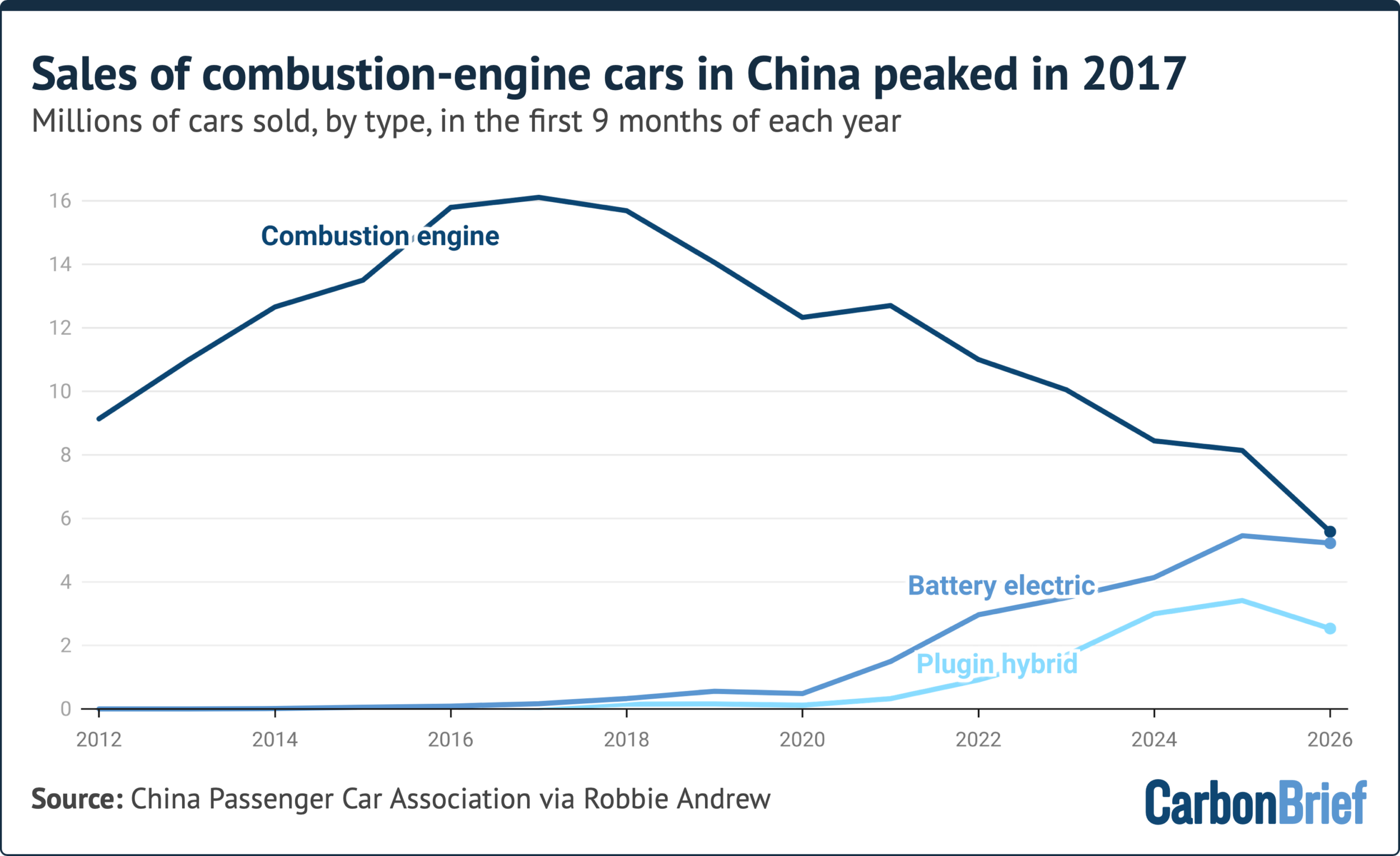
While the market changes in 2026 to date were particularly dramatic, they reflect a broad continuation of trends seen over the past decade.
Indeed, sales of combustion-engine cars in China peaked in 2017 and they have been declining ever since, shown in the figure below.
Impact of Hormuz
Part of the reason for the advance of NEVs in 2026, said Chinese technology news outlet OFweek, was petrol cars “giving up market share” as they were outperformed by electric alternatives.
Cui Dongshu, secretary-general of the CPCA, cited higher petrol prices as an explanation for September’s weak combustion-car sales, in comments to financial news outlet National Business Daily.
Imports of oil into China in January-September have fallen 15% compared to 2025, equivalent to 470m barrels, as ongoing conflict tightened supply and drove up prices.
China’s passenger-car NEV fleet has displaced 143m barrels of oil so far during the strait of Hormuz crisis, Euan Graham, senior energy analyst at thinktank Ember, tells Carbon Brief.
EVs “accounted for 12% of the decrease in China’s oil use post-Hormuz”, according to an estimate provided to thinktank the Brookings Institute by an unnamed analyst.