

Anuradha Barua, Aakriti Wanchoo and Swapan Mehra are from Iora Ecological Solutions, a New Delhi-based company focused on nature-based solutions, climate action, conservation and environmental policy.
When Rojo Neog’s village in northeast India was hit by a power cut in July, he headed out to buy candles. Three days later, his body was recovered – swept away by surging floodwaters. His niece said the water had risen from knee- to neck-level in about half an hour.
The devastating floods highlight how climate risk across India is becoming harder to confine to a season or a disaster bulletin. Just weeks before the disaster in Assam, authorities in Mumbai rationed water as reservoir storage fell to just over 10%.
India does not lack warnings about climate risk. The more difficult task is making sure money, institutions and communities are ready to act before those warnings become disasters. Adaptation should not be just an obligation once a crisis has arrived, but an investment made while there is still something to protect.
-
Bonn climate talks end in “gridlock” on adaptation and emissions-cutting
Splits between developed and developing countries over finance and science held back progress on key areas of climate action, leaving disappointment and much work for COP31

As governments head towards COP31 in Antalya this November, India should push not only for more adaptation finance, but for finance that arrives earlier and can be traced to outcomes on the ground.
That is the gap India needs to close if we wish to become truly resilient in the face of the changing climate. Money must move with risk, institutions must know what to do before an emergency is declared, and long-term spending must reduce vulnerability before it becomes loss.
India’s adaptation disconnect
This year the disconnect has become painfully clear in Assam, where more than 100 people have died due to the flooding, with nearly 140,000 people across seven districts affected. More than 450 villages remain inundated, while some 49,000 people are taking shelter in relief camps after losing everything.
No financing mechanism can stop a river from rising. But timely measures can change what happens before it does. If forecasts and river levels triggered financing before the water arrived, authorities could position boats and stock shelters, and evacuate people where needed, while families could move cattle, seed, medicines and documents before roads disappeared.
For Indian women workers, a just transition means surviving climate impacts with dignity
India already has much of the information needed to address climate change. High-risk states and districts should agree in advance which local thresholds trigger action, who is responsible and how funds will be released, so officials do not have to negotiate responsibility and budgets from scratch once risk becomes an emergency.
Linking community know-how to financing
Our work in Majuli, a river island district in Assam, shows why this matters.
Across 64 villages, communities helped identify flood and erosion risks, assess their capacity to respond, and to develop resilience measures with indicative budgets and possible funding sources.
Communities often know what would help; the harder task is connecting that knowledge to institutions and finance that can act on it.
Extreme heat costing India’s poorest workers 2% of GDP, survey finds
Public health offers an example of how systems can adapt as risks change. In New Delhi, vector-control workers who once prepared for a defined “dengue season” now remain on alert throughout the year, using surveillance and hotspot mapping to identify risks earlier.
The next step is to make these systems more predictive by integrating climate forecasts into public health planning.
India needs sustained investment in drainage, health systems, wetlands, water security and climate-resilient agriculture. Some will remain public responsibilities; others, including water reuse, efficient irrigation, resilient cold chains and risk-proofed infrastructure, can generate savings or revenue and attract private capital if projects are prepared well.
The economic case for adaptation is not always about generating new revenue. Often, it is about avoiding future costs. Flood shelters, public-health preparedness, early-warning systems and support for the poorest households will still need public or grant finance. The point is to match the finance to the risk rather than treat adaptation as a single financing problem.

Rising disaster bill shows cost of inaction
India is already spending heavily on adaptation, with related expenditure reaching 5.6% of GDP in 2021-22. Yet tracked adaptation finance was only about $15 billion annually, almost entirely from domestic public sources, against estimated needs of about $100 billion a year through 2030.
Internationally, the shortfall is wider: developing countries may need $310 billion-$365 billion annually by 2035, compared with just $26 billion in international public adaptation finance in 2023.
For governments repeatedly paying for flood, droughts and heat relief, the cost of inaction can quickly exceed the cost of building resilience, though not all the costs of inaction appear neatly on a balance sheet.
In floodplain landscapes such as Assam’s Kaziranga National Park, animals move towards higher ground every monsoon as the floodplain fills, crossing roads and leaving the park in search of safety. During the 2024 floods, 215 animals died, including 13 one-horned rhinos.
Development plans in such sensitive landscapes must leave room for water, wildlife and communities to move safely. A wetland may not generate monetary revenue, but the floodwater it stores has real value. The cost of losing that capacity may only become visible when the next flood arrives.
Comment: Climate adaptation in Africa needs investment, not imported solutions
Success should not be measured only by how quickly relief follows a disaster. It should also be measured by what never had to be replaced: people and animals moved before the water rose, seeds kept dry, medicines waiting at the shelter, a wetland that still had room to hold water, and a family that could leave while the road was still open.
Adaptation becomes an investment when it preserves those choices before they disappear.
The post India needs climate adaptation cash to be an investment, not a quick fix appeared first on Climate Home News.
India needs climate adaptation cash to be an investment, not a quick fix

For the first time, new-energy vehicles (NEVs) made up 67% of new car sales in China in September, according to the latest data from the China Passenger Car Association (CPCA).
The figures show that NEVs, which include battery electric cars and plug-in hybrids, captured a record share of sales, even though fewer were sold than last year.
This is because sales of combustion-engine cars are falling steeply, a trend that the CPCA has attributed to rising petrol prices following the start of the Hormuz crisis.
Indeed, sales of fuel-only cars were down 31% year-on-year in the first nine months of 2026, with plug-in hybrid sales down 26% – whereas battery EV sales were only down 4%.
One analyst tells Carbon Brief that China’s rapidly growing EV fleet has offset demand for 143m barrels of oil since the start of the Hormuz crisis.
Another says that the crisis is “reinforcing China’s electrification of road transport”.
Meanwhile, amid slowing domestic sales, Chinese carmakers’ exports of NEVs more than doubled [in 2026 to date / in September] from a year earlier.
NEV record
A record two out of every three cars sold in September in China were NEVs, according to CPCA data, as shown in the figure below.
(NEVs predominantly include battery electric vehicles – BEVs – and plug-in hybrids – PHEVs. BEVs only run on electricity, whereas PHEVs also have a combustion engine.)
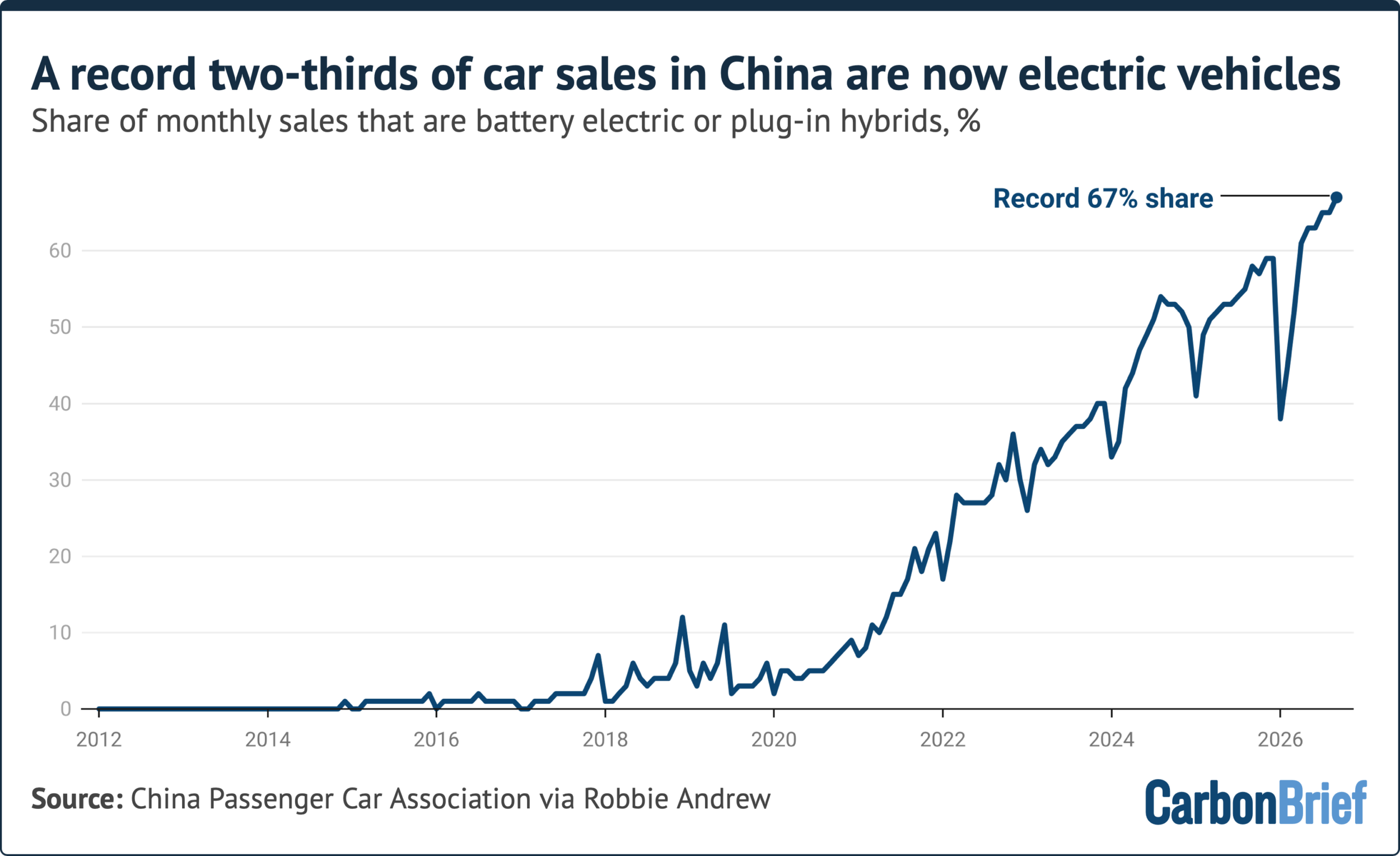
This marks a rapid rise for NEVs from just 6% of new car sales in 2020 up to 58% in 2026 to date – and a record 67% in the month of September.
This year, NEVs’ share of sales has also bounced back from a low of 39% in January, after the full purchase tax exemption that had been in place for more than a decade came to an end in December 2025.
The gain in NEV share in 2026 has come amid a slowdown across the wider domestic passenger-car market, which has hit sales of combustion-engine vehicles particularly hard.
This September, passenger-car retail sales across all categories declined, with overall sales volumes falling 28% year-on-year.
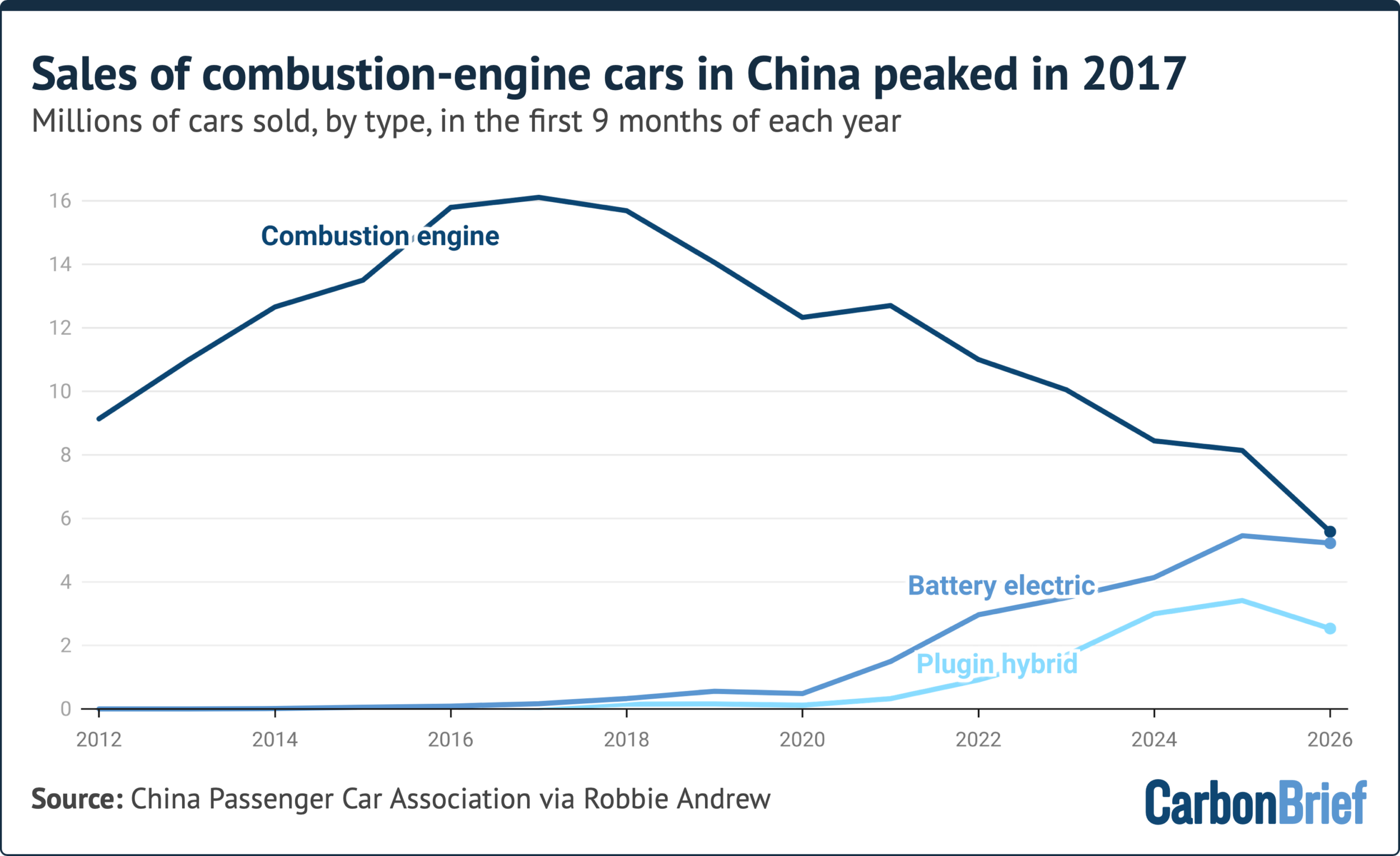
The contraction was led by combustion-engine vehicles, which saw sales fall 43% year-on-year in September and 31% in 2026 to date.
However, sales of PHEVs also fell by 36% year-on-year in September and by 26% in 2026 to date. By comparison, BEVs performed better, although sales still declined 8.5% from a year earlier in September and 4% in 2026 to date.
As a result, NEV sales overall fell by 17% in September and 13% in 2026 to date.
While the market changes in 2026 to date were particularly dramatic, they reflect a broad continuation of trends seen over the past decade.
Indeed, sales of combustion-engine cars in China peaked in 2017 and they have been declining ever since, shown in the figure below.
Impact of Hormuz
Part of the reason for the advance of NEVs in 2026, said Chinese technology news outlet OFweek, was petrol cars “giving up market share” as they were outperformed by electric alternatives.
Cui Dongshu, secretary-general of the CPCA, cited higher petrol prices as an explanation for September’s weak combustion-car sales, in comments to financial news outlet National Business Daily.
Imports of oil into China in January-September have fallen 15% compared to 2025, equivalent to 470m barrels, as ongoing conflict tightened supply and drove up prices.
China’s passenger-car NEV fleet has displaced 143m barrels of oil so far during the strait of Hormuz crisis, Euan Graham, senior energy analyst at thinktank Ember, tells Carbon Brief.
EVs “accounted for 12% of the decrease in China’s oil use post-Hormuz”, according to an estimate provided to thinktank the Brookings Institute by an unnamed analyst.
Erica Downs, a senior research scholar at Columbia University’s Center on Global Energy Policy, tells Carbon Brief that the strait of Hormuz crisis and higher oil prices are “reinforcing China’s electrification of road transport”