

Since the start of this year, Africa’s most populous nation Nigeria has faced prolonged stretches of severe heat.
A recent quick-fire analysis found that the conditions in February, when temperatures exceeded 40C, were made 10 times more likely by human-caused climate change.
But the heat is still ongoing, with temperatures reaching a record 44.8C in Sokoto, a city in north-western Nigeria, on 1 April.
With records of heat and its impacts lacking in Nigeria, Carbon Brief speaks to doctors, farmers and meteorologists about how this episode of extreme weather is affecting the country.
Health impacts
The ongoing extreme heat in Nigeria is having a range of health impacts – and most of these are not being routinely recorded, experts tell Carbon Brief.

On 28 March, Nigeria’s national electricity grid collapsed, plunging the country into a general blackout for the second time during the heatwave.
Despite its wealth of oil and gas, blackouts are common in Nigeria and many people rely on petrol and diesel generators to cool their homes. However, fuel prices have skyrocketed in the past year, putting such alternatives out of the reach for many Nigerians.
The impact of the heat is “catastrophic”, Dr Ugo Uguwanyi, a doctor in Abuja, Nigeria’s capital city, tells Carbon Brief:
“Don’t even bother to step out from 10am to 6pm. And make sure you burn the diesel to power the air conditioning to be able to sleep at night.”
Information about the heatwave’s impact is limited, but this does not mean the weather conditions are not dangerous, according to the authors of the recent analysis into the role of climate change in Nigeria’s extreme heat. Rather, a lack of systematic reporting may obscure what they described as a “silent killer”.
The study’s authors called for “improved monitoring and research on the impacts and risks associated with heatwaves”.
Nigeria’s dry season runs approximately from December through to March – although it is longer in the north of the country and shorter in the south. Temperatures build during this season, typically bringing more reported cases of “meningitis, stress, stroke, blood pressure and stroke”, Dr Uguwanyi says.
Such cases are likely to increase during intense heatwaves, which are projected to become more common if global warming continues to accelerate, he adds.
Dr Ebbi Robinson, chairman of the Nigeria Medical Association in the oil-rich, southern state of Rivers, adds that while “there is no specific documentation”, extreme heat typically brings an increase in hospital visits to dermatologists, with symptoms such as rashes and itching.
He says that his association is rolling out new methods to warn people of the health impacts from extreme heat:
“We are making radio jingles and banners to let people know these heatwaves are real and sensitise them on how to mitigate against the direct and indirect consequences.”
In mid-February, the Nigerian Meteorological Agency (NiMet) issued a public forecast warning on the prolonged heatwave.
The agency advised citizens to stay hydrated, wear light clothing and avoid direct exposure to high temperatures during peak periods. A group of Nigerian doctors also issued safety tips.
Wasiu Adeniyi Ibrahim, a meteorologist at NiMet, tells Carbon Brief:
“Heatwaves, characterised by prolonged periods of excessively hot temperatures and humidity, are becoming more frequent and intense.
“We have observed a departure of 2-4C from normal (long-time average temperature, 1991-2020) in the month of February. It is clear that climate change is bringing more and more dangerously hot days to Africa.”
Workforce impacts
In February, NiMet’s director of weather forecast services, Vincent Weli, advised that a state of emergency be declared in states most affected by the heatwave and workers be allowed to take breaks between noon and 3pm. Speaking to Nigeria’s Channels Television, Weli said:
“Of course, you know, with high temperature, cognitive development will be affected and productivity will be affected. There will be a loss of concentration.”
The call was necessary as “the condition was favourable for an outbreak of meningitis”, Ibrahim explains to Carbon Brief:
“We observed high dust concentration combined with this excessive heat which could trigger a meningitis outbreak. Epileptic power supply, low ventilations and other factors could make the situation worse, if not properly controlled.”
Meningitis, an inflammation of the membranes covering the brain and the spinal cord, is more easily spread in extreme heat and dusty conditions.
However, no such directive has been issued by state governments.
“Many state governments in Nigeria are not taking weather and climate information very seriously,” Ibrahim says.
Meanwhile, in Lagos, Nigeria’s most populated city, ride-hailing drivers are operating under “melting” conditions, stuck between preserving their health or livelihood, according to a Rest of World report.
Agricultural impacts
The heatwave is also expected to reduce agricultural productivity, a sector that contributes about 22% to Nigeria’s gross domestic product (GDP) and accounts for more than a third of total employment. Ibrahim tells Carbon Brief:
“Heatwaves can reduce agricultural productivity by causing heat stress to crops and livestock.
“It could negatively affect crop growth and development by disrupting physiological processes, such as photosynthesis, respiration and water uptake. High temperatures can lead to wilting, leaf scorching and reduced nutrient uptake, impairing plant growth, fewer fruits and reducing yields.
“In animals, heatwaves may reduce feed intake, lower weight gain, decrease milk production, reduce reproductive performance and [cause] animal mortality, if proper mitigation measures are not in place.”

Again, there is not a lot of data on how the current heat is affecting agriculture in Nigeria.
However, the national secretary of the All Farmers Association of Nigeria, Yunusa Halidu, tells Carbon Brief its members expect the heatwave to affect productivity yield this year. He says:
“The heat is extreme this year,although we have been expecting it, as we work with the Nigerian Meteorological Agency. We know it is global warming and we are working to see how we can mitigate the effects.”
A shorter version of this article was first published in DeBriefed, Carbon Brief’s weekly climate newsletter, on 5 April. Subscribe for free.


The post How Nigeria is reeling from extreme heat fuelled by climate change appeared first on Carbon Brief.
How Nigeria is reeling from extreme heat fuelled by climate change

Drought and heatwaves occurring together – known as “compound” events – have “surged” across the world since the early 2000s, a new study shows.
Compound drought and heat events (CDHEs) can have devastating effects, creating the ideal conditions for intense wildfires, such as Australia’s “Black Summer” of 2019-20 where bushfires burned 24m hectares and killed 33 people.
The research, published in Science Advances, finds that the increase in CDHEs is predominantly being driven by events that start with a heatwave.
The global area affected by such “heatwave-led” compound events has more than doubled between 1980-2001 and 2002-23, the study says.
The rapid increase in these events over the last 23 years cannot be explained solely by global warming, the authors note.
Since the late 1990s, feedbacks between the land and the atmosphere have become stronger, making heatwaves more likely to trigger drought conditions, they explain.
One of the study authors tells Carbon Brief that societies must pay greater attention to compound events, which can “cause severe impacts on ecosystems, agriculture and society”.
Compound events
CDHEs are extreme weather events where drought and heatwave conditions occur simultaneously – or shortly after each other – in the same region.
These events are often triggered by large-scale weather patterns, such as “blocking” highs, which can produce “prolonged” hot and dry conditions, according to the study.
Prof Sang-Wook Yeh is one of the study authors and a professor at the Ewha Womans University in South Korea. He tells Carbon Brief:
“When heatwaves and droughts occur together, the two hazards reinforce each other through land-atmosphere interactions. This amplifies surface heating and soil moisture deficits, making compound events more intense and damaging than single hazards.”
CDHEs can begin with either a heatwave or a drought.
The sequence of these extremes is important, the study says, as they have different drivers and impacts.
For example, in a CDHE where the heatwave was the precursor, increased direct sunshine causes more moisture loss from soils and plants, leading to a drought.
Conversely, in an event where the drought was the precursor, the lack of soil moisture means that less of the sun’s energy goes into evaporation and more goes into warming the Earth’s surface. This produces favourable conditions for heatwaves.
The study shows that the majority of CDHEs globally start out as a drought.
In recent years, there has been increasing focus on these events due to the devastating impact they have on agriculture, ecosystems and public health.
In Russia in the summer of 2010, a compound drought-heatwave event – and the associated wildfires – caused the death of nearly 55,000 people, the study notes.

The record-breaking Pacific north-west “heat dome” in 2021 triggered extreme drought conditions that caused “significant declines” in wheat yields, as well as in barley, canola and fruit production in British Columbia and Alberta, Canada, says the study.
Increasing events
To assess how CDHEs are changing, the researchers use daily reanalysis data to identify droughts and heatwaves events. (Reanalysis data combines past observations with climate models to create a historical climate record.) Then, using an algorithm, they analyse how these events overlap in both time and space.
The study covers the period from 1980 to 2023 and the world’s land surface, excluding polar regions where CDHEs are rare.
The research finds that the area of land affected by CDHEs has “increased substantially” since the early 2000s.
Heatwave-led events have been the main contributor to this increase, the study says, with their spatial extent rising 110% between 1980-2001 and 2002-23, compared to a 59% increase for drought-led events.
The map below shows the global distribution of CDHEs over 1980-2023. The charts show the percentage of the land surface affected by a heatwave-led CDHE (red) or a drought-led CDHE (yellow) in a given year (left) and relative increase in each CDHE type (right).
The study finds that CDHEs have occurred most frequently in northern South America, the southern US, eastern Europe, central Africa and south Asia.

Threshold passed
The authors explain that the increase in heatwave-led CDHEs is related to rising global temperatures, but that this does not tell the whole story.
In the earlier 22-year period of 1980-2001, the study finds that the spatial extent of heatwave-led CDHEs rises by 1.6% per 1C of global temperature rise. For the more-recent period of 2022-23, this increases “nearly eightfold” to 13.1%.
The change suggests that the rapid increase in the heatwave-led CDHEs occurred after the global average temperature “surpasse[d] a certain temperature threshold”, the paper says.
This threshold is an absolute global average temperature of 14.3C, the authors estimate (based on an 11-year average), which the world passed around the year 2000.
Investigating the recent surge in heatwave-leading CDHEs further, the researchers find a “regime shift” in land-atmosphere dynamics “toward a persistently intensified state after the late 1990s”.
In other words, the way that drier soils drive higher surface temperatures, and vice versa, is becoming stronger, resulting in more heatwave-led compound events.
Daily data
The research has some advantages over other previous studies, Yeh says. For instance, the new work uses daily estimations of CDHEs, compared to monthly data used in past research. This is “important for capturing the detailed occurrence” of these events, says Yeh.
He adds that another advantage of their study is that it distinguishes the sequence of droughts and heatwaves, which allows them to “better understand the differences” in the characteristics of CDHEs.
Dr Meryem Tanarhte is a climate scientist at the University Hassan II in Morocco, and Dr Ruth Cerezo Mota is a climatologist and a researcher at the National Autonomous University of Mexico. Both scientists, who were not involved in the study, agree that the daily estimations give a clearer picture of how CDHEs are changing.
Cerezo-Mota adds that another major contribution of the study is its global focus. She tells Carbon Brief that in some regions, such as Mexico and Africa, there is a lack of studies on CDHEs:
“Not because the events do not occur, but perhaps because [these regions] do not have all the data or the expertise to do so.”
However, she notes that the reanalysis data used by the study does have limitations with how it represents rainfall in some parts of the world.
Compound impacts
The study notes that if CDHEs continue to intensify – particularly events where heatwaves are the precursors – they could drive declining crop productivity, increased wildfire frequency and severe public health crises.
These impacts could be “much more rapid and severe as global warming continues”, Yeh tells Carbon Brief.
Tanarhte notes that these events can be forecasted up to 10 days ahead in many regions. Furthermore, she says, the strongest impacts can be prevented “through preparedness and adaptation”, including through “water management for agriculture, heatwave mitigation measures and wildfire mitigation”.
The study recommends reassessing current risk management strategies for these compound events. It also suggests incorporating the sequences of drought and heatwaves into compound event analysis frameworks “to enhance climate risk management”.
Cerezo-Mota says that it is clear that the world needs to be prepared for the increased occurrence of these events. She tells Carbon Brief:
“These [risk assessments and strategies] need to be carried out at the local level to understand the complexities of each region.”




The post Heatwaves driving recent ‘surge’ in compound drought and heat extremes appeared first on Carbon Brief.
Heatwaves driving recent ‘surge’ in compound drought and heat extremes
Greenhouse Gases
DeBriefed 6 March 2026: Iran energy crisis | China climate plan | Bristol’s ‘pioneering’ wind turbine
Welcome to Carbon Brief’s DeBriefed.
An essential guide to the week’s key developments relating to climate change.
This week
Energy crisis
ENERGY SPIKE: US-Israeli attacks on Iran and subsequent counterattacks across the Middle East have sent energy prices “soaring”, according to Reuters. The newswire reported that the region “accounts for just under a third of global oil production and almost a fifth of gas”. The Guardian noted that shipping traffic through the strait of Hormuz, which normally ferries 20% of the world’s oil, “all but ground to a halt”. The Financial Times reported that attacks by Iran on Middle East energy facilities – notably in Qatar – triggered the “biggest rise in gas prices since Russia’s full-scale invasion of Ukraine”.
‘RISK’ AND ‘BENEFITS’: Bloomberg reported on increases in diesel prices in Europe and the US, speculating that rising fuel costs could be “a risk for president Donald Trump”. US gas producers are “poised to benefit from the big disruption in global supply”, according to CNBC. Indian government sources told the Economic Times that Russia is prepared to “fulfil India’s energy demands”. China Daily quoted experts who said “China’s energy security remains fundamentally unshaken”, thanks to “emergency stockpiles and a wide array of import channels”.
‘ESSENTIAL’ RENEWABLES: Energy analysts said governments should cut their fossil-fuel reliance by investing in renewables, “rather than just seeking non-Gulf oil and gas suppliers”, reported Climate Home News. This message was echoed by UK business secretary Peter Kyle, who said “doubling down on renewables” was “essential” amid “regional instability”, according to the Daily Telegraph.
China’s climate plan
PEAK COAL?: China has set out its next “five-year plan” at the annual “two sessions” meeting of the National People’s Congress, including its climate strategy out to 2030, according to the Hong Kong-based South China Morning Post. The plan called for China to cut its carbon emissions per unit of gross domestic product (GDP) by 17% from 2026 to 2030, which “may allow for continued increase in emissions given the rate of GDP growth”, reported Reuters. The newswire added that the plan also had targets to reach peak coal in the next five years and replace 30m tonnes per year of coal with renewables.
ACTIVE YET PRUDENT: Bloomberg described the new plan as “cautious”, stating that it “frustrat[es] hopes for tighter policy that would drive the nation to peak carbon emissions well before president Xi Jinping’s 2030 deadline”. Carbon Brief has just published an in-depth analysis of the plan. China Daily reported that the strategy “highlights measures to promote the climate targets of peaking carbon dioxide emissions before 2030”, which China said it would work towards “actively yet prudently”.
Around the world
- EU RULES: The European Commission has proposed new “made in Europe” rules to support domestic low-carbon industries, “against fierce competition from China”, reported Agence France-Presse. Carbon Brief examined what it means for climate efforts.
- RECORD HEAT: The US National Oceanic and Atmospheric Administration has said there is a 50-60% chance that the El Niño weather pattern could return this year, amplifying the effect of global warming and potentially driving temperatures to “record highs”, according to Euronews.
- FLAGSHIP FUND: The African Development Bank’s “flagship clean energy fund” plans to more than double its financing to $2.5bn for African renewables over the next two years, reported the Associated Press.
- NO WITHDRAWAL: Vanuatu has defied US efforts to force the Pacific-island nation to drop a UN draft resolution calling on the world to implement a landmark International Court of Justice (ICJ) ruling on climate, according to the Guardian.
98
The number of nations that submitted their national reports on tackling nature loss to the UN on time – just half of the 196 countries that are part of the UN biodiversity treaty – according to analysis by Carbon Brief.
Latest climate research
- Sea levels are already “much higher than assumed” in most assessments of the threat posed by sea-level rise, due to “inadequate” modelling assumptions | Nature
- Accelerating human-caused global warming could see the Paris Agreement’s 1.5C limit crossed before 2030 | Geophysical Research Letters covered by Carbon Brief
- Future “super El Niño events” could “significantly lower” solar power generation due to a reduction in solar irradiance in key regions, such as California and east China | Communications Earth & Environment
(For more, see Carbon Brief’s in-depth daily summaries of the top climate news stories on Monday, Tuesday, Wednesday, Thursday and Friday.)
Captured
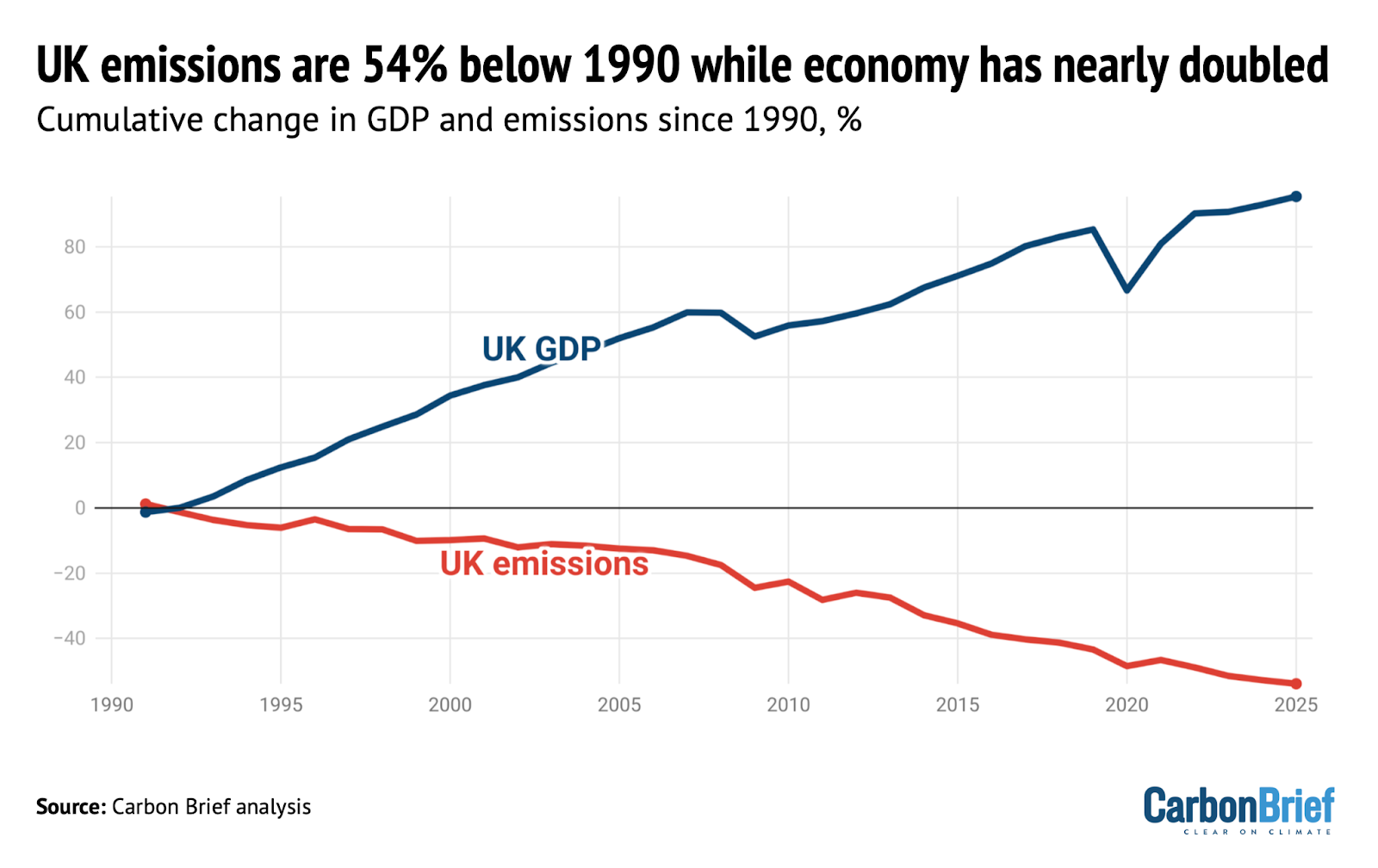
UK greenhouse gas emissions in 2025 fell to 54% below 1990 levels, the baseline year for its legally binding climate goals, according to new Carbon Brief analysis. Over the same period, data from the World Bank shows that the UK’s economy has expanded by 95%, meaning that emissions have been decoupling from growth.
Spotlight
Bristol’s ‘pioneering’ community wind turbine
Following the recent launch of the UK government’s local power plan, Carbon Brief visits one of the country’s community-energy success stories.
The Lawrence Weston housing estate is set apart from the main city of Bristol, wedged between the tree-lined grounds of a stately home and a sprawl of warehouses and waste incinerators. It is one of the most deprived areas in the city.
Yet, just across the M5 motorway stands a structure that has brought the spoils of the energy transition directly to this historically forgotten estate – a 4.2 megawatt (MW) wind turbine.
The turbine is owned by local charity Ambition Lawrence Weston and all the profits from its electricity sales – around £100,000 a year – go to the community. In the UK’s local power plan, it was singled out by energy secretary Ed Miliband as a “pioneering” project.
‘Sustainable income’
On a recent visit to the estate by Carbon Brief, Ambition Lawrence Weston’s development manager,