

Countries attending a first-of-its-kind fossil-fuel summit have been asked to consider “action recommendations” such as “halting all new fossil-fuel expansion” and “reject[ing] gas as a bridging fuel”, according to a preliminary scientific report seen by Carbon Brief.
Around 50 nations will gather in Santa Marta, Colombia from 24-29 April to debate ways to “transition away” from fossil fuels, in the face of worsening climate change and sky-high oil prices.
The talks come after a large group of nations campaigned for, but ultimately failed, to get all countries to formally agree to a “roadmap” away from fossil fuels at the COP30 climate summit in Brazil in November.
The nations gathering in Santa Marta for the summit co-hosted by Colombia and the Netherlands, call themselves the “coalition of the willing”.
Ahead of country officials arriving in Santa Marta, a global group of academics will gather in the city this week to present and discuss the latest scientific evidence on fossil-fuel phaseout, which will then inform debate among policymakers.
A preliminary scientific “synthesis report” circulated to governments attending the talks and seen by Carbon Brief offers 12 “action insights” for countries to consider, along with a wide range of “action recommendations”.
These recommendations range from “phase out subsidies on fossil-fuel production and consumption” to “kick-start a forum to develop a legal framework to ban fossil-fuel advertisements”.
‘Rapid’ assessment
The preliminary scientific report seen by Carbon Brief – titled, “Action insights for the Santa Marta process” – is the result of some rapid work by an “ad-hoc” group of around 24 scientists.
It is designed to present governments attending the talks with concrete and actionable recommendations for transitioning away from fossil fuels.
The preliminary version, which includes recommendations such as “halting all new fossil fuel expansion”, has already been circulated to governments, with a view that this could help them to prepare for the talks in advance.
It will be further debated and refined by scientists attending the academic segment of the Santa Marta talks, before a final version is made public towards the end of April, Carbon Brief understands.
The process to produce the report began shortly after the conclusion of the COP30 climate summit in Brazil in November, explains its lead author, Dr Friedrich Bohn, a research scientist and co-founder of the Earth Resilience Institute in Germany. He tells Carbon Brief:
“When [Brazil] announced there would be a Santa Marta conference led by Colombia and the Netherlands, I was sitting listening with a small group of scientists. We thought: ‘This is great news, but it should be supported by scientific expertise.’”
One of the members of Bohn’s group had a pre-existing relationship with the Colombian government, allowing a dialogue to quickly be established, he continues:
“In the beginning, the idea was to just write a peer-reviewed paper. But, because of this close connection to the Colombian government and some feedback from them, the synthesis paper evolved.”
The report came out of a “very rapidly evolved process” that relied on the “goodwill” and “enthusiasm” of the academics involved, adds coordinating author Prof Frank Jotzo, a professor of climate change economics at Australian National University. (Jotzo is a former Carbon Brief contributing editor.) He tells Carbon Brief:
“It’s an attempt to get broad coverage on relevant topics from researchers with good expertise and reputation.”
The group of 24 scientists involved spent around two months compiling the “action insights” for the report, drawing on their expertise and the latest available research, says Jotzo.
Given the rapid nature of the report, it does not aim to be “completist”, has not been externally reviewed and did not follow a stringent process for author selection comparable to that used by Intergovernmental Panel on Climate Change (IPCC) reports, he adds.
The contributors to the report currently skew to the global north and include more men than women, adds Bohn.
‘Direct guidance’
In a departure from IPCC reports, the preliminary Santa Marta synthesis report offers “very direct guidance to action”, says Jotzo.
The report lists 12 “action insights”, each with three “action recommendations”. (The list was cut down from a shortlist of about 40-50 insights, Carbon Brief understands.)
One of the most striking in the draft is “action insight 5”, which says:
“Take immediate measures to prevent future emissions. Ban new fossil infrastructure, mandate deep methane cuts, accelerate electrification and inscribe fossil-fuel phase-down targets in NDCs [nationally determined contributions] and clean-energy pathways support to low and middle income countries (LMICs).”
The accompanying three “action recommendations” include “halting all new fossil-fuel extraction and infrastructure projects ahead of a final investment decision”, “implementing deep, legally binding methane cuts in the energy sector” and “inscrib[ing] targets for fossil-fuel phase down, electrification and green exports in NDCs”.
(The draft report includes multiple references to “phasing out” and “phasing down” fossil fuels, rather than the “transition away from fossil fuels” language that was, ultimately, agreed by countries at the COP28 UN climate talks in Dubai in 2023.)
Another action insight says “public support for climate action is broadly underestimated and undermined by interest groups, but it can be strengthened by debunking greenwashing narratives”.
One recommendation for this insight is that nations “reject natural gas as a bridging technology and CCS [carbon capture and storage] techniques as scalable compensation”.
In a letter introducing the report to governments and civil society, the scientists note that making direct recommendations is a “challenge for our community”, but added:
“However, in the spirit of a constructive collaboration between science and policymaking, we allowed ourselves to identify some potential courses of action that our community would recommend for each particular issue – and we invite you to weigh these against your own circumstances and pick up whatever seems most useful for you and your colleagues.”
The prescriptiveness of the recommendations – something strictly prohibited in IPCC reports – was an explicit request from the Colombian government, Bohn says:
“The idea of actionable recommendations was introduced by the Colombian government.
“There was some discussion within the team about this. It’s a tricky area when you leave science and move to consultation. Therefore, we agreed, in the end, to call them ‘actionable recommendations’ and to make them as precise as possible, from the scientific perspective.”
Jotzo, a veteran of the IPCC process, tells Carbon Brief that it was “very liberating” to work on a report with a “free-form process”:
“The bulk of policy-related research is very readily deployed to recommendations pointing out what countries could do. The IPCC process, for example, just doesn’t allow that. As far as the summary for policymakers in the IPCC is concerned, it will usually be governments that filter out anything that could be interpreted as a specific recommendation.”
He adds that the hope is that some of the action insights might be reflected in the high-level segment of the Santa Marta conference:
“No one is under any illusions that governments will walk away from the Santa Marta conference and will have made a decision to implement recommendations one, seven and nine – or something like that. But it is a chance to insert directly applicable action points into national and plurilateral policy agendas.”
Colombia calling
The preliminary report will be further debated and refined by scientists attending the “pre-academic segment” of the Santa Marta talks.
This is taking place from 24-26 April, ahead of the “high-level segment” involving ministers and other policymakers from 28-29 April.
The pre-academic segment will also separately see the launch of a new advisory panel on fossil-fuel transition and a scientifically led roadmap for how Colombia can transition away from fossil fuels, Carbon Brief understands.
The high-level segment is expected to be attended by representatives from around 50 countries, including COP31 host Turkey and major oil-and-gas producers such as the UK, Canada, Australia, Brazil and Norway.
Countries expected to attend account for one-third of global fossil-fuel demand and one-fifth of global production, according to the Colombian government.
At the end of the conference, countries are due to release a report featuring a “menu of solutions” for transitioning away from fossil fuels, according to Colombia’s environment minister Irene Vélez Torres.
This report is in turn set to inform a global “roadmap” on transitioning away from fossil fuels being developed by the Brazilian COP30 presidency, which is due to be presented at COP31 in Turkey this November.
The Brazilian COP30 presidency offered to bring forward a “voluntary” fossil-fuel transition “roadmap” outside of the official COP process, after countries failed to formally agree to one during negotiations in Belém.



The post Revealed: Scientists tell Colombia fossil-fuel transition summit to ‘halt new expansion’ appeared first on Carbon Brief.
Revealed: Scientists tell Colombia fossil-fuel transition summit to ‘halt new expansion’

Climate Change
After a week of plenty of activity and drama for Greenpeace at sea, I felt like writing to you on a much quieter theme…
Do you have a favourite book, poem or story about the ocean?
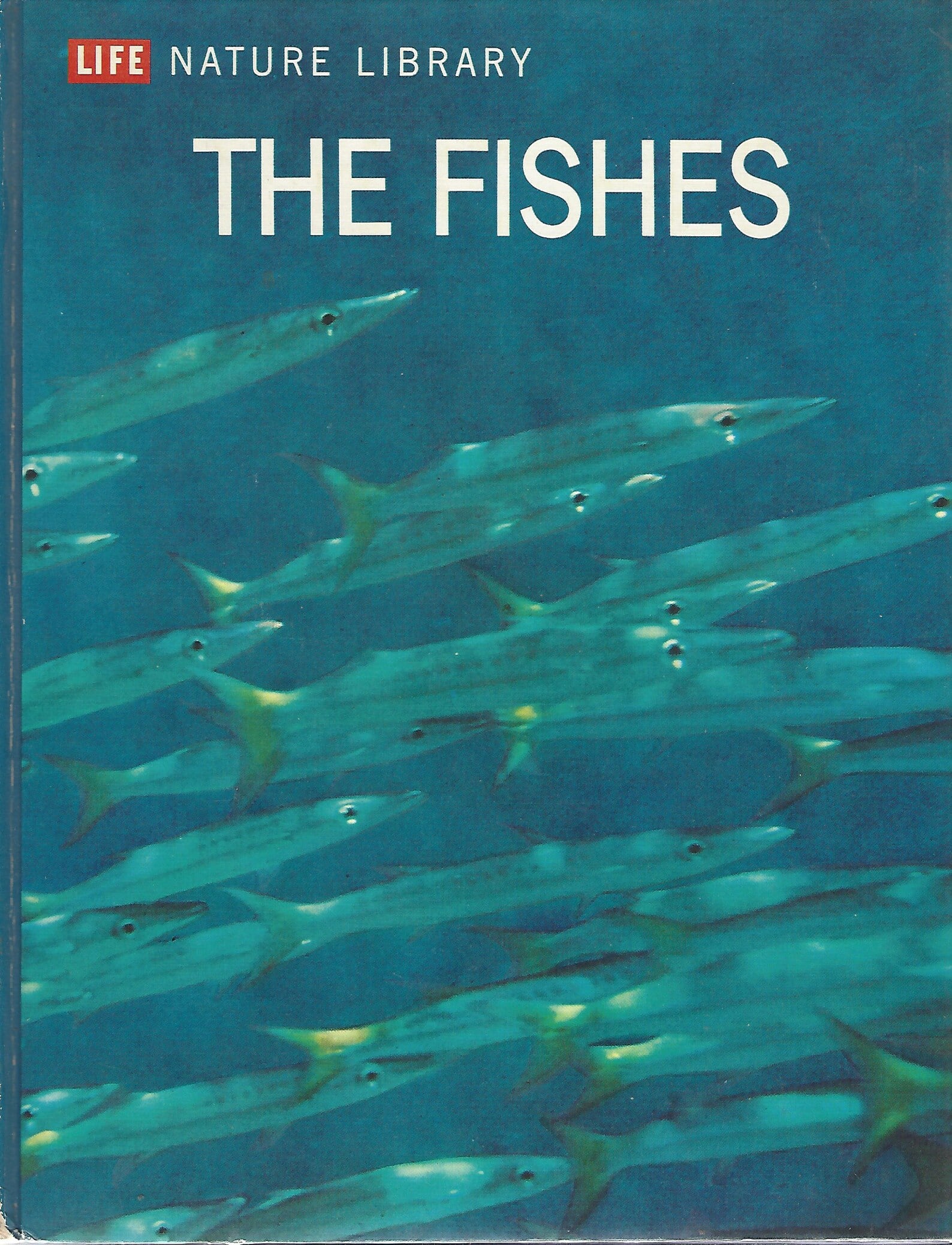
When I was very small, it was the TimeLife book of The Fishes, by F. D. Ommanney, which I remember endlessly poring over, my child’s mind gripped, in total fascination. The cover illustration showed a shoal of barracuda, mid-water and heading upwards, lit up as an iridescent blue by a column of sunlight. Oddly, it is only the cover and the illustrations of the deep sea creatures which I now remember—but I loved that book, as the weakened spine, blunted pages and dog-eared corners attested.
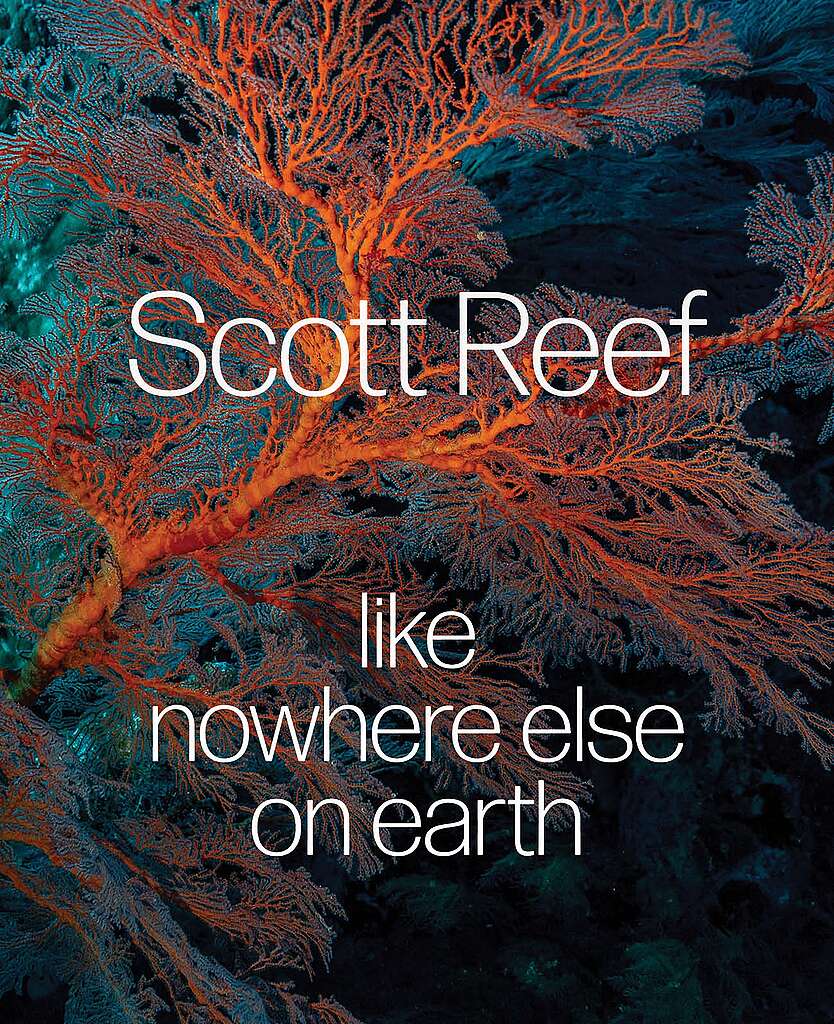
The Fishes has been on my mind recently, because I’ve been working with some dear friends on our own illustrated oceans book, to be published by Upswell Publishing. The book is called Scott Reef: Like Nowhere Else on Earth, and I want to share with you a bit of the story behind its creation.
Scott Reef is absolutely magnificent: Australia’s largest freestanding oceanic reef, brimming with life, including rare and threatened species such as a genetically distinct population of green sea turtles, pygmy blue whales and the wonderfully elegant dusky sea snake. But Scott Reef isn’t near our capital cities; it is way off the north-west coast of WA. And it is threatened with devastation by Woodside, which wants to drill up to 57 toxic wells at the Reef for its vast, dirty Browse gas project.
One of the main challenges in the fight to save Scott Reef from being turned into an industrialised gas zone by Woodside is bringing this incredible location to life for people who haven’t actually experienced it first hand. Because despite its ecological significance and dazzling beauty, ‘Scott Reef’ is also—at least not yet—exactly a household name.
To help get over this barrier, Greenpeace has enabled a number of photographers to travel to Scott Reef by boat (including the Rainbow Warrior) to document its astonishing diversity of colour and life. We then brought these images together in a remarkable photobook, produced by our talented in-house team, which we’ve been putting into the hands of as many leaders as possible—including the MPs whose decisions can determine the Reef’s future.
Back in June this year, I was sharing a copy of our in-house book at a business gathering in Perth when someone pulled me aside. Had we thought about publishing the book commercially? Apart from anything else, he wanted to buy a copy himself! He had a point. We were proud of what we’d created, but a commercially published version could reach a much wider audience and have even greater campaign impact. I immediately turned to my dear friend, Terri-ann White, who runs Upswell Publishing in WA, for advice.
Terri-ann has a huge heart and terrific vision. So many wonderful things in WA owe their existence to her doings, and, true to form, she was immediately encouraging and enthusiastic. “But,” she said, “it would add a whole new dimension if we had some words to accompany the incredible pictures.”
Fair enough, I thought. I could ask a few authors.
“And when would you like it published?” she asked.
“Ideally November,” I answered sheepishly.
Now, in publishing terms, nobody goes from idea to finished work, beautifully produced by a commercial publisher, in just four months. It. Just. Doesn’t. Happen. A book of this scale would ordinarily take nine months, I was told. But Terri-ann was undeterred. “If you can get a rapid turnaround on the writing, I will give it a shot.”
Over the following few days, I sent out 24 emails to prospective writers. To my joy and surprise 23 of them responded almost immediately with an enthusiastic yes!
Terri-ann was somewhat alarmed and perplexed when I told her the good news… we’d discussed a few authors, not more than twenty! “Impossible,” she texted. “Editing is important and you are talking about thousands of words!” But I also know Terri-ann. She does the impossible. And so, here we are… Terri-ann is going to hit that improbable deadline. Scott Reef: Like Nowhere Else on Earth will be on shelves in November.
The contributors are a wonderfully diverse bunch, united by their enthusiasm for Scott Reef — and their extraordinary speed!
It’s a brilliant mix. The book brings together national icons like Peter Garrett, Tim Winton, Mick Dodson, Janet Holmes à Court and Fiona Stanley; the intellectual heft of professors Frank Bongiorno, Jessica Meeuwig, Rick Steiner and Samantha Hepburn; the poetic vision of Prema Arasu, Berndt Sellheim and Saadiah Freeman; the field expertise and passionate first hand witnessing of Imogen Zethoven, Tooni Mahto, Ben Fitzpatrick, Geoff Bice, Olaf Meynecke, Paul Gamblin, Sarah Gittoes and Hayley Baillie; and the determination of emerging activist voices Jackson Reid and Emma Sangalli.
Their elegant words wrap themselves around the sheer wonder of the underwater world, brought to life by the work of the photographers — of whom one, Wendy Mitchell, has also contributed a wonderful essay.
Terri-ann showed me the full physical proofs this week and they are breathtaking. This book contains some of my absolute favourite images of wildlife beneath the waves -– and believe me, after almost 20 years at Greenpeace, I’ve been privileged enough to see some remarkable shots! The essays bring a whole new depth and richness to the story of Scott Reef.
If I am being honest, and maybe a bit sentimental, I hope that a four or five-year-old child somewhere in Australia will spend part of their summer holidays turning the pages of this book, wide-eyed with curiosity and awe at the beauty and strangeness of the creatures that call our oceans home.
Our shared commitment is to make sure that, as those children grow up, the wonders of Scott Reef will exist not just in the pages of the book, but out there in the wild waters off north-western Australia—alive, thriving, and every bit as extraordinary as they are today; a living wonder beneath the waves.
Pre-orders of Scott Reef: Like Nowhere Else on Earth are available here.


Q & A
Sometimes you get asked a question so often that you decide to produce a report to answer it!
We know there is strong public opposition to voter opposition to gas drilling at Scott Reef and fracking in the Kimberley in Western Australia. But I am frequently asked whether, even if people don’t want it, more gas drilling is a necessary evil to sustain WA’s prosperity?
The short answer is an unequivocal ‘No’. The longer answer is our new report, From Gas to Green: Building Western Australia’s Future State, which makes the comprehensive case that Asia’s gas market is declining — while WA has an enormous untapped opportunity to become a global leader in green industries and exports, helping drive the region’s shift away from fossil fuels. The faster that WA embarks on a decisive shift away from gas—and that includes no fracking in the Kimberley, or drilling at Scott Reef — so much the better for the state’s people, ecology and economy.
For the first time, new-energy vehicles (NEVs) made up 67% of new car sales in China in September, according to the latest data from the China Passenger Car Association (CPCA).
The figures show that NEVs, which include battery electric cars and plug-in hybrids, captured a record share of sales, even though fewer were sold than last year.
This is because sales of combustion-engine cars are falling steeply, a trend that the CPCA has attributed to rising petrol prices following the start of the Hormuz crisis.
Indeed, sales of fuel-only cars were down 31% year-on-year in the first nine months of 2026, with plug-in hybrid sales down 26% – whereas battery EV sales were only down 4%.
One analyst tells Carbon Brief that China’s rapidly growing EV fleet has offset demand for 143m barrels of oil since the start of the Hormuz crisis.
Another says that the crisis is “reinforcing China’s electrification of road transport”.
Meanwhile, amid slowing domestic sales, Chinese carmakers’ exports of NEVs more than doubled [in 2026 to date / in September] from a year earlier.
NEV record
A record two out of every three cars sold in September in China were NEVs, according to CPCA data, as shown in the figure below.
(NEVs predominantly include battery electric vehicles – BEVs – and plug-in hybrids – PHEVs. BEVs only run on electricity, whereas PHEVs also have a combustion engine.)
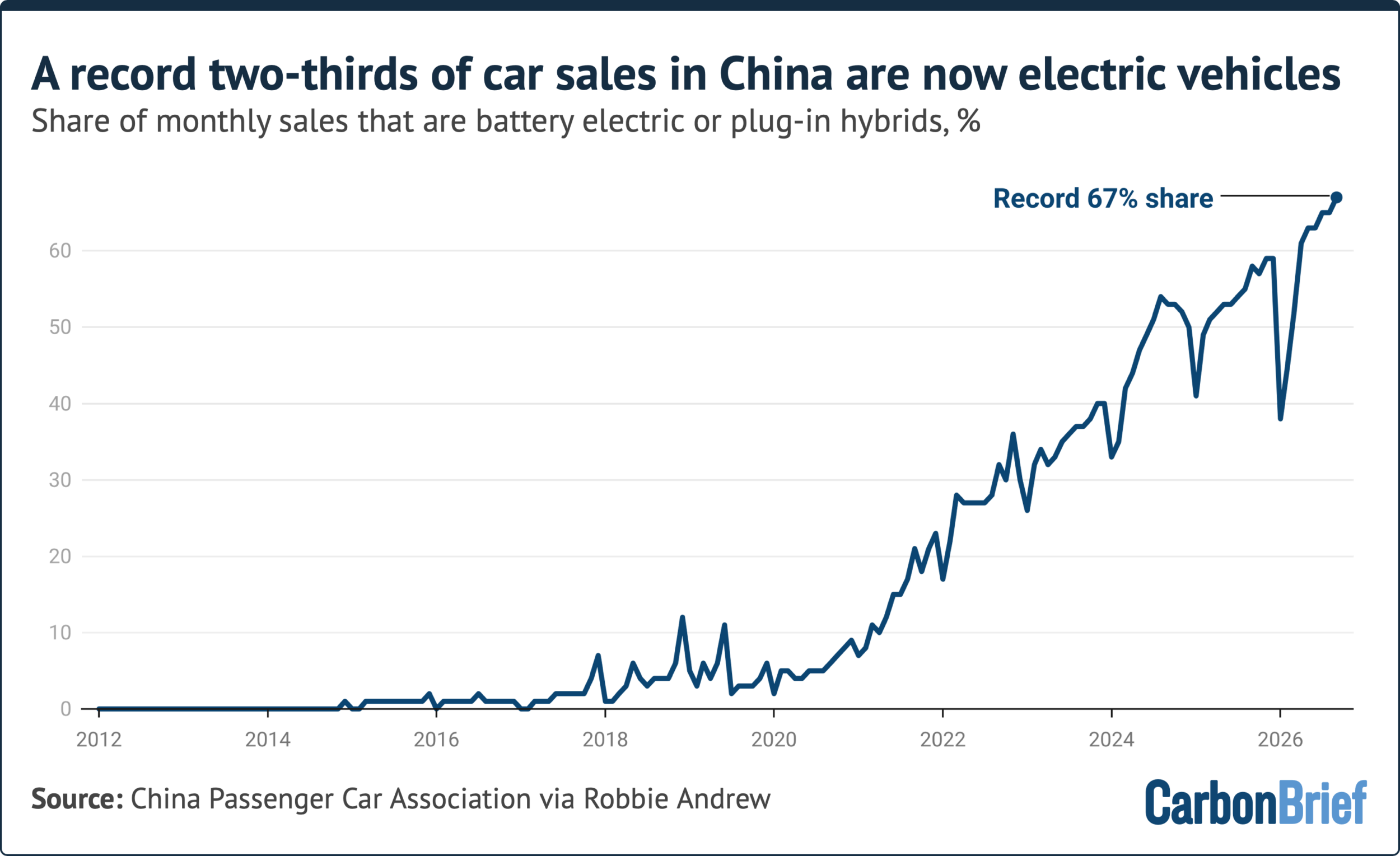
This marks a rapid rise for NEVs from just 6% of new car sales in 2020 up to 58% in 2026 to date – and a record 67% in the month of September.
This year, NEVs’ share of sales has also bounced back from a low of 39% in January, after the full purchase tax exemption that had been in place for more than a decade came to an end in December 2025.
The gain in NEV share in 2026 has come amid a slowdown across the wider domestic passenger-car market, which has hit sales of combustion-engine vehicles particularly hard.
This September, passenger-car retail sales across all categories declined, with overall sales volumes falling 28% year-on-year.
The contraction was led by combustion-engine vehicles, which saw sales fall 43% year-on-year in September and 31% in 2026 to date.
However, sales of PHEVs also fell by 36% year-on-year in September and by 26% in 2026 to date. By comparison, BEVs performed better, although sales still declined 8.5% from a year earlier in September and 4% in 2026 to date.