

Welcome to Carbon Brief’s DeBriefed.
An essential guide to the week’s key developments relating to climate change.
This week
Oil prices rebound
OIL UP AGAIN: Oil prices surged by more than 7% and back above $100 a barrel on Monday after US-Iran peace talks faltered and US president Donald Trump ordered the blockading of Iranian ports, reported BBC News. The jump came after prices fell last week in the wake of the announcement of a conditional two-week ceasefire, it said.
RESCUE PLANS: European countries unveiled plans to protect citizens and businesses from rising energy prices. Ireland announced a support package worth €505m, reported BBC News, while Germany agreed on measures worth €1.6bn, said Bloomberg. Meanwhile, Reuters reported on a draft EU proposal due to be unveiled next week that would see the bloc reduce electricity prices and roll out clean energy more quickly in response to the crisis.
UNSOLICITED ADVICE: Trump renewed his criticism of UK energy policy and called on the government to “drill, baby drill”, reported the Independent. Via social media, the president said: “Europe is desperate for energy, and yet the United Kingdom refuses to open North Sea oil, one of the greatest fields in the world. Tragic!!!” (See Carbon Brief’s recent factcheck of various false claims about the North Sea.)
Around the world
- C-WORD: Faced with pressure from the US, countries attending spring meetings of the International Monetary Fund and World Bank were urged to “not mention the climate”, reported the Guardian. It added that plans to agree a new “climate change action plan” for the World Bank “may be shelved, along with substantive discussion of the climate crisis”.
- NEW DIRECTION: Péter Magyar’s landslide victory over Victor Orbán in Hungary’s elections “presents new opportunities for the country to reduce emissions and invest in clean energy”, reported Time. Carbon Brief explored what it means for European climate action.
- ‘FURNACE’ SUMMER: There was widespread coverage – including in the Boston Globe, ABC News, CNN, Euro Weekly News, Guardian and New Scientist – of warnings from meteorologists of the development of a “super” El Niño phenomenon that could ramp up temperatures and drive extreme weather.
- ANTALYA COP: The Turkish government unveiled the dates and venues for the “leaders’ summit” segment of November’s COP31 conference, according to Climate Home News.
- PACIFIC PRE-COP: Meanwhile, the Guardian reported that Tuvalu will host a special meeting of world leaders before the climate summit in Antalya.
€10bn a year
The amount of state support that French prime minister Sébastien Lecornu has pledged for electrification through to 2030 in a bid to reduce the country’s dependence on fossil fuels. In a speech late on Friday 10 April, Lecornu noted the figure amounted to a “doubling” of existing support.
Latest climate research
- Over a four-month period of 2023, more than 70% of editorials discussing net-zero in four right-leaning UK newspapers included “at least one misleading statement” | Climate Policy
- Air pollution from global transport currently has a net cooling effect that offsets 80% of the warming impact of the sector’s CO2 emissions | npj Climate and Atmospheric Science
- The incorporation of “observational constraints” into climate-model projections suggests that the Atlantic Meridional Overturning Circulation could weaken by 50% by 2100 in a medium-emissions scenario | Science Advances
(For more, see Carbon Brief’s in-depth daily summaries of the top climate news stories on Monday, Tuesday, Wednesday, Thursday and Friday.)
Captured
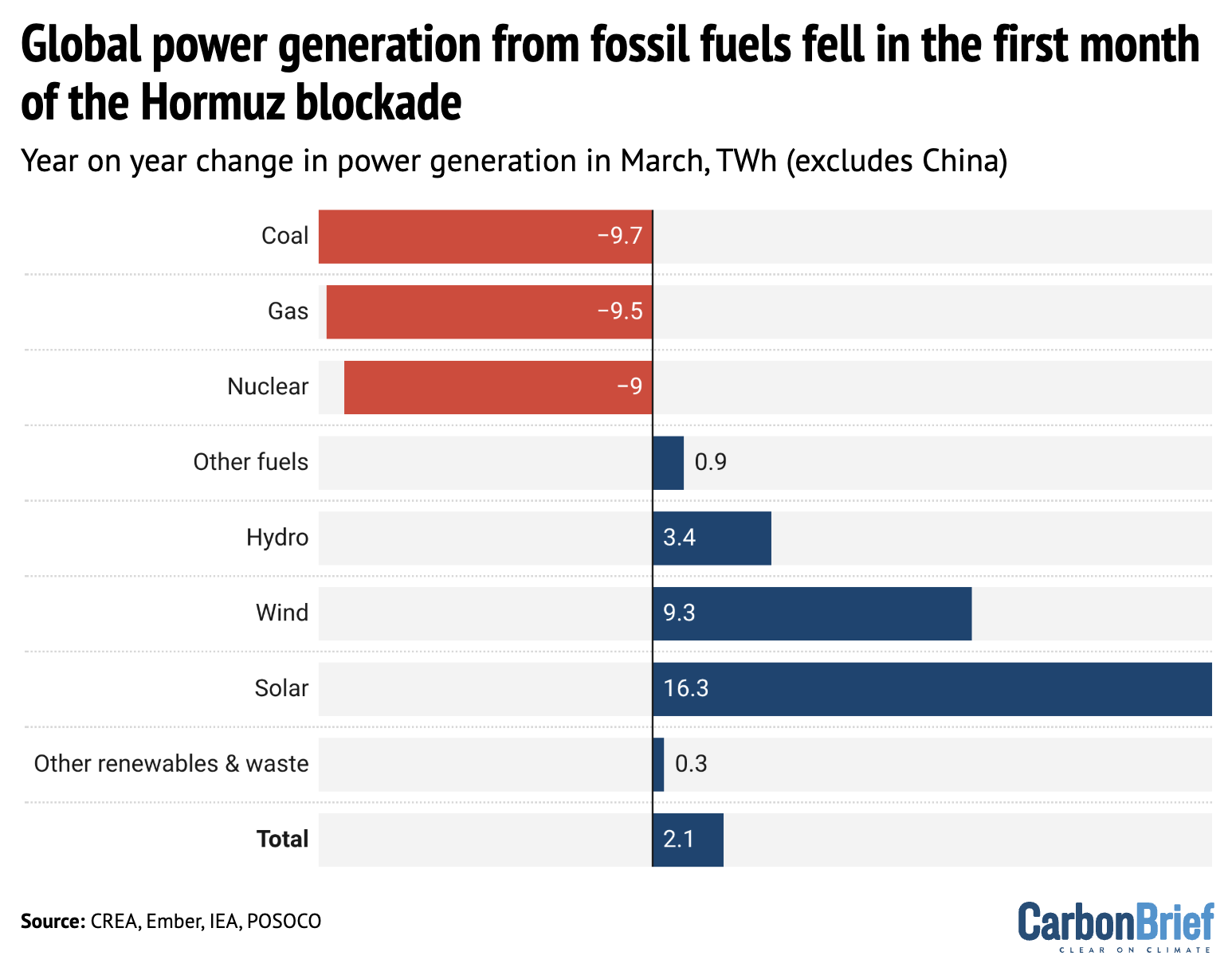
Analysis by the Centre for Research on Energy and Clean Air (CREA) found that global electricity generation from fossil fuels fell in the first month of the closure of the Strait of Hormuz. Across all countries with real-time electricity data outside of China, coal-fired power generation fell 3.5% and gas-fired power generation fell 4.0%, according to CREA. This was offset by a rise in solar power and wind generation, which increased by 14% and 8%, respectively. Hydropower generation also saw a small increase, the analysis showed, but this was “more than offset” by a drop in nuclear power generation.
Spotlight
How climate change affects Afghan lives
This week, Carbon Brief reports on the impact of climate change in Afghanistan, following deadly floods this year.
Earlier this month, heavy rains, flash floods and landslides struck large parts of Afghanistan, damaging thousands of homes, destroying crops, bridges and roads and taking nearly 100 lives.
The flooding – reported to have affected 74,000 people in 31 of 34 provinces – is the latest weather-related catastrophe to afflict the nation, whose communities have suffered the brunt of repeated flash floods, droughts and landslides in recent years.
Hameed Hakimi, non-resident senior fellow at the Atlantic Council’s South Asia Center, told Carbon Brief the recent floods would hurt livelihoods and food security, noting reports of destroyed wheat and rice crops in the most affected eastern parts of the country. He said:
“This is common. For at least a decade now, [we have seen] these flash floodings and the damage that happens to rural life, farming, the disruption to crops…Flash flooding physically eats up the land. So, it not only damages where people live, but also people’s livelihoods, based on what they grow.”
The damage to crops will be felt acutely, he explained, given that food security in the landlocked nation is already strained by the blockage of its main transit trade artery through Pakistan and international sanctions that have frozen long-term development aid.
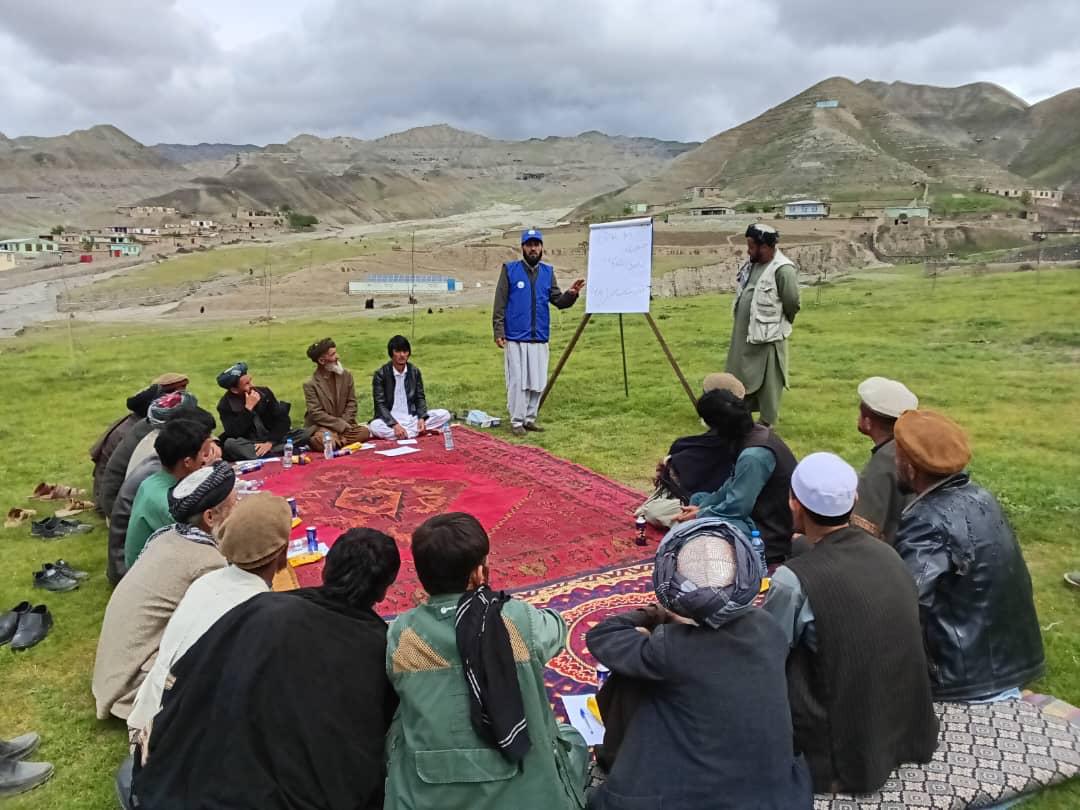
Speaking to Carbon Brief, Abdulhadi Achakzai, founding CEO of the Environmental Protection Trainings and Development Organization (EPTDO), an Afghan NGO, described flooding in Afghanistan as a “chronic situation”.
Achakzai, whose organisation runs projects that help urban and rural communities adapt to climate impacts, says climate change hurts the country in four key ways: extreme drought; extreme temperature; “natural hazards”, including landslides and dust storms; and, finally, flash flooding. He said:
“Climate change is a serious matter in Afghanistan. Every nation and every corner within this country is severely affected.”
Ranked 176 of 187 on the University of Notre Dame “global adaptation index”, Afghanistan is among the countries most vulnerable to climate change.
Average temperature across the country has increased from 12.2C in 1960 to 14.2C in 2024, according to the World Bank’s climate change knowledge portal. Drought is widespread, severe and persistent – harming food and water security in a nation of subsistence farmers.
Meanwhile, extreme weather events are the leading driver of internal displacement in the country. More than three-quarters of the 710,000 people who relocated within Afghanistan in 2024 did so driven by “environmental hazards”, such as drought and flood, according to a recent climate vulnerability assessment from the International Organization for Migration.
Finance struggles
Despite feeling the impacts of extreme weather, Afghanistan has been barred from UN climate negotiations and had limited access to climate finance since 2021. (The government attended COP29 in Baku as guests of the Azerbaijan hosts, but did not take part in formal negotiations.)
This is because the international community does not recognise the Taliban government, which resumed power in 2021, due to its record on human rights and its repression of women and girls in particular.
Almost all financing from key climate funds has been suspended, with the exception of a few projects where UN agencies and NGOs act simultaneously as a “requesting” and “implementation” partner.
Aid from UN climate funds fell from $5.9m annually over 2014-20 to $3.9m annually over 2021-24, according to recent analysis by the Berghof Foundation. Multilateral development banks provided a further $337m of funds badged as “climate finance” over 2021-23, it said.
By comparison, Afghanistan’s national climate plan, submitted to the UN Framework Convention on Climate Change (UNFCCC) in 2016, requested $17.4bn in climate finance over 2020-30. An updated national climate plan seen by Carbon Brief – completed in 2021 and later endorsed by the Taliban government, but not accepted by member governments of the UNFCCC – called for $20.6bn through to 2030.
Achakzai, whose organisation attends the COP climate summit each year in an observer capacity, has in the past been the sole delegate from Afghanistan to the conference.
He is calling on the UNFCCC to accept the country’s latest climate plan – and to find an “alternative solution” that would give the people of the country a voice in negotiations. He said:
“Every year we are losing hundreds, thousands of people because of climate change-related matters. Every year we are losing hundreds, thousands of hectares of crops. We are affected by [the decisions of] other countries. Why are we not part of this process?”
Watch, read, listen
BLOSSOM WATCHER: The Guardian reported on the successful search to find a researcher to continue Japan’s 1,200-year cherry blossom record.
COP OUT: Deutsche Welle spoke to experts to understand why India walked away from its bid to host COP33 in 2028.
‘BOMBS AND PORN’: The New Republic looked at who is set to benefit from the rapid build-out of energy-intensive AI datacentres.
Coming up
- 20-24 April: Intergovernmental Panel on Climate Change (IPCC) working group one report author meeting, Santiago, Chile
- 22 April: Earth day
- 22 April: Launch of third edition of the Lancet Countdown’s Europe report
- 24-29 April: First conference on transitioning away from fossil fuels, Santa Marta, Colombia
Pick of the jobs
- International Organization for Migration, senior thematic associate (climate action) | Salary: UN G-6 salary grade | Location: Dakar, Senegal
- Climate Action Network UK, several board member roles | Salary: Unknown. Location: Unknown
- UK Department for Energy, Food and Rural Affairs, G7 science lead | Salary: £56,375. Location: Bristol, London, Newcastle-upon-Tyne or York, UK
- Save the Children UK, senior climate change advisor | Salary: £62,000-£65,000. Location: London
DeBriefed is edited by Daisy Dunne. Please send any tips or feedback to debriefed@carbonbrief.org.
This is an online version of Carbon Brief’s weekly DeBriefed email newsletter. Subscribe for free here.


The post DeBriefed 17 April 2026: Fossil-fuel power slumps | ‘Super’ El Niño warning | Afghanistan’s climate struggle appeared first on Carbon Brief.

Scientists have vowed to keep working on the next flagship set of reports for the Intergovernmental Panel on Climate Change (IPCC), after a political row over the timeline for their release saw its latest session suspended on Friday evening without agreement.
During the weekend, government officials and scientists alike expressed disappointment over the inability to reach a compromise before some delegates from developing countries and small island states had to leave the week-long meeting in Ethiopia to catch flights home.
The disagreement – which has persisted since early 2024 – turns on whether the three key parts of the AR7 assessment should all be published before the conclusion of the UN’s next Global Stocktake of global climate action, which is due to be completed in late 2028.
The IPCC issued a statement after the close of the session, saying that “key agenda items” – the timelines for the three AR7 reports, as well as the IPCC budget – remain open and under discussion. It said the IPCC’s plenary session and its deliberations on the pending agenda “will resume at the earliest opportunity”, giving no further details of when.
IPCC Chair Jim Skea told delegates in closing remarks that recent months had been some of the most turbulent for the climate science panel and that, if there were stronger words than “profound disappointment” he would use them, according to a summary published by the Earth Negotiators Bulletin (ENB). IPCC discussions happen behind closed doors.
IPCC scientists remained committed
In an open letter, issued on Monday, a group of nearly 120 scientists – from a total of 664 AR7 authors – said they “stand committed to continue working to deliver the AR7 reports in a manner that is rigorous, timely and inclusive, in line with our mandate to be policy-relevant”.
“An assessment that arrives after the decisions it is meant to inform cannot serve its purpose,” they emphasised. “The second Global Stocktake in 2028 is such a decision point, and the world should not have to face it without the IPCCʼs latest assessment.”
Europe, small islands and the least developed countries, plus many Latin American and developed nations, want the IPCC to meet this deadline, arguing that the findings from the UN climate science body are irreplaceable in the UN climate policy-making process.
However, around a dozen developing countries plus Russia have argued that the reports should come later in order to allow for greater research input from the Global South – something that, in their view, would make the findings fairer. They also claim that a shorter timeline would put excessive pressure on experts.
-
Who shapes climate science? The equity question facing the IPCC
Early completion of the next global climate science assessment reports risks excluding research from the Global South, which is key to ensuring the findings are fair -
Governments that support climate science must stand firm against naysayers
The IPCC is meeting to decide the timing of its next major report, as some countries try to delay it and weaken the case for faster emissions cuts


The most vocal of this group at last week’s meeting were India and Saudi Arabia, according to the ENB summary and a developed country diplomat. Critics see this push for a longer timeline as an excuse to deprive government decision-makers of the latest science and ease pressure on emerging economies to raise their ambition, particularly on cutting emissions.
Commenting on last week’s meeting, France’s ambassador for climate negotiations Benoît Faraco said a broad coalition of developed and developing countries from all five continents, “united in their support for science and the timeline proposed by scientists”, had withstood pressure “from a few countries” seeking to slow down the process of adopting the IPCC reports.
He added that France would not back down and would “continue to fight tirelessly for science, protect the integrity of information, and convince our partners that without the best available scientific data, we will be less effective in tackling climate change and protecting our populations”.
Inclusivity proposal stalled
In a bid to unlock a solution for the AR7 timeline, countries discussed ways to improve the inclusivity of the IPCC’s work. One option put on the table was for the IPCC to expand its funding for delegates from developing countries to attend some or all of its sessions from one to two participants, according to the ENB summary and a delegate speaking to Climate Home News.
That would increase the costs for the IPCC to complete AR7 by up to a quarter, according to an assessment shared by the secretariat. The panel’s budget is under severe strain and its officials have warned that, without additional voluntary contributions, it risks running out of money before it can deliver on this assessment cycle.
Climate Home News understands that some of the IPCC’s traditional donors – which mainly include European countries, Japan and Australia – indicated a willingness to support funding for an additional developing country participant. But without an agreement over the budget or the timeline for the reports, that option was ultimately not adopted.
‘Disappointed and worried’
The three reports are managed by working groups that collate and draw overall findings from the latest scientific studies and data on the physical effects of global warming around the world, how to adapt to it, and pathways for cutting planet-heating emissions in order to meet the temperature goals of the Paris Agreement.
Winston Chow, an urban climate professor at Singapore Management University who co-chairs Working Group II on adaptation, wrote in a LinkedIn post that he was “disappointed and worried” for the IPCC authors who have worked “extraordinarily hard” to assess the relevant climate science over the past two years.
He said he shared their concern that “the rigour, time and goodwill they’ve invested are now being put at risk by the Panel’s stalemate”.
As science comes under attack at UN talks, climate movement splits over how to respond
For Working Group II, a meeting for 250 experts writing that report is scheduled for January 2027, followed by the approval of a special report on cities and climate change in Singapore next March.
But because the IPCC’s budget has not been confirmed due to uncertainty about the AR7 schedule, travel support for those researchers is at risk, wrote Chow. “If they cannot participate, our assessments will lose vital expertise, perspectives and scientific breadth, and the collective effort of our authors will be undermined,” he warned.
Scientific work continues
Despite the political holdups, he – together with French climate scientist Robert Vautard, co-chair of Working Group 1 – agreed with IPCC head Skea who told the IPCC’s closing session on Friday: “The engine room of the IPCC is working, and it’s healthy.”
Vautard commented in a separate post on LinkedIn after it ended: “The boat is at full steam.” Working groups I and II are due to start revising the first drafts of their reports, while Working Group III on reducing emissions is finalising its first draft which will be out soon, he wrote.
“The most exciting two years of the cycle are ahead, for the authors. The momentum in the engine room is here and now. Trust the engine room!” he added.
The IPCC and some scientists report that progress has been made towards achieving an equitable balance of authors from the Global North and the Global South.
The group of researchers who signed the open letter on Monday noted that “inclusivity is at the heart of how we work”, with author teams bringing together experts from developed and developing countries with diverse backgrounds and at different stages of their careers.
Plea to overcome political differences
The signatories include several scientists from some of the countries opposed to the alignment of all IPCC reports with the Global Stocktake.
“We are committed to an assessment in which the knowledge, experience and priorities of every region are fully reflected, a commitment we share with the leadership of the IPCC.
Equity is built into how our assessment is being drafted,” they added.
They appealed to governments that make up the IPCC “to overcome their political differences and work together as we do as a global scientific community, so that we can deliver the IPCC reports the world needs to hear”.
In a statement published on Monday, IPCC chair Skea said reaching consensus on the schedule for the reports is “vital”. He added that the assessments provide authoritative scientific evidence to inform national climate policies, strengthen adaptation and resilience and support access to climate finance, as well as helping communicate the scale of the climate crisis and the urgency of efforts to tackle it.
The post IPCC scientists vow to press on with climate reports despite political deadlock appeared first on Climate Home News.
IPCC scientists vow to press on with climate reports despite political deadlock
An Lambrechts is a biodiversity politics expert at Greenpeace International with extensive experience in biodiversity-related multilateral negotiations. She is the head of the Greenpeace delegation at the Convention on Biological Diversity (CBD) COP17 happening in Yerevan, Armenia.
In 2022, COP15 delivered the landmark Kunming-Montreal Global Biodiversity Framework to halt and reverse biodiversity loss by 2030. With COP17 starting in Yerevan, we are now halfway to t