

The European Commission has put forward a plan to boost production of EU-made, low-carbon steel, cement and renewables in an effort to rely less on other countries.
The proposed “Industrial Accelerator Act” (IAA) aims to boost “resilient and decarbonised” industrial production in EU manufacturing, says the commission.
Under the proposal, a percentage of products bought from “energy-intensive industries” and other sectors under public-procurement deals would be required to be “low-carbon” and made in the EU.
This includes targets for steel, aluminium and electric vehicle (EV) parts.
Non-EU countries with trade agreements, such as the UK and Japan, could also be included in the “Made in Europe” portion of the plan.
The proposal – which must be approved by the European Parliament and EU member states – could save millions of tonnes of carbon dioxide (CO2) by 2030, claims the commission.
Much of the media coverage on the proposed policy focuses on its aim to tackle reliance on China for low-carbon technologies, while Politico calls it a “climate law in disguise”.
In this Q&A, Carbon Brief outlines the key details of the proposal, what must happen for it to take effect and what it could mean for climate change.
Where does the ‘Industrial Accelerator Act’ proposal come from?
The publication of the proposed IAA follows weeks of delays as the EU attempts to boost its manufacturing industries – which have been struggling with international competition and high energy costs – while also supporting decarbonisation.
Industries such as steel, cement and chemicals produce roughly a fifth of the EU’s emissions, so decarbonising them will be essential for achieving the bloc’s net-zero goals.
The IAA is an effort to help energy-intensive industries cut their emissions while remaining globally competitive, in part by “creating lead markets for low-carbon products”.
It was first announced in the European Commission’s 2024 political guidelines, laying out its priorities for the five years out to 2029.
In the section concerning the EU’s plans for a “clean industrial deal” – referring to broader plans to support industries and accelerate their decarbonisation – the guidelines stated:
“We will put forward an industrial decarbonisation accelerator act to support industries and companies through the transition.”
When the clean industrial deal was subsequently released in February 2025, it said the promised act would introduce “clean, resilient, circular, cybersecure” criteria that would “strengthen demand for EU-made clean products”.
The act was also intended to “speed-up permitting for industrial access to energy and industrial decarbonisation” and “develop a voluntary label on the carbon intensity of industrial products”.
Underpinning these plans was the idea of increasing demand for low-carbon products in public and private procurements – in particular, those that were “Made in Europe”.
The proportion of products that will be included under the “Made in Europe” definition remains unclear. In the final proposal, the commission notes it will “tailor requirements to the specific structure, maturity and dependencies of each sector”.
The word “decarbonisation” was dropped from the act’s title by commission president Ursula von der Leyen in her state of the EU address in September 2025, in order “to allow for a broader sectoral and technological scope”.
This reflects wider disputes within the commission itself around the coverage of the IAA. There has also been strong opposition to the proposed “made in Europe” section of the act from different groups of member states.
The debate has also taken place against the background of calls to weaken key parts of EU climate policy – in particular, the EU emissions trading system (ETS).
Environmental groups have voiced concerns about the climate focus of the IAA being sidelined, at the expense of boosting the bloc’s competitiveness.
A major issue in the discussions has been whether the “made in Europe” label should include “trusted partners” from outside the EU, such as the UK and Switzerland.
The commission’s trade directorate has reportedly pushed for a more open system that includes more countries. Germany has been among the member states warning that restrictive rules could deter foreign investment and raise prices.
Meanwhile, Politico reported that the commission’s growth directorate, supported by France, wanted “made in Europe” to be restricted to countries in the European Economic Area – the 27 EU member states alongside Iceland, Liechtenstein and Norway.
The publication of the IAA proposal – which follows on from the automotive package adopted by the EU in December 2025 – was delayed numerous times amid the disagreements.
According to Politico, “haggling” continued over the Monday and Tuesday before the proposal was released, before it could be agreed internally within the commission by the “college of commissioners”.
What is in the IAA proposal?
Following these tense internal negotiations, the European Commission released its IAA proposal on 4 March 2026. It says the proposal will “increase demand for low-carbon, European-made technologies and products”.
The act sets a goal of increasing manufacturing’s share of EU GDP to 20% by 2035, up from 14.3% in 2024.
It introduces “targeted and proportionate” low-carbon and “made in EU” requirements for public procurement and public support schemes for specific sectors.
These will initially apply to steel, cement, aluminium, cars and net-zero technologies – defined within the proposal as batteries, battery energy storage systems (BESS), solar PV, heat pumps, wind turbines, electrolysers and nuclear technologies. It also establishes a framework that could be extended to other energy-intensive sectors in the future.
The commission notes that these sectors have been chosen due to their strategic importance, as well as being “essential enablers of the clean transition and vital to downstream industries”.
However, it says they are facing declining production in Europe, slower decarbonisation investments and global competition and market distortions, such as unfair subsidies.
For steel, the proposal would introduce a requirement for public procurement and public support schemes to use low-carbon steel within the automotive and construction industries.
This will help “create market demand” and “give investors confidence and predictability, boosting innovation and making clean steel a core part of the EU’s industrial future”, says the commission.
However, this falls short of the 70% low-carbon steel requirement that had been included in an earlier draft of the act, according to Reuters. Other earlier drafts of the IAA proposal had also included an emissions label for steel.
This voluntary carbon-intensity label had previously been set out within the clean industrial deal and had originally been expected to come into effect in 2025, before being pushed back and, ultimately, excluded from the IAA.
Beyond steel, the IAA sets minimum “Made in EU” requirements for public procurement of 70% for EVs, 25% for aluminium and 25% for cement.
The European Commission will now offer the UK, Japan and other like-minded countries the opportunity to be included under the “Made in Europe” manufacturing targets, if they offer reciprocal access to EU-based manufacturers, according to the Financial Times. The outlet adds that this is being welcomed by the UK government, which had lobbied for such access for months.
The measures within the IAA are in line with the recommendations of the Draghi report on EU competitiveness, says the commission. As such, it says they are designed to “increase value creation in the EU, strengthening our industrial base against the backdrop of growing unfair global competition and increasing dependencies on non-EU suppliers in strategic sectors”.
Alongside the introduction of requirements on public procurement within the bloc, the IAA proposal highlights that the EU is “committed to maintaining that openness as a key source of economic strength and resilience”.
The EU hosted almost a quarter of global foreign direct investment in 2024.
To further support such investment and ensure the benefits extend to technology transfer and job creation, the IAA introduces additional conditions for international investments.
These would apply for investments of more than €100m in emerging sectors such as batteries, EVs, solar PV and critical raw materials by companies that hold more than 40% of global production capacities.
Conditions would include EU companies holding a majority share, technology transfer, integration into EU value chains and job creation, according to the European Commission. There would also need to be a guarantee that a minimum of 50% of employees are European.
The introduction of common conditions across the bloc would mean the IAA “strike[s] a carefully calibrated balance by ensuring that strategic foreign investments contribute to Europe’s competitiveness, resilience and industrial transformation, while preventing fragmentation”, according to the commission.
Additionally, EU member states would be required to set up a single digital permitting process to “speed up and simplify manufacturing projects” under the IAA.
This would include dedicated single points of contact and maximum timelines of 18 months for certain projects, such as energy-intensive industry decarbonisation projects or those located in “industrial acceleration areas”.
Member states would designate these areas to encourage strategic manufacturing clusters, it says. The commission adds that projects within these areas would benefit from improved coordination and access to infrastructure, finance and skills ecosystems, as well as faster permitting.
What comes next?
The commission’s proposal will now be negotiated by members of the European Parliament and then by country ministers at the Council of the EU.
After these negotiations take place, the proposal can be adopted and the act can take effect.
But this may not be a simple process, as many countries remain divided on the key terms of the proposed law. (See: Where does the ‘Industrial Accelerator Act’ proposal come from?)
Nine EU countries pushed back on the proposal last December, reported Politico. The UK has been “lobbying” countries including Germany, Italy and the Netherlands to oppose it, according to Bloomberg. Reuters noted that the plan is backed by France.
EU commissioner for internal market and services, Stéphane Séjourné, told a press conference on 4 March that the “faster” the proposal moves through the EU lawmaking stages, the “more stability we will actually have”.
After the law takes effect, the commission says it will evaluate the key results three years later. A full review is then proposed after five years.
What could the act mean for carbon emissions?
The IAA could save around 30.6m tonnes of CO2 (MtCO2) in 2030, according to the European Commission.
According to the impact assessment published alongside the proposed act, the changes brought in for the steel, cement, aluminium, battery and vehicle sectors would drive significant CO2 reductions by 2030.
The document breaks down these emissions savings for 2030 as follows:
- Producing more batteries in the EU, rather than relying on imports from China, could save 25.6MtCO2.
- The 25% low-carbon steel target in the automotive and construction sectors could save around 3.4MtCO2.
- Vehicle manufacturing emissions could drop by 0.7MtCO2 due to “shifts in production”.
- The 5% low-carbon cement target could save 0.69MtCO2.
- The 25% low-carbon aluminium target could save 0.22MtCO2.
According to the impact assessment, the emissions required to produce a battery in the EU are around 25% lower than a “Chinese manufactured battery using the average Chinese grid”. This is due to “strict” EU environmental standards, it adds.
The report estimates that all of these savings in CO2 would be worth more than €3bn in avoided climate damages.
Streamlining the process for permitting to “accelerate” decarbonisation projects should also “lea[d] to an accelerated pace of GHG [greenhouse gas] savings”, the document says, but does not list a figure for this.
The impact assessment for the IAA proposal notes that there is currently a “structural imbalance” in the EU’s industrial transition.
It states that although emissions associated with industrial production are declining, this is “largely driven by shrinking production”, rather than improved carbon efficiency.
Carbon emissions and production volumes in the EU iron and steel sectors have dropped “almost in parallel” between 2005 and 2023, says the report.
It adds that projections show that these emissions will need to decline “much faster” to meet future EU climate targets.
The “competitiveness and decarbonisation” of EU manufacturing is “unlikely to improve” without further action, such as the IAA, says the report.
In other words, the IAA effectively aims to ensure that emissions cuts can accelerate while maintaining – or even increasing – industrial production within the EU.
What has the reaction to the IAA been?
While many welcomed the IAA proposal as a “first step”, others criticised the final proposal for walking back on the ambition in earlier drafts.
In a statement released alongside the proposal, Stéphane Séjourné, executive vice-president for prosperity and industrial strategy at the European Commission, said the IAA marked a “major step in the renewal of the European economic doctrine”. He added:
“Facing unprecedented global uncertainty and unfair competition, European industry can count on the provisions of this Act to boost demand and guarantee resilient supply chains in strategic sectors. It will create jobs by directing taxpayers’ money to European production, decreasing our dependencies and enhancing our economic security and sovereignty.”
Others shared his sentiment that in the face of a changing international trade environment, the IAA would boost European competitiveness. Neil Makaroff, director at the European thinktank Strategic Perspectives, said in a statement:
“With its first ‘made in Europe’ policy, the EU is embracing long-overdue economic realism and adapting itself to the new brutal global trade reality. Rather than letting the single market be an open outlet for Chinese overcapacities, each euro of taxpayer money can be directed to rebuild Europe’s manufacturing base. This is how Europeans can start learning the language of industrial powers.”
Tinne van der Straeten, the CEO of WindEurope, said the IAA sent an “important political signal”, but “a simple and harmonised implementation of the new rules is crucial”.
WWF highlighted that public procurement is only a small part of the EU economy and called for complementary measures that also target private consumption.
Camille Maury, senior policy officer on industrial decarbonisation at WWF EU, said:
“The commission has finally pressed the accelerator on clean industry by opening the door to create demand for clean products. However, to win the race to decarbonise, the commission and policy makers will need to put effort into strengthening low-carbon requirement criteria and designing truly green labels for steel and cement that exclude fossil fuel-based production.”
In particular, the lack of a low-carbon label for steel within the IAA drew criticism, with, for example, Daniel Pietikainen, policy manager for steel at climate NGO Bellona Europa, saying:
“The Act no longer provides the basis for a low-carbon steel label. While we can work with the Ecodesign Regulation as the vehicle for a steel label, the commission must commit to an ambitious timeline now. Any operational labelling scheme that is contingent on a delegated act with no clear timeline is not a signal; it is a delay.”
Similarly, the exceptions for international investment in emerging sectors, such as batteries and solar, were labelled as a “very disappointing…watering-down” by Christoph Podewils, secretary general of the European Solar Manufacturing Council. In a statement, he added:
“We need ‘Made in Europe’ to ensure the continent’s long-term energy security. The current explosion in energy prices, caused by the war in Iran, demonstrates the importance of being independent of other regions.
“If the European solar industry has to wait another three years after the legislation is adopted, many companies will have disappeared in the meantime due to ongoing unfair competition from China.”

The post Q&A: What the EU’s new industry and ‘Made in Europe’ rules mean for climate action appeared first on Carbon Brief.
Q&A: What the EU’s new industry and ‘Made in Europe’ rules mean for climate action

Drought and heatwaves occurring together – known as “compound” events – have “surged” across the world since the early 2000s, a new study shows.
Compound drought and heat events (CDHEs) can have devastating effects, creating the ideal conditions for intense wildfires, such as Australia’s “Black Summer” of 2019-20 where bushfires burned 24m hectares and killed 33 people.
The research, published in Science Advances, finds that the increase in CDHEs is predominantly being driven by events that start with a heatwave.
The global area affected by such “heatwave-led” compound events has more than doubled between 1980-2001 and 2002-23, the study says.
The rapid increase in these events over the last 23 years cannot be explained solely by global warming, the authors note.
Since the late 1990s, feedbacks between the land and the atmosphere have become stronger, making heatwaves more likely to trigger drought conditions, they explain.
One of the study authors tells Carbon Brief that societies must pay greater attention to compound events, which can “cause severe impacts on ecosystems, agriculture and society”.
Compound events
CDHEs are extreme weather events where drought and heatwave conditions occur simultaneously – or shortly after each other – in the same region.
These events are often triggered by large-scale weather patterns, such as “blocking” highs, which can produce “prolonged” hot and dry conditions, according to the study.
Prof Sang-Wook Yeh is one of the study authors and a professor at the Ewha Womans University in South Korea. He tells Carbon Brief:
“When heatwaves and droughts occur together, the two hazards reinforce each other through land-atmosphere interactions. This amplifies surface heating and soil moisture deficits, making compound events more intense and damaging than single hazards.”
CDHEs can begin with either a heatwave or a drought.
The sequence of these extremes is important, the study says, as they have different drivers and impacts.
For example, in a CDHE where the heatwave was the precursor, increased direct sunshine causes more moisture loss from soils and plants, leading to a drought.
Conversely, in an event where the drought was the precursor, the lack of soil moisture means that less of the sun’s energy goes into evaporation and more goes into warming the Earth’s surface. This produces favourable conditions for heatwaves.
The study shows that the majority of CDHEs globally start out as a drought.
In recent years, there has been increasing focus on these events due to the devastating impact they have on agriculture, ecosystems and public health.
In Russia in the summer of 2010, a compound drought-heatwave event – and the associated wildfires – caused the death of nearly 55,000 people, the study notes.

The record-breaking Pacific north-west “heat dome” in 2021 triggered extreme drought conditions that caused “significant declines” in wheat yields, as well as in barley, canola and fruit production in British Columbia and Alberta, Canada, says the study.
Increasing events
To assess how CDHEs are changing, the researchers use daily reanalysis data to identify droughts and heatwaves events. (Reanalysis data combines past observations with climate models to create a historical climate record.) Then, using an algorithm, they analyse how these events overlap in both time and space.
The study covers the period from 1980 to 2023 and the world’s land surface, excluding polar regions where CDHEs are rare.
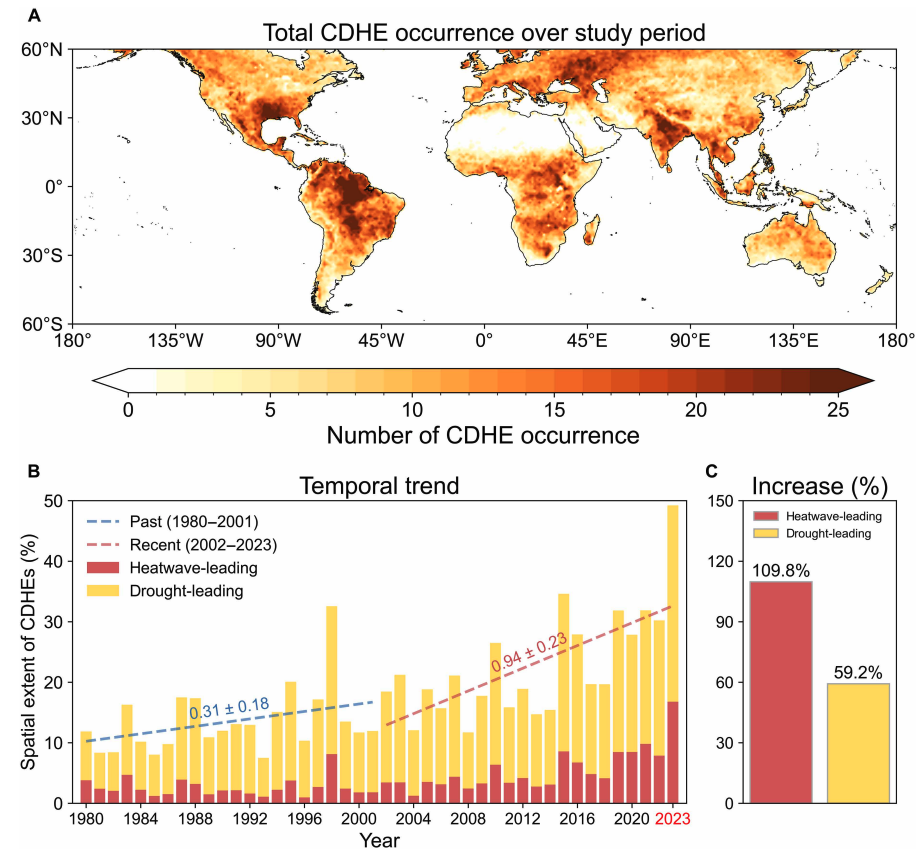
The research finds that the area of land affected by CDHEs has “increased substantially” since the early 2000s.
Heatwave-led events have been the main contributor to this increase, the study says, with their spatial extent rising 110% between 1980-2001 and 2002-23, compared to a 59% increase for drought-led events.
The map below shows the global distribution of CDHEs over 1980-2023. The charts show the percentage of the land surface affected by a heatwave-led CDHE (red) or a drought-led CDHE (yellow) in a given year (left) and relative increase in each CDHE type (right).
The study finds that CDHEs have occurred most frequently in northern South America, the southern US, eastern Europe, central Africa and south Asia.
Threshold passed
The authors explain that the increase in heatwave-led CDHEs is related to rising global temperatures, but that this does not tell the whole story.
In the earlier 22-year period of 1980-2001, the study finds that the spatial extent of heatwave-led CDHEs rises by 1.6% per 1C of global temperature rise. For the more-recent period of 2022-23, this increases “nearly eightfold” to 13.1%.
The change suggests that the rapid increase in the heatwave-led CDHEs occurred after the global average temperature “surpasse[d] a certain temperature threshold”, the paper says.
This threshold is an absolute global average temperature of 14.3C, the authors estimate (based on an 11-year average), which the world passed around the year 2000.
Investigating the recent surge in heatwave-leading CDHEs further, the researchers find a “regime shift” in land-atmosphere dynamics “toward a persistently intensified state after the late 1990s”.
In other words, the way that drier soils drive higher surface temperatures, and vice versa, is becoming stronger, resulting in more heatwave-led compound events.
Daily data
The research has some advantages over other previous studies, Yeh says. For instance, the new work uses daily estimations of CDHEs, compared to monthly data used in past research. This is “important for capturing the detailed occurrence” of these events, says Yeh.
He adds that another advantage of their study is that it distinguishes the sequence of droughts and heatwaves, which allows them to “better understand the differences” in the characteristics of CDHEs.
Dr Meryem Tanarhte is a climate scientist at the University Hassan II in Morocco, and Dr Ruth Cerezo Mota is a climatologist and a researcher at the National Autonomous University of Mexico. Both scientists, who were not involved in the study, agree that the daily estimations give a clearer picture of how CDHEs are changing.
Cerezo-Mota adds that another major contribution of the study is its global focus. She tells Carbon Brief that in some regions, such as Mexico and Africa, there is a lack of studies on CDHEs:
“Not because the events do not occur, but perhaps because [these regions] do not have all the data or the expertise to do so.”
However, she notes that the reanalysis data used by the study does have limitations with how it represents rainfall in some parts of the world.
Compound impacts
The study notes that if CDHEs continue to intensify – particularly events where heatwaves are the precursors – they could drive declining crop productivity, increased wildfire frequency and severe public health crises.
These impacts could be “much more rapid and severe as global warming continues”, Yeh tells Carbon Brief.
Tanarhte notes that these events can be forecasted up to 10 days ahead in many regions. Furthermore, she says, the strongest impacts can be prevented “through preparedness and adaptation”, including through “water management for agriculture, heatwave mitigation measures and wildfire mitigation”.
The study recommends reassessing current risk management strategies for these compound events. It also suggests incorporating the sequences of drought and heatwaves into compound event analysis frameworks “to enhance climate risk management”.
Cerezo-Mota says that it is clear that the world needs to be prepared for the increased occurrence of these events. She tells Carbon Brief:
“These [risk assessments and strategies] need to be carried out at the local level to understand the complexities of each region.”



The post Heatwaves driving recent ‘surge’ in compound drought and heat extremes appeared first on Carbon Brief.
Heatwaves driving recent ‘surge’ in compound drought and heat extremes
Greenhouse Gases
DeBriefed 6 March 2026: Iran energy crisis | China climate plan | Bristol’s ‘pioneering’ wind turbine
Welcome to Carbon Brief’s DeBriefed.
An essential guide to the week’s key developments relating to climate change.
This week
Energy crisis
ENERGY SPIKE: US-Israeli attacks on Iran and subsequent counterattacks across the Middle East have sent energy prices “soaring”, according to Reuters. The newswire reported that the region “accounts for just under a third of global oil production and almost a fifth of gas”. The Guardian noted that shipping traffic through the stra