Connect with us

Published

on

Since Donald Trump returned to the White House last year, his administration in the US has laid off thousands of scientists and frozen research grants worth billions of dollars.

The cutbacks have had far-reaching consequences for all areas of scientific research, extending all the way to Earth’s fragile polar regions, researchers say.

Speaking to Carbon Brief, polar researchers explain how Trump’s attacks on science have affected efforts to study climate change at Earth’s poles, including by disrupting fieldwork, preventing data collection and even forcing researchers to leave the US.

One climate scientist tells Carbon Brief that the administration’s decision to terminate the only US icebreaker used in Antarctica forced her to cancel her fieldwork at the last minute – with her scientific cargo still held up in Chile.

As US polar scientists reel from the cuts, Trump has caused a geopolitical storm with threats to take control of Greenland, the self-ruling island which is part of the Kingdom of Denmark and located between the Arctic and Atlantic oceans.

Below, Carbon Brief speaks to experts about what Trump’s sweeping changes could mean for climate science at Earth’s poles

Why is the US important for polar research?

The US’s wealth, power and geography have made it a key player in polar research for more than a century.

Ahead of Trump’s second term, the National Science Foundation (NSF), a federal agency that funds US science, was the largest single funder of polar research globally, with its Office of Polar Programs overseeing extensive research in both the Arctic and Antarctica.

The US has three permanent bases in Antarctica: McMurdo Station, Amundsen-Scott South Pole Station and Palmer Station.

In Alaska, which the US purchased from Russia in 1867, there is the Toollik Field Station and the Barrow Arctic Research Center. The US also has the Summit Station in Greenland.

US institutes operate several satellites that provide scientists across the world with key data on the polar regions.

This includes the National Oceanic and Atmospheric Administration’s (NOAA) Joint Polar Satellite System, which provides data used for extreme weather forecasting.

Over the past few years, US institutes have led and provided support for the world’s largest polar expeditions.
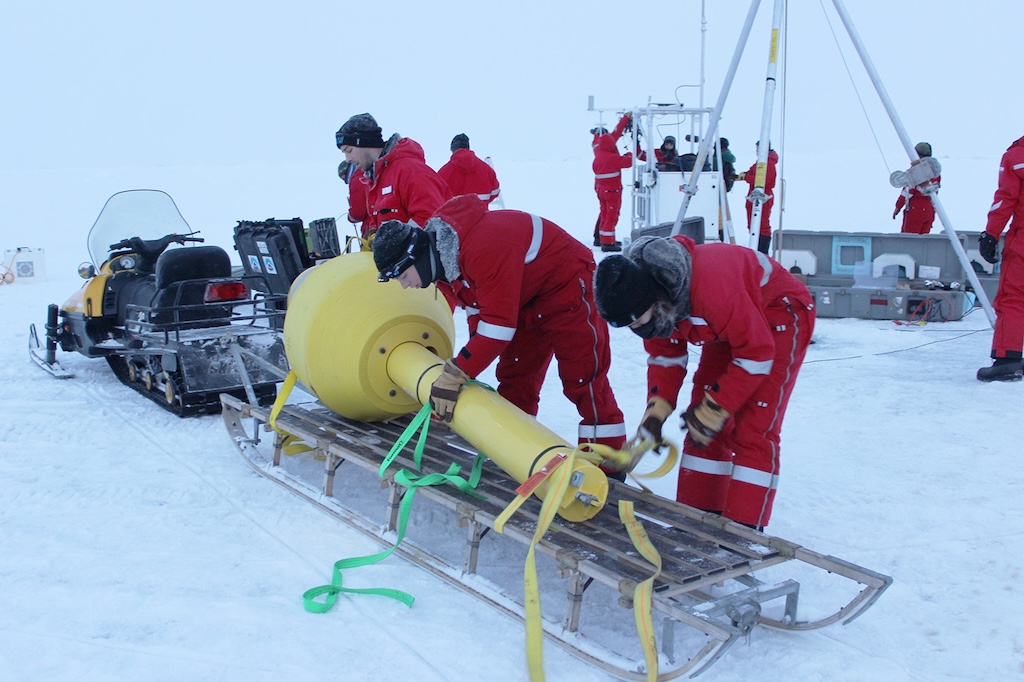
Researchers taking part in the MOSAiC expedition in 2019. Credit: Daisy Dunne for Carbon Brief

This includes MOSAiC, the largest Arctic expedition on record, which took place from 2019-20 and was co-led by research institutes from the US and Germany. [Carbon Brief joined the expedition for its first leg and covered it in depth with a series of articles.]

The US has historically been “incredibly valuable” to research efforts in the Arctic and Antarctica, a senior US polar scientist currently living in Europe, who did not wish to be named, tells Carbon Brief.

“For a lot of the international collaborations, the US is a big component, if not the largest,” the scientist says.

“We do a lot of collaborative work with other countries,” adds Dr Jessie Creamean, an atmospheric scientist working in polar regions based at Colorado State University. “Doing work in the polar regions is really an international thing.”

Back to top

How has Trump affected US polar research in his second term?

Since returning to office, the Trump administration has frozen or terminated 7,800 research grants from federal science agencies and laid off 25,000 scientists and personnel.

This includes nearly 2,000 research grants from the NSF, which is responsible for the Office for Polar Programs and for funding a broad range of climate and polar research.

Courts have since made orders to reinstate thousands of these grants and some universities have settled with the federal government to unfreeze funding. However, it is unclear whether scientists have yet received those funds.

As with other areas of US science, the impact of Trump’s attacks on polar research have been far-reaching and difficult to quantify, scientists tell Carbon Brief.

Key scientific institutions affected include NASA, NOAA and the National Center for Atmospheric Research (NCAR) in Colorado.

In December, the Trump administration signalled that it planned to dismantle NCAR, calling it a source of “climate alarmism”. At the end of January, the NSF published a letter that “doubled down” on the administration’s promise to “restructure” and “privatise” NCAR.

NCAR has been responsible for a host of polar research in recent years, with several NCAR scientists involved in the MOSAiC expedition.

“NCAR is kind of like a Mecca for atmospheric research,” the US polar scientist who did not want to be named tells Carbon Brief. “They’ve done so much. Now their funding is drying up and people are scrambling.”

At NOAA, one of the major polar programmes to be affected is the National Snow and Ice Data Center (NSIDC), which regularly issues updates about Arctic and Antarctic sea ice.

Last July, Space reported that researchers at NSIDC were informed by the Department of Defense – now renamed the Department of War under Trump – that they would lose access to data from a satellite operated by the US air force, which was used to calculate sea ice changes.

Although the Department of Defense reversed the decision following a public outcry, the uncertainty drove the researchers at NSIDC to switch to sourcing data from a Japanese satellite instead, explains Dr Zack Labe. Labe is a climate scientist who saw his position at NOAA terminated under the Trump administration and now works at the nonprofit research group Climate Central. He tells Carbon Brief:

“It looked like they were losing access to that data and, after public outcry, they regained access to the data. And then, later this year, they had to switch to another satellite.”

He adds that the Trump administration’s layoffs and budget cuts has also forced the programme to scale back its communications initiatives:

“A big loss at NSIDC is that they used to put out these monthly summaries of current conditions in Greenland, the Arctic and Antarctic called Sea Ice Today. It was a really important resource to describe the current weather and sea ice conditions in these regions.

“These reports went to stakeholders, they went to Indigenous communities within the Arctic. And that has stopped in the past year due to budget cuts.”

Elsewhere, the New York Times reported that a director at the Office for Polar Programs found out she was being laid off while on a trip to Antarctica.

US polar research took another hit in September, when the NSF announced that it was terminating the lease for the Nathaniel B Palmer, the only US icebreaker dedicated to Antarctic research.

The Nathaniel B Palmer pictured at the Ross Ice Shelf in Antarctica. Credit: NOAA

The statement gave just one month’s notice, saying that the vessel would be returned to its operator in October.

Creamean was among the scientists who were affected by the termination. She tells Carbon Brief:

“I was supposed to go on that icebreaker in September. I have a project funded at Palmer Station, along with colleagues from Scripps Institution of Oceanography. We were supposed to go set up for an 18-month study there. We have the money for the project, but we just didn’t get to go because the icebreaker got decommissioned.

“It was a big bummer. We shipped everything down to South America. All of our cargo is still sitting in Punta Arenas [in Chile].”

Elsewhere, other scientists have warned that the termination of the icebreaker could affect the continuity of Antarctic data collection.

In a statement, Dr Naomi Ochwat, a glaciologist at the University of Colorado, Boulder, said that decades of data on changes to Antarctic glaciers taken from the deck of the Palmer had been vital to her research.

For some, one of the most worrying impacts of Trump’s attacks on US polar science is on the careers of scientists, which will likely lead to many of them leaving the country.

All of the researchers that Carbon Brief spoke to said they had heard many stories of US polar scientists deciding to relocate outside of the country or to leave the profession altogether.

Creamean is one of the polar scientists to make the difficult decision to temporarily leave the US. She says:

“I’m actually moving to Sweden for a year starting in May. I’m going to do a visiting science position [at Stockholm University]. I’m hoping to come back. But if things are not looking good and things are looking more positive in Sweden, maybe I’ll stay there. I don’t know.”

Labe tells Carbon Brief that the “brain drain” of US scientists is the “biggest story” when it comes to Trump’s impact on polar research:

“I think one of the long-term repercussions is just how many people will be forced out of science due to a lack of opportunities. I think this is something that will grow in 2026. There were a lot of grants that were two-to-three years and, so, were still running, but they will be ending now.”

Back to top

What could the changes mean for international climate research at Earth’s poles?

With all research at Earth’s poles relying heavily on international collaboration, Trump’s attacks on science are likely to have far-reaching implications outside of the US, scientists tell Carbon Brief.

One implication of budget and personnel cuts could be the loss of continuous data from US researchers, bases and satellites.

Many US polar datasets have been collected for decades and are relied upon by scientists and institutes around the world. This includes records for Arctic and Antarctica’s oceans, sea ice, atmosphere and wildlife.

Trump’s impact has highlighted to scientific organisations outside of the US how vulnerable US datasets can be to political changes, says Labe, adding:

“From a climate perspective, you need a consistent data record over a long period of time. Even a small gap in data caused by uncertainty can cause major issues in understanding long-term trends in the polar regions.

“Other scientific organisations around the world are realising that they’re going to have to find alternative sources for data.”

Creamean tells Carbon Brief that, while some datasets have been discontinued, researchers have made an effort to keep records going despite personnel and budget constraints. She says:

“I know at Summit Station in Greenland they had some instruments that were pulled out that had been measuring things like the surface energy budget for a long time. That dataset has been discontinued.

“Thankfully, some programmes have been able to somehow hold on and continue to do baseline measurements. There’s a station up in Alaska [Barrow] where, as far as I know, measurements have been maintained there. That’s good because some measurements up there have been happening since the 60s and 70s.”

Summit Station in Greenland. Credit: NOAA

Trump’s changes could also cast uncertainty over the US’s role in taking part and offering support to upcoming collaborative Arctic and Antarctic expeditions.

In addition to helping scientists better understand the impact of climate change on Earth’s polar regions, these expeditions have also enabled countries with testy geopolitical relationships to come together for a common goal, the US polar scientist who did not want to be named tells Carbon Brief.

For example, the MOSAiC expedition from 2019-20 saw the US and Germany work alongside Russian and Chinese research institutes to study the impact of climate change on the Arctic, says the scientist, adding:

“It was an international collaboration that involved people who should be geopolitical enemies. Science is a way that we seem to be able to work together, to solve problems together, because we all live on one planet. And, right now, to see these changes in the US, it’s quite concerning [for these kinds of collaborations].”

A team of researchers take ice cores in front of the Russian icebreaker Akademik Fedorov during the MOSAiC expedition in 2019. Credit: Daisy Dunne for Carbon Brief

The retreat of the US from polar research might see other powers step up to fill the gap, scientists tell Carbon Brief.

Several scientists mentioned the Nordic countries as possibly taking a larger role in leading polar research, while one said that “China seems to be picking up the slack that’s left behind”.

China currently has five Antarctic research stations – Great Wall, Zhongshan, Kunlun, Taishan and Qinling – along with one Arctic station in Ny-Ålesund, Svalbard.

The Financial Times recently reported on China’s growing ambitions for Arctic exploration, involving its fleet of five icebreakers.

Back to top

What could be the impact of Trump’s threats to take control of Greenland on climate research?

In recent months, Trump has whipped up a media frenzy with threats to take control of Greenland, the world’s largest island lying between the Arctic and Atlantic oceans, which is self-governing and part of the Kingdom of Denmark.

Last month, he clarified that he will not try to take Greenland “by force”, but that he is seeking “immediate negotiations” to acquire the island for “national security reasons”.

Trump’s interest in the island is likely influenced by the rapid melting away of Arctic sea ice due to climate change, which is opening up new sea routes and avenues for potential resource exploitation, reported the Washington Post.

His comments have sparked condemnation from a wide range of US scientists who conduct fieldwork in Greenland.

An open letter signed by more than 350 scientists “vehemently opposes” Trump’s threats to take control of Greenland and expresses “solidarity and gratitude” to Greenland’s population. It says:

“Greenland deserves the world’s attention: it occupies a key position geopolitically and geophysically. As climate warms, rapid loss of Greenland’s ice affects coastal cities and communities worldwide.”

A breakdown in diplomatic relations between the US and Greenland could prevent scientists from being able to carry out their climate research on the island, one of the scientists to sign the letter wrote in a supporting statement:

“Scientific access to Arctic environments is essential for research which secures our shared future and, directly, materially benefits American citizens. It is deeply upsetting that these essential relationships are being undermined, perhaps irreparably, by the Trump administration.”

Dr Yarrow Axford, one of the letter’s organisers who is a palaeoclimatologist and science communicator based in Massachusetts, told Nature that Trump’s comments could put Greenland climate research at risk, saying:

“We Americans have benefited from all these decades of peaceful partnership with Greenland. Scientific understanding of climate change has benefited tremendously. I hope scientists can reach out to Congress and point out what a wonderful partnership that is.”

In addition to the US-run Summit Station, there are at least eight other research stations in Greenland, operated by a range of institutions from across the world.

Aerial view of Greenland ice sheet.
Aerial view of Greenland ice sheet. Credit: Alvis Upitis / Alamy Stock Photo

A major focus of research efforts in the region is the Greenland ice sheet, Earth’s second-largest body of ice which is rapidly melting away because of climate change.

The ice sheet holds enough freshwater to raise global sea levels by around more than seven metres, if melted completely.

Any political moves that could “jeopardise” the study of the Greenland ice sheet would be detrimental, says Creamean:

“Greenland is a ‘tipping point’ in that, the ice sheet melting, that could be one of the biggest contributors to sea level rise. It’s not like we can wait to study it, it needs to be understood now.”


Back to top

The post Q&A: How Trump is threatening climate science in Earth’s polar regions appeared first on Carbon Brief.

Q&A: How Trump is threatening climate science in Earth’s polar regions

Continue Reading

Climate Change

Interview: COP31 president says electrification is ‘surest way to protect citizens’

Published

on

Last month, COP31 president-designate Murat Kurum launched a target for 35% of the world’s final energy to come from electricity by 2035.

In an interview with Carbon Brief, Kurum says that the target was not a political choice, but instead reflects the latest evidence on “what is needed to keep 1.5C within reach”.

The ongoing Hormuz crisis means there is an “urgent” need for renewables and electrification, which are the “surest and cleanest way to protect citizens” from high energy prices.

Kurum says that the Brazilian and Ethiopian presidencies of COP30 and COP32, as well as the EU, UK and Canada, have welcomed the target.

He adds that “all have confirmed it will be central to discussions at COP31”.

In the interview, Kurum – who is also Turkey’s minister of environment, urbanisation and climate change – tells Carbon Brief where the target came from and what he expects to happen next.

Carbon Brief: You recently launched a target for 35% of the world’s final energy to come from electricity by 2035. Where did this idea come from?

Murat Kurum: The “35 by 35” target is grounded in technical data and based on the IEA [International Energy Agency] and IRENA [International Renewable Energy Agency] analysis of what is needed to keep [the 1.5C Paris Agreement target] within reach. The level was not chosen politically. Rather, it reflects what the science and the energy modelling tell us is required.

CB: Why do you think an electrification target is important right now?

MK: The case for the target is urgent right now. The latest war in the Gulf has made energy diversification – and, in particular, renewable energy transition and electrification – a top global priority, because it is the surest and cleanest way to protect citizens around the world from high and volatile energy prices.

At a time of real fragmentation in international relations, a single, shared target is needed to focus global efforts by aligning governments, businesses and investors behind a common benchmark and to send a clear market signal.

CB: Which countries are supporting this target so far?

MK: The reaction so far has been extremely positive and, while we presented our target at the UN June climate meetings in Bonn, our earlier conversations with parties at both the Petersberg and Copenhagen climate dialogues paved the way for this launch.

For example, the EU, UK, and Canada have welcomed the target, as have the Brazilian COP30 and Ethiopian COP32 presidencies. All have confirmed it will be central to discussions at COP31.

This support has been reflected in the business community as well, with polling by the We Mean Business Coalition showing that 90% of businesses expect to have largely electrified their operations by 2035 and that 88% expect electrification will make their business more competitive.

CB: How do you hope and expect to see this taken forward at the COP? Could it be in the formal COP outcomes, or part of the second global stocktake?

MK: We are now taking electrification forward as an “action agenda” initiative to bring actors together and drive progress. The action agenda and the [formal COP] negotiations are separate, but complementary, with different processes and thresholds, and it is too early to say what all countries might be able to agree in the negotiations. That is for parties to determine as the year progresses.

We are focused and determined to use COP31 as a moment to spark a global conversation about electrification.

CB: What are the key priorities for reaching the target?

MK: The critical sectors for reaching the target are buildings, transport and industry, which together account for around 45% of global emissions. Financial support for the developing world and investment in grids and infrastructure is also crucial.

The target also builds on COP28’s target to triple renewable energy capacity and seeks to take advantage of the tumbling cost of renewable power and other technologies critical to the energy transition. This is a journey that Turkey itself is taking ambitious steps on, including our plan to reach 120GW [gigawatts] of renewable capacity by 2035.

This interview was first published in the 10 July 2026 edition of Carbon Brief’s DeBriefed weekly newsletter. Sign up for free.

The post Interview: COP31 president says electrification is ‘surest way to protect citizens’ appeared first on Carbon Brief.

Interview: COP31 president says electrification is ‘surest way to protect citizens’

Continue Reading

Climate Change

DeBriefed 10 July 2026: Deadly Europe heat | EU electrification leak | COP31 president interview

Published

on

Welcome to Carbon Brief’s DeBriefed. 
An essential guide to the week’s key developments relating to climate change.

This week

‘Catastrophic’ climate impacts

RECORD HEAT: Western Europe experienced its hottest June on record – some 3C above average – according to analysis covered by the Guardian. It said the finding came “as the UK enters its third heatwave of the year and wildfires ravage France and Spain”. Le Monde said 10,000 people had been evacuated due to wildfires in southern France.

‘EXCESS DEATHS’: The June heatwave killed more than 2,700 people in France, according to a guest post analysis for Carbon Brief. Similar analysis for Germany said there had been more than 5,000 “excess deaths”, reported Bloomberg. Meanwhile, an ongoing heatwave in the US has killed at least 30 people, said USA Today.

STORM TEST: Floods have killed 39 people in Guangxi province in southern China, said state-run newspaper China Daily. Scientists warned that climate change and the weather phenomenon El Niño are exposing China to “catastrophic storms” that will test its resilience in 2026, reported Reuters. The nation’s latest official climate report found that “extreme weather and climate events…have become more frequent and severe”, said China National Radio.

Around the world

  • EU ELECTRIFICATION: The European Commission is set to unveil a 2040 target for EU electrification on 17 July, reported Bloomberg. Citing a leaked draft, it said the plan would aim to cut oil use in half and gas use by two-thirds.
  • PEAKING PLAN: China has published an “action plan” for peaking emissions during the 15th five-year plan period to 2030, reported Xinhua. It lists targets including “new energy vehicles” making up 30% of cars on the road by 2030, said Reuters.
  • CLIMATE ‘FLAT EARTHER’: The Trump administration has appointed Matthew Wielicki, described by Politico as a “climate critic”, to lead the office in charge of the US national climate assessment. Common Dreams quoted a scientist describing the move as “like putting a flat-earther in charge of NASA”.
  • UGANDAN SUIT: A group of farmers from Uganda have launched a legal suit in London against the East African oil pipeline, according to Climate Home News.

23%

The share of Irish electricity used by data centres in 2025, reported the Irish Times.

2%

The share of global electricity used by data centres in the same year, according to Carbon Brief analysis of the Energy Institute statistical review.


Latest climate research

  • Meltwater from the western Himalayan glaciers will peak at around 2C of warming, before declining at higher warming levels | Environmental Research Letters
  • Current coral restoration efforts may be unsuitable for temperate reefs, including those in the Mediterranean | Nature Ecology & Evolution
  • People tend to underestimate the level of “broad public support” for climate action | Nature Climate Change

(For more, see Carbon Brief’s in-depth daily summaries of the top climate news stories on Monday, Tuesday, Wednesday, Thursday and Friday.)

Captured

Average number of days per year with a daily maximum temperature of at least 30C in a selection of major European cities, for each decade since the 1950s

Carbon Brief explained – via eight facts – why air conditioning rates in some parts of Europe are relatively low, as the technology emerges as a new front in the global “culture war” over climate action. Analysis for the article illustrated that, in many parts of the world’s fastest-warming continent, air conditioning simply was not needed in the past.

Spotlight

COP31 president speaks to Carbon Brief on electrification

This week, Carbon Brief interviews Murat Kurum, president-designate of the COP31 UN climate talks in November and Turkey’s minister of environment, urbanisation and climate change, on his target to boost global electrification.

Carbon Brief: You recently launched a target for 35% of the world’s final energy to come from electricity by 2035. Where did this idea come from?

Murat Kurum: The “35 by 35” target is grounded in technical data and based on the IEA [International Energy Agency] and IRENA [International Renewable Energy Agency] analysis of what is needed to keep [the 1.5C Paris Agreement target] within reach. The level was not chosen politically. Rather, it reflects what the science and the energy modelling tell us is required.

CB: Why do you think an electrification target is important right now?

MK: The case for the target is urgent right now. The latest war in the Gulf has made energy diversification – and, in particular, renewable energy transition and electrification – a top global priority, because it is the surest and cleanest way to protect citizens around the world from high and volatile energy prices.

At a time of real fragmentation in international relations, a single, shared target is needed to focus global efforts by aligning governments, businesses and investors behind a common benchmark and to send a clear market signal.

COP31 president-designate Murat Kurum. Credit: Supplied by COP31 secretariat

CB: Which countries are supporting this target so far?

MK: The reaction so far has been extremely positive and, while we presented our target at the UN June climate meetings in Bonn, our earlier conversations with parties at both the Petersberg and Copenhagen climate dialogues paved the way for this launch.

For example, the EU, UK, and Canada have welcomed the target, as have the Brazilian COP30 and Ethiopian COP32 presidencies. All have confirmed it will be central to discussions at COP31.

This support has been reflected in the business community as well, with polling by the We Mean Business Coalition showing that 90% of businesses expect to have largely electrified their operations by 2035 and that 88% expect electrification will make their business more competitive.

CB: How do you hope and expect to see this taken forward at the COP? Could it be in the formal COP outcomes, or part of the second global stocktake?

MK: We are now taking electrification forward as an “action agenda” initiative to bring actors together and drive progress. The action agenda and the [formal COP] negotiations are separate, but complementary, with different processes and thresholds, and it is too early to say what all countries might be able to agree in the negotiations. That is for parties to determine as the year progresses.

We are focused and determined to use COP31 as a moment to spark a global conversation about electrification.

CB: What are the key priorities for reaching the target?

MK: The critical sectors for reaching the target are buildings, transport and industry, which together account for around 45% of global emissions. Financial support for the developing world and investment in grids and infrastructure is also crucial.

The target also builds on COP28’s target to triple renewable energy capacity and seeks to take advantage of the tumbling cost of renewable power and other technologies critical to the energy transition. This is a journey that Turkey itself is taking ambitious steps on, including our plan to reach 120GW [gigawatts] of renewable capacity by 2035.

Watch, read, listen

HEATED: A Financial Times long read asked if Europe – the world’s fastest-warming continent – is “prepared for a world of extreme heat”.

LITIGATED: The Outrage and Optimism podcast spoke to Prof Joana Setzer and Catherine Higham about the latest trends in climate litigation.

‘SHATTERED’: Confidence in fossil-fuel exports via the strait of Hormuz has been “shattered”, wrote IEA chief Fatih Birol for Foreign Policy.

Coming up

Pick of the jobs

DeBriefed is edited by Daisy Dunne. Please send any tips or feedback to debriefed@carbonbrief.org.

This is an online version of Carbon Brief’s weekly DeBriefed email newsletter. Subscribe for free here.

The post DeBriefed 10 July 2026: Deadly Europe heat | EU electrification leak | COP31 president interview appeared first on Carbon Brief.

DeBriefed 10 July 2026: Deadly Europe heat | EU electrification leak | COP31 president interview

Continue Reading

Climate Change

Eight facts about air conditioning amid an overheated global debate

Published

on

As successive heatwaves hit Europe, air-conditioning (AC) has emerged as a new front in the international “culture war” over climate action.

France, Germany and the UK have experienced record-breaking heat and thousands of heat-related deaths this summer, with June temperatures in many regions passing 40C.

This has drawn attention to the relatively low rates of AC use in these countries – and in Europe as a whole – especially when compared to its widespread adoption in the US.

Legacy newspapers, bloggers and even Elon Musk have all weighed in on “European hostility” to AC, criticising Europe’s “cultural conservatism” and “overbearing governments”.

Right-wing politicians, including National Rally in France and the UK Conservatives, have styled themselves as champions of AC, while opposing efforts to tackle climate change.

Missing from most of these interventions is the fact that human-caused climate change has made once-rare heat far more common, in what is the world’s fastest warming continent.

Carbon Brief analysis for this article shows that, until the 2020s, it was rare for many European cities to see days above 30C, making AC an unnecessary expense.

Here, Carbon Brief explains – via eight facts – why AC rates in some parts of Europe are relatively low, as well as clarifies and contextualises some of the misleading claims circulating about the technology.

Much of Europe has not needed AC in the past

AC installation rates in northern parts of Europe are very low. The best available estimates suggest that 6% of households in Germany and just 4% in England use AC.

However, these rates are largely explained by the historical climates in these nations.

Unlike the US, much of the housing stock and infrastructure in Europe was built at a time when AC did not exist and was not necessary.

Moreover, nations such as France, Germany and the UK have only started to regularly experience extreme heat in recent decades.

The chart below shows the average number of days per year, in each decade since the 1950s, when maximum temperatures have exceeded 30C in major European cities. Capitals such as London and Paris have seen a significant jump since around 2000.

Average number of days per year with a daily maximum temperature of at least 30C in a selection of major European cities, for each decade since the 1950s
Average number of days per year with a daily maximum temperature of at least 30C in a selection of major European cities, for each decade since the 1950s. Source: Copernicus ERA5, Carbon Brief analysis by Dr Zeke Hausfather.

Prof Jan Rosenow, an energy and climate researcher at the University of Oxford, tells Carbon Brief:

“For most of the 20th century, northern Europe simply didn’t need cooling. Homes in Britain and Germany were built to keep heat in, not out, because winters were cold and summers rarely hot.”

Much of the commentary about the relatively low rates of European AC use focuses on cultural or “ideological” factors. (See: Some European nations have ‘resisted’ AC – but its popularity is growing.)

However, Rosenow says people’s views on AC in these countries likely stem from their historically colder climates. He adds:

“Attitudes formed around those facts, not the other way round…There is a cultural element, but it is the product of climate, not of some green ideological project.”

In the past, many in Europe relied on traditional methods to keep buildings cool. Richard Black, head of communications at Climate Analytics, made this point in a post on LinkedIn:

“Once, residents of cities such as Paris could cope with summer heatwaves by opening shutters and windows during the night, and closing them again in the morning to trap the cool air inside…We’ve reached a limit to this sort of adaptation.”

Now, with Europe around 2.5C warmer than pre-industrial levels, climate change is routinely driving record-breaking heatwaves, even in the north of the continent.

This is forcing a reappraisal of societies that were “built for a climate that no longer exists”, as the UK’s Climate Change Committee (CCC) put it in a recent report.

Experts broadly agree that much of Europe will indeed need more AC, particularly in spaces housing the most vulnerable populations, such as care homes, schools and hospitals.

At the same time, they also emphasise broader, “passive” efforts to make cities and homes cooler alongside increased AC use. (See: AC is not the only answer to overheating cities.)

Back to top

AC is already widely used in hotter parts of Europe

During periods of extreme heat, articles criticising “European hostility” towards the technology frequently note that “only about 20%” of households in Europe have AC.

Often, this is contrasted with the US, where more than 90% of households have AC installed. (In fact, the US is something of a global outlier, matched only by Japan.)

However, the continent-wide figure for Europe obscures the reality. In southern Europe – where temperatures are and have always been higher – AC is relatively common.

The map below, based on official EU data, shows that southern European nations use far more household energy for “space cooling” than those in the north.

Percentage share of household energy consumption used for “space cooling”, including AC, in EU member states and the Balkans
Percentage share of household energy consumption used for “space cooling”, including AC, in EU member states and the Balkans. Source: Eurostat.

Government figures show that nearly 60% of Italian households have AC. Household-level data in many countries is patchy, but various analyses have placed that figure at 70-80% in Greece and 41% in Spain – with higher penetration in the hotter, southern part of the country.

The same pattern can be seen within France. International coverage has stressed the country’s “cultural resistance to AC”, citing a nationwide figure from 2020 that suggests “only” 25% of French households have AC.

However, polling data from customers of the Hello Watt energy app suggests that there is a distinct north-south divide in French uptake. At least 60% of households in Mediterranean regions of France are equipped with AC, according to these figures.

This can be seen in the map below, with households across northern regions, including Paris, reporting far lower AC installation rates, often below 5%.

Percentage share of households equipped with AC in departments of mainland France
Percentage share of households equipped with AC in departments of mainland France, according to polling data. Source: Hello Watt.

Finally, when making such comparisons to Europe, it is worth noting that high rates of AC use reported for the entire US also obscure significant differences between – and within – US states. This, too, aligns with differences in regional climate.

Hotter states in the US south have near-universal AC access. But in Washington, a north-western state with a climate more comparable to that of western Europe, 66% of people have AC in their homes.

Back to top

Some European nations have ‘resisted’ AC – but its popularity is growing

International commentators have written extensively about Europe’s “longstanding resistance to cooling technology”, especially when compared to the US.

Newspaper editorials in the Washington Post and the Wall Street Journal, alongside numerous op-eds and blog posts, have added fuel to this “culture war”. Elon Musk has even promoted an AI-generated message stating that Europeans “should just install AC”.

Often, European attitudes are attributed to “guilt” about AC’s energy demand, “cultural conservatism” or “overbearing governments”. One commentator ascribed divergent attitudes in Europe and the US to “different ideas about physical suffering and sacrifice”.

Meanwhile, right-leaning commentators and climate-sceptic groups have blamed “climate policies, which view AC as an unnecessary luxury”.

In general, these critiques often fail to consider the most obvious explanation, which is that AC adoption is low in northern Europe because the historical climate made AC unnecessary.

Critical articles have instead drawn attention to restrictions on AC use in some European countries, as well as the lack of support for AC in official heatwave guidance.

For France, in particular, polling has indeed highlighted widespread disapproval of AC, both on environmental grounds and due to alleged health impacts. Such messages have also been voiced regularly in French media and by left-leaning and green politicians.

However, across Europe there are plenty of signs that such attitudes are shifting, following successive spells of extreme heat.

Amid the June heatwave, there were reports from Germany, France and the UK of “skyrocketing” AC sales. This surge was even acknowledged by the foreign ministry in China, due to the nation’s role in supplying many of these products.

The shift is taking place in politics as well. Marine Tondelier, leader of the French Green party – which has traditionally opposed AC – recently stated that “there are places where we just can’t do without AC anymore”.

Overall, AC has been on the rise across Europe, with France, Spain and the Netherlands all using more than twice as much energy for AC and other “space cooling” technologies in 2024 as they did in 2015.

AC production in Germany has also risen by at least 75% in recent years and a growing share of German homes are being built with it installed.

Notably, there is little evidence that “climate policies” are blocking Europeans from installing AC. Polling in Germany shows that, while people are concerned about environmental impacts, the high costs of installing and running it are perceived as greater barriers.

Finally, there is an important distinction between individual AC units in people’s homes and installing them in public spaces, such as hospitals, care homes and schools.

While neither is widespread in France, support for the latter can increasingly be found across the political spectrum, from Greens to the far-right National Rally (RN).

Back to top

AC emissions are growing, but its climate impact could be limited

Some people have noted that a wider rollout of AC in Europe could drive up emissions.

As noted in the Financial Times by columnist and chief data reporter John Burn-Murdoch, there is a logic to this argument, “at least superficially”. He writes:

“AC uses a lot of energy; if the proposed defence against emissions-driven global warming means emitting more, then we have an obvious problem.”

The emissions impact of AC depends heavily on the generation mix of a country’s power sector.

According to the International Energy Agency (IEA), “space cooling” – mostly AC, but this does include some fans – used 2,100 terawatt-hours (TWh) of power globally in 2022.

As such, it was responsible for 1bn tonnes of carbon dioxide (CO2) from electricity use globally. This equates to around 2.7% of total CO2 emissions globally from fossil fuels and industry.

(As well as indirect emissions through power use, AC units can also directly release greenhouse gases – used as AC refrigerants – when they leak or are improperly disposed of. Following the 2016 Kigali Amendment, countries are progressively trying to phase down the use of potent greenhouse gases in AC units.)

In a LinkedIn post, Lauri Myllyvirta, lead analyst at the Centre for Research on Energy and Clean Air and regular Carbon Brief contributor, says:

“There is a lot of alarmist messaging about how much electricity AC uses. However, on an annual basis, the demand is not that substantial. Currently, AC uses about 1% of electricity in the EU and catching up to adoption rates in the US would double this.”

According to the IEA estimates from 2018, “if left unchecked, energy demand from AC will more than triple by 2050”, reaching 6,200TWh of power.

By mid-century, households would contribute the most to the increase (70%), with at least two-thirds of the world’s households potentially having AC, according to the Paris-based agency.

Decarbonising electricity grids and energy-efficiency improvements can reduce AC emissions and their impact on climate.

For instance, in countries with a low-carbon electricity mix – such as France, where nuclear energy accounts for 67% of its electricity generation – expanding AC would have a more limited climate impact than in other countries.

In countries such as India, there could be a more significant increase in emissions as AC is adopted, due to the role coal plays in the country’s energy mix, especially during the night. Demand is growing fast – following low access historically – and many AC units are inefficient, with high electricity use.

According to a new working paper from the India Energy and Climate Center (IECC) at the University of California, Berkeley, “room AC” – portable plug-in units, as opposed to those permanently installed in buildings – already accounts for nearly one-quarter of India’s peak electricity demand (60-70GW) – and this is before the majority of Indian households have bought their first AC unit.

Dr Nikit Abhyankar, co-faculty director of the IECC, tells Carbon Brief that, as AC use is expanded across the world, it should be paired with solar and battery storage, where the “economics have completely shifted” in the last few years. This will help to cut both energy bills and emissions.

According to the IEA, accelerating energy efficiency improvements could deliver more than one-third of all CO2 emission reductions between now and 2030.

The global energy demand needed to run ACs alone in 2050 could be reduced by 1,300GW – the equivalent of all of China and India’s coal plants – through energy efficiency measures, it estimates.

Aditya Valiathan Pillai, a climate adaptation researcher at King’s College London, tells Carbon Brief that, as the use of AC expands, there is a conversation to be had about where and “what type of technology [is used] and who gets access” to it.

A final point is that many AC units are air-to-air heat pumps, which can efficiently heat homes, as well as keeping them cool. As such, wider AC adoption could boost the adoption of electrified heat, helping to cut emissions from gas boilers.

Back to top

Heat from AC can contribute to directly warming cities

Some critics of AC mention its electricity demands and associated CO2 emissions from fossil-fuel combustion, which contribute to raising the temperature of the entire planet. (See: AC emissions are growing, but its climate impact could be limited.)

But AC also has a localised impact. It works by removing heat from indoor air and pushing it outdoors, raising temperatures on the street and exacerbating the “urban heat island” effect.

Left-leaning French politicians are among those citing this as an argument against AC, particularly in cities. Indeed, Emmanuel Grégoire, the Socialist mayor of Paris, appeared to be making this point in an interview with Le Monde, during the June heatwave:

“[AC] can be useful for cooling collective spaces and protecting the most vulnerable populations, but individual AC is a scourge – it makes the problem worse by heating the city even more.”

One study concludes that, in a city such as Phoenix, Arizona, where the technology is widespread, AC use during a heatwave can raise night-time temperatures by 1-1.5C.

Another models a nine-day heatwave in Paris – in a future with “massive” AC use – and finds an increase in external temperature of more than 2C, due to heat emitted by the units.

Given this, some scientists argue that AC can be a form of climate “maladaptation” – referring to actions that backfire and make people more vulnerable to global warming.

The Intergovernmental Panel on Climate Change (IPCC) has highlighted this issue, concluding:

“AC may constitute a maladaptation because of its high demands on energy and associated heat emissions, especially in high-density cities.”

Compared to the US, more people in Europe live in dense, urban areas. According to Dr Vincent Viguié, a climate change economist at École des Ponts ParisTech, this could leave Europeans more exposed to heat from AC units. He tells Carbon Brief:

“If you live in a neighbourhood that is not dense, like in a suburban neighbourhood or in the countryside, you don’t care about this…So, once again, there is a key difference between US and European cities.”

Viguié is among the experts arguing that other climate-adaptation measures should be considered alongside AC, to keep entire cities cool – not just individual homes. He says:

“It’s not to say that the heat released by AC by itself is a reason to forbid AC…It’s just that not taking that into account may lead to bad decisions.”

Back to top

More AC could help to reduce heat deaths in Europe

Heatwaves can be deadly, especially for older or vulnerable members of society.

According to climate scientists at World Weather Attribution, “heatwaves cause more deaths in Europe than all other natural hazards combined”.

The heatwave in June 2026 is estimated to have killed more than 20,000 people in Europe. In France – which has seen some of the hottest temperatures – the heatwave caused more than 2,700 heat-related deaths, according to analysis published by Carbon Brief.

AC does help to protect people from the effects of extreme heat. A 2021 study found that globally, AC averted an estimated 190,000 heat-related deaths annually during 2019-21.

With its much higher penetration of AC, the US has fewer deaths due to extreme heat than Europe.

Heat kills around 11 people out of every 100,000 in Europe, compared to around two people in the US, according to analysis by data scientist Dr Hannah Ritchie from Our World in Data.

Several publications have pointed out that “Europe’s heatwaves are deadlier than American gun violence”. While this is technically accurate in absolute terms, Ritchie says the comparison is “a bit silly” for a number of reasons, not least because on a per-capita basis, US gun deaths are higher.

Average annual deaths per 100,000 for heat and gun deaths in the US (red) and Europe (blue) to as close to the end of 2024 as possible
Average annual deaths per 100,000 for heat and gun deaths in the US (red) and Europe (blue) to as close to the end of 2024 as possible. Heat deaths are based on excess death methodology, not death certificates. Source: By the Numbers.

However, experts suggest that AC is only one part of a wider effort to protect people from extreme heat.

A 2020 study looking at heat-related mortality in Canada, Japan, Spain and the US, found that excess deaths due to heat decreased between 1972 and 2009.

For example, the proportion of deaths due to extreme heat fell from 1.7% to 0.5% over the period in the US and 3.5% to 2.8% in Spain.

However, an increase in AC only explained 16.7% of the drop in the US and 14.3% in Spain.

The research concludes that “other factors have played an equal or more important role in increasing the resilience of populations”. This is supported by research that shows changes to cities, such as planting more trees, as well as behavioural shifts and public-health measures, can all protect people from dangerous heat.

Additionally, across Europe there is already a range of policies and measures in place to protect the most vulnerable from heatwaves. Many of these were brought in following the unprecedented summer of 2003, when 70,000 died from extreme heat.

These policies were highlighted by French environment minister Agnès Pannier-Runacher, in response to the far-right National Rally (RN) party’s AC proposals:

“The incompetent RN has just found out that nursing homes need air-conditioned rooms. Thank you, but it’s actually been mandatory since 2004.”

Another study found that measures that have already been rolled out in France would cut the projected death toll of a 2003-like heatwave by more than 75%. This is in part due to the expansion of AC in places such as nursing homes, but also other approaches, such as heat action plans.

For example, France has a multi-tiered action plan, which includes local governments ensuring access to cooled spaces and water, keeping a list of vulnerable individuals for targeted interventions, as well as national information campaigns.

According to the UN’s office for disaster risk reduction, this French plan has led to a “significant reduction in heat-related mortality”.

While action plans have proved successful in a number of nations, less than half of European countries have such a plan in place.

Back to top

‘Net-zero rules’ are not blocking AC installation in the UK

In the UK, Conservative politicians and right-leaning media have tried to pit the adoption of AC against net-zero policy.

Writing in the climate-sceptic Daily Telegraph, columnist Matthew Lynn claimed falsely:

“Strict net-zero rules now mean that aircon is effectively banned in the UK.”

(Further down the article, he concedes: “AC is not strictly speaking banned in new-build homes in the UK. But tough environmental rules mean that it is very hard, and expensive, to install in practice.”)

The same narrative has been used in articles by GB News, the Sun and others. A separate article in the Daily Telegraph’s “money” section goes further, claiming that AC had been “torn from homes under net-zero clampdown”.

A blog post from the Ministry of Housing, Communities and Local Government rebuts these claims, stating:

“There has been media coverage this week suggesting that AC is banned in homes. This is incorrect.”

For the UK, while it is true that fewer than 5% of homes currently have AC, this is largely due to the fact that it was not hot enough in the past to warrant the expense. Historically, the focus has therefore been on keeping buildings warm, rather than cool.

Extreme heat has previously been rare in the country, so homes were built with insulation and other measures to keep heat in during the “dank winters”. (See: Much of Europe has not needed AC in the past.)

Current regulations do not ban the installation of AC outright. However – as the government’s blog post notes – there is no blanket rule, meaning there are some localised differences.

Certain areas – or certain kinds of properties – may be subject to additional complications for installing AC.

In a 2025 video on Instagram, shadow secretary of state for energy security and net-zero Claire Coutinho referenced the London plan, for example, which is a framework for development in the capital launched in 2021. She said:

“[London mayor] Sadiq Khan says no. The London plan says we shouldn’t have air con because it uses too much energy. But this is mad! This is a poverty mindset that we need to get away from.”

The London Plan does not stop homes from having AC. It simply says that, for new buildings, passive design measures should be prioritised, such as the orientation of the building, the window design and incorporation of measures such as external shading and trees.

A recent response from the mayor added further measures, such as the need to “minimise the necessity for the operation of mechanical measures including AC, which would further add to the heat island effect within urban areas and add operational cost to residents”.

Elsewhere, new-build homes across England must meet the requirements of “part O” of the 2022 building regulation updates. This includes addressing overheating in buildings through energy-efficient design and prioritising passive cooling, with AC as a last resort.

For existing buildings, most AC units fall under “permitted development rights”, meaning no planning application is required to install them.

Additionally, regulations were relaxed in 2025 to make it easier to install an air-to-air heat pump – which can both heat and cool air – without planning permission.

This means that, far from blocking the expansion of AC, net-zero policy has made it easier to install specific cooling systems.

Speaking to Carbon Brief, Andrew Sissons, director of sustainable future at Nesta, says the government must now implement its announced £2,500 subsidy for air-to-air heat pumps “as quickly as possible”, to further ensure that the technology can be rolled out efficiently. He adds:

“[The government] should also continue to expand permitted development rights for air-to-air heat pumps, with a particular focus on flats and homes in denser areas. As long as heat pumps meet the MCS [Microgeneration Certification Scheme] noise test, there are few reasons to limit their use via the planning system.”

Some properties, such as large homes, listed buildings or those in conservation areas, may still require planning permission to install an air-to-air heat pump or other AC. Sissons notes that this can add cost and delay to installation.

While it cannot be said that AC has been blocked or banned due to net-zero, neither has it been prioritised.

This may shift as temperatures continue to rise. UK government advisors at the Climate Change Committee (CCC) suggest that 22% of the UK’s housing stock will likely need active cooling, such as AC, to cope with 2C of global warming.

The CCC’s recent adaptation report also calls for all new homes to be built using low-cost, passive cooling measures, alongside more AC.

Active cooling such as AC is more likely to be needed for retrofitting existing homes, the report adds.

Back to top

AC is not the only answer to overheating cities

AC has become increasingly politicised in Europe, as demonstrated by France’s RN party announcing its “grand plan for AC” in all public buildings.

As noted by Dutch MEP Gerben-Jan Gerbrandy, this “far-right” embrace of AC is coming from the same people who for years have “delayed emissions reductions”.

In response, left-leaning policymakers in Europe have frequently downplayed the role of AC, prioritising programmes of urban greening and retrofitting older buildings.

Such approaches for dealing with extreme heat have already proved successful. Therefore, many experts argue that these methods, alongside AC, will be essential to prepare for a hotter world.

According to the IPCC’s sixth assessment report, adaptive infrastructure, such as urban forests and green roofs, can reduce energy use because of cooling, with co-benefits for climate, air quality, physical and mental health.

While retrofitting older buildings for heat as well as insulating them from the cold might prove challenging, urban greening and an active shade policy – one that determines how much of every street is exposed to direct sunlight – are simple measures cities can adopt.

Some experts have also warned about the high cost of running AC, expressing concerns that excessive reliance on the technology could increase energy poverty.

In a Carbon Brief guest post published in 2025, researchers at the Basque Centre for Climate Change found that framing AC as the “default solution” can miss the opportunity to design “more inclusive, human-centred responses” to rising temperatures.

William Lewis, a PhD candidate and one of the guest post’s authors, tells Carbon Brief it is not a case of “one or the other”, when considering AC and other options:

“We have this opportunity in European countries to choose a slightly different path [from the US], which isn’t AC in every single home.”

King’s College London’s Pillai says that, by centring the debate on AC, the far-right response to the heatwaves in Europe has “completely neglected the science of how you cool human beings”.

There are many solutions, he adds, that are already widely used across hot developing countries, such as ceiling fans, windows that open and cross-ventilation, as well as strategies to reduce cumulative hours of heat exposure.

Pillai tells Carbon Brief that, while places reaching 42C and higher “definitely need to think about AC very seriously”, places in the “low to mid 30Cs” could rely on these alternatives.

Behavioural change, he adds, is the “least glamorous part” of heat policy, but “pulls most of the weight” of protecting people. These include a wide range of actions and responses – from reducing heat exposure, to wearing lighter clothing and drinking more water and fluids.

There are also workplace protections. Pillai tells Carbon Brief that these could include legislation on mandatory work breaks, cooling and shade requirements at workplaces, as well as health insurance that covers heat stress days that have been lost by heat-exposed workers.

Back to top

The post Eight facts about air conditioning amid an overheated global debate appeared first on Carbon Brief.

Eight facts about air conditioning amid an overheated global debate

Continue Reading

Trending

Copyright © 2022 BreakingClimateChange.com