

Nearly 100 UK newspaper editorials opposed climate action in 2025, a record figure that reveals the scale of the backlash against net-zero in the right-leaning press.
Carbon Brief has analysed editorials – articles considered the newspaper’s formal “voice” – since 2011 and this is the first year opposition to climate action has exceeded support.
Criticism of net-zero policies, including renewable-energy expansion, came entirely from right-leaning newspapers, particularly the Sun, the Daily Mail and the Daily Telegraph.
In addition, there were 112 editorials – more than two a week – that included attacks on Ed Miliband, continuing a highly personal campaign by some newspapers against the Labour energy secretary.
These editorials, nearly all of which were in right-leaning titles, typically characterised him as a “zealot”, driving through a “costly” net-zero “agenda”.
Taken together, the newspaper editorials mirror a significant shift on the UK political right in 2025, as the opposition Conservative party mimicked the hard-right populist Reform UK party by definitively rejecting the net-zero target that it had legislated for and the policies that it had previously championed.
Record climate opposition
Nearly 100 UK newspaper editorials voiced opposition to climate action in 2025 – more than double the number of editorials that backed climate action.
As the chart below shows, 2025 marked the fourth record-breaking year in a row for criticism of climate action in newspaper editorials.
This also marks the first time that editorials opposing climate action have overtaken those supporting it, during the 15 years that Carbon Brief has analysed.
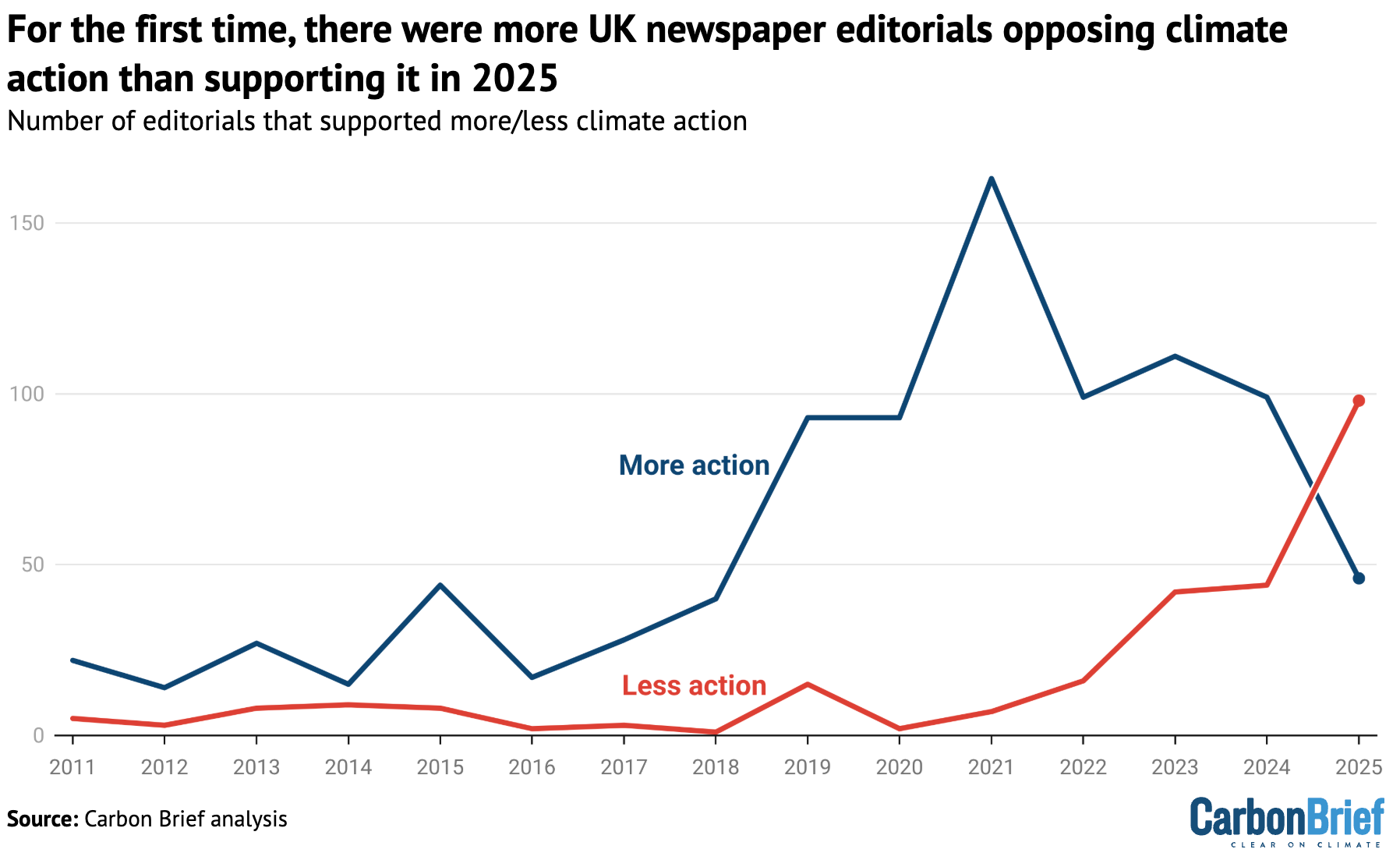
This trend demonstrates the rapid shift away from a long-standing political consensus on climate change by those on the UK’s political right.
Over the past year, the Conservative party has rejected both the “net-zero by 2050” target that it legislated for in 2019 and the underpinning Climate Change Act that it had a major role in creating. Meanwhile, the Reform UK party has been rising in the polls, while pledging to “ditch net-zero”.
These views are reinforced and reflected in the pages of the UK’s right-leaning newspapers, which tend to support these parties and influence their politics.
All of the 98 editorials opposing climate action were in right-leaning titles, including the Sun, the Daily Mail, the Daily Telegraph, the Times and the Daily Express.
Conversely, nearly all of the 46 editorials pushing for more climate action were in the left-leaning and centrist publications the Guardian and the Financial Times. These newspapers have far lower circulations than some of the right-leaning titles.
In total, 81% of the climate-related editorials published by right-leaning newspapers in 2025 rejected climate action. As the chart below shows, this is a marked difference from just a few years ago, when the same newspapers showed a surge in enthusiasm for climate action.
That trend had coincided with Conservative governments led by Theresa May and Boris Johnson, which introduced the net-zero goal and were broadly supportive of climate policies.
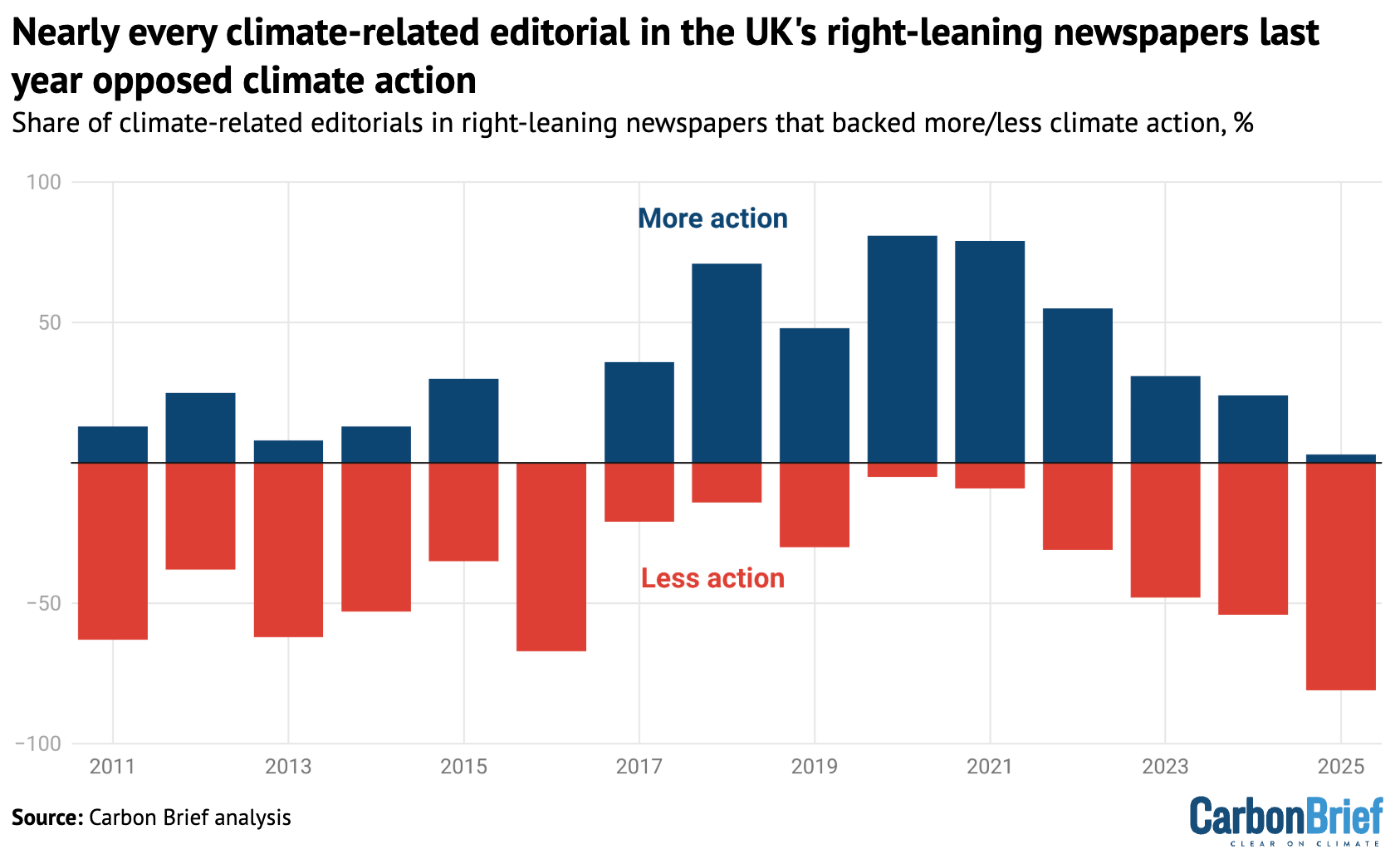
Notably, none of the editorials opposing climate action in 2025 took a climate-sceptic position by questioning the existence of climate change or the science behind it. Instead, they voiced “response scepticism”, meaning they criticised policies that seek to address climate change.
(The current Conservative leader, Kemi Badenoch, has described herself as “a net-zero sceptic, not a climate change sceptic”. This is illogical as reaching net-zero is, according to scientists, the only way to stop climate change from getting worse.)
In particular, newspapers took aim at “net-zero” as a catch-all term for policies that they deemed harmful. Most editorials that rejected climate action did not even mention the word “climate”, often using “net-zero” instead.
This supports recent analysis by Dr James Painter, a research associate at the University of Oxford, which concluded that UK newspaper coverage has been “decoupling net-zero from climate change”.
This is significant, given strong and broad UK public support for many of the individual climate policies that underpin net-zero. Notably, there is also majority support for the “net-zero by 2050” target itself.
Much of the negative framing by politicians and media outlets paints “net-zero” as something that is too expensive for people in the UK.
In total, 87% of the editorials that opposed climate action cited economic factors as a reason, making this by far the most common justification. Net-zero goals were described as “ruinous” and “costly”, as well as being blamed – falsely – for “driving up energy costs”.
The Sunday Telegraph summarised the view of many politicians and commentators on the right by stating simply that said “net-zero should be scrapped”.
While some criticism of net-zero policies is made in good faith, the notion that climate change can be stopped without reducing emissions to net-zero is incorrect. Alternative policies for tackling climate change are rarely presented by critical editorials.
Moreover, numerous assessments have concluded that the transition to net-zero can be both “affordable” and far cheaper than previously thought.
This transition can also provide significant economic benefits, even before considering the evidence that the cost of unmitigated warming will significantly outweigh the cost of action.
Miliband attacks intensify
Meanwhile, UK newspapers published 112 editorials over the course of 2025 taking personal aim at energy security and net-zero secretary Ed Miliband.
Nearly all of these articles were in right-leaning newspapers, with the Sun alone publishing 51. The Daily Mail, the Daily Telegraph and the Times published most of the remainder.
This trend of relentlessly criticising Miliband personally began last year in the run up to Labour’s election victory. However, it ramped up significantly in 2025, as the chart below shows.
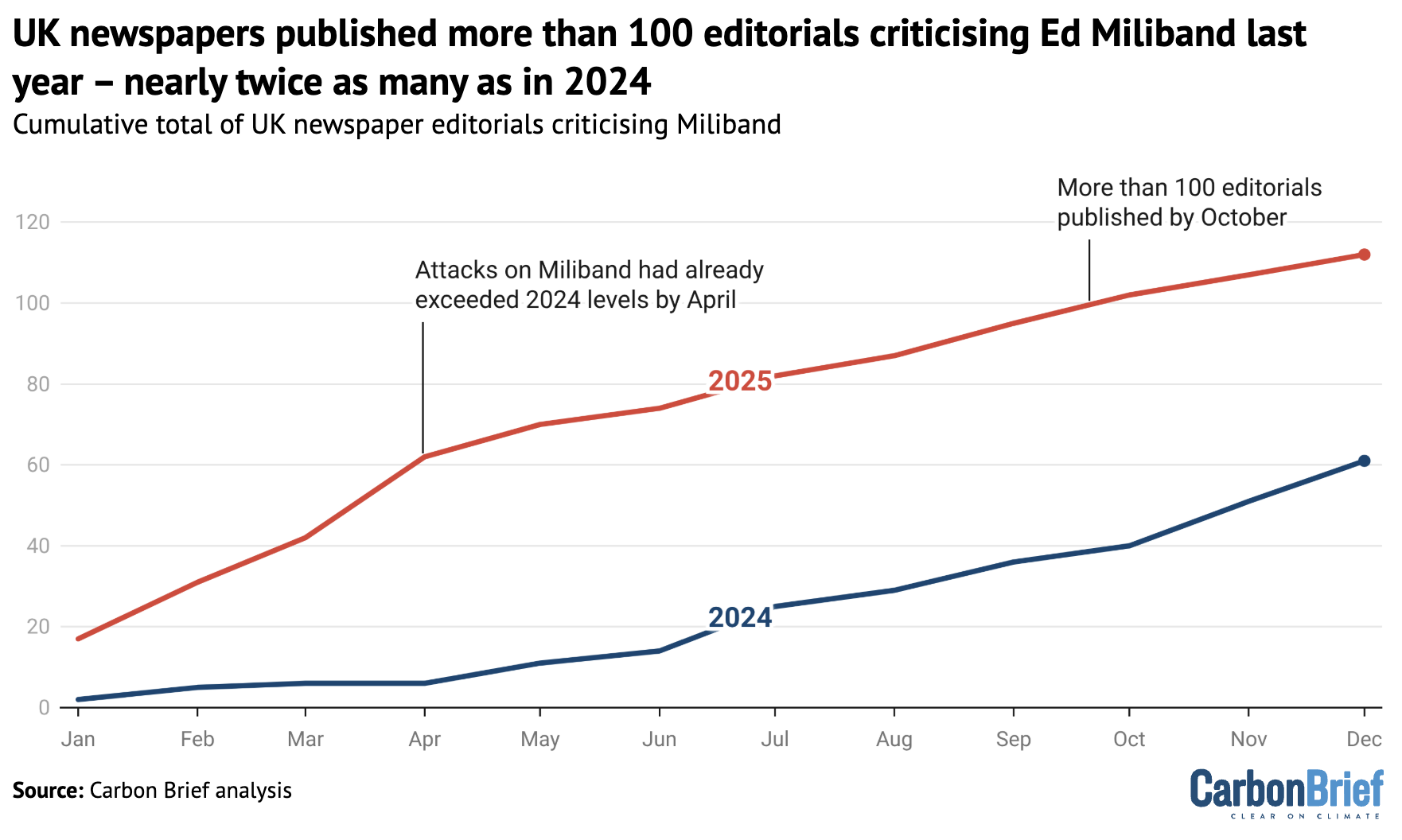
Around 58% of the editorials that opposed climate action used criticism of climate advocates as a justification – and nearly all of these articles mentioned Miliband, specifically.
Editorials denounced Miliband as a “loon” and a “zealot”, suffering from “eco insanity” and “quasi-religious delusions”. Nicknames given to him include “His Greenness”, the “high priest of net-zero” and “air miles Miliband”.
Many of these attacks were highly personal. The Daily Mail, for example, called Miliband “pompous and patronising”, with an “air of moral and intellectual superiority”.
Frequently, newspapers refer to “Ed Miliband’s net-zero agenda”, “Ed Miliband’s swivel-eyed targets” and “Mr Miliband’s green taxes”.
These formulations frame climate policies as harmful measures that are being imposed on people by the energy secretary.
In fact, the Labour government decisively won an election in 2024 with a manifesto that prioritised net-zero policies. Often, the “targets” and “taxes” in question are long-standing policies that were introduced by the previous Conservative government, with cross-party support.
Moreover, the government’s climate policy not only continues to rely on many of the same tools created by previous administrations, it is also very much in line with expert evidence and advice. This is to prioritise the expansion of clean power and to fuel an economy that relies on increasing levels of electrification, including through electric cars and heat pumps.
Despite newspaper editorials regularly calling for Miliband to be “sacked”, prime minister Keir Starmer has voiced his support both for the energy secretary and the government’s prioritisation of net-zero.
In an interview with podcast The Rest is Politics last year, Miliband was asked about the previous Carbon Brief analysis that showed the criticism aimed at him by right-leaning newspapers.
Podcast host Alastair Campbell asked if Miliband thought the attacks were the legacy of his strong stance, while Labour leader, during the Leveson inquiry into the practices of the UK press. Miliband replied:
“Some of these institutions don’t like net-zero and some of them don’t like me – and maybe quite a lot of them don’t like either.”
Renewable backlash
As well as editorial attitudes to climate action in general, Carbon Brief analysed newspapers’ views on three energy technologies – renewables, nuclear power and fracking.
There were 42 newspaper editorials criticising renewable energy in 2025. This meant that, for the first time since 2014, there were more anti-renewables editorials than pro-renewables editorials, as the chart below shows.
As with climate action more broadly, this was a highly partisan issue. The Times was the only right-leaning newspaper that published any editorials supporting renewables.
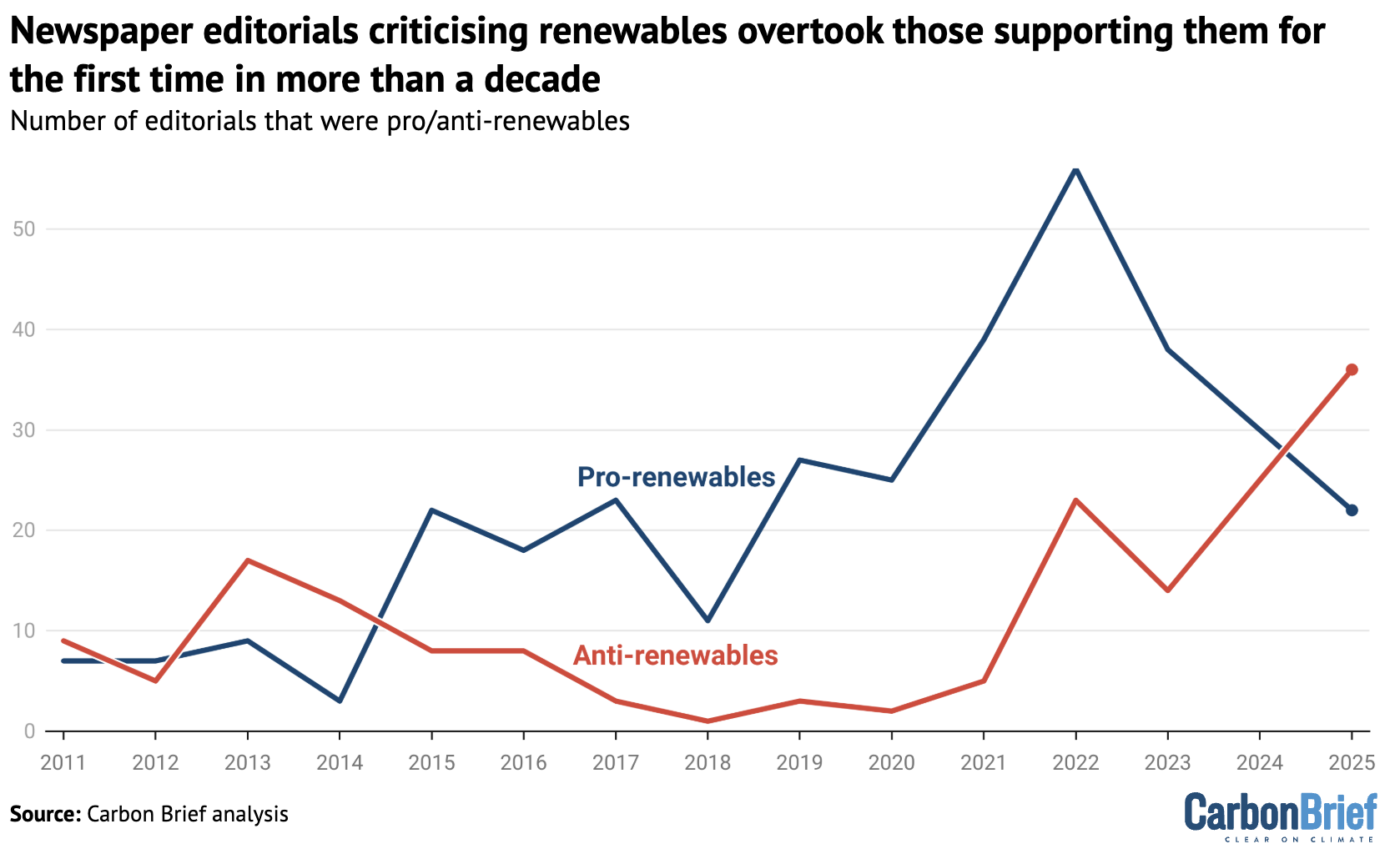
By far the most common stated reason for opposing renewable energy was that it is “expensive”, with 86% of critical editorials using economic arguments as a justification.
The Sun referred to “chucking billions at unreliable renewables” while the Daily Telegraph warned of an “expensive and intermittent renewables grid”.
At the same time, editorials in supportive publications also used economic arguments in favour of renewables. The Guardian, for example, stressed the importance of building an “affordable clean-energy system” that is “built on renewables”.
There was continued support in right-leaning publications for nuclear power, despite the high costs associated with the technology. In total, there were 20 editorials supporting nuclear power in 2025 – nearly all in right-leaning newspapers – and none that opposed it.
Fracking was barely mentioned by newspapers in 2023 and 2024, after a failed push by the Conservatives under prime minister Liz Truss to overturn a ban on the practice in 2022. This attempt had been accompanied by a surge in supportive right-leaning newspaper editorials.
There was a small uptick of 15 editorials supporting fracking in 2025, as right-leaning newspapers once again argued that it would be economically beneficial.
The Sun urged current Conservative leader Badenoch to make room for this “cheap, safe solution” in her future energy policy. The government plans to ban fracking “permanently”.
North Sea oil and gas remained the main fossil-fuel policy focus, with 30 editorials – all in right-leaning newspapers – that mentioned the topic. Most of the editorials arguing for more extraction from the North Sea also argued for less climate action or opposed renewable energy.
None of these editorials noted that the UK is expected to be significantly less reliant on fossil-fuel imports if it pursues net-zero, than if it rolls back on climate action and attempts to squeeze more out of the remaining deposits in the North Sea.
Methodology
This is a 2025 update of previous analysis conducted for the period 2011-2021 by Carbon Brief in association with Dr Sylvia Hayes, a research fellow at the University of Exeter. Previous updates were published in 2022, 2023 and 2024.
The count of editorials criticising Ed Miliband was not conducted in the original analysis.
The full methodology can be found in the original article, including the coding schema used to assess the language and themes used in editorials concerning climate change and energy technologies.
The analysis is based on Carbon Brief’s editorial database, which is regularly updated with leading articles from the UK’s major newspapers.


The post Analysis: UK newspaper editorial opposition to climate action overtakes support for first time appeared first on Carbon Brief.
Analysis: UK newspaper editorial opposition to climate action overtakes support for first time

Scientists have vowed to keep working on the next flagship set of reports for the Intergovernmental Panel on Climate Change (IPCC), after a political row over the timeline for their release saw its latest session suspended on Friday evening without agreement.
During the weekend, government officials and scientists alike expressed disappointment over the inability to reach a compromise before some delegates from developing countries and small island states had to leave the week-long meeting in Ethiopia to catch flights home.
The disagreement – which has persisted since early 2024 – turns on whether the three key parts of the AR7 assessment should all be published before the conclusion of the UN’s next Global Stocktake of global climate action, which is due to be completed in late 2028.
The IPCC issued a statement after the close of the session, saying that “key agenda items” – the timelines for the three AR7 reports, as well as the IPCC budget – remain open and under discussion. It said the IPCC’s plenary session and its deliberations on the pending agenda “will resume at the earliest opportunity”, giving no further details of when.
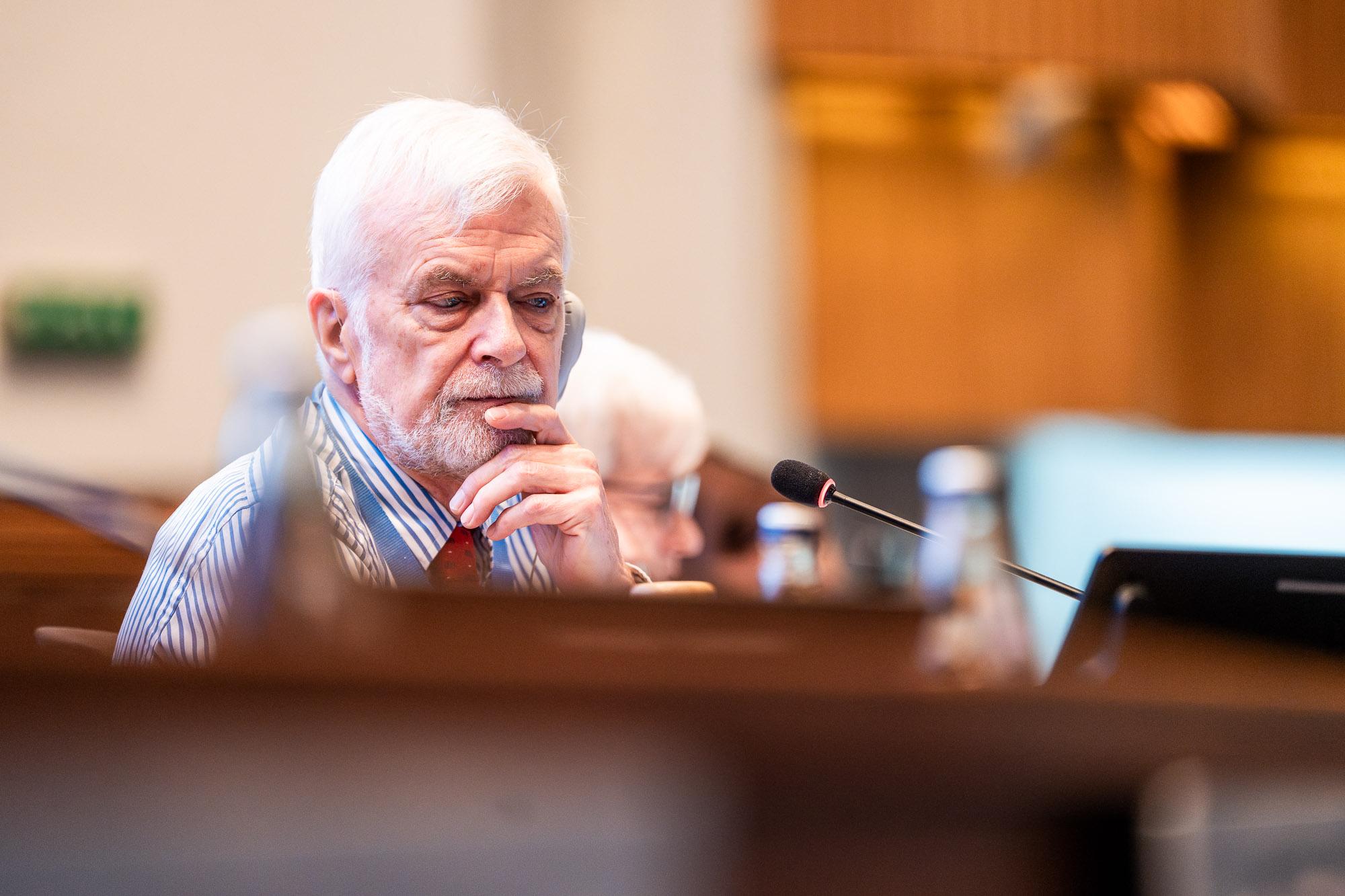
IPCC Chair Jim Skea told delegates in closing remarks that recent months had been some of the most turbulent for the climate science panel and that, if there were stronger words than “profound disappointment” he would use them, according to a summary published by the Earth Negotiators Bulletin (ENB). IPCC discussions happen behind closed doors.
IPCC scientists remained committed
In an open letter, issued on Monday, a group of nearly 120 scientists – from a total of 664 AR7 authors – said they “stand committed to continue working to deliver the AR7 reports in a manner that is rigorous, timely and inclusive, in line with our mandate to be policy-relevant”.
“An assessment that arrives after the decisions it is meant to inform cannot serve its purpose,” they emphasised. “The second Global Stocktake in 2028 is such a decision point, and the world should not have to face it without the IPCCʼs latest assessment.”
Europe, small islands and the least developed countries, plus many Latin American and developed nations, want the IPCC to meet this deadline, arguing that the findings from the UN climate science body are irreplaceable in the UN climate policy-making process.
However, around a dozen developing countries plus Russia have argued that the reports should come later in order to allow for greater research input from the Global South – something that, in their view, would make the findings fairer. They also claim that a shorter timeline would put excessive pressure on experts.
-
Who shapes climate science? The equity question facing the IPCC
Early completion of the next global climate science assessment reports risks excluding research from the Global South, which is key to ensuring the findings are fair -
Governments that support climate science must stand firm against naysayers
The IPCC is meeting to decide the timing of its next major report, as some countries try to delay it and weaken the case for faster emissions cuts


The most vocal of this group at last week’s meeting were India and Saudi Arabia, according to the ENB summary and a developed country diplomat. Critics see this push for a longer timeline as an excuse to deprive government decision-makers of the latest science and ease pressure on emerging economies to raise their ambition, particularly on cutting emissions.
Commenting on last week’s meeting, France’s ambassador for climate negotiations Benoît Faraco said a broad coalition of developed and developing countries from all five continents, “united in their support for science and the timeline proposed by scientists”, had withstood pressure “from a few countries” seeking to slow down the process of adopting the IPCC reports.
He added that France would not back down and would “continue to fight tirelessly for science, protect the integrity of information, and convince our partners that without the best available scientific data, we will be less effective in tackling climate change and protecting our populations”.
Inclusivity proposal stalled
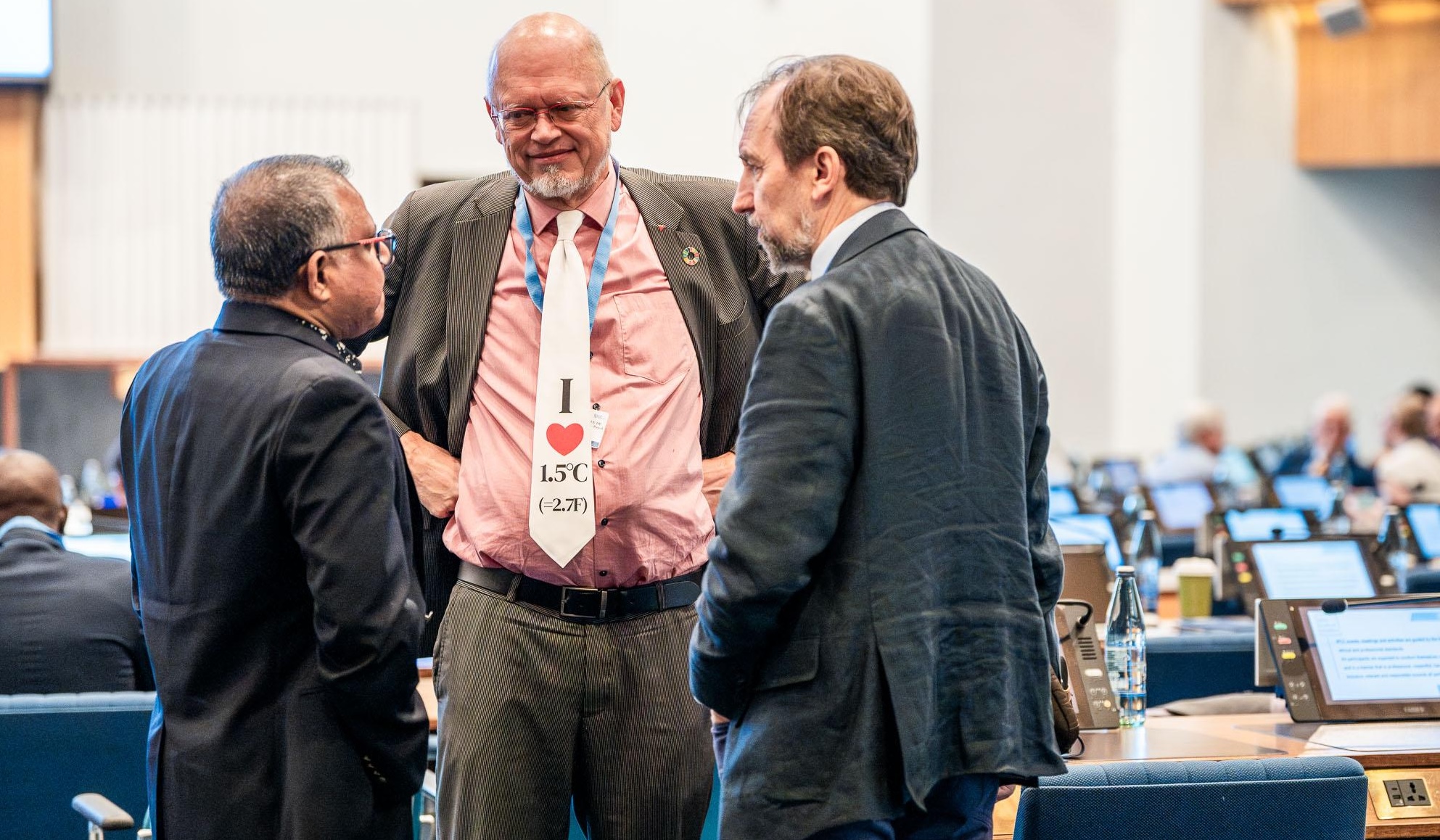
In a bid to unlock a solution for the AR7 timeline, countries discussed ways to improve the inclusivity of the IPCC’s work. One option put on the table was for the IPCC to expand its funding for delegates from developing countries to attend some or all of its sessions from one to two participants, according to the ENB summary and a delegate speaking to Climate Home News.
That would increase the costs for the IPCC to complete AR7 by up to a quarter, according to an assessment shared by the secretariat. The panel’s budget is under severe strain and its officials have warned that, without additional voluntary contributions, it risks running out of money before it can deliver on this assessment cycle.
Climate Home News understands that some of the IPCC’s traditional donors – which mainly include European countries, Japan and Australia – indicated a willingness to support funding for an additional developing country participant. But without an agreement over the budget or the timeline for the reports, that option was ultimately not adopted.
‘Disappointed and worried’
The three reports are managed by working groups that collate and draw overall findings from the latest scientific studies and data on the physical effects of global warming around the world, how to adapt to it, and pathways for cutting planet-heating emissions in order to meet the temperature goals of the Paris Agreement.
Winston Chow, an urban climate professor at Singapore Management University who co-chairs Working Group II on adaptation, wrote in a LinkedIn post that he was “disappointed and worried” for the IPCC authors who have worked “extraordinarily hard” to assess the relevant climate science over the past two years.
He said he shared their concern that “the rigour, time and goodwill they’ve invested are now being put at risk by the Panel’s stalemate”.
As science comes under attack at UN talks, climate movement splits over how to respond
For Working Group II, a meeting for 250 experts writing that report is scheduled for January 2027, followed by the approval of a special report on cities and climate change in Singapore next March.
But because the IPCC’s budget has not been confirmed due to uncertainty about the AR7 schedule, travel support for those researchers is at risk, wrote Chow. “If they cannot participate, our assessments will lose vital expertise, perspectives and scientific breadth, and the collective effort of our authors will be undermined,” he warned.
Scientific work continues
Despite the political holdups, he – together with French climate scientist Robert Vautard, co-chair of Working Group 1 – agreed with IPCC head Skea who told the IPCC’s closing session on Friday: “The engine room of the IPCC is working, and it’s healthy.”
Vautard commented in a separate post on LinkedIn after it ended: “The boat is at full steam.” Working groups I and II are due to start revising the first drafts of their reports, while Working Group III on reducing emissions is finalising its first draft which will be out soon, he wrote.
“The most exciting two years of the cycle are ahead, for the authors. The momentum in the engine room is here and now. Trust the engine room!” he added.
The IPCC and some scientists report that progress has been made towards achieving an equitable balance of authors from the Global North and the Global South.
The group of researchers who signed the open letter on Monday noted that “inclusivity is at the heart of how we work”, with author teams bringing together experts from developed and developing countries with diverse backgrounds and at different stages of their careers.
Plea to overcome political differences
The signatories include several scientists from some of the countries opposed to the alignment of all IPCC reports with the Global Stocktake.
“We are committed to an assessment in which the knowledge, experience and priorities of every region are fully reflected, a commitment we share with the leadership of the IPCC.
Equity is built into how our assessment is being drafted,” they added.
They appealed to governments that make up the IPCC “to overcome their political differences and work together as we do as a global scientific community, so that we can deliver the IPCC reports the world needs to hear”.
In a statement published on Monday, IPCC chair Skea said reaching consensus on the schedule for the reports is “vital”. He added that the assessments provide authoritative scientific evidence to inform national climate policies, strengthen adaptation and resilience and support access to climate finance, as well as helping communicate the scale of the climate crisis and the urgency of efforts to tackle it.
The post IPCC scientists vow to press on with climate reports despite political deadlock appeared first on Climate Home News.
IPCC scientists vow to press on with climate reports despite political deadlock