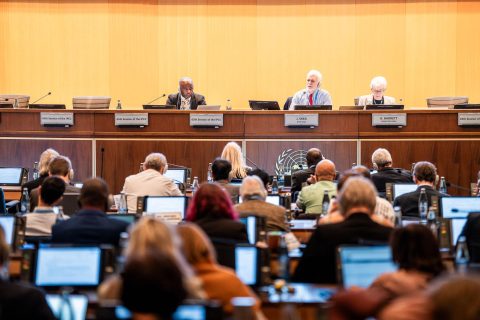
The UK’s new prime minister Andy Burnham remained tight-lipped on his views on climate change during his leadership campaign.
When asked his views on allowing new North Sea drilling in June – a move that the oil-and-gas industry and right-wing media have pushed for in recent months – he said he had “something of an open mind” on the issue.
But a trawl of Burnham’s past comments about climate change, net-zero and fossil fuels reveals a different picture.
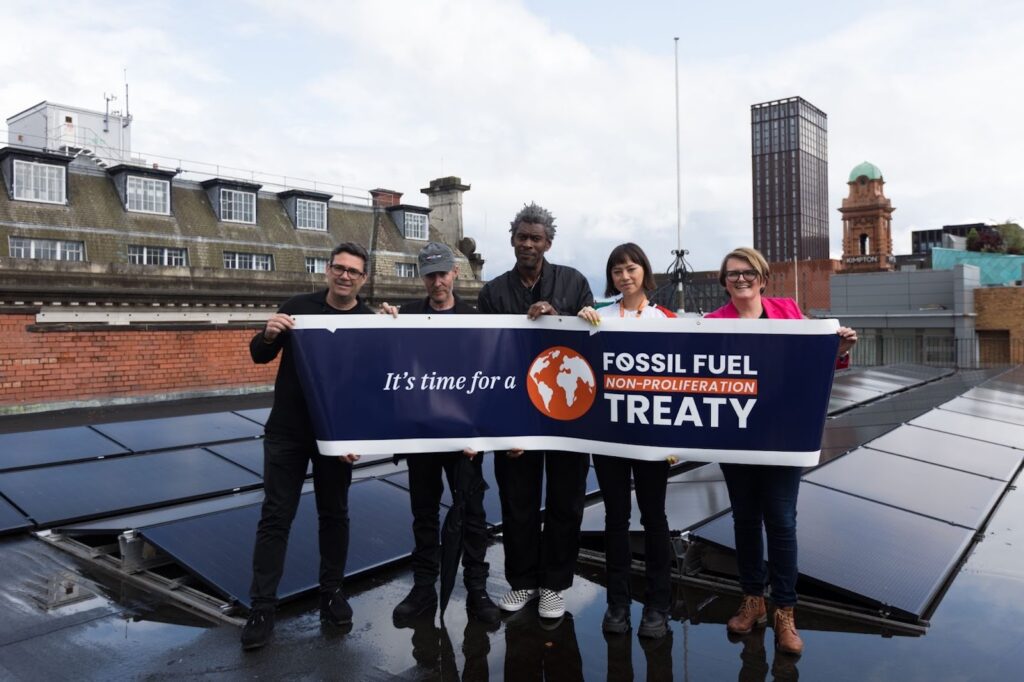
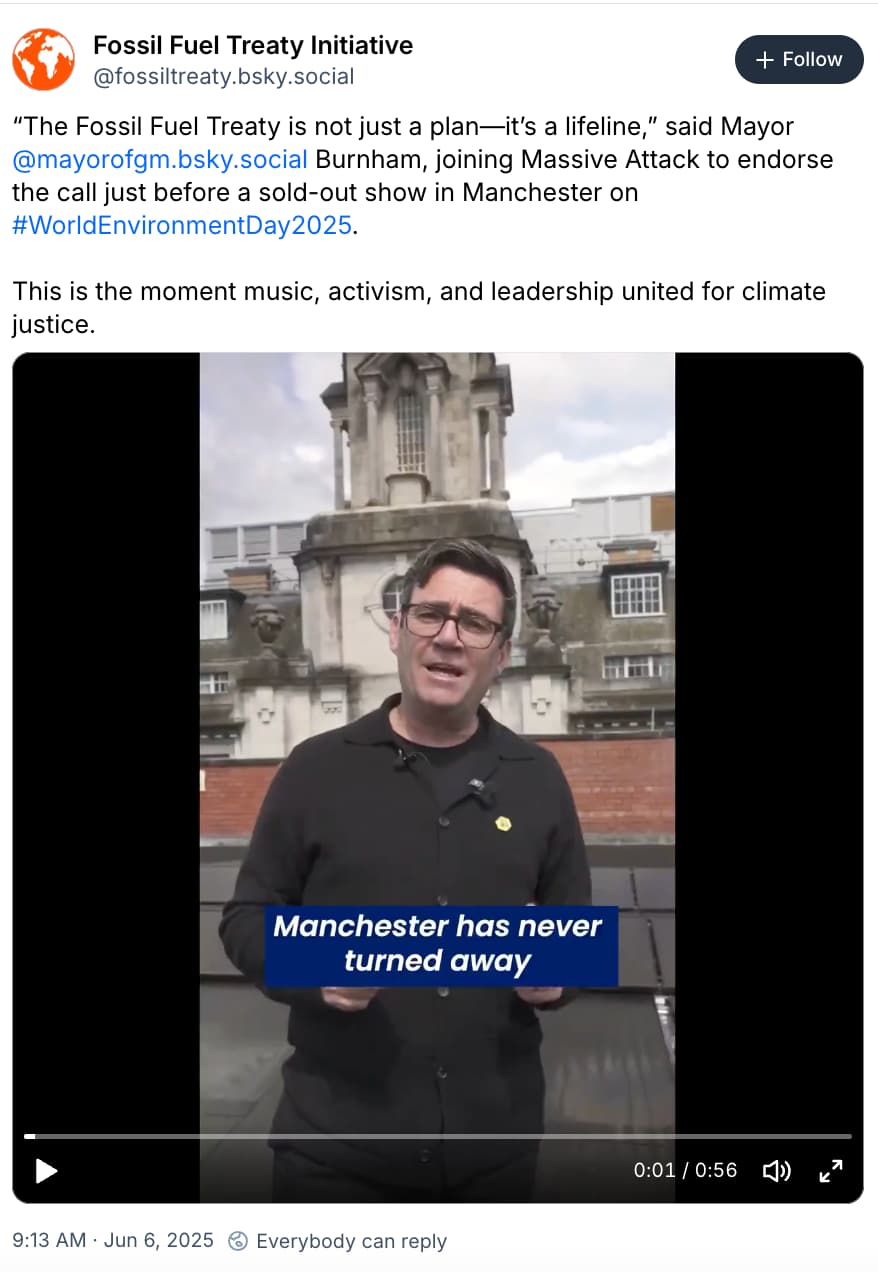
Just a year ago in June 2025, Burnham, while mayor of Greater Manchester, gave his support to the fossil fuel treaty – a proposed international pact on phasing out coal, oil and gas – calling it a “lifeline” that “all governments” should join.
In a video message endorsing the treaty, he also said that “there should be no turning away from net-zero”.
During his last bid to be Labour leader in 2015, he used similar language, saying:
“Labour under my leadership will never turn our back on either our duty to tackle climate change or the prospects offered by the green economy.”
Burnham has spoken about the threat of climate change since at least 2008, noting in 2021 that accelerated action could “create thousands of good jobs”, but also warning that net-zero risked becoming the “next Brexit”.
Burnham is yet to appoint his cabinet, but there is much speculation that he will select current net-zero secretary Ed Miliband as his chancellor – with their ally Miatta Fahnbulleh having a “strong chance” of taking Miliband’s former position.
Below, Carbon Brief recounts 28 things that Burnham has said about climate change, net-zero, fossil fuels, energy and transport.
Climate change
“Tackling climate change isn’t just about protecting the planet – it’s a powerful opportunity to build a fairer, greener future for our communities and businesses.”
Calling for local councils to be given more power and money for climate action, 29 November 2025
“There is little doubt that Greater Manchester’s biodiversity has taken a hit over the years, with habitats being lost, destroyed and becoming less diverse due to the impact of development, climate change, pollution and invasive species…We are committed to delivering a city-region for all residents to enjoy – a fairer, greener and more prosperous place for everyone.”
Statement after Greater Manchester declared a “biodiversity emergency”, 25 March 2022
“Over the next decade, if we accelerate our response to the climate crisis, we can create thousands of good jobs, improve homes, overhaul our transport system and make [Manchester] an even better place to live.”
Greater Manchester Green Summit, 18 October 2021
“The environment has never been higher on the national and international agenda.”
Statement after visiting a peat bog restoration project in England, 9 January 2020
“I think climate change [action] will be driven more quickly from the bottom up, if I’m honest. It’s the will of evolution if you wait for the government to act…When governments aren’t listening you get out and get your voice heard…so I think [climate protesters] deserve our encouragement, not our criticism.”
Speaking to Manchester Evening News at a student climate protest in Manchester, 24 May 2019
“Labour under my leadership will never turn our back on either our duty to tackle climate change or the prospects offered by the green economy.”
Labour leadership candidate speech, 15 July 2015
“Climate change can seem a distant, impersonal threat – in fact the associated costs to health are a very real and present danger…We need well-designed climate change policies that drive health benefits.”
Speaking to the Guardian about a study on climate and health, 25 November 2009
“The Stern report on the economics of climate change has changed the debate, in this country and around the world. It made it clear that the people who could suffer most from a failure to tackle climate change, or from a lack of ambition in our approach to it, are those living in the developing countries. They are the most vulnerable…[and] Stern said that the cost of not acting would be large. That is why the government took various measures in the recent spending review to ensure that we are prepared to face the challenges posed by climate change.”
Speaking in the UK parliament on the economic impacts of climate change on his final day as chief secretary to the Treasury, 24 January 2008
Net-zero
“There should be no turning away from net-zero.”
Speaking after giving his support to the fossil fuel treaty – a proposed global pact to introduce laws to phase out coal, oil and gas – on behalf of Manchester, 6 June 2025
“An opportunity is opening up for Britain as other countries move away from net-zero. We should seize that…We can make Britain a green leader. This is not the time to tiptoe, it is the time to commit to this path.”
Speaking at Innovation Zero World Congress in London, 29 April 2025
“[We] need a government that fully buys into the 2038 vision because the UK will not get to 2050 unless places like Greater Manchester are freed up to go faster – and we’re ready to go faster.”
Speaking about Greater Manchester’s aim to reach net-zero by 2038, 19 October 2022
“In Greater Manchester we have plans to build 30,000 net-zero social rented homes because we recognise that a successful city region needs good quality, affordable accommodation for everyone.”
Speech on the future of cities, 24 June 2022
“By building a broad consensus behind the drive to net-zero, we can ensure that the transition is a fair one that delivers social justice as well as climate justice. This is an opportunity for all of us to show how cutting carbon emissions in our cities can make a real difference to our communities – away from the abstractions and rooted in the real world.”
Panel discussion in Glasgow during the COP26 climate summit, 12 November 2021
“To the extent that people have picked up anything from COP26, it’s a sense that the drive to net-zero will mean cost and inconvenience for ordinary people and offsetting for the wealthy and entitled. All of a sudden, you can feel how net-zero could become the new Brexit – a debate that gets very divided on class grounds…This has got to be a wake-up call. We cannot let this happen. We need to act now to build a broad social consensus behind the drive to net-zero. How to do that? It starts with taking control of the climate narrative from those steering it in the wrong direction and turning it around…We must show how, if done in the right way, the drive to net-zero is actually an opportunity to reduce the cost of living; to make people’s lives better and society fairer.”
Writing for the London Standard, 5 November 2021
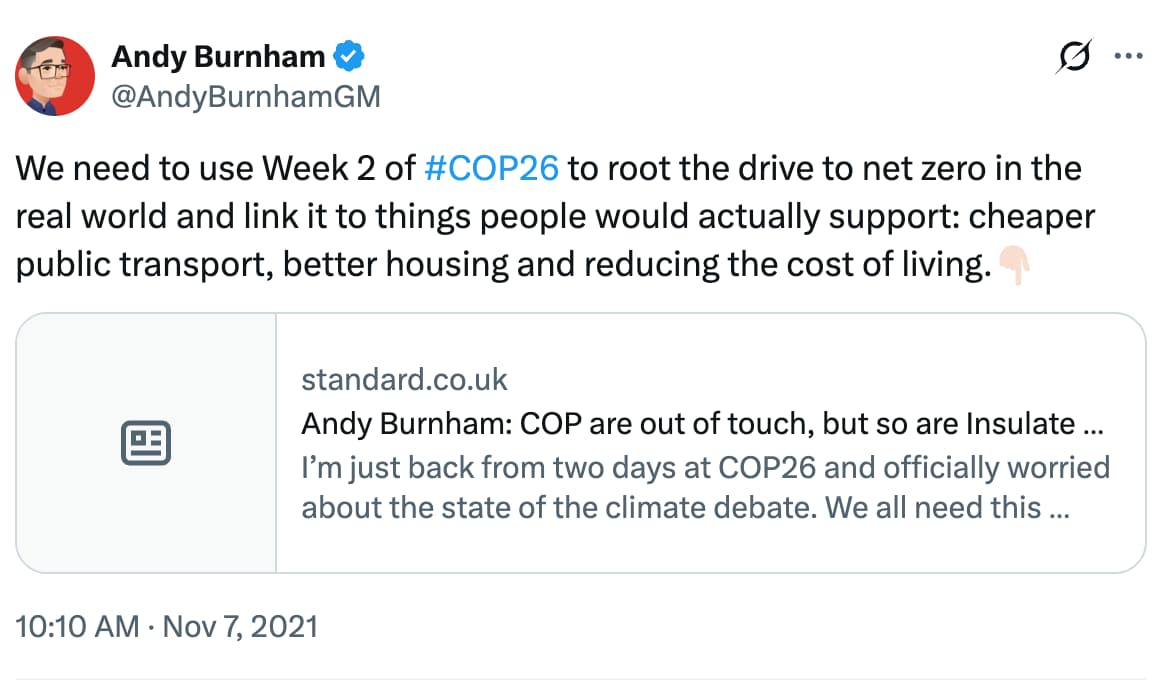
“The drive to net-zero is a chance to re-industrialise the north of England, this time in a clean way. Create really good jobs, future-facing jobs for people, better public transport, improve people’s homes…If we go quickly towards net-zero, it’s the quickest way to level up the country.”
ITV interview at COP26, 1 November 2021
“If we really embrace the drive to net-zero, that is the route to level up the country…But it needs substantial investment, upfront, now, of the kind that Rachel Reeves, shadow chancellor [and chancellor under Keir Starmer’s government], has been talking about. We need long-term predictable funding.”
Interview with GB News at COP26, 1 November 2021
“I would have preferred to hear slightly less about carbonated wine and much more about a decarbonised economy.”
Referencing a UK budget, which included tax cuts for sparkling wine and other drinks, 28 October 2021
“Decarbonising is not just about lowering costs on to people. It’s the route to get better, cheaper public transport. It’s the route to getting homes that are cheap to run. It’s actually the way we can create thousands of good jobs for the people who live in Greater Manchester. This is the route to levelling up the country by going further and faster on decarbonisation.”
Speaking to Manchester Confidential, 20 October 2021
“[I am] asking people to stop seeing the environmental agenda as a cost and a burden agenda. I think this is a barrier that we’ve got to get over. Already in the media interviews I’ve done today, people are saying ‘can you afford it?’, ‘can it be achievable when times are tough?’.
“My answer to that is, at some point in the 21st century, all homes will be zero-carbon. At some point in this century, all buildings of any kind will be zero-carbon…All cars will be zero-carbon, all public transport will be zero-carbon…The question is: when? And surely the places that embrace those things first are putting themselves in a position of economic strength when it comes to facing up to the future. Rather than seeing the whole agenda as a burden, we’ve got to see it for the benefits that it can bring.
“There may be a greater upfront cost in a zero-carbon home, but let’s stop thinking, as we tend to do in Britain, of the short-term, the short-termist approach to life. Surely let’s start talking to the public about the lifetime cost.”
Greater Manchester Green Summit, 21 March 2018
Fossil fuels
“I’ve got something of an open mind, you know. I don’t have a sort of fixed position.”
Speaking on the issue of new North Sea oil and gas in a New Statesman interview, 3 June 2026
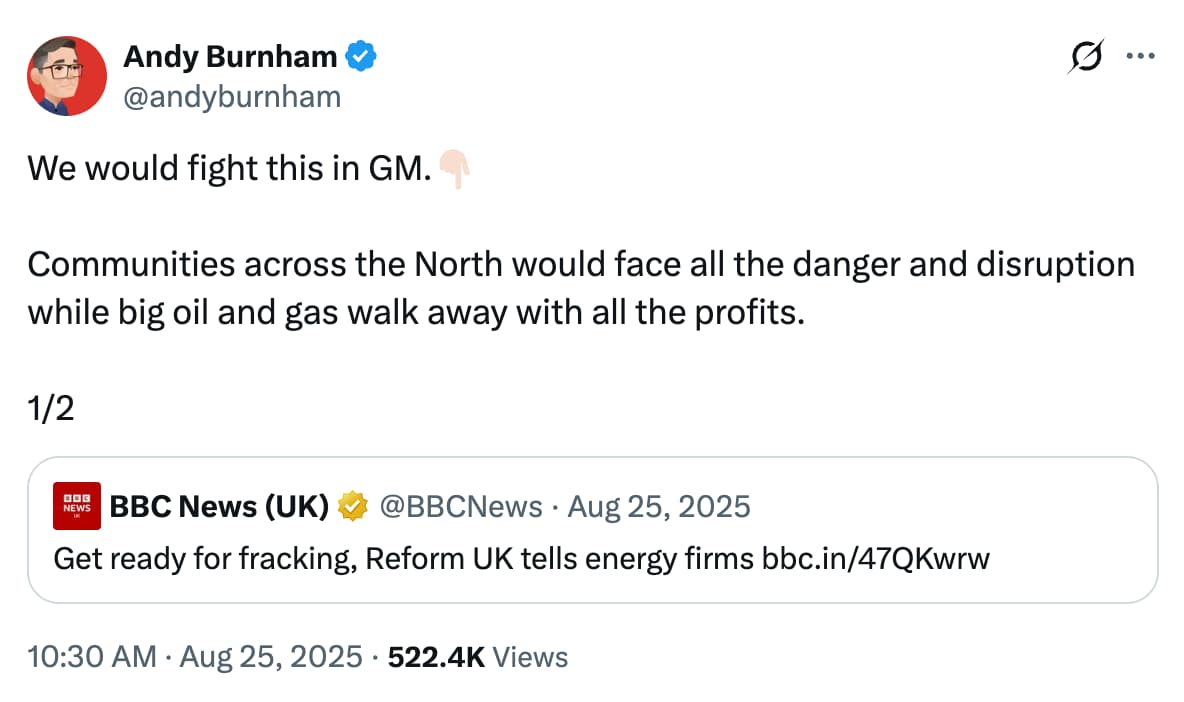
“We would fight this in GM [Greater Manchester]…Communities across the north would face all the danger and disruption while big oil and gas walk away with all the profits.”
In response to Reform’s call for fracking, on X, 25 August 2025
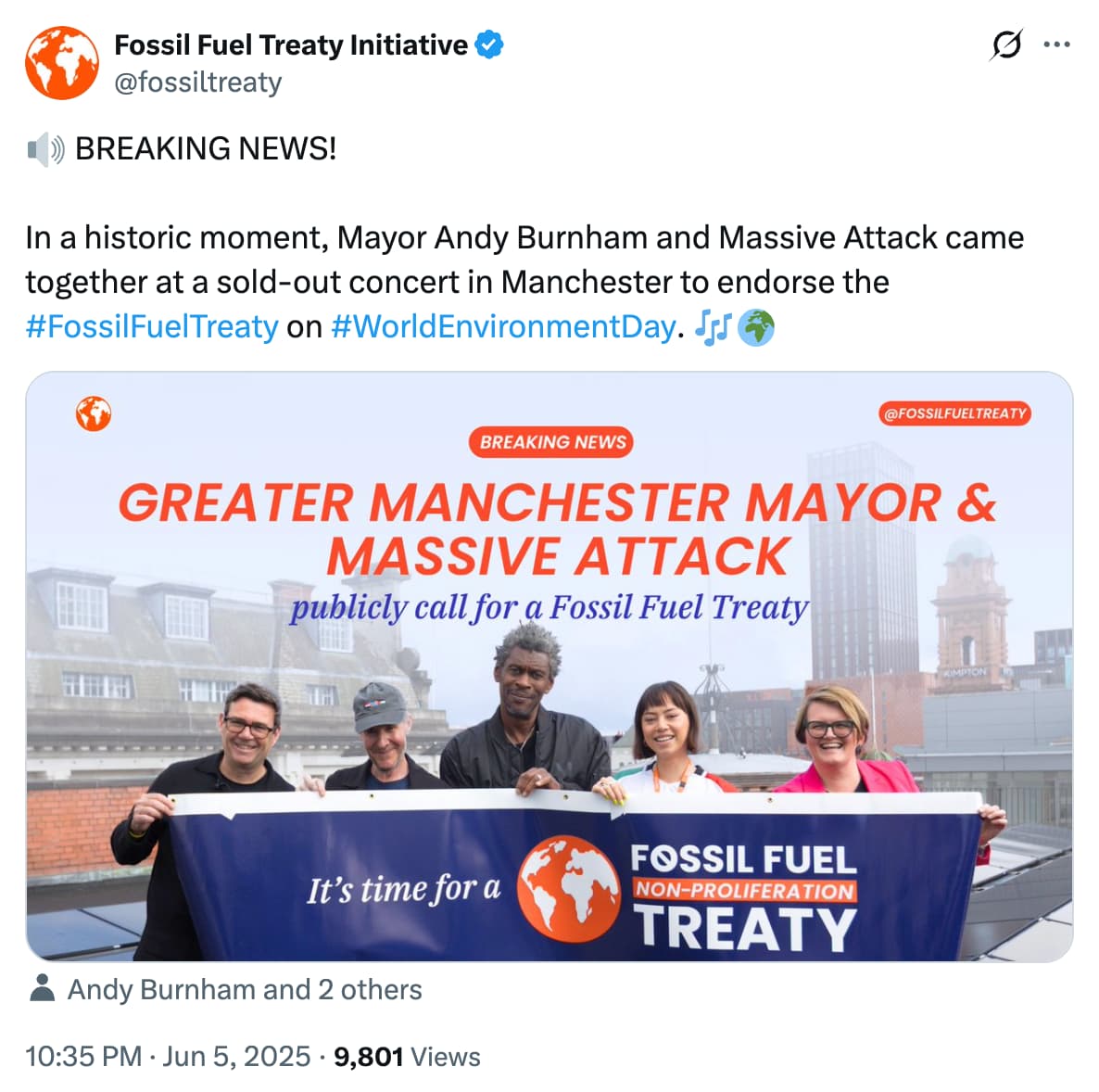
“I am proud to endorse the fossil-fuel treaty proposal today on behalf of Greater Manchester. It’s not just a plan – it’s a lifeline. It’s a call to end coal, oil and gas, hold polluters accountable…I urge all governments, nationals and subnationals to join this fight.”
Statement upon endorsing the fossil-fuel treaty, 5 June 2025
“Fracking is the past, it is not the future.”
Speech at London climate protest, 20 September 2019
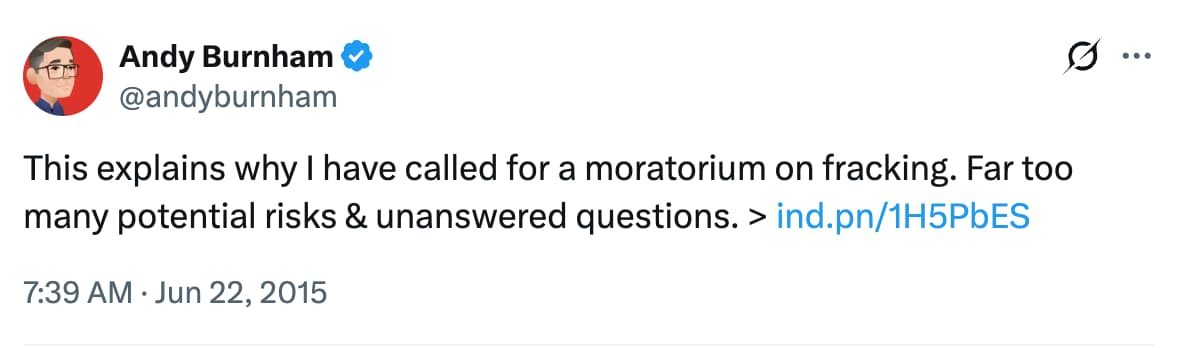
“I have called for a moratorium on fracking. Far too many potential risks and unanswered questions.”
On X, 22 June 2015
Energy and transport
“What I would do, if successful, is lay out a plan for more public control over water, energy, transport, so that over the period we can get those bills down, fares down, and give people and give businesses breathing space.”
LBC interview, 2 July 2026
“I am all in favour of tough decisions at a national level. I don’t believe there should be a third runway at Heathrow, for instance. But I think those are decisions for national government.”
Guardian interview, 13 June 2019
“There is a debate to be had about aviation, isn’t there? There are changing public attitudes about aviation. Rather than just saying no to people flying, don’t we need to accelerate research into low and zero-carbon forms of aviation?”
Guardian interview, 13 June 2019
“Today, I stand alongside the mayors of some of the greatest cities in the world. I’m committed to a cleaner, greener and healthier future for Greater Manchester. Around a third of greenhouse gas emissions in our city-region come from transport.”
When signing the C40 Fossil-Fuel-Free Streets Declaration, which includes support for zero-emissions vehicles and walking and cycling, on behalf of Manchester, 14 September 2018
This article was updated on 20 July to reflect Burnham replacing Keir Starmer as UK prime minister.

UK withdraws millions in funding from world’s second-largest rainforest in Congo
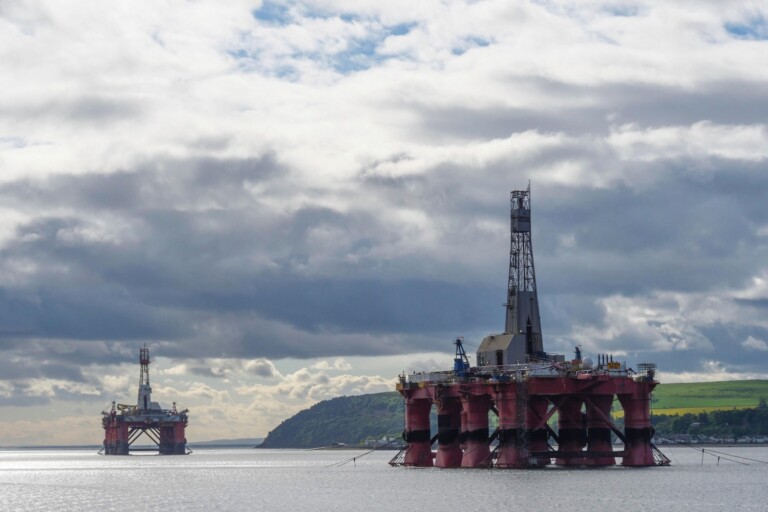
Analysis: UK newspapers have already printed 63 editorials in 2026 backing North Sea drilling
Livestock heat deaths in transit doubled in UK record-hot summer of 2025
Analysis: UK sales of electric vehicles just overtook petrol cars for the first time
The post 28 quotes from new UK leader Andy Burnham on climate, net-zero and fossil fuels appeared first on Carbon Brief.
28 quotes from new UK leader Andy Burnham on climate, net-zero and fossil fuels
Climate Change
Analysis: Weaker EV targets could cost UK consumers £3bn a year by 2030
An upcoming UK government consultation on weakening targets for electric vehicles (EVs) could cost consumers as much as £3bn a year by 2030, according to Carbon Brief analysis.
It could require the UK to import an extra 17m barrels of oil in 2030, raising expected net imports by 8%, as well as adding 2.5% to national emissions that year, the analysis shows.
After years of fierce lobbying by parts of the car industry – and despite the significant savings on offer for EV drivers – media reports suggest that EV targets could be “watered down”.
Under current rules, battery EVs – BEVs, those which run only on electricity – must make up a rising share of new car sales in the UK.
This policy, known as the “zero-emission vehicles” (ZEV) mandate, was introduced by the previous Conservative government and sets a goal for 33% BEV sales in 2026, rising to 80% in 2030.
(Carmakers are able to use “flexibilities” to help meet their targets, which reduces the effective target under the ZEV mandate to an estimated 25% of sales in 2026.)
Now, the government under new Labour prime minister Andy Burnham is reported to be considering a cut in the BEV target for 2030 to just 50% of new car sales, alongside options for 60% or 70%.
Carbon Brief understands that a consultation on weakening the ZEV mandate is being reviewed by the prime minister’s office in Number 10, ahead of being formally released.
If the mandate is weakened to 50% by 2030 – and if carmakers make more use of “flexibilities” – there could be up to 3m fewer BEVs on UK roads by 2030, according to the NGO T&E.
Previous Carbon Brief analysis found that BEVs are around £1,100 cheaper to run per year than a petrol car, thanks to far lower fuel costs.
Overall, BEVs are more than £1,000 per year cheaper to own than either petrol cars or plug-in hybrids (PHEVs, which can run on petrol or electricity).
This is according to analysis of the “total cost of ownership” by the Energy and Climate Intelligence Unit (ECIU), including purchase price, fuel costs, insurance and proposed pay-per-mile charges.
In total, Carbon Brief analysis shows that UK drivers could be hit with an extra £3bn in annual ownership costs by 2030, if the ZEV mandate is weakened, as shown below.

A weaker ZEV mandate could “put billions of pounds of committed investments at risk”, reports BusinessGreen, including in the EV charging network and battery supply chains.
Industry group Energy UK says that the mandate is “working in the way it was designed to work” and that it is the “single biggest driver of emissions reductions” in government climate plans.
However, Carbon Brief analysis shows that a weaker ZEV mandate could result in an extra 7.4m tonnes of carbon dioxide emissions (MtCO2) in 2030. This would add the equivalent of 2.5% to national emissions in 2030, under the UK’s international climate goal for that year.
In addition, a weaker ZEV mandate could result in the UK needing to import an extra 17m barrels of oil in 2030, equivalent to 8% of projected net imports that year.
Energy UK says that shifting to EVs will help to reduce household energy bills “for everyone”. This is not only through direct cost-of-ownership savings for EV drivers, but also by spreading the costs of upgrading the electricity system across a wider user base.
Car industry group the Society of Motor Manufacturers and Traders claims that its members are spending “blilions…on discounts, finance incentives and marketing support” and that “natural” EV demand is below the level required to meet the current ZEV mandate. Its claims are disputed.
related
Q&A: Does the world need ‘carbon capture and storage’ to reach net-zero?
UK withdraws millions in funding from world’s second-largest rainforest in Congo
28 quotes from new UK leader Andy Burnham on climate, net-zero and fossil fuels
Analysis: UK newspapers have already printed 63 editorials in 2026 backing North Sea drilling
The post Analysis: Weaker EV targets could cost UK consumers £3bn a year by 2030 appeared first on Carbon Brief.
Analysis: Weaker EV targets could cost UK consumers £3bn a year by 2030
Climate Change
“We’ve gone backwards” – new plastics treaty text dims hopes for production curbs
A new draft text to revive deadlocked UN plastics treaty talks does not include specific measures on managing runaway plastic production, a growing source of greenhouse gas emissions, drawing criticism from some countries and campaigners that ambition for the global pact is shrinking.
After diplomats met in Nairobi early in July for the first time since negotiations fell apart a year ago, Chilean ambassador Julio Cordano, who is chairing the talks, released a first document last weekend, setting out elements of a possible treaty to tackle plastic pollution.
Cordano stressed this is an “informal reference document” rather than a negotiated text. But its structure is similar to a draft treaty and closely resembles the previous version rejected by governments during the last round of formal negotiations in Geneva.
The new text recognises the world’s “unsustainable” levels of plastic production and consumption, both of which are projected to nearly triple by 2060. But it contains no measures to stem that growth, critics say, pointing to what they see as a broader weakening of ambition.
They argue the document is increasingly aligned with the demands of fossil fuel-producing countries, including Gulf states, the US and Russia, which have pushed for the treaty to focus on managing plastic waste rather than limiting production.
“When you leave the countries that have the most vested interests in delaying meaningful action to shape the agenda, you end up with a text that does nothing to end plastic pollution,” said David Azoulay, environmental health programme director at the Center for International Environmental Law (CIEL).
France disappointed with production omission
“We’ve gone backwards rather than forwards,” Christina Dixon, a campaigner at the Environmental Investigation Agency (EIA), told Climate Home News. “A text that was rejected by the majority of countries in Geneva as being too weak and not ambitious enough has been repackaged one year later with some key elements removed and put out as a kind of sign of progress.”
A French diplomatic source told Climate Home News it was “disappointing” that the text lacked any concrete provisions on tackling “unsustainable” levels of plastics production and consumption. That is despite a majority of countries repeatedly advocating for curbs and scientists saying the world cannot put an end to plastic pollution without tackling the issue at source, they added.
Governments across Europe, Latin America, Africa and the Pacific islands have previously called for efforts to limit the manufacturing of plastics to “sustainable levels”, but their efforts have been frustrated by strong and persistent opposition from a small group of fossil fuel producers, who see plastics as a growing market for oil and gas.
Weakening of production ambition
Cordano told Climate Home News that the “concept” of sustainable production is still reflected in different parts of the new document.
But measures aimed at achieving that objective have progressively weakened over time. Initial versions of the draft treaty, dating back to 2024, included a standalone article with the option of setting a global target to reduce the production and consumption of primary plastics.
That disappeared from successive drafts published in Geneva last year. The last version nevertheless said data on plastic production could be considered in future assessments of whether the treaty was meeting its objectives. Observers saw this as an important provision that could have strengthened the pact over time and potentially kept the door open for a global production target.
The new text only mentions “sustainable production” in the preamble and includes an article saying that countries could improve the design of plastic products in order to contribute to “sustainable production”.
“There’s a war of attrition element,” said Dennis Clare, a negotiator for the Pacific island nation of Micronesia. “The countries that want to do less are dragging out discussions and gradually pressuring the more ambitious to compromise towards a lower common denominator.”
Little space for thorny discussions
Countries have twice failed to agree on a global plastics treaty at what were meant to be final rounds of negotiations in December 2024 and August 2025. After being selected as the new chair earlier this year, Cordano has been working to steer the process back on track through a series of informal meetings, hoping diplomats can find common ground ahead of the next formal negotiations scheduled for early 2027.
But he has been criticised for sidelining discussions on some of the thorniest issues. Cordano kept plastic production off the official agenda for the Nairobi meeting a few weeks ago. He said beforehand that countries could bring any issue to the table, but production did not feature in the summary of discussions subsequently published by the chair.
Clare said discussions on fundamental elements of the treaty, including production, had been “constrained” and that there was little space for them in Nairobi.
Cordano told Climate Home News the Nairobi talks had provided space both for “reaffirming positions and expressing new ideas”, adding that countries “remain free to raise all issues they consider important”.
Informal talks between negotiators are held behind closed doors and neither the media nor external observers can take part.


Campaigners have accused the chair of making political calculations to reach an agreement at any cost. “He has clearly identified that the only way to achieve an agreement by consensus is to do away with the more complex elements of the treaty like those that deal with sustainable production and consumption of plastics,” the EIA’s Dixon said.
Cordano said he continues to be guided by countries as “they develop their own exchanges and continue working towards possible landing zones”.
Push for more ambition
Governments will debate the new text at another meeting of chief negotiators in Bangkok, Thailand, at the end of September, and a new version of the document is expected after that meeting.
The French diplomatic source said the current text should not be viewed as “an end-product”, but as a starting point that “can and should be improved”.
France, together with the EU and members of the High Ambition Coalition (HAC), will continue pushing for stronger provisions, including measures to address plastic production, the source said.
China’s coal power rebounds as record clean energy goes to waste
The HAC group includes over 70 countries, primarily from across Europe, Latin America, Africa and the Pacific.
Micronesian negotiator Clare said countries on the frontline of the plastics crisis may decide to reject a really weak treaty that puts the burden on them to clean up somebody else’s waste, while producers can keep churning out plastics unrestrained.
“If the treaty does not include essential elements of the solution, even an initial, apparent diplomatic success – an agreement – can come to be seen over time as an environmental failure,” Clare warned.
The post “We’ve gone backwards” – new plastics treaty text dims hopes for production curbs appeared first on Climate Home News.
“We’ve gone backwards” – new plastics treaty text dims hopes for production curbs
Climate Change
South Africa’s offshore oil push meets grassroots resistance in court
Layers of red dust coat South Africa’s Saldanha Bay, a legacy of the one billion-plus tonnes of iron ore exported from what was once a quiet coastal fishing town in the 1970s. Now the government wants to turn this area into the “oil and gas hub of South Africa”, but opposition from local communities and civil society could force a change of plan.
Since 2014 South Africa has developed a strategy for taking “full advantage” of its marine resources, known as Operation Phakisa. It has resulted in the mapping of more than 95% of the country’s nearly 3,000-kilometre coastline for offshore oil and gas exploration.
The plan seeks to “drill 30 exploration wells in 10 years”, which it estimates could lead to the production of an average of 370,000 barrels of oil and gas per day over 20 years, with Saldanha Bay earmarked as a key logistics hub. It also aims to develop other marine sectors like aquaculture, maritime transport and ocean tourism.
However, two major court cases against the government and oil giants Shell and TotalEnergies have challenged those plans, as coastal residents, allied with national civil society groups, have pushed back against oil concessions held by the multinationals, arguing they were not consulted, and that towns like Saldanha Bay could face social and environmental harms from the fossil fuel extraction.
Melissa Groenink-Groves, programme manager at legal nonprofit Natural Justice, said the cases in South Africa could set a precedent for the whole region. “When communities win in the courts, the successes serve as inspiration for other communities to advocate [for] their rights in their own contexts,” she explained.
She added that the legal challenges to Operation Phakisa also develop climate litigation in the African context, and could impact how environmental impact assessments are conducted going forward.
Globally, as the oil and gas industry sets its sights on the ocean, with over 85% of new discoveries in 2024 made offshore, scientists and activists warn it could threaten marine life and coastal communities, and weaken the ocean’s ability to trap excess heat from the atmosphere, fuelling planetary warming further.

Taking oil companies to court
About 300 kilometres north of Saldanha Bay, the Aukotowa Fisheries Cooperative, backed by nonprofits The Green Connection and Natural Justice, has taken TotalEnergies to court over its plans to drill for oil and gas in a 30,000-square-kilometre block off South Africa’s west coast.
The oil exploration block is in a biodiverse marine area bordering Namibia and South Africa known as the Orange Basin, which is a “highly relevant” sanctuary for endangered species, according to Nelson Mandela University’s Institute for Coastal and Marine Research.
Among other grievances, the cooperative maintains that the company’s environmental impact assessment was flawed, failing to consider the project’s contribution to climate change, and that the government “placed the profits of a multinational corporation above the livelihoods of vulnerable coastal communities”. The Western Cape High Court concluded hearings in late March and is expected to deliver a ruling later this year.
Walter Steenkamp, chairperson of the Aukotowa Cooperative, is concerned that the oil and gas drilling will lead to increased inequality, asking “for whom is the development? Definitely not for us.”
In a written statement, TotalEnergies told Climate Home News that it “is a responsible operator fully committed to complying with all applicable South African legislation”.
Southeast Asia’s fragile grids threaten billions in clean energy investment
Communities and climate impacts at stake
On the other side of the country, along South Africa’s eastern coastline, community-based nonprofit Sustaining the Wild Coast and partner organisations challenged Shell and Impact Africa’s exploration permit, arguing that the firms had failed to consult impacted communities – a legal requirement under South African law.
Co-plaintiff Sinegugu Zukulu also said in 2022 that “oil and gas will lead to more emissions, and in the face of climate change, this is wholly irresponsible”.
Following two rulings against the companies by lower courts, the case is now before South Africa’s highest Constitutional Court, which has reserved judgment since September 2025. A ruling against the companies would be final, effectively ending the exploration permit.
Legal expert Groenink-Groves said oil exploration applications under Operation Phakisa have been “granted largely without properly assessing the devastating impact an oil spill could have on small-scale fishers, the risks of drilling in ultra-deep waters, [and] without accounting for climate change impacts associated with oil and gas exploitation”.
She added that exploration applications have often failed to consider coastal management laws and in some cases, cross-border and regional environmental risks.
Shell and South Africa’s Department of Mineral and Petroleum Resources did not respond to written requests for comment.

South Africa’s offshore oil ambitions
Fishers around South Africa, many of whom have for generations relied on marine resources for survival, say the country’s offshore oil and gas push is sacrificing their livelihoods for profit.
“Why do they want to destroy our heritage? We can’t afford to say yes to oil and gas because the ocean is our source of life,” said Carmelita Mostert, a member of advocacy group Coastal Links and third-generation Saldanha Bay fisher.
Yet with unemployment above 30%, alongside high levels of poverty and wealth inequality, the government sees Operation Phakisa as a vehicle for socioeconomic development.
South Africa’s Minister of Mineral and Petroleum Resources Gwede Mantashe has described the court cases as “anti-development”, and claimed that the environmental organisations are funded by the CIA.
Sifiso Dladla, a campaigner with human rights organisation groundWork, argued that the close relationship between the government and the fossil fuel industry – including its 3% contribution to gross tax revenue – limits the potential success of movements pushing for an inclusive energy system. Politicians “need money to win elections. Mining companies need the government to protect them,” he said.
Patrick Bond, a political economist and sociology professor at the University of Johannesburg, said Operation Phakisa only makes economic sense if its social and environmental harms are ignored, adding that “if a genuine social cost of carbon analysis were done in any African fossil fuel project, there would be few – if any – able to justify the projects economically”.
At a global scale, Bond said oil multinationals have the financial backing of European governments – including France’s $2.8 billion stake in TotalEnergies – which can help make local resistance more effective where it has international allies to amplify the messages.
For Saldanha Bay fisher Mostert, the fight is about protecting the livelihoods of coastal communities. “It is my hope that we can stand strong and protest,” she said. “If oil and gas is not allowed, our lives will be much easier and better – but if oil and gas goes ahead we will be in absolute agony.”
The post South Africa’s offshore oil push meets grassroots resistance in court appeared first on Climate Home News.
South Africa’s offshore oil push meets grassroots resistance in court
-
Climate Change1 year ago
Guest post: Why China is still building new coal – and when it might stop
-
Greenhouse Gases1 year ago
Guest post: Why China is still building new coal – and when it might stop
-
Greenhouse Gases2 years ago嘉宾来稿:满足中国增长的用电需求 光伏加储能“比新建煤电更实惠”
-
Climate Change2 years ago嘉宾来稿:满足中国增长的用电需求 光伏加储能“比新建煤电更实惠”
-
Climate Change2 years ago
Bill Discounting Climate Change in Florida’s Energy Policy Awaits DeSantis’ Approval
-
Renewable Energy10 months agoSending Progressive Philanthropist George Soros to Prison?
-
Greenhouse Gases1 year ago
嘉宾来稿:探究火山喷发如何影响气候预测
-
Carbon Footprint2 years agoUS SEC’s Climate Disclosure Rules Spur Renewed Interest in Carbon Credits