

2024年,清洁能源技术对中国经济的贡献率首次达到10%以上,相关销售和投资总额达到13.6万亿元人民币(1.9万亿美元)。
在2024年,清洁能源行业推动了四分之一的国内生产总值(GDP)增长,其市场规模已超过房地产销售。
Carbon Brief根据官方、行业数据和分析师报告进行的最新行业分析显示,清洁技术在中国经济中的作用日益增强,尤其是所谓的“新三样”行业,即太阳能、电动汽车和电池。
本篇分析对“清洁能源”行业的定义较为宽泛,涵盖可再生能源、核能、电网、储能、电动汽车和铁路。这些技术和基础设施是中国推动能源生产和使用脱碳的关键。
其他关键调研结果包括:
- 2024年清洁能源投资达到6.8万亿元人民币(9400亿美元),同比增长7%。相比2023年40%的增速,这一增长有所放缓,但符合预期趋势。
- 中国对清洁能源的投资规模接近全球对化石燃料的投资总额,其体量相当于沙特阿拉伯的经济总量。
- 作为“新三样”,电动汽车、电池和太阳能仍然是清洁能源行业的核心驱动力,三者创造了四分之三的附加值,并吸引了该行业一半以上的投资。
- 2024年,清洁能源行业经济产出的增长拉动了其对GDP的贡献,而2023年主要依靠投资增长带动。
- 若考虑整个生产链的产值,清洁能源行业对中国经济的总体贡献为 13.6万亿元人民币(1.9万亿美元),略高于GDP总量的10%。
- 该行业的增长速度是中国整体经济增速的三倍,占2024年GDP增长的26%。
- 值得注意的是,若无清洁技术的增长,中国2024年的GDP增速可能仅为3.6%,远低于官方公布的5.0%目标。
展望2025年,清洁能源投资可能会进一步增长,因为许多大型项目正加快推进,以试图在“十四五”规划(2021-2025年)结束前完工。
在此之后,清洁能源行业的发展将很大程度上取决于下一份五年规划设定的新目标和政策,该计划即于今年制定。
清洁能源达到GDP里程碑
2023年,在清洁能源行业巨大的产能投资浪潮推动下,该行业贡献了中国约40%的经济增长。
正如去年的分析所预测,超常规的投资增长率在2024年不可避免地会降温,而新的数据也证明了这一趋势。
尽管如此,2024年清洁能源行业的投资仍然保持增长,并且该行业的商品和服务产值增速依然超过20%。
因此,正如下图所示,2024年清洁能源行业占中国GDP的比重首次超过10%。
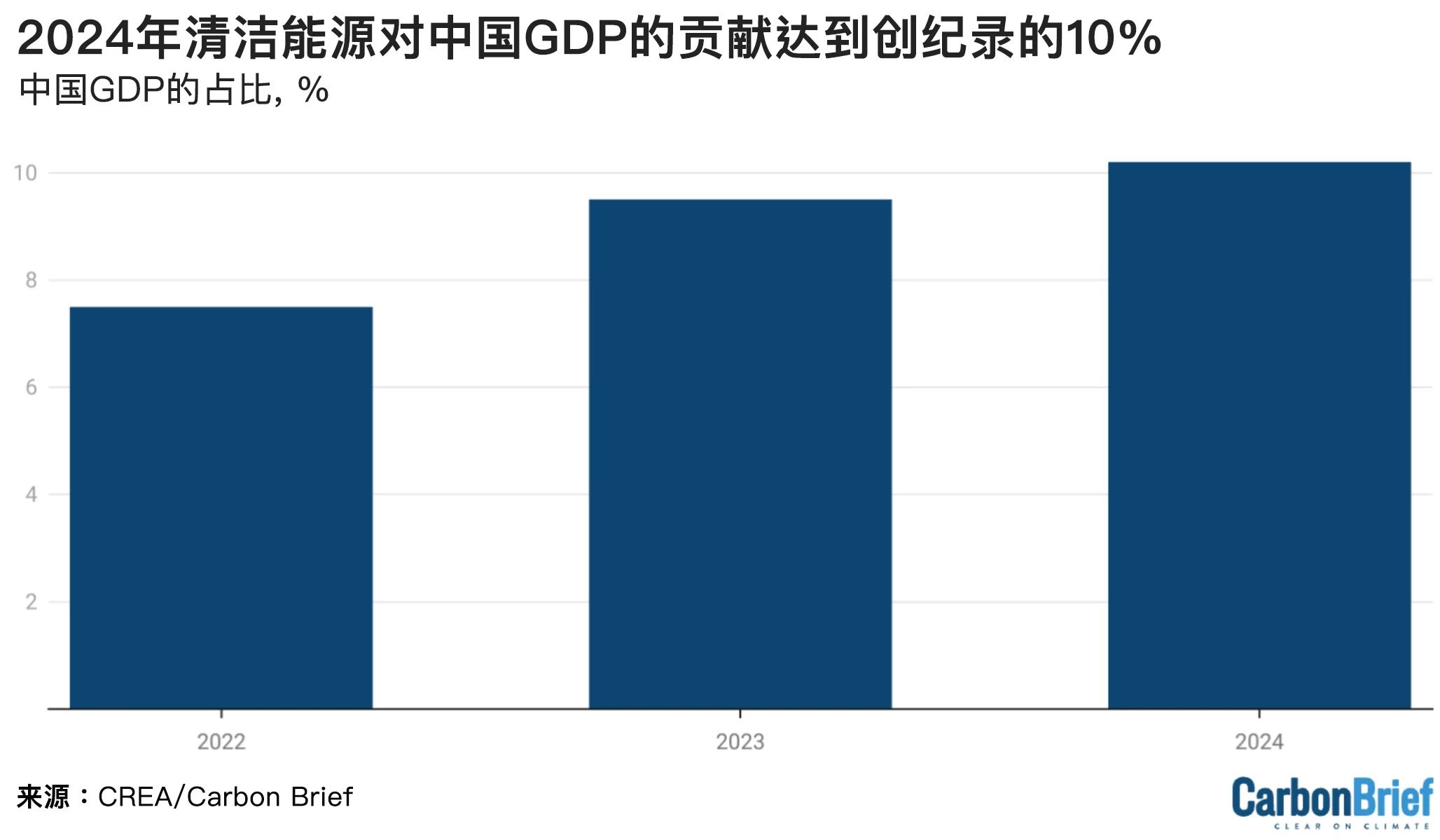
清洁能源行业对中国经济的整体贡献达到13.6万亿元人民币(1.9万亿美元),其规模与沙特阿拉伯或瑞士等主要经济体相当。
同时,该行业在中国经济中的比重已超过房地产销售(9.6万亿元人民币)和农业(9.1万亿元人民币)。
电动汽车和太阳能是增长主要驱动力
2024年清洁能源行业的生产和投资总值预计增长了13%,自2022年以来则增长了50%,如下图所示。
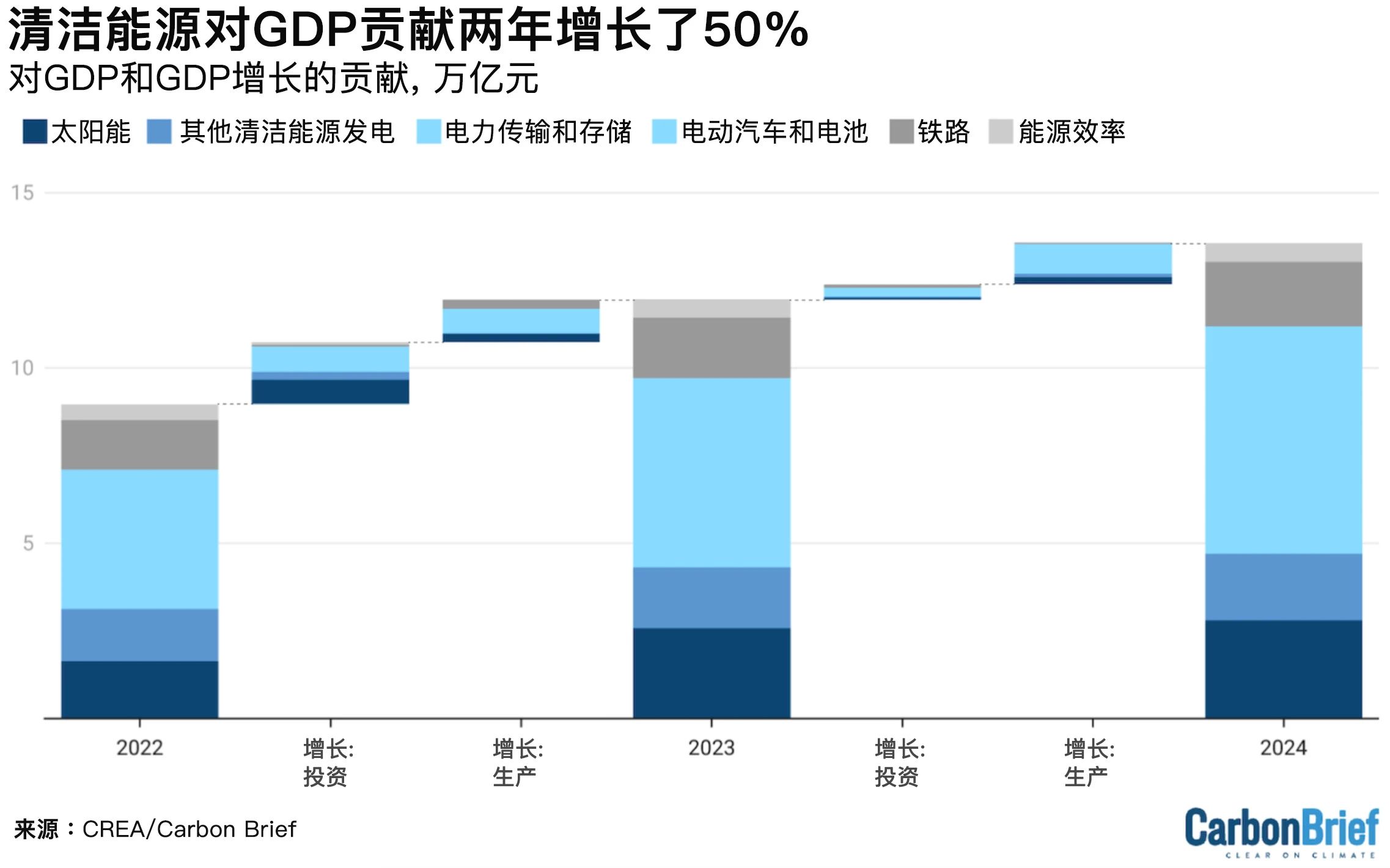
这些行业的商品和服务产值增长了21%,达到6.8万亿元人民币(9500亿美元)。
总体而言,电动汽车生产是最具价值的细分行业,其次是清洁能源生产、铁路运输、电力传输与储存,以及能源效率。
下表详细列出了各行业和活动的具体数据。

价格下跌促进采用,但对生产商构成挑战
在全球大多数经济体都在担忧高通胀之际,中国却面临通货紧缩的压力,主要原因是制造业快速扩张,而国内需求相对疲软。
多个关键清洁能源行业都受到这一趋势的影响。尽管产量不断增长,但供过于求导致收入和利润增长乏力,使该行业的实际贡献在一定程度上被忽视。
以太阳能电池板制造为例,尽管产量大幅增长,但行业名义产值下降了41%。

不过,由于项目数量激增,加上太阳能电池板成本仅占整个太阳能发电项目成本的不到三分之一,太阳能项目的投资名义价值仍保持稳定。
太阳能发电电力价值增长了40%,使得太阳能行业对名义GDP增长的总体贡献率上升至正值。
总体来看,清洁能源行业的增加值按名义计算增长了约8.5%,低于实际增长率的15%,但仍远高于GDP增速,占名义GDP增长的17%。
2024年12月,一场重要的年度经济政策会议强调,需要“积极营造绿色低碳产业健康发展生态”。这表明政府可能会采取措施解决清洁制造业供应过剩和该行业盈利能力较弱的问题。
清洁能源经济快速增长的影响
清洁能源行业连续第二年在中国经济增长目标的实现中发挥了关键作用。
供应增加和价格下降的双重因素,导致中国清洁能源部署速度远超几年前的预期,同时也促进了清洁能源在新兴海外市场的部署。
预计这一增长趋势将在2025年延续,这主要得益于多个重大项目都致力于在“十四五”规划(2021-2025年)收官前完工。
2025年以后,该行业的发展将在很大程度上取决于今年即将完成的下一个五年计划(2026-2030年)中的新目标和政策。
随着近几年清洁能源发电装机容量的闪电式扩张,该行业正陷入盈利能力下降和产能过剩的困境。
若要恢复行业盈利能力,中国既需要保持强劲的国内需求,也需要采取措施解决产能过剩问题。此外,弃电问题(尤其对太阳能发电产生限制)也亟需解决,以确保市场需求能持续释放。
根据中国主要部委提出的2030年和2035年目标所显示的初步迹象,中国难以将关键清洁能源技术需求维持在2023-2024年水平。
如果清洁能源行业在下一个五年规划时期的目标低于当前部署速度,该行业可能从拉动GDP增长的推动力转变为拖累因素,并加剧供过于求的问题。相反,更具雄心的清洁能源目标将有助于保持该行业对经济的积极贡献。
鉴于清洁能源在投资增长中发挥的重要作用,政府的经济刺激措施可能会支持清洁能源领域的投资。
此外,清洁能源现在在中国经济增长中的关键作用,也使得政策制定者更有动力确保该行业的健康发展。



The post 分析:2024年清洁能源对中国GDP的贡献将达到创纪录的10% appeared first on Carbon Brief.

June Rubis is a steering group committee member for the Cali Fund, from Sarawak in Malaysian Borneo.
At COP16 in Cali, governments made a significant commitment: at least half of the funding from the new Cali Fund should support the self-identified needs of Indigenous Peoples and local communities, including women and youth. It was a watershed moment for multilateral benefit-sharing.
The challenge now is to translate that commitment into access arrangements that recognise the different institutions, priorities and decision-making processes of Indigenous Peoples and local communities.
For generations, biodiversity and traditional Indigenous knowledge have provided significant value to companies who depend on nature’s genetic diversity to discover new drugs that fight diseases, create products that improve health, and grow crops resilient to extreme heat and flooding events. While some compounds are sampled directly from the source country, increasingly the digital blueprints are held in online public databases which are freely accessible to use for innovation and research.
Countries urged to ramp up “insufficient” nature policies at COP17
The Cali Fund was established at COP16 to encourage commercial users of Digital Sequence Information, or DSI, to share benefits arising from its use. Estimates suggest it could generate over $3.5 billion a year – a stark contrast to the modest $10,656 currently committed to the fund from just five SMEs, underlining how much progress must be made at COP17 over the next two weeks.
The COP16 decision that set up the fund offers two routes for money to reach Indigenous Peoples and local communities: through government authorities, and through direct payments to institutions identified by Indigenous Peoples and local communities themselves.
Varied ways of organising
Indigenous Peoples and local communities organise through a wide range of institutions. Some have national or regional organisations experienced in managing international grants. Others work through territorial organisations, customary institutions, community associations, cooperatives or networks. Some have professional finance teams and audited accounts; others have extensive experience governing territories, collective resources or conservation work without having been organised around international funding requirements.
For direct access, some questions are already apparent. Which institutions should be able to receive funds? How should they be identified? What fiduciary standards should apply? How should safeguards and accountability work where institutional capacities differ? What support may be needed where institutions have strong community mandates but less experience with international finance?
Comment: Protecting nature is a public duty, not a Wall Street profit opportunity
If access is designed mainly around institutions that already meet the expectations of large international finance mechanisms, early funding will tend to favour those already familiar to funders. They will gain further experience and become better positioned for future funding, while institutions with less administrative capacity may remain outside the system despite strong community mandates and long histories of stewardship.
These first decisions matter most, because they set the terms for everyone who follows.
The role of intermediaries requires care. Some Indigenous organisations may want a fiscal host to hold and manage funds on their behalf. Communities may choose to work through an NGO they trust. Government-facilitated arrangements may work well in particular national contexts.
What matters is the function an intermediary performs and the authority that comes with it. Providing administrative support is different from deciding which Indigenous organisations qualify, which priorities can receive support, or how success will be assessed. Direct access means communities keep that decision-making authority.
Decision-making power
The COP16 decision refers to institutions that Indigenous Peoples and local communities identify. But authority among Indigenous Peoples does not sit in one kind of body. It may sit with territorial organisations, customary institutions, community associations or combinations of these. Legal recognition and customary authority do not always align neatly.
Global deforestation slowed in 2025 but Brazil’s election could undo “fragile” gains
An important feature of the Cali Fund’s governance is that Indigenous Peoples and local communities participate as full members of the Steering Committee, rather than as observers. Seven Indigenous Peoples and local community representatives, one from each of the seven socio-cultural regions, participate in consensus-based decision-making alongside representatives of governments and UN entities. Six additional representatives from civil society, scientific institutions and the private sector participate as observers.
That representation carries responsibility. Institutional legitimacy, access and representation take different forms across the seven socio-cultural regions. Indigenous Peoples and local communities members therefore have an important role in bringing those differences into the Fund’s governance and in ensuring that arrangements developed for one context do not become the assumed model for everyone else.
Safeguards and clear responsibilities
COP17 can establish the core principles and direction, while allowing operational pathways to develop in ways that respond to different regional contexts. The decisions countries take in Yerevan will shape how that flexibility is realised in practice.
The choices made around access will influence which institutions are able to participate, which routes become established and which forms of authority are recognised within the funding architecture. The aim should be an architecture with enough structure to maintain confidence while allowing for different forms of Indigenous and community governance.
A credible direct-access pathway will need safeguards, financial oversight and clear responsibilities. This would give the 50% commitment a stronger institutional foundation.
The Cali Fund’s importance will ultimately depend not only on how much funding reaches Indigenous Peoples and local communities, but on whether they are able to determine how the money is accessed, governed and used. This requires access pathways that recognise their institutions, priorities and decision-making processes, rather than requiring them to conform to a single predetermined model.
The post COP17 must settle who decides how Cali Fund money is disbursed appeared first on Climate Home News.
COP17 must settle who decides how Cali Fund money is disbursed
The UK government has approved extraction at the Jackdaw gas field in the North Sea, despite acknowledging that this decision could make it harder for Britain to convince other countries to move away from fossil fuel production.
UK energy secretary Miatta Fahnbulleh approved the drilling on Wednesday after months of high-profile debate, fuelled in part by interventions from US President Donald Trump. She argued that the project would boost energy security in the wake of the Middle East fossil fuel crisis, protect hundreds of jobs and add £2.9 billion ($3.88bn) to the UK economy.
She said Jackdaw’s gas would be cleaner than imported gas and would not prevent the UK from meeting its legally-binding carbon targets and its goal of net zero by 2050. As the field is already licensed, she said extraction was consistent with the Labour Party’s 2024 manifesto promise not to issue any new oil and gas licenses.
The same morning, the government announced a new Energy Wealth Fund to reinvest oil and gas revenues in the climate transition. It will start with £2 billion ($2.67bn) from the government and be topped up over time with tax revenues from offshore oil and gas production.

Climate campaigners in the UK and abroad were quick to condemn the decision, while a leading legal expert told Climate Home News it goes against the advice of the International Court of Justice. Meanwhile, the government’s own documents reveal that it recognises the drilling could damage the UK’s reputation and its ability to push forward the global transition away from fossil fuels.
“Climate leadership” blow
The 92-page decision document says Fahnbulleh “acknowledges that international standing on climate is important and accepts that a decision to grant consent may not further the UK’s international climate leadership.”
It adds: “She acknowledges concerns about the potential implications for the UK’s credibility and influence – including the difficulty inherent in encouraging other states to move away from fossil fuel production while the UK continues, in a limited and transitional way, to draw on its own domestic resources.”
While noting that Jackdaw has not been issued with a new license – just permission to extract gas – the document says Fahnbulleh “accepts this does not fully resolve the underlying tension in the UK’s position” but “considers this alongside the substance of the UK’s wider record [on emissions reduction], which remains significant”.
It continues that she accepts these concerns are “legitimate” and weigh against approving gas extraction, but only gives this argument a “moderate negative weight” set against the benefits of gas production.
“Huge” wrong signal
In international climate talks, the UK has long supported the transition away from fossil fuels and is one of very few major oil and gas producers to ban new licenses. Across the North Sea, the Norwegian government continues to make offshore areas available for oil and gas exploration through annual licensing rounds.
Climate experts and campaigners shared the concern, acknowledged in the decision document, that approving Jackdaw could set a precedent for fossil fuel production elsewhere. Sam Fankhauser, professor of climate change economics at Oxford University, said the direct climate impact of Jackdaw is “much smaller than the debate around it would suggest” but the “wrong signal it sends, however, is huge”.
-
Carbon capture industry faces tough future, as UK raids green spending
Despite a spate of projects getting underway, the mood at an industry conference in London this week was low with government subsidies set to shrink -
Paris Agreement committee names three countries snubbing it over NDCs
More than 30 countries have failed to submit an NDC, but only three have repeatedly ignored the committee’s efforts to engage with them

