


What is clean energy and why is it important?
by Elissa Tennant
Clean energy is essential for a sustainable, healthier, and economically stable future. By transitioning away from fossil fuels — like coal, oil, and gas — and embracing scalable clean energy solutions — like solar, wind and more — we can reduce pollution, create jobs, and ensure long-term energy security.
There are many types of clean energy, which makes it harder for governments, corporations, and the public to agree on which is best. Let’s break down exactly what is clean energy, where it comes from, and how we can speed up America’s transition to a clean energy economy.
What is clean energy?
Clean energy refers to energy sources that create minimal or no carbon pollution while producing electricity. Unlike fossil fuels, which release harmful emissions after production that contribute to climate change and environmental degradation, clean energy offers a sustainable, efficient, and eco-friendly way of powering our lives. Key characteristics of clean energy include:
-
- Renewable or sustainable: Clean energy sources are naturally replenished and can be used indefinitely, as long as the necessary infrastructure is maintained.
- Minimal environmental impact: These energy sources generate little to no air and water pollution, making them far less harmful to our planet than fossil fuels.
- Efficient and cost-effective in the long term: While initial investment costs can be high, clean energy sources often become more affordable over time, leading to lower energy expenses.
Transitioning to clean energy decreases reliance on coal, oil, and gas, reducing pollution and promoting energy security. Thanks to manufacturing and the AI boom, energy demand is growing. In order to meet this increasing demand, we need to maximize our use of clean and cheap, renewable energy sources.
Types of Scalable Clean Energy Sources (“The Big 5”)
1. Solar Power
Solar power is generated by harnessing sunlight to generate electricity through photovoltaic panels.

Along with wind power, solar is the cheapest form of energy available. Solar panel costs fell by about 90% over the past 15 years.
Solar is also the fastest-growing electricity source in world history. It accounted for almost 80% of new power generating capacity added in the U.S. in 2024 and about 40% of new power production globally in 2023 (about 6% of total power generation).
Part of the reason solar is growing so fast is that it’s easily scalable. Panels can be added to rooftops and parking lots or placed in solar farms. Emerging technologies like solar tiles make it even easier to install solar panels.
Challenges of Solar Power
Solar is intermittent — in other words, the sun doesn’t shine all the time. That means solar needs to be paired with battery storage and utility upgrades. The good news here is that battery prices have come way down, too. And, in the last two years, there has been a surge of battery manufacturing in the U.S., leading to good jobs and lots of investment in towns across the country.
2. Wind Energy
Wind energy is produced by using turbines to convert wind into electricity. Wind is commonly “collected” and harnessed in onshore and offshore wind farms or standalone turbines.

Along with solar, wind is the cheapest source of new electricity. Wind power costs fell by about 70% over the past 15 years. It is not as fast-growing as solar, but is still experiencing growth as a source of clean energy. Wind accounted for about 10% of new power generating capacity added in the U.S. in 2024 and about 25% of new power production globally in 2023 (8% of total power generation).
Challenges of Wind Energy
Wind energy has come under fire in the current administration, which has criticized it for being unreliable and killing whales, among other false or misleading claims. Whales, in particular, have been dying at unusually high rates since 2016, which scientists attribute to a variety of factors, including increased commercial activity in whale habitats.
As of 2025, new wind energy projects are halted on all federal lands or waters. Clean energy activists are hoping to see this ban lifted in the near future.
3. Nuclear Power
Nuclear power refers to clean electricity generation from nuclear fission. It is created in large-scale nuclear plants and emerging small modular reactors (SMRs).
In 2023 the first nuclear reactor to be fully planned and built in the U.S. in the last 30 years was brought online in Georgia. Not many nuclear plants have been built since 1990 because fracking made natural gas, which is a fossil fuel, plentiful. Recently, public opinion has shifted to be more favorable on nuclear power and there have been several policies passed designed to make it more affordable and efficient to build new nuclear reactors. See our nuclear page for more information.
Benefits of Nuclear Power
Nuclear power has even lower lifetime carbon emissions than solar power. Nuclear reactors and power plants have a much lower land footprint than solar and wind farms. It is a clean, firm source of power not dependent on variable weather, and it produces about 9% of global electricity today.
Challenges of Nuclear Power
There are minor risks and impacts associated with radiation and storage of nuclear waste involved in producing nuclear power. These risks are less than that of using fossil fuels, but media and public perception tend to give nuclear a bad reputation.
The high costs and slow deployment of nuclear power are also challenges. Because nuclear facilities often exceed their planned budget, the energy ends up being more expensive than other clean sources.
4. Geothermal Energy
Creating geothermal energy involves using heat from the Earth’s interior to generate power. It is generally produced in power plants in geologically active regions. In some cases it can be harnessed directly from the source to heat homes and buildings.
Benefits of Geothermal Energy
Geothermal energy, like nuclear, is a clean, firm source of power not dependent on variable weather. While most geothermal power today is generated from hot water near the ground surface, enhanced geothermal is being developed quickly to cost-effectively harness deeper heat in a lot more places. See our geothermal page for more information.
Mining for geothermal energy uses similar extraction techniques to oil and gas. Expertise and specific skills built over decades by oil and gas workers are directly transferable to a new clean energy source of energy. It’s a great way to transition American workers into a clean energy economy.
Challenges of Geothermal Energy
Geothermal is location-specific and must be harvested where there are hydrothermal resources, which is mostly in the western half of the U.S. To get geothermal power to the East Coast, America would need to install better transmission lines.
Aside from the transmission lines, the general cost of geothermal energy is expensive up front. There are currently few financial incentives to set up a geothermal operation. However, once set up, there are very little maintenance and operational costs in the long-term.
There is also a risk of seismic activity when drilling for geothermal energy, unless the drilling operation is run with strict standards to prevent earthquakes.
5. Hydropower Energy
Hydropower energy uses the movement of water to generate power. It requires a flowing water source.
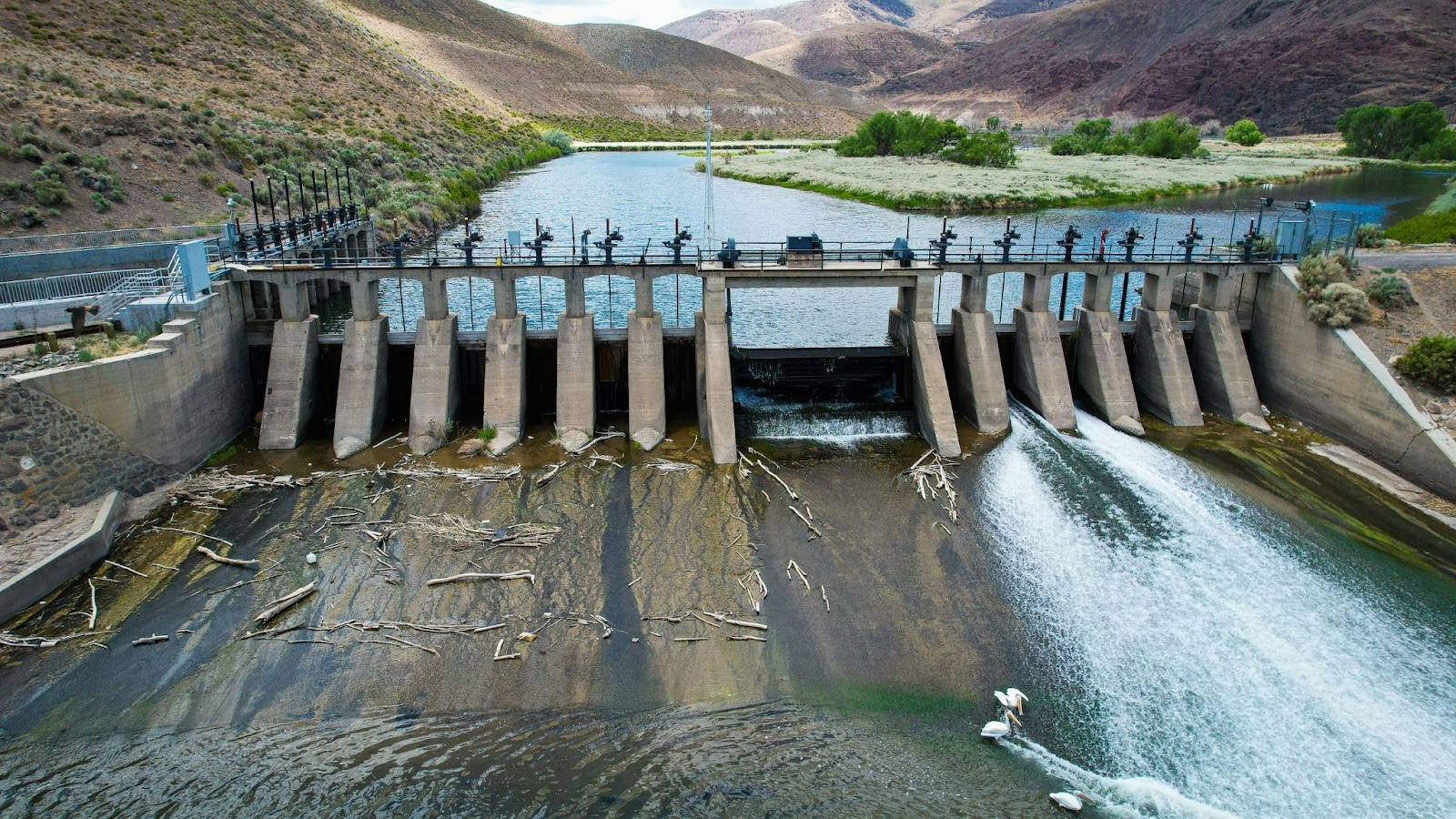
Again, hydropower is a clean, firm source of power generally not dependent on variable weather (with the exception of drought). It produces about 14% of global electricity today.
Challenges of Hydropower Energy
Large hydropower projects can lead to conflicts by displacing local communities, and natural habitats, including important fisheries, can be disrupted if a careful balance between energy needs and ecosystem services is not established. Perhaps the most discussed impact is the disruption of fish migration.
Hydropower is also not particularly scalable. Most good dam sites in the U.S. are already built, and an increase in drought is making it harder to find water sources for hydropower. See our hydropower page for more information.
Why is Clean Energy Important?
Transitioning to clean energy doesn’t just cut emissions and reduce pollution. There are a number of benefits we’ll see by making the switch as soon as possible.
- Environmental benefits: Decreases air and water pollution.
- Economic benefits: Lowers energy costs for homes and businesses in the long run while creating jobs in the renewable energy sector.
- Geopolitical benefits: Enhances national energy independence and security by reducing our reliance on imported fossil fuels.
- Health benefits: Reduced air pollution leads to improved public health by decreasing respiratory diseases and other illnesses caused by fossil fuel pollution.
Challenges to Clean Energy Adoption
One of the main challenges is that some clean energy sources, like solar and wind, are intermittent and require energy storage solutions. The U.S. electrical grid is aging and was designed for fossil fuel power sources. It needs modernization to support a transition to renewables, but permitting processes can delay new projects, and political opposition has slowed clean energy expansion.
Misinformation about clean energy costs and reliability also creates public resistance. Not everyone even understands the answer to the question “What is clean energy?” The current political climate and administration prioritizes oil and gas over clean energy sources, making it harder to sway public perception of clean energy expansion.
The Future of Clean Energy
Technological advancements are making clean energy more accessible, with improvements in battery storage and hydrogen fuel cells as well as clean energy sources like nuclear power and geothermal energy.
Governments and corporations play a key role in driving policy changes and investments that accelerate clean energy adoption. By shifting public perception and emphasizing the importance of transitioning to clean energy, we can urge these institutions to create policies, incentives, and investments in the clean energy economy.
Experts predict that with continued innovation and policy support, clean energy could become the dominant global energy source within the next few decades.
What is clean energy? It’s the future! Using fossil fuels has caused changes to our climate that are already hurting us, but we can protect ourselves from even more damage. Here’s what you can do right now to speed up the transition to a clean energy economy:

The post What is clean energy and why is it important? appeared first on Citizens' Climate Lobby.

Drought and heatwaves occurring together – known as “compound” events – have “surged” across the world since the early 2000s, a new study shows.
Compound drought and heat events (CDHEs) can have devastating effects, creating the ideal conditions for intense wildfires, such as Australia’s “Black Summer” of 2019-20 where bushfires burned 24m hectares and killed 33 people.
The research, published in Science Advances, finds that the increase in CDHEs is predominantly being driven by events that start with a heatwave.
The global area affected by such “heatwave-led” compound events has more than doubled between 1980-2001 and 2002-23, the study says.
The rapid increase in these events over the last 23 years cannot be explained solely by global warming, the authors note.
Since the late 1990s, feedbacks between the land and the atmosphere have become stronger, making heatwaves more likely to trigger drought conditions, they explain.
One of the study authors tells Carbon Brief that societies must pay greater attention to compound events, which can “cause severe impacts on ecosystems, agriculture and society”.
Compound events
CDHEs are extreme weather events where drought and heatwave conditions occur simultaneously – or shortly after each other – in the same region.
These events are often triggered by large-scale weather patterns, such as “blocking” highs, which can produce “prolonged” hot and dry conditions, according to the study.
Prof Sang-Wook Yeh is one of the study authors and a professor at the Ewha Womans University in South Korea. He tells Carbon Brief:
“When heatwaves and droughts occur together, the two hazards reinforce each other through land-atmosphere interactions. This amplifies surface heating and soil moisture deficits, making compound events more intense and damaging than single hazards.”
CDHEs can begin with either a heatwave or a drought.
The sequence of these extremes is important, the study says, as they have different drivers and impacts.
For example, in a CDHE where the heatwave was the precursor, increased direct sunshine causes more moisture loss from soils and plants, leading to a drought.
Conversely, in an event where the drought was the precursor, the lack of soil moisture means that less of the sun’s energy goes into evaporation and more goes into warming the Earth’s surface. This produces favourable conditions for heatwaves.
The study shows that the majority of CDHEs globally start out as a drought.
In recent years, there has been increasing focus on these events due to the devastating impact they have on agriculture, ecosystems and public health.
In Russia in the summer of 2010, a compound drought-heatwave event – and the associated wildfires – caused the death of nearly 55,000 people, the study notes.

The record-breaking Pacific north-west “heat dome” in 2021 triggered extreme drought conditions that caused “significant declines” in wheat yields, as well as in barley, canola and fruit production in British Columbia and Alberta, Canada, says the study.
Increasing events
To assess how CDHEs are changing, the researchers use daily reanalysis data to identify droughts and heatwaves events. (Reanalysis data combines past observations with climate models to create a historical climate record.) Then, using an algorithm, they analyse how these events overlap in both time and space.
The study covers the period from 1980 to 2023 and the world’s land surface, excluding polar regions where CDHEs are rare.
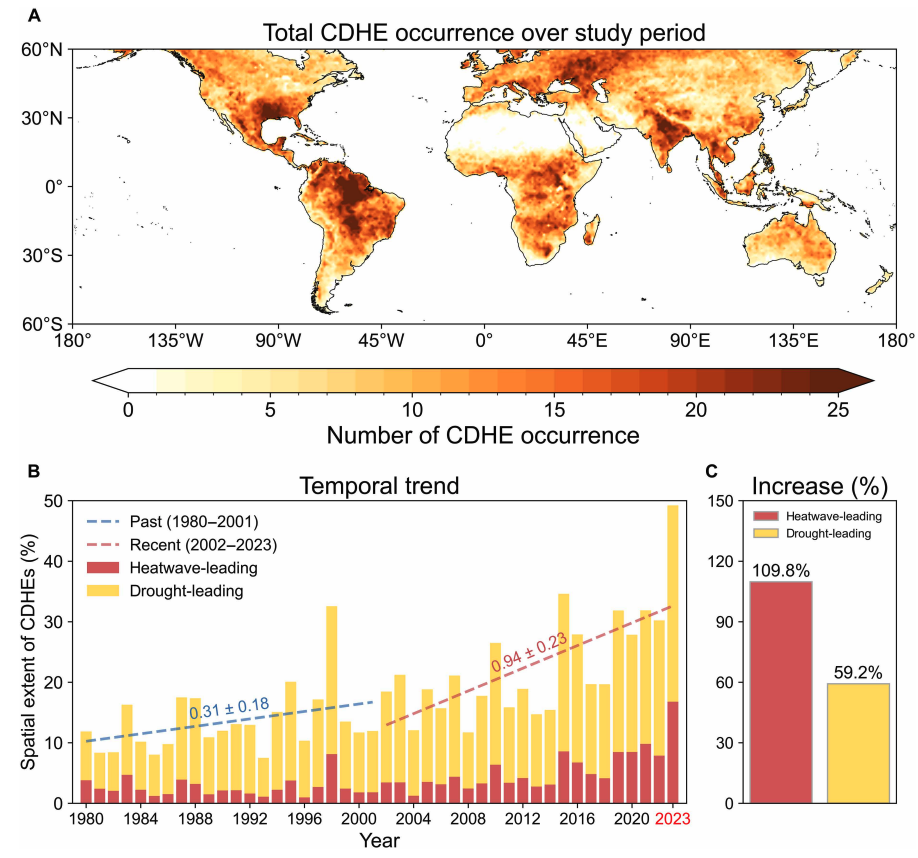
The research finds that the area of land affected by CDHEs has “increased substantially” since the early 2000s.
Heatwave-led events have been the main contributor to this increase, the study says, with their spatial extent rising 110% between 1980-2001 and 2002-23, compared to a 59% increase for drought-led events.
The map below shows the global distribution of CDHEs over 1980-2023. The charts show the percentage of the land surface affected by a heatwave-led CDHE (red) or a drought-led CDHE (yellow) in a given year (left) and relative increase in each CDHE type (right).
The study finds that CDHEs have occurred most frequently in northern South America, the southern US, eastern Europe, central Africa and south Asia.
Threshold passed
The authors explain that the increase in heatwave-led CDHEs is related to rising global temperatures, but that this does not tell the whole story.
In the earlier 22-year period of 1980-2001, the study finds that the spatial extent of heatwave-led CDHEs rises by 1.6% per 1C of global temperature rise. For the more-recent period of 2022-23, this increases “nearly eightfold” to 13.1%.
The change suggests that the rapid increase in the heatwave-led CDHEs occurred after the global average temperature “surpasse[d] a certain temperature threshold”, the paper says.
This threshold is an absolute global average temperature of 14.3C, the authors estimate (based on an 11-year average), which the world passed around the year 2000.
Investigating the recent surge in heatwave-leading CDHEs further, the researchers find a “regime shift” in land-atmosphere dynamics “toward a persistently intensified state after the late 1990s”.
In other words, the way that drier soils drive higher surface temperatures, and vice versa, is becoming stronger, resulting in more heatwave-led compound events.
Daily data
The research has some advantages over other previous studies, Yeh says. For instance, the new work uses daily estimations of CDHEs, compared to monthly data used in past research. This is “important for capturing the detailed occurrence” of these events, says Yeh.
He adds that another advantage of their study is that it distinguishes the sequence of droughts and heatwaves, which allows them to “better understand the differences” in the characteristics of CDHEs.
Dr Meryem Tanarhte is a climate scientist at the University Hassan II in Morocco, and Dr Ruth Cerezo Mota is a climatologist and a researcher at the National Autonomous University of Mexico. Both scientists, who were not involved in the study, agree that the daily estimations give a clearer picture of how CDHEs are changing.
Cerezo-Mota adds that another major contribution of the study is its global focus. She tells Carbon Brief that in some regions, such as Mexico and Africa, there is a lack of studies on CDHEs:
“Not because the events do not occur, but perhaps because [these regions] do not have all the data or the expertise to do so.”
However, she notes that the reanalysis data used by the study does have limitations with how it represents rainfall in some parts of the world.
Compound impacts
The study notes that if CDHEs continue to intensify – particularly events where heatwaves are the precursors – they could drive declining crop productivity, increased wildfire frequency and severe public health crises.
These impacts could be “much more rapid and severe as global warming continues”, Yeh tells Carbon Brief.
Tanarhte notes that these events can be forecasted up to 10 days ahead in many regions. Furthermore, she says, the strongest impacts can be prevented “through preparedness and adaptation”, including through “water management for agriculture, heatwave mitigation measures and wildfire mitigation”.
The study recommends reassessing current risk management strategies for these compound events. It also suggests incorporating the sequences of drought and heatwaves into compound event analysis frameworks “to enhance climate risk management”.
Cerezo-Mota says that it is clear that the world needs to be prepared for the increased occurrence of these events. She tells Carbon Brief:
“These [risk assessments and strategies] need to be carried out at the local level to understand the complexities of each region.”




The post Heatwaves driving recent ‘surge’ in compound drought and heat extremes appeared first on Carbon Brief.
Heatwaves driving recent ‘surge’ in compound drought and heat extremes
Greenhouse Gases
DeBriefed 6 March 2026: Iran energy crisis | China climate plan | Bristol’s ‘pioneering’ wind turbine
Welcome to Carbon Brief’s DeBriefed.
An essential guide to the week’s key developments relating to climate change.
This week
Energy crisis
ENERGY SPIKE: US-Israeli attacks on Iran and subsequent counterattacks across the Middle East have sent energy prices “soaring”, according to Reuters. The newswire reported that the region “accounts for just under a third of global oil production and almost a fifth of gas”. The Guardian noted that shipping traffic through the strait of Hormuz, which normally ferries 20% of the world’s oil, “all but ground to a halt”. The Financial Times reported that attacks by Iran on Middle East energy facilities – notably in Qatar – triggered the “biggest rise in gas prices since Russia’s full-scale invasion of Ukraine”.
‘RISK’ AND ‘BENEFITS’: Bloomberg reported on increases in diesel prices in Europe and the US, speculating that rising fuel costs could be “a risk for president Donald Trump”. US gas producers are “poised to benefit from the big disruption in global supply”, according to CNBC. Indian government sources told the Economic Times that Russia is prepared to “fulfil India’s energy demands”. China Daily quoted experts who said “China’s energy security remains fundamentally unshaken”, thanks to “emergency stockpiles and a wide array of import channels”.
‘ESSENTIAL’ RENEWABLES: Energy analysts said governments should cut their fossil-fuel reliance by investing in renewables, “rather than just seeking non-Gulf oil and gas suppliers”, reported Climate Home News. This message was echoed by UK business secretary Peter Kyle, who said “doubling down on renewables” was “essential” amid “regional instability”, according to the Daily Telegraph.
China’s climate plan
PEAK COAL?: China has set out its next “five-year plan” at the annual “two sessions” meeting of the National People’s Congress, including its climate strategy out to 2030, according to the Hong Kong-based South China Morning Post. The plan called for China to cut its carbon emissions per unit of gross domestic product (GDP) by 17% from 2026 to 2030, which “may allow for continued increase in emissions given the rate of GDP growth”, reported Reuters. The newswire added that the plan also had targets to reach peak coal in the next five years and replace 30m tonnes per year of coal with renewables.
ACTIVE YET PRUDENT: Bloomberg described the new plan as “cautious”, stating that it “frustrat[es] hopes for tighter policy that would drive the nation to peak carbon emissions well before president Xi Jinping’s 2030 deadline”. Carbon Brief has just published an in-depth analysis of the plan. China Daily reported that the strategy “highlights measures to promote the climate targets of peaking carbon dioxide emissions before 2030”, which China said it would work towards “actively yet prudently”.
Around the world
- EU RULES: The European Commission has proposed new “made in Europe” rules to support domestic low-carbon industries, “against fierce competition from China”, reported Agence France-Presse. Carbon Brief examined what it means for climate efforts.
- RECORD HEAT: The US National Oceanic and Atmospheric Administration has said there is a 50-60% chance that the El Niño weather pattern could return this year, amplifying the effect of global warming and potentially driving temperatures to “record highs”, according to Euronews.
- FLAGSHIP FUND: The African Development Bank’s “flagship clean energy fund” plans to more than double its financing to $2.5bn for African renewables over the next two years, reported the Associated Press.
- NO WITHDRAWAL: Vanuatu has defied US efforts to force the Pacific-island nation to drop a UN draft resolution calling on the world to implement a landmark International Court of Justice (ICJ) ruling on climate, according to the Guardian.