
Connect with us

Published

on

In today’s dynamic manufacturing world, energy is more than just a utility; it’s the spark that keeps production running. Industrial facilities, powered by massive engines and heavy machinery, often operate 24/7, driving output but also consuming enormous amounts of electricity.

The issues? Soaring energy costs and a growing environmental footprint.

Sometimes it’s like a cycle that often feels impossible to break, but what if your facility could draw energy from a cleaner, more reliable, and cost-effective energy source?

Yes, you heard it right, and that’s where solar power comes in!

As electricity prices continue to rise and corporate sustainability goals become more pressing, manufacturers are rethinking how they power their commercial operations.

Therefore, solar energy is emerging as a game-changing solution, offering reliability, long-term savings, and a sustainable path forward for the Australian manufacturing industry.

In this blog, we’ll explore how manufacturers are successfully implementing solar power, featuring real-world case studies from Cyanergy that highlight both the business advantages and environmental impact.

So, let’s explore how solar energy can help your manufacturing facility reduce costs and enhance efficiency, achieving long-term sustainability.

Why Solar Energy Is Essential for Modern Manufacturing Facilities?

In Australia, manufacturing facilities typically have large roof or yard footprints, significant and relatively
stable electrical loads, including lighting, motors, HVAC, and other machinery. So, the energy used every day is
enormous.

By harnessing the sun’s energy, factories can significantly cut operating
costs
, reduce carbon emissions, and gain greater control over long-term energy stability.

Beyond the environmental benefits, solar power also strengthens a company’s competitive edge and brand reputation in
an increasingly eco-conscious market.

Here we’ve penned down the importance of solar power in the manufacturing industry:

  1. Energy cost mitigation 
  2. So, how solar energy reduces manufacturing costs in Australia?

    With electricity prices rising and energy market volatility increasing, incorporating solar energy offers a
    way to
    reduce grid dependency and lower utility costs in the long term.

  3. Ensure Operational Continuity & Resilience
  4. Solar panel systems, when paired
    with
    battery storage, can help smooth peak energy demand, reduce grid dependence, and improve functioning
    time.

  5. Promote Sustainability and Brand Value
  6. In larger industries, many manufacturers are under pressure from customers, regulators, investors, and
    internal
    stakeholders to reduce
    their carbon footprint
    .

    Solar helps them to achieve energy freedom, powering businesses with a sustainable energy source.

  7. Increase Asset value & ROI
  8. Solar systems, when sized appropriately and properly optimised, can deliver payback in a few years and
    continue to
    provide savings thereafter.

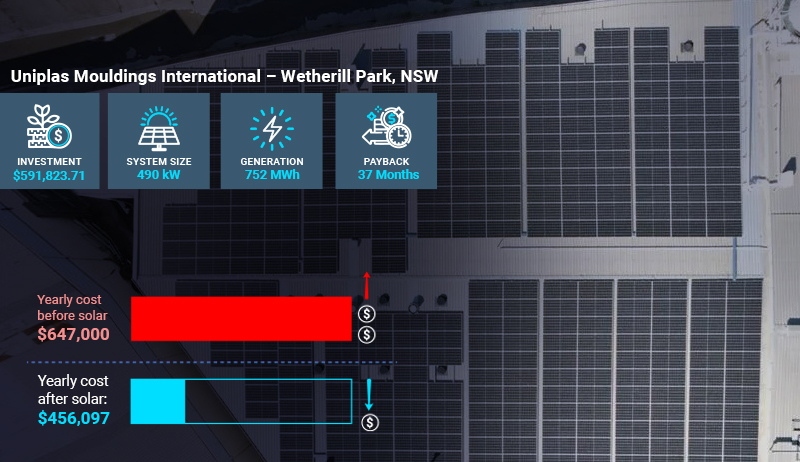
According to Cyanergy’s capability statement, we delivered a 490
kW system
that generated 752 MWh for a manufacturing client, with a 37-month payback period.

This shows that industrial-scale solar can deliver real, practical results for manufacturers.

Now, let’s examine solar power solutions for manufacturing facilities, case studies, and best practices to ensure a
clear understanding.

Case Studies from Cyanergy: Real-World Manufacturing Success in Australia!

In this part of the blog, we have selected three examples from Cyanergy to illustrate how manufacturing facilities are utilising solar energy.

These are not generic installations; these are production-oriented businesses taking real steps across different states of Australia.

1. Uniplas Mouldings International – Wetherill Park, NSW

Project Overview

  • System size: 490 kW solar system installed in staged phases
  • Investment: AUD $591,823.71.
  • Annual generation: 752 MWh
  • Yearly energy costs before solar: approximately $647,000.
  • After solar: $456K, which is approximately 55% of the previous
  • Payback period: 37 months

Why it matters

For Uniplas, a large industrial manufacturer, the solar system not only significantly reduces their operating energy
costs, but the payback of just over 3 years means that the return on investment is also attractive for the
business.

The staged approach also allowed them to access multiple subsidies and implement the project rapidly; for example,
the first stage of 200 kW was completed in four weeks.

This clearly shows how manufacturing operations can incorporate
solar
without any significant disruption.

2. AC Laser – Thomastown, VIC

Project Overview

  • System size: 99.45 kW
  • Annual generation: 141.75 MWh
  • Annual electricity cost before solar: $79,000.
  • After solar: $38,160, a reduction of more than 50%
  • Payback period: 26 months

Why it matters

This is a smaller-scale manufacturing facility compared to Uniplas, yet the results are impressive: a more than 50%
cost reduction and a shorter payback period.

This shows that not only large-scale commercial properties but also mid-sized manufacturing operations can benefit
from solar, not just large ones.

Insights Gained from the Case

  • Don’t wait until your business is huge, as size is scalable.
  • The solar system’s size aligned well with the manufacturing load, saving thousands of dollars.
  • Rapid ROI shows manufacturing facilities can justify solar as a capital investment for their business.

3. Specialised (Cycling-Industry manufacturer) – Port Melbourne, VIC

Project Overview

  • System size: 39.6 kW
  • Annual generation: 47.32 MWh
  • Electricity cost before solar: $26,720; after solar: $17,770
  • Payback period: 45 months

Why it matters

Although smaller, this project depicts that solar energy is a viable option for manufacturing across various sizes
and sectors, even in facilities with a relatively small carbon footprint.

The case emphasises sustainability as a business value and how solar can support brand positioning as well as cost
savings.

Major Takeaways

  • Solar supports both cost and branding sustainability
    goals
    .

  • Even medium-sized systems can provide meaningful savings.
  • The ROI
    generated
    must be viewed in terms of both financial and reputational benefits for any
    business, whether it’s large or small.

Is Now the Right Time for Manufacturers to Transition to Solar Energy?

After knowing the numerous benefits of solar solutions, you may be tempted to go solar. However, transitioning from
traditional energy sources to solar energy comes with a cost. 

From government
incentives
to long-term cost savings, the financial case for solar energy is compelling.

Still wondering, is it time for businesses to go solar? Here’s why you should act now:

  • Electricity prices continue to rise in many markets, strengthening the return on investment for solar
    energy.

  • Many governments and utilities offer incentives, favourable tariffs, or rebates
    for industrial solar projects.

  • Day by day, the pressure for sustainability reporting and corporate social responsibility (CSR) is
    intensifying. Manufacturing facilities with high energy loads are often subject to inspection.

  • Technology costs have fallen recently, making solar panels and inverters
    more affordable than ever and reducing payback time.

  • With the right sizing and execution, the solar system becomes a long-term asset that pays for itself,
    releasing capital for other manufacturing investments.

Best Practices for Manufacturing Facilities Considering Solar

Solar can be a powerful game-changer for manufacturing companies and large commercial buildings when implemented correctly.

But that doesn’t mean it’s as easy as flipping the switch.

Therefore, before investing in Solar power, ensure you understand every step that leads to real savings and sustainable success for your business.

1. Conduct a detailed energy assessment & align solar to load

Before installation, it is essential to understand your manufacturing facility’s energy usage patterns, including the peak usage limit, daily load curves, and seasonal variations.

The better the match between system size, orientation, and actual usage, the higher the yield and the quicker the payback.

At Cyanergy, we provide a customised design based on site analysis.

2. Use staging or modular deployment

If you have a large manufacturing site, you may benefit from staging the solar solution in phases.

For example, in Uniplas’s case, the installation was divided into three stages. This enables access to multiple subsidies, enhances cash flow, and mitigates the risk of disruption.

3. Optimise your system size & measure consumption rate

Over-sizing or under-sizing can both cause significant loss in a business. Therefore, the design should minimise waste and maximise the use of solar energy on-site.

As in AC Laser’s mid-sized facility, a 99 kW system fits their load and delivers huge savings.

4. Check your rooftop or plant infrastructure

Is your rooftop compatible with solar panel installation?

For manufacturing facilities, factors such as roof strength, shading, orientation, structural constraints, and maintenance access are crucial.

Ensure the facility can support panels, inverters, wiring, and monitoring systems without compromising building aesthetics.

5. Perform regular monitoring & performance tracking

Everything requires a certain amount of care and maintenance to function properly over time. The story is the same for a solar panel system.

Real-time monitoring allows you to spot performance issues, shading effects, degradation, and inverter downtime.

Cyanergy emphasises continuous monitoring post-installation.

6. Research on financial modelling & payback analysis

When going for solar, always calculate realistic payback periods, ensure system cost fits within capital budgets,

You should also check the available incentives, tax benefits, payback time, and how to stack several rebates for maximum savings.

For example, many Cyanergy projects offer a 2–4 year payback, with several solar rebates that can be combined with the VEU Rebate.

7. Align with sustainability and your brand strategy

In manufacturing factories, incorporating solar energy can be a substantial component of a broader sustainability strategy. Why?

Solar reduces your dependency on harmful fossil fuels, cutting greenhouse gas emissions.

It positions your brand and promotes your business, demonstrating corporate responsibility and improving stakeholder perception.

8. Maintenance & lifecycle planning

Solar systems require periodic maintenance, inverter replacements, cleaning, and monitoring.

So, manufacturing facilities should incorporate service arrangements into their design. Plan for system longevity, degradation, and eventual replacement or upgrade to ensure optimal performance.

9. Consider adding Battery storage

Even though optional, integrating battery storage or demand management can enhance value by enabling peak shaving, reducing demand charges, and storing excess energy for nighttime use or during grid outages.

10. Engage stakeholders and minimise disruption

In manufacturing, you can’t easily stop production. Plan your solar installation during low-production periods, coordinate with your team, and prioritise safety to minimise downtime.

Final Notes: Ready To Take The Next Step?

For manufacturing facilities, solar power isn’t just about being eco-friendly; it’s a smart business move for Australians. Cyanergy’s case studies showed that even large manufacturers can achieve paybacks of 2–4 years, reduce costs, lower emissions, and enhance brand value.

With proper planning, energy assessment, correct system sizing, phased installation, and active monitoring, solar can deliver lasting benefits.

So, if rising energy bills or sustainability goals are on your radar, it’s time to view solar energy as an innovative manufacturing solution, apart from just a renewable energy source.

Reach out to Cyanergy, conduct an energy audit, and engage a solar specialist with manufacturing experience today. Cyanergy is here to help!

Your Solution Is Just a Click Away

The post Understanding Commercial Heat Pump Warranties with Cyanergy  appeared first on Cyanergy.

Understanding Commercial Heat Pump Warranties with Cyanergy 

Continue Reading

Renewable Energy

How “Marie Antoinnete” Can We Get?

Published

on

To many of use, the holidays serve as a reminder that most Americans (61%) live paycheck-to-paycheck, and many have trouble paying for groceries.  All this in a nation where the top 0.1% have more wealth that the bottom 50%.

Perhaps most egregious is the fact that people (like me) who write posts like this are regarded as “communists” by the far-right.

How “Marie Antoinnete” Can We Get?

Continue Reading

Renewable Energy

Statement on the Bipartisan American Affordability and Jobs Act Passing the Senate from ACORE President and CEO Ray Long

Published

on

Statement on the Bipartisan American Affordability and Jobs Act Passing the Senate from ACORE President and CEO Ray Long

WASHINGTON, D.C. — ACORE congratulates the U.S. Senate on the passage of the  Bipartisan American Affordability and Jobs Act (BAAJA), legislation that is an essential step to achieving affordable and reliable power across the United States.

BAAJA comes at a critical time when we need to build out our energy infrastructure to help reduce escalating power prices and prevent expected shortages in just the next few years. This legislation is expected to reduce residential electricity bills by $19 billion, create over 100,000 new jobs, invest $55 billion from data centers into energy infrastructure, and reduce CO2 emissions from the power sector by 20 percent in the next decade. 

There’s no time to waste. We need to improve our electric grid and build out 15 times the peak power of New York City in just the next four years. Let’s get this bill passed in the House so we can get building.   

### 

About ACORE  
ACORE is a nonpartisan nonprofit organization that operates at the intersection of affordability, reliability, and clean energy deployment. Our work is focused on stabilizing energy prices, strengthening the electric grid, and driving investment in cost-effective technologies to ensure that clean energy delivers for people, businesses, and the U.S. economy.

ACORE convenes a membership spanning the full clean energy value chain—investors and financiers, developers and EPCs, hyperscalers and energy buyers, manufacturers and advisors. Our members were directly involved in more than 80% of the American clean energy infrastructure projects added to the grid in 2025. We champion all clean energy technologies including transmission, solar, wind, storage, geothermal, hydropower, nuclear, and beyond. ACORE members are the companies investing in and building tomorrow’s electric power system, accelerating infrastructure development, strengthening grid reliability, and enhancing domestic competitiveness.   

Media Contacts: 

Tamari Palmer 
Associate, Communications
palmer@acore.org

Chris Higginbotham 
VP, Communications
higginbotham@acore.org  

The post Statement on the Bipartisan American Affordability and Jobs Act Passing the Senate from ACORE President and CEO Ray Long appeared first on ACORE.

https://acore.org/news/statement-on-the-bipartisan-american-affordability-and-jobs-act-passing-the-senate-from-acore-president-and-ceo-ray-long/

Continue Reading

Renewable Energy

What’s Destroying the World?

Published

on

I would say it’s the vicious circle that goes like this: ignorance –> electing authoritarian leaders –> leaders further destroy the educational system –> greater ignorance.

Given that there are still tens of millions of Trump supporters living among us, it’s really a miracle that we didn’t elect a criminal sociopath much earlier.

What’s Destroying the World?

Continue Reading

Trending
